45 Beautiful Flowers That Start With D: Names, Photos & Growing Tips
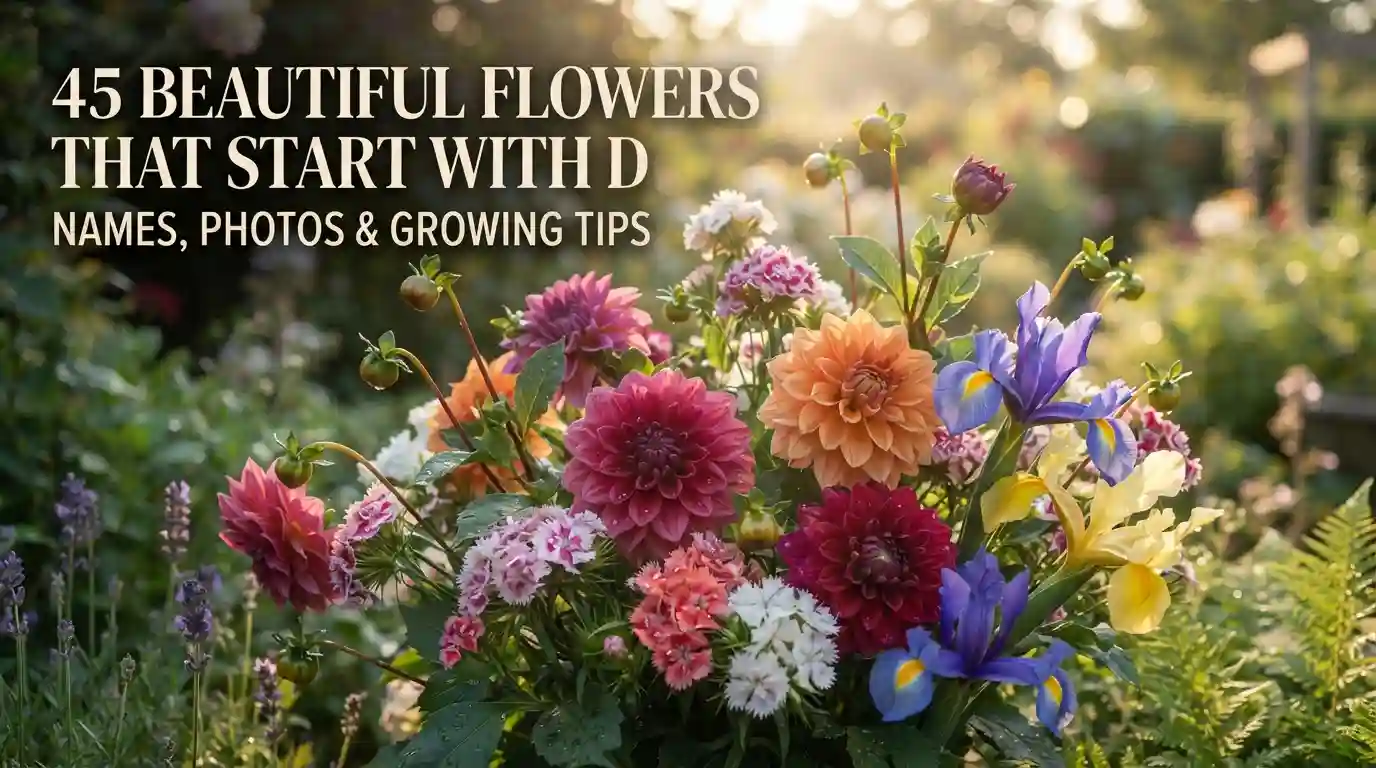
Ask most people to name a flower that starts with D, and they’ll land on daffodil or dahlia within a second, then stall out. That’s a shame, because flowers that start with D include one of the more varied collections in the flower alphabet—from a foxglove spike toxic enough to affect the human heart to a South African succulent groundcover that thrives on total neglect. This guide brings together 45 verified varieties, each checked for its botanical name, native origin, and safety around pets or children, rather than repeating the same six names a dozen different ways.
Quick Answer: The Standout D Flowers
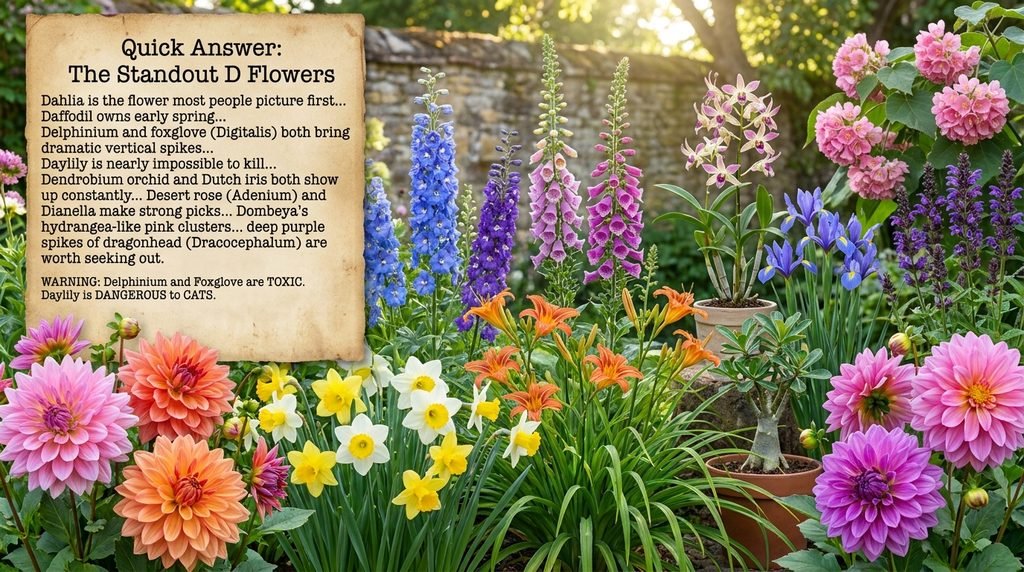
Dahlia is the flower most people picture first, and for good reason — few plants offer this much color variety and bloom size from a single tuber. Daffodil owns early spring the way crocus owns late winter, pushing through cold soil before most bulbs have stirred. Delphinium and foxglove (Digitalis) both bring dramatic vertical spikes to a border, though both carry serious toxicity warnings worth remembering.
For an easy, forgiving perennial, daylily is nearly impossible to kill in the garden — but it’s genuinely dangerous to cats, which matters more than its ease of care. Dendrobium orchid and Dutch iris both show up constantly in florist work, while desert rose (Adenium) and Dianella make strong picks for anyone gardening in heat or drought. For something few neighbors will recognize, dombeya’s hydrangea-like pink clusters or the deep purple spikes of dragonhead (Dracocephalum) are worth seeking out.
What Flowers That Start With D Symbolize
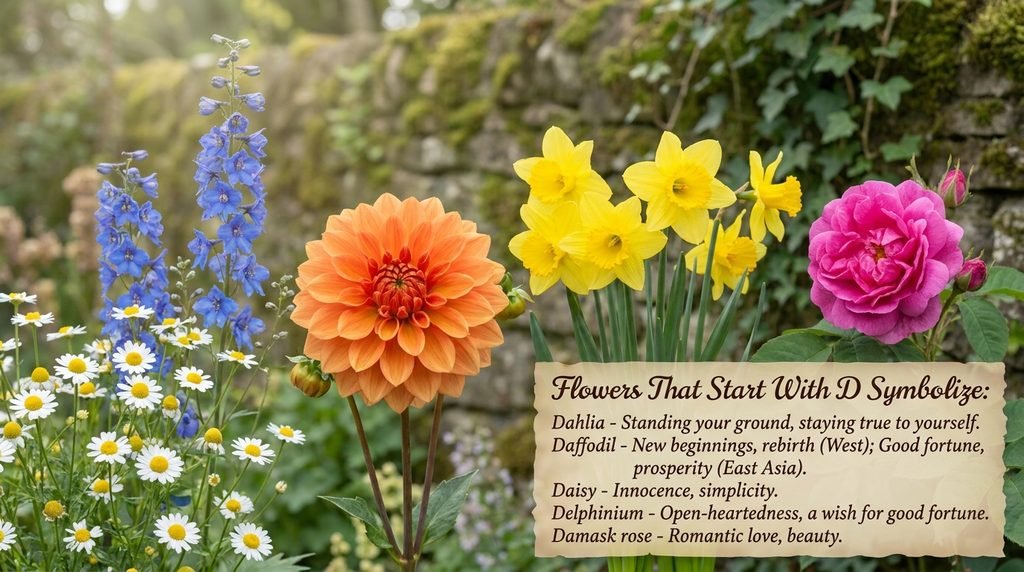
Flower symbolism is regional and often contradictory, so the meanings below are common associations rather than settled fact. Dahlia has picked up a reputation for standing your ground and staying true to yourself, a meaning some trace to the flower’s tendency to hold its shape and color even in difficult growing conditions. Daffodil carries an almost opposite duality—in much of the West, it symbolizes new beginnings and rebirth because it ranks among spring’s first flowers. In parts of East Asia, however, people associate it with good fortune and prosperity, especially during Lunar New Year celebrations.
Daisy, in its many forms, has long symbolized innocence and simplicity, likely because its plain white-and-yellow structure contrasts with showier cultivated blooms. Delphinium carries lofty, almost aspirational meanings, including open-heartedness and wishes for good fortune, perhaps because its flower spikes rise so dramatically. Damask rose stands apart from the rest, symbolizing romantic love and beauty after centuries of association with perfumery and rosewater production across the Middle East.
Color Groups at a Glance
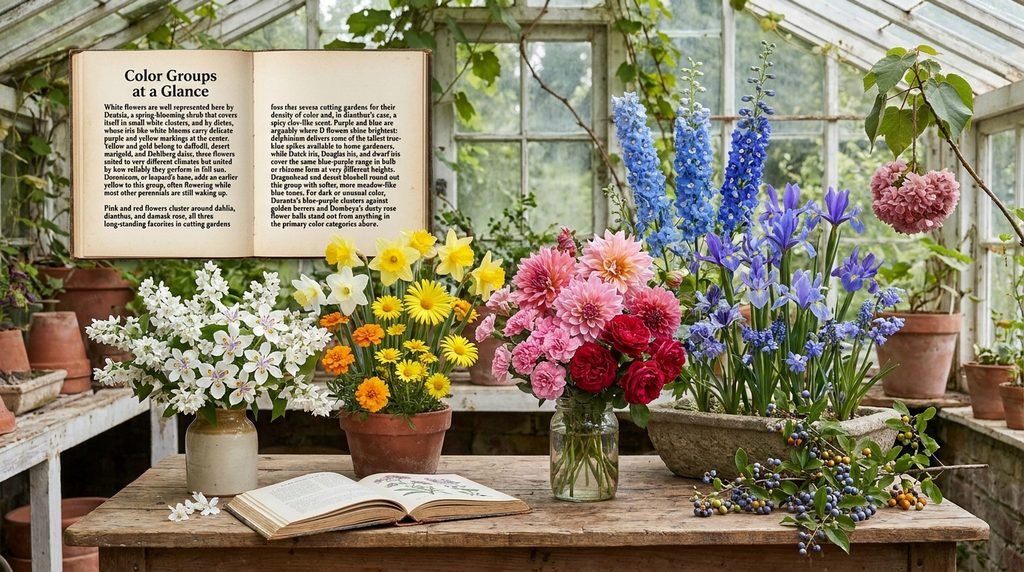
White flowers stand out in this group through Deutzia, a spring-blooming shrub that produces clusters of small white flowers, and Dietes, whose iris-like white blooms feature delicate purple and yellow markings at the center. Yellow and gold belong to daffodil, desert marigold, and Dahlberg daisy, three flowers suited to very different climates but united by how reliably they perform in full sun. Doronicum, or leopard’s bane, adds an earlier yellow to this group, often flowering while most other perennials are still waking up.
Pink and red flowers cluster around dahlia, dianthus, and damask rose, all three long-standing favorites in cutting gardens for their density of color and, in dianthus’s case, a spicy clove-like scent. Purple and blue are arguably where D flowers shine brightest: delphinium delivers some of the tallest true-blue spikes available to home gardeners, while Dutch iris, Douglas iris, and dwarf iris cover the same blue-purple range in bulb or rhizome form at very different heights. Dragonhead and desert bluebell round out this group with softer, more meadow-like blue tones. For dark or unusual color, Duranta’s blue-purple clusters against golden berries and Dombeya’s dusty rose flower balls stand out from anything in the primary color categories above.
Garden Favorites Worth Growing
Daylily earns its reputation as one of the most forgiving perennials available, tolerating poor soil, drought, and general neglect while still producing a fresh flush of blooms nearly every day through summer — though, as covered later, that same toughness comes with a serious caveat for cat owners.
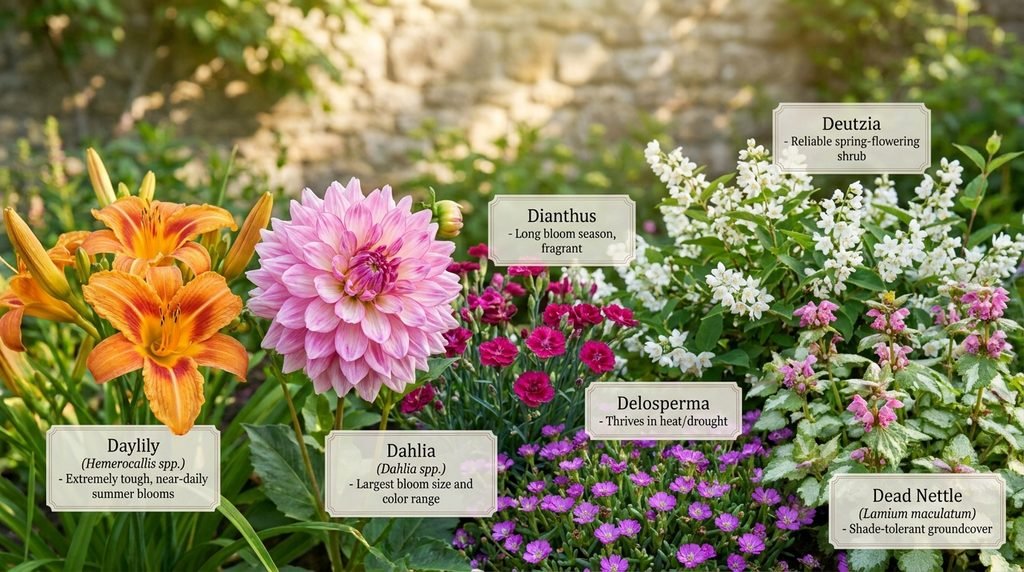
Dahlia takes more effort, needing its tubers lifted before frost in most climates, but rewards that work with some of the largest, most varied blooms of any perennial on this list. Dianthus behaves more like a dependable border filler, blooming for months with a fragrance that daylily and dahlia simply don’t offer. Delosperma, the South African ice plant, has become a go-to groundcover for hot, dry slopes where almost nothing else will hold color through a full summer.
| Garden Favorite | Botanical Name | Why It’s Chosen |
| Daylily | Hemerocallis spp. | Extremely tough, near-daily summer blooms |
| Dahlia | Dahlia spp. | Largest bloom size and color range on this list |
| Dianthus | Dianthus spp. | Long bloom season, fragrant, good for borders |
| Delosperma | Delosperma cooperi | Thrives in heat and drought, low maintenance |
| Deutzia | Deutzia gracilis | Reliable spring-flowering shrub |
| Dead Nettle | Lamium maculatum | Shade-tolerant flowering groundcover |
Daylily and dahlia dominate this table for opposite reasons — one asks for almost nothing and blooms anyway, while the other asks for real seasonal effort and pays it back with scale and color that few other garden perennials can match.
Indoor and Container-Friendly D Flowers
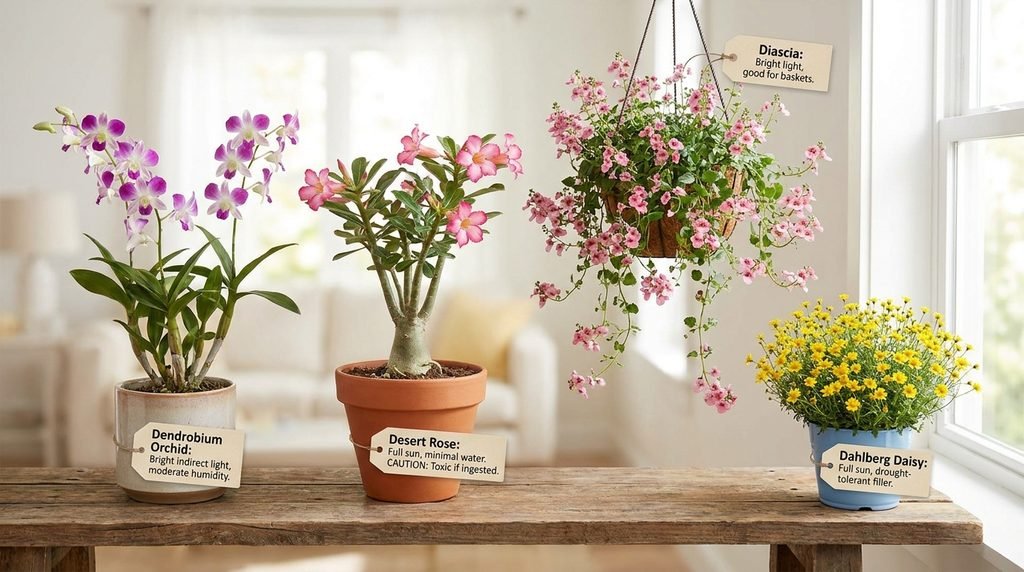
Dendrobium orchid has become one of the more approachable orchids for home growers, tolerating a wider temperature range than many of its relatives while still producing long-lasting sprays of blooms. Desert rose thrives in the same bright, dry conditions many houseplants struggle with, making it a strong choice for a sunny indoor windowsill where other flowering plants tend to fail.
Dianthus and dahlberg daisy both perform well in patio containers, spilling over the edges of a pot rather than growing upright, which makes them useful for hanging baskets where daffodil or dahlia would look out of place.
| Indoor or Container Flower | Botanical Name | Growing Notes |
| Dendrobium Orchid | Dendrobium spp. | Bright indirect light, moderate humidity |
| Desert Rose | Adenium obesum | Full sun, minimal water, well-draining soil |
| Diascia | Diascia spp. | Bright light, regular watering, good for baskets |
| Dahlberg Daisy | Thymophylla tenuiloba | Full sun, drought-tolerant container filler |
| Dombeya | Dombeya wallichii | Bright light, protected from frost |
Desert rose is worth calling out specifically here, since it’s toxic if ingested — a detail covered in more depth in the caution section below, but worth knowing before placing it somewhere a curious pet or toddler can reach the leaves or sap.
Florist Favorites: D Flowers Built for Bouquets
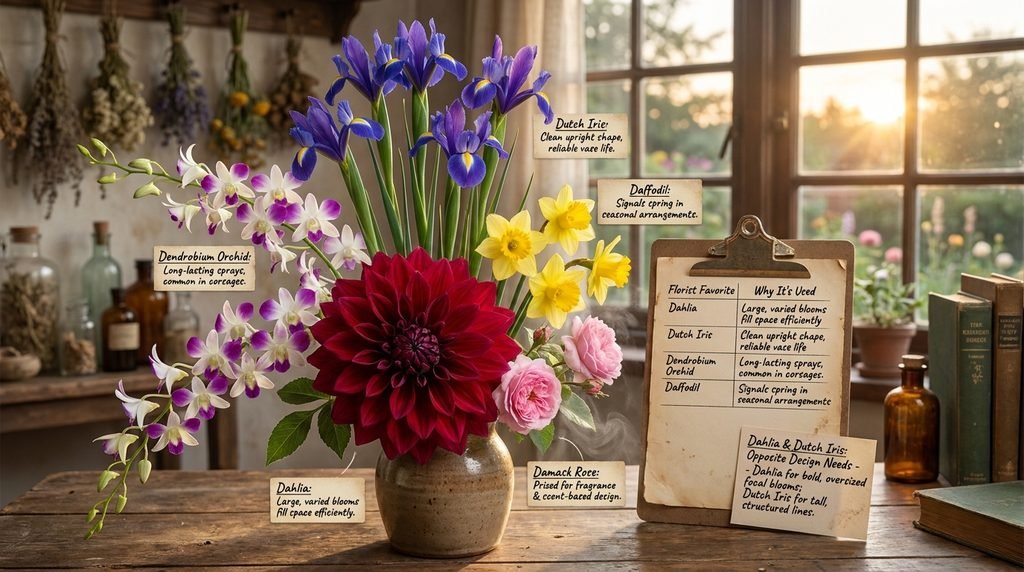
Dahlia has become one of the most requested wedding and event flowers of the last decade, largely because a single dinner-plate variety can fill as much visual space as half a dozen smaller blooms. Dutch iris shows up constantly in mixed arrangements for its clean, upright form and reliable vase life, while dendrobium orchid sprays are a staple of both bouquets and corsages because a single stem can carry ten or more blooms that hold up for weeks. Damask rose earns its place here for a different reason—it is grown as much for its fragrance and use in rose water as for cut flowers. Its blooms also feature in high-end floral arrangements that emphasize scent as much as appearance.
| Florist Favorite | Why It’s Used |
| Dahlia | Large, varied blooms fill space efficiently |
| Dutch Iris | Clean upright shape, reliable vase life |
| Dendrobium Orchid | Long-lasting sprays, common in corsages |
| Daffodil | Signals spring in seasonal arrangements |
Dahlia and Dutch iris cover almost opposite design needs — dahlia for bold, oversized focal blooms and Dutch iris for the tall, structured lines that hold an arrangement together.
Rare and Unusual D Flowers
Dragonhead, or Dracocephalum, rarely appears outside specialty perennial catalogs despite its striking deep purple flower spikes and mild minty scent, likely because it’s less widely propagated commercially than more common blue perennials like delphinium.
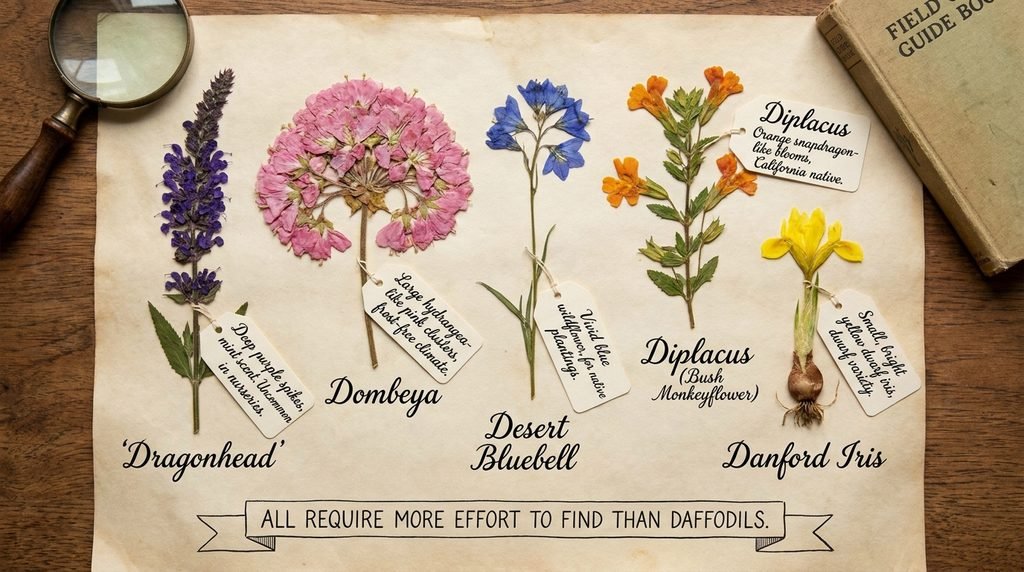
Dombeya is even less familiar to most Western gardeners, grown mostly in warm, frost-free climates for its large, hanging clusters of pink flowers that genuinely resemble hydrangea blooms despite being an entirely unrelated plant family. Desert bluebell, a Southwestern U.S. wildflower with vivid blue, bell-shaped flowers, is often overlooked simply because it grows wild rather than being cultivated, though it’s increasingly used in native and pollinator-focused garden designs. Diplacus, the bush monkeyflower, rounds out this group as a California native shrub whose orange, snapdragon-like blooms are common in the wild but still uncommon in ordinary garden centers outside its native range.
- Dragonhead — deep purple spikes with a faint mint scent, uncommon in nurseries
- Dombeya — large hydrangea-like pink clusters, needs a frost-free climate
- Desert Bluebell — vivid blue wildflower increasingly used in native plantings
- Diplacus (Bush Monkeyflower) — orange snapdragon-like blooms, common in the wild but rare in stores
- Danford Iris — a small, bright yellow dwarf iris often confused with its purple relative, reticulated iris
These five share a common thread: none are difficult to grow once sourced, but all require more effort to find than the daffodils and dahlias sitting on a typical nursery shelf.
A Caution on Toxicity
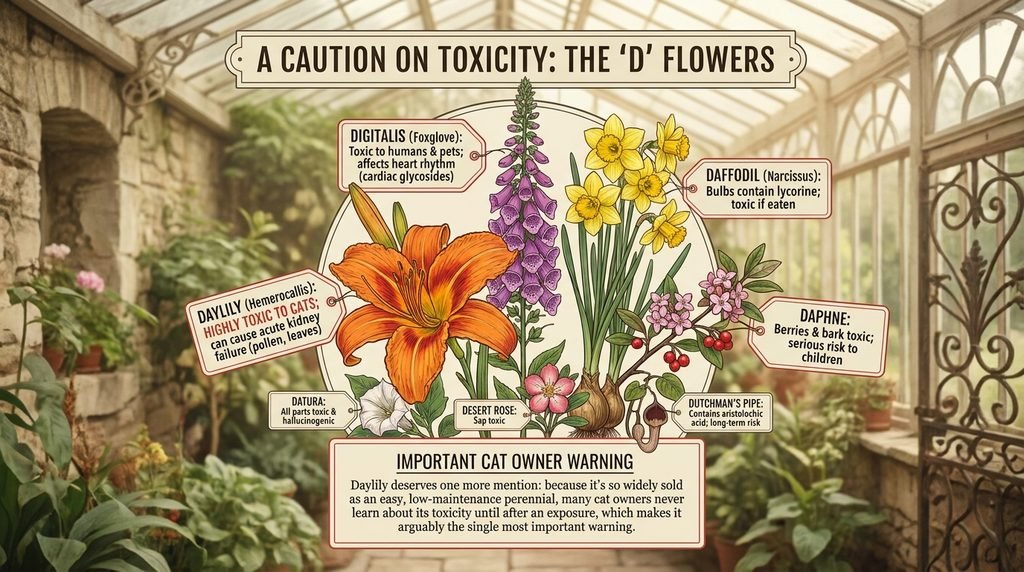
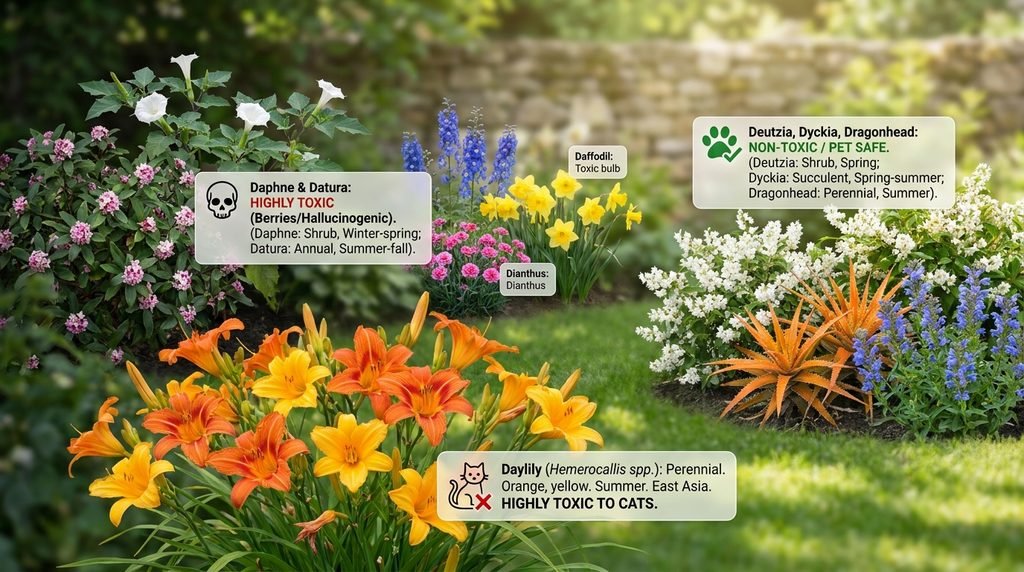
This is one letter where the toxicity conversation matters more than usual, since several extremely popular D flowers carry real risk. Daylily is the most urgent example — every part of the plant is highly toxic to cats specifically, capable of causing acute kidney failure from even a small amount of pollen or a nibbled leaf, which makes it one of the more dangerous common garden flowers for households with indoor-outdoor cats.
Foxglove (Digitalis) contains cardiac glycosides that can harm humans and pets by affecting heart rhythm. Historically, doctors have also refined these compounds into heart medications under careful medical supervision, showing how the same chemistry can give a plant both dangerous and pharmaceutical properties. Daffodil bulbs contain lycorine, toxic if eaten and capable of causing vomiting or worse, and daphne is dangerous nearly year-round, with its berries in particular posing a serious risk to children who might mistake them for something edible.
| Flower | Toxicity Concern |
| Daylily | Highly toxic to cats; can cause kidney failure |
| Digitalis (Foxglove) | Toxic to humans and pets; affects heart rhythm |
| Daffodil | Bulbs contain lycorine; toxic if eaten |
| Daphne | Berries and bark toxic; serious risk to children |
| Datura | All parts toxic and hallucinogenic |
| Desert Rose | Sap toxic; historically used in arrow poison |
| Dutchman’s Pipe | Contains aristolochic acid; long-term health risk |
Daylily deserves another mention outside the table: because nurseries widely sell it as an easy, low-maintenance perennial, many cat owners remain unaware of its toxicity until their cat is exposed, making it arguably the most important warning in this entire guide.
Life Cycle at a Glance
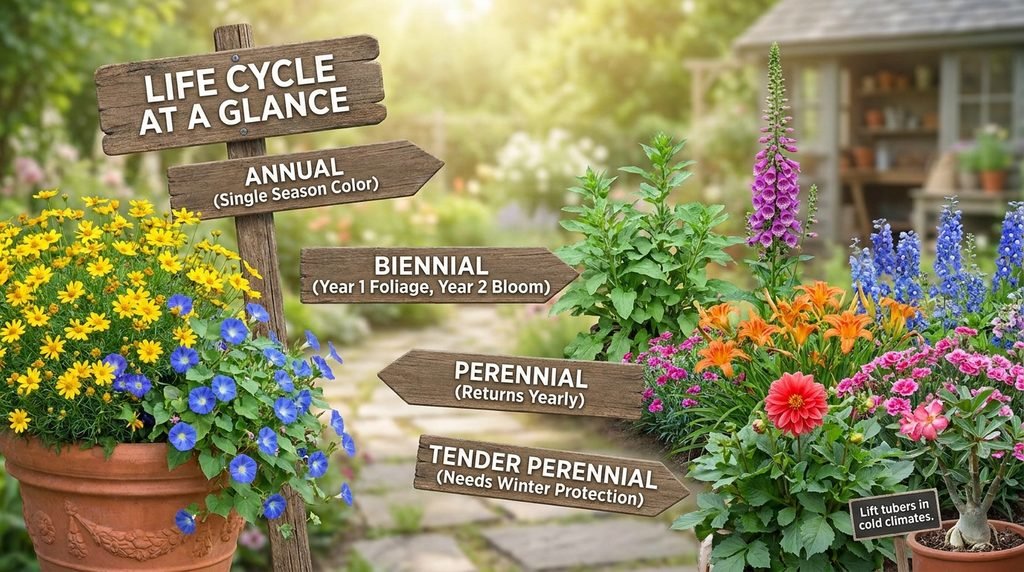
Understanding whether a D flower is an annual, biennial, or perennial changes how it fits into a planting plan. True annuals like dwarf morning glory and Dahlberg daisy complete their life cycle in a single season, which makes them useful for quick color in a new bed without long-term commitment. Biennials such as dame’s rocket spend their first year building foliage and only flower in year two, a pattern that surprises gardeners expecting bloom in the first season. Most of the flowers on this list, including daylily, dahlia, delphinium, and the various D irises, are true perennials that return yearly once established, though dahlia specifically behaves as a tender perennial in cold climates and needs its tubers lifted and stored over winter.
| Life Cycle | Example D Flowers |
| Annual | Dahlbergia Daisy, Dwarf Morning Glory, Datura |
| Biennial | Dame’s Rocket, Digitalis (in most climates) |
| Perennial | Daylily, Delphinium, Dianthus, Doronicum, Dianella |
| Tender Perennial / Needs Winter Protection | Dahlia, Desert Rose, Dombeya, Duranta |
The tender perennial row is the one that trips up new gardeners most often, since a dahlia or desert rose bought in spring will die back completely if left in the ground through a hard winter, even though it isn’t a true annual by nature.
Botanical Name Crosswalk
Common names make conversation easier, but they can cause real confusion among flowers that start with D. In some regions, people casually call three unrelated bulbs “dwarf iris.” The crosswalk below helps you avoid a mix-up at checkout, because you may not discover that you ordered the wrong bulb until months later when a different color blooms.
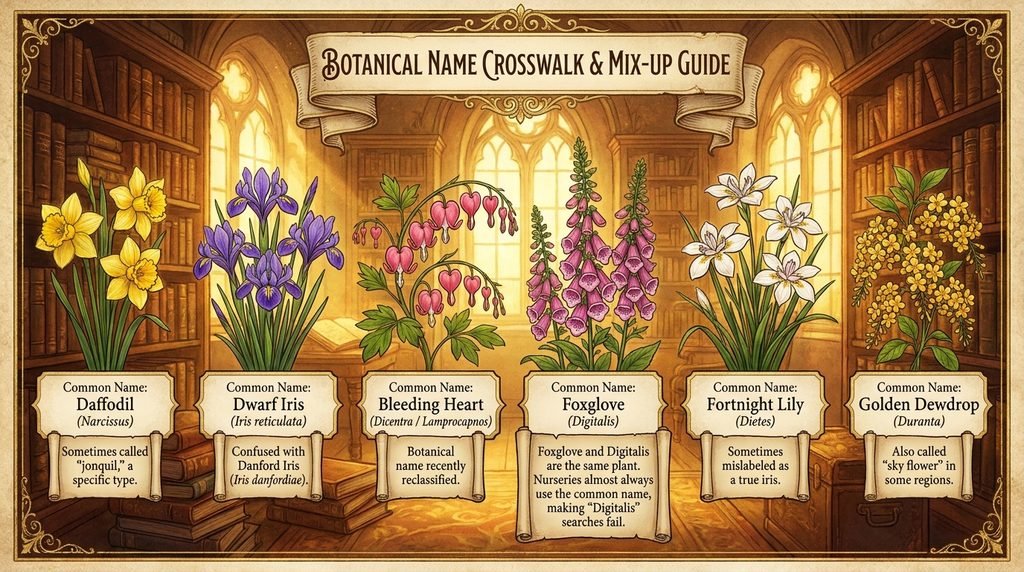
| Common Name | Botanical Genus | Common Mix-Up |
| Daffodil | Narcissus | Sometimes called “jonquil,” which is technically a specific type |
| Dwarf Iris | Iris reticulata | Confused with Danford Iris (Iris danfordiae) |
| Bleeding Heart | Dicentra / Lamprocapnos | Botanical name recently reclassified |
| Foxglove | Digitalis | Rarely sold under its botanical name at all |
| Fortnight Lily | Dietes | Sometimes mislabeled as a true iris |
| Golden Dewdrop | Duranta | Also called “sky flower” in some regions |
Foxglove and Digitalis are the same plant, but nurseries almost always use the common name, which means a search for “Digitalis” at a garden center may turn up nothing even though the plant itself is in stock under a different label.
Full Comparison Table
The table below is the master reference for this guide, covering all 45 flowers that start with D with botanical name, plant type, primary color, bloom season, native origin, and a safety note in one place. Read the type column first when planning a garden layout, since it separates true annuals from perennials, bulbs, shrubs, and orchids — several D flowers that look similar in photos, like the various irises, actually have very different growing requirements once you check their type and origin.
| Flower | Botanical Name | Type | Color | Bloom Season | Native Origin | Safety Note |
| Daffodil | Narcissus spp. | Bulb | Yellow, white | Spring | Europe, North Africa | Toxic bulbs (lycorine) |
| Dahlia | Dahlia spp. | Tuberous perennial | Many colors | Summer–fall | Mexico, Central America | Mildly toxic to pets |
| English Daisy | Bellis perennis | Perennial/biennial | White, pink | Spring | Europe | Low toxicity risk |
| Daylily | Hemerocallis spp. | Perennial | Orange, yellow, red | Summer | East Asia | Highly toxic to cats |
| Delphinium | Delphinium spp. | Perennial | Blue, purple, white | Summer | Northern Hemisphere | Toxic (alkaloids) |
| Dendrobium Orchid | Dendrobium spp. | Orchid | White, purple, pink | Varies | Asia, Australia | Non-toxic |
| Dianthus | Dianthus spp. | Perennial/annual | Pink, red, white | Spring–summer | Europe, Asia | Mildly toxic to pets |
| Flowering Dogwood | Cornus florida | Tree | White, pink | Spring | Eastern North America | Mildly toxic berries |
| Dutch Iris | Iris × hollandica | Bulb | Blue, purple, yellow | Spring–summer | Hybrid (Mediterranean origin) | Toxic bulb |
| Dutchman’s Pipe | Aristolochia macrophylla | Vine | Brownish-purple | Spring–summer | Eastern North America | Toxic (aristolochic acid) |
| Desert Rose | Adenium obesum | Succulent shrub | Pink, red, white | Spring–summer | Africa, Arabian Peninsula | Highly toxic sap |
| Diascia | Diascia spp. | Annual/tender perennial | Pink, coral | Spring–fall | South Africa | Non-toxic |
| Digitalis (Foxglove) | Digitalis purpurea | Biennial/perennial | Purple, pink, white | Summer | Europe | Highly toxic |
| Daphne | Daphne spp. | Shrub | Pink, white | Winter–spring | Europe, Asia | Highly toxic berries |
| Datura (Devil’s Trumpet) | Datura stramonium | Annual | White, purple | Summer–fall | Americas | Highly toxic, hallucinogenic |
| Dietes (Fortnight Lily) | Dietes iridioides | Perennial | White with markings | Spring–summer | Southern/Eastern Africa | Low toxicity risk |
| Dicentra (Bleeding Heart) | Lamprocapnos spectabilis | Perennial | Pink, white | Spring | East Asia | Mildly toxic |
| Duranta (Golden Dewdrop) | Duranta erecta | Shrub | Blue, purple | Summer–fall | Central/South America | Toxic berries |
| Delosperma (Ice Plant) | Delosperma cooperi | Succulent groundcover | Purple, pink | Summer | South Africa | Non-toxic |
| Deutzia | Deutzia gracilis | Shrub | White | Spring | Japan | Non-toxic |
| Doronicum (Leopard’s Bane) | Doronicum orientale | Perennial | Yellow | Spring | Europe, Mediterranean | Mildly toxic |
| Drumstick Primula | Primula denticulata | Perennial | Purple, pink, white | Spring | Himalayas | Low toxicity risk |
| Dianella (Flax Lily) | Dianella caerulea | Perennial | Blue flowers, blue berries | Spring–summer | Australia | Mildly toxic berries |
| Dahlberg Daisy | Thymophylla tenuiloba | Annual | Yellow | Spring–fall | Texas, Mexico | Non-toxic |
| Dead Nettle | Lamium maculatum | Perennial groundcover | Pink, purple, white | Spring–summer | Europe, Asia | Non-toxic |
| Dame’s Rocket | Hesperis matronalis | Biennial | Purple, white | Spring–summer | Europe, Western Asia | Non-toxic |
| Day Jessamine | Cestrum diurnum | Shrub | White | Summer | Caribbean | Toxic berries |
| Desert Marigold | Baileya multiradiata | Perennial (short-lived) | Yellow | Spring–fall | Southwestern US, Mexico | Toxic to livestock |
| Dwarf Morning Glory | Convolvulus tricolor | Annual | Blue, white, yellow center | Summer | Mediterranean | Mildly toxic seeds |
| Dyer’s Chamomile | Cota tinctoria | Perennial | Yellow | Summer | Europe, Western Asia | Non-toxic |
| Dogtooth Violet | Erythronium dens-canis | Bulb | Pink, purple, white | Spring | Europe, Asia | Non-toxic |
| Douglas Iris | Iris douglasiana | Perennial rhizome | Purple, lavender, cream | Spring | California, Oregon | Toxic rhizome |
| Reticulated (Dwarf) Iris | Iris reticulata | Bulb | Purple, blue | Late winter–spring | Caucasus, Middle East | Toxic bulb |
| Danford Iris | Iris danfordiae | Bulb | Yellow | Late winter–spring | Turkey | Toxic bulb |
| Dombeya | Dombeya wallichii | Shrub/small tree | Pink | Winter | Madagascar, East Africa | Non-toxic |
| Dyckia | Dyckia spp. | Succulent bromeliad | Orange, yellow | Spring–summer | South America | Non-toxic |
| Diamond Frost Euphorbia | Euphorbia graminea | Annual/tender perennial | White | Spring–fall | Mexico, Central America | Toxic sap (irritant) |
| Desmodium (Showy Tick Trefoil) | Desmodium canadense | Perennial | Pink, purple | Summer | North America | Non-toxic |
| Dwarf Crested Iris | Iris cristata | Perennial rhizome | Blue, purple | Spring | Eastern United States | Toxic rhizome |
| Damask Rose | Rosa × damascena | Shrub | Pink | Late spring–summer | Middle East | Non-toxic; edible petals |
| Dutch Hyacinth | Hyacinthus orientalis | Bulb | Purple, pink, white, blue | Spring | Eastern Mediterranean | Toxic bulb; skin irritant |
| Desert Bluebell | Phacelia campanularia | Annual | Blue | Spring | Southwestern US | Mild skin irritant |
| Diplacus (Bush Monkeyflower) | Diplacus aurantiacus | Shrub | Orange, yellow | Spring–summer | California, Oregon | Non-toxic |
| Dragonhead | Dracocephalum ruyschiana | Perennial | Blue, purple | Summer | Europe, Asia | Non-toxic |
| Dwarf Bush Honeysuckle | Diervilla lonicera | Shrub | Yellow | Summer | Eastern North America | Non-toxic |
A few rows deserve extra attention after scanning the full table. Daylily’s toxicity to cats stands apart from everything else here because the plant is so widely available and so frequently recommended as beginner-friendly, which makes the risk easy to miss.
Which D Flower Should You Choose?
Matching your specific situation to a flower is usually faster than rereading every section above, so the table below works as a shortcut for the most common reasons someone lands on this guide in the first place.
| Your Situation | Recommended D Flower(s) |
| Fast, easy color with little effort | Dahlbergia, Dianthus, Dwarf Morning Glory |
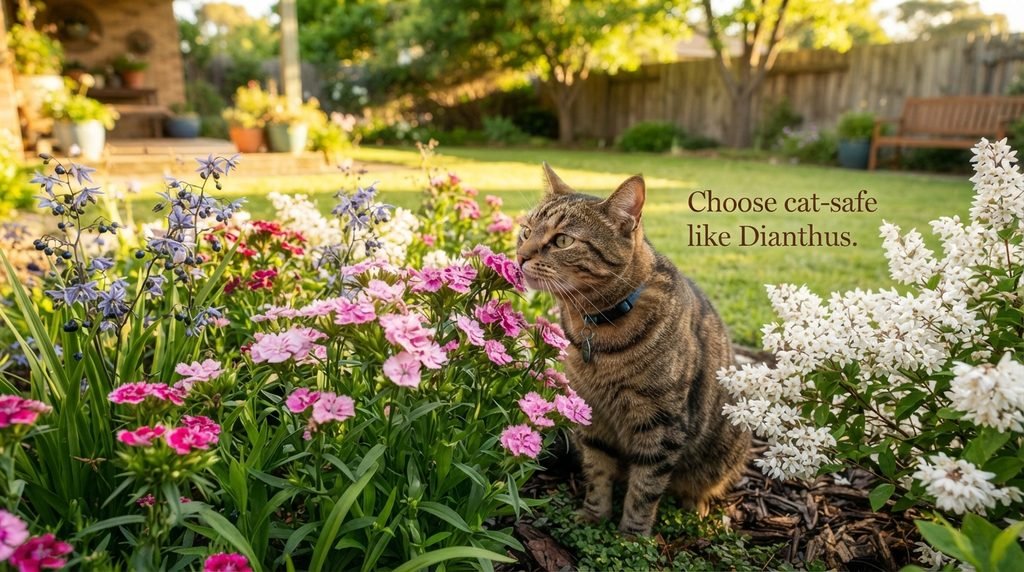
| Home with cats | Avoid Daylily entirely; choose Dianella, Deutzia, or Dianthus instead |
| Shaded or woodland garden | Dicentra, Drumstick Primula, Dwarf Crested Iris |
| Formal bouquet or wedding flower | Dahlia, Dutch Iris, Dendrobium Orchid |
| Hot, dry, low-water garden | Desert Rose, Delosperma, Dyckia, Desert Marigold |
| Rare or conversation-starting bloom | Dombeya, Dragonhead, Danford Iris |
| Fragrant flower for a gift | Damask Rose, Dianthus |
The cat-safety row is worth reading twice, since daylily is common enough to show up unlabeled in a mixed nursery flat, and the difference between a safe garden and a genuine emergency can come down to checking the plant tag before checkout rather than assuming a popular flower is automatically a safe one.
Conclusion
Flowers that start with D range from garden staples like dahlia and daffodil to genuinely rare finds like dombeya and dragonhead, with a surprising number of serious toxicity warnings tucked in among the more familiar names. Whether the goal is a low-maintenance perennial bed, a pet-safe garden, or a single dramatic bouquet flower, this list of 45 verified names should cover the search. The one habit worth carrying forward from this guide is checking safety before appearance — daylily’s popularity doesn’t make it harmless, and a little research before planting saves far more trouble than it costs.
Frequently Asked Questions
Is daylily really dangerous to cats?
Yes — every part of the daylily plant, including pollen and water from a vase holding the flowers, is highly toxic to cats and can cause acute kidney failure. This makes daylily one of the few genuinely dangerous common garden flowers for households with cats, despite its popularity as an easy perennial.
What D flowers are best for beginners?
Daylily, dianthus, and Dahlberg daisy are all forgiving choices that tolerate average soil and inconsistent watering. Delosperma is an excellent option for anyone gardening in a hot, dry spot with minimal experience.
Are there indoor flowers that start with D?
Yes—dendrobium orchid and desert rose rank among the most commonly grown indoor D flowers, and both thrive in bright light with relatively low water needs. Diascia and dahlberg daisy also grow well in containers on a sunny patio or balcony.
What are some rare flowers that start with D?
Gardeners consider Dombeya, dragonhead, desert bluebell, and diplacus rare mainly because standard nurseries rarely stock them, not because they are difficult to grow. Gardeners also often overlook Danford iris, even though it grows easily and produces early blooms.
What blue or purple flowers start with D?
Delphinium, Dutch iris, Douglas iris, dwarf crested iris, dragonhead, and desert bluebell all offer blue or purple tones, with delphinium providing the tallest and most dramatic spikes of the group.
Which D flowers are safe around children? Deutzia, Dianella, Dahlbergia daisy, Delosperma, and damask rose are all low-risk choices. Keep daphne, datura, foxglove, and daylily out of reach or avoid planting them in gardens accessible to children.
Which D flowers bloom the longest?
Daylily and dianthus both offer extended bloom periods through summer, especially with regular deadheading, while dianthus can flower from spring well into fall in the right climate.