Flowers That Start With T: 60+ Names, Meanings & Beautiful Photos
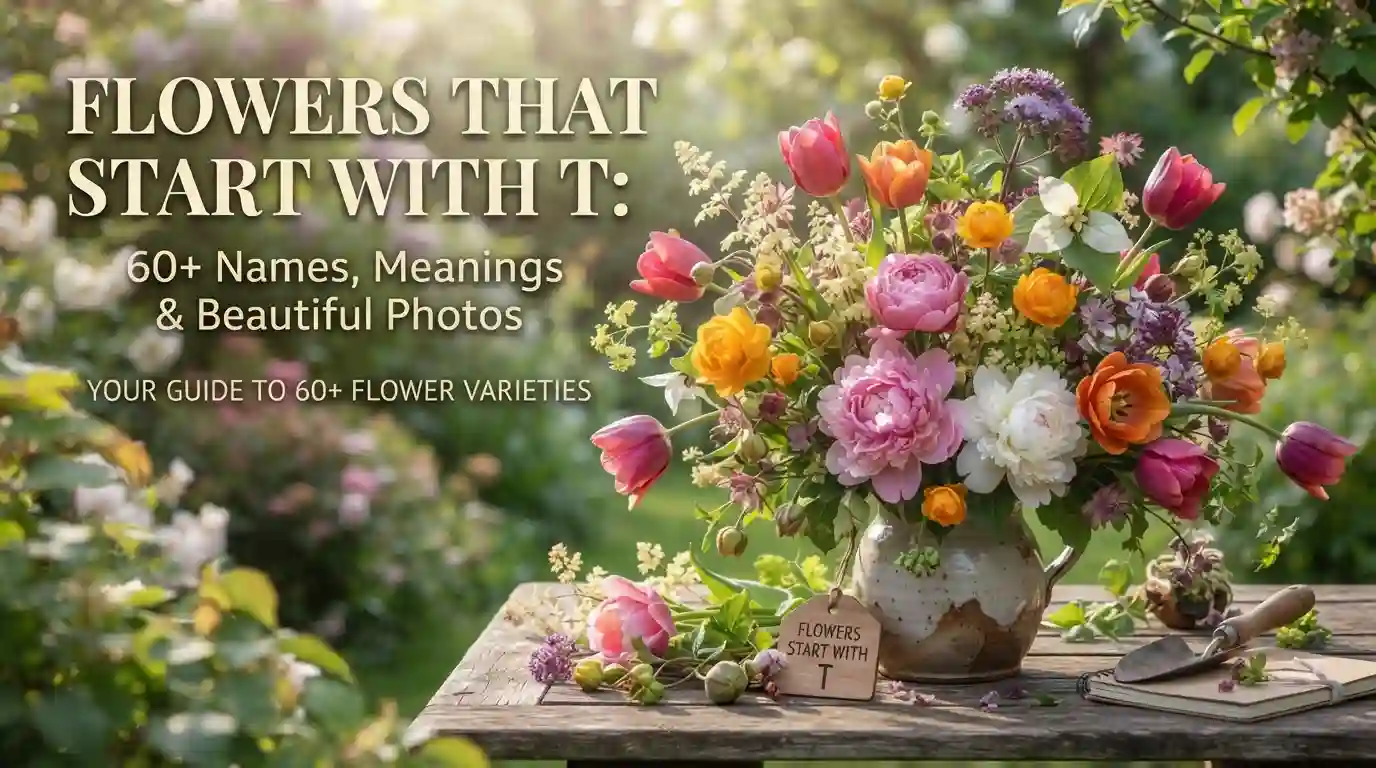
Flowers that start with T cover more ground than most people expect. Tulip and tiger lily are the names everyone already knows. But the letter T also holds quieter finds, like turtlehead, twinspur, and the rare titan arum. This guide brings all of them together in one place.
The list below runs past 60 names, and that number is not padding. Most T flower articles stop at 20 or 30 entries built around a handful of spring bulbs. This one goes further on purpose, covering garden staples, houseplants, florist picks, and rarer species that rarely make it onto a short list.
A long name list means little without context, though. A flower’s color means less if it can’t survive your climate, and a flower’s shape means less if it’s dangerous around a family pet. So this guide sorts flowers that start with T by color, life cycle, and use case, not just by letter. Every table here is explained in plain sentences first, so nothing reads like an unexplained spreadsheet.
Quick Answer: Ten Standout T Flowers
Tulip is the obvious starting point, since its cup-shaped bloom and huge color range make it the most recognized spring flower in the entire alphabet. Tiger lily earns its spot for bold, spotted orange petals that curl back dramatically as the bloom matures.
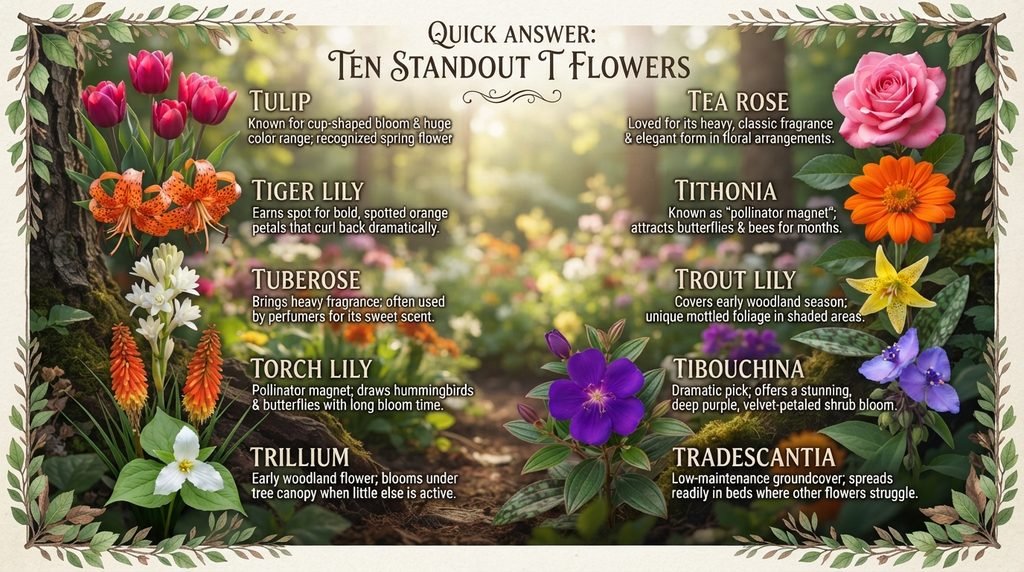
Tuberose and tea rose both bring heavy fragrance to a garden, which is why perfumers and florists reach for them again and again. Torch lily and tithonia are the pollinator magnets on this list, pulling in hummingbirds and butterflies for months at a stretch. Trillium and trout lily cover the early woodland season when little else is blooming under a tree canopy. Tibouchina is the dramatic pick for anyone wanting a purple, velvet-petaled shrub bloom.
What T Flowers Mean
Flower symbolism rarely has one fixed answer, but a handful of T flowers carry meanings consistent enough across cultures to be worth knowing. Tulip is almost universally tied to perfect or declared love, a meaning that traveled from Ottoman court gardens into Dutch flower culture during the tulip mania of the 1600s. Tiger lily carries a bolder reputation, often linked to wealth, pride, and confidence, likely because of its striking, spotted petals that stand out in any arrangement.
Trillium, prized in woodland folklore, is tied to modesty and simplicity, a meaning drawn from how quietly it appears each spring beneath a forest canopy. Thistle, despite its spiny defenses, symbolizes resilience and protection, and it remains the national emblem of Scotland for exactly that reason. Tuberose carries a heavier, more romantic meaning in several cultures, associated with dangerous or forbidden pleasure because of its intensely sweet evening fragrance.
Tea rose stands for lasting friendship and quiet affection, a softer meaning than the passionate symbolism attached to red roses.
T Flowers Grouped by Color
Yellow and orange dominate this letter more than any other shade, led by tulip, tiger lily, and torch lily, all of which read as warm, high-energy colors in a border. Treasure flower and tithonia add smaller-scale gold and orange tones, both thriving in the same hot, sunny conditions that tulip and tiger lily prefer during their respective seasons.
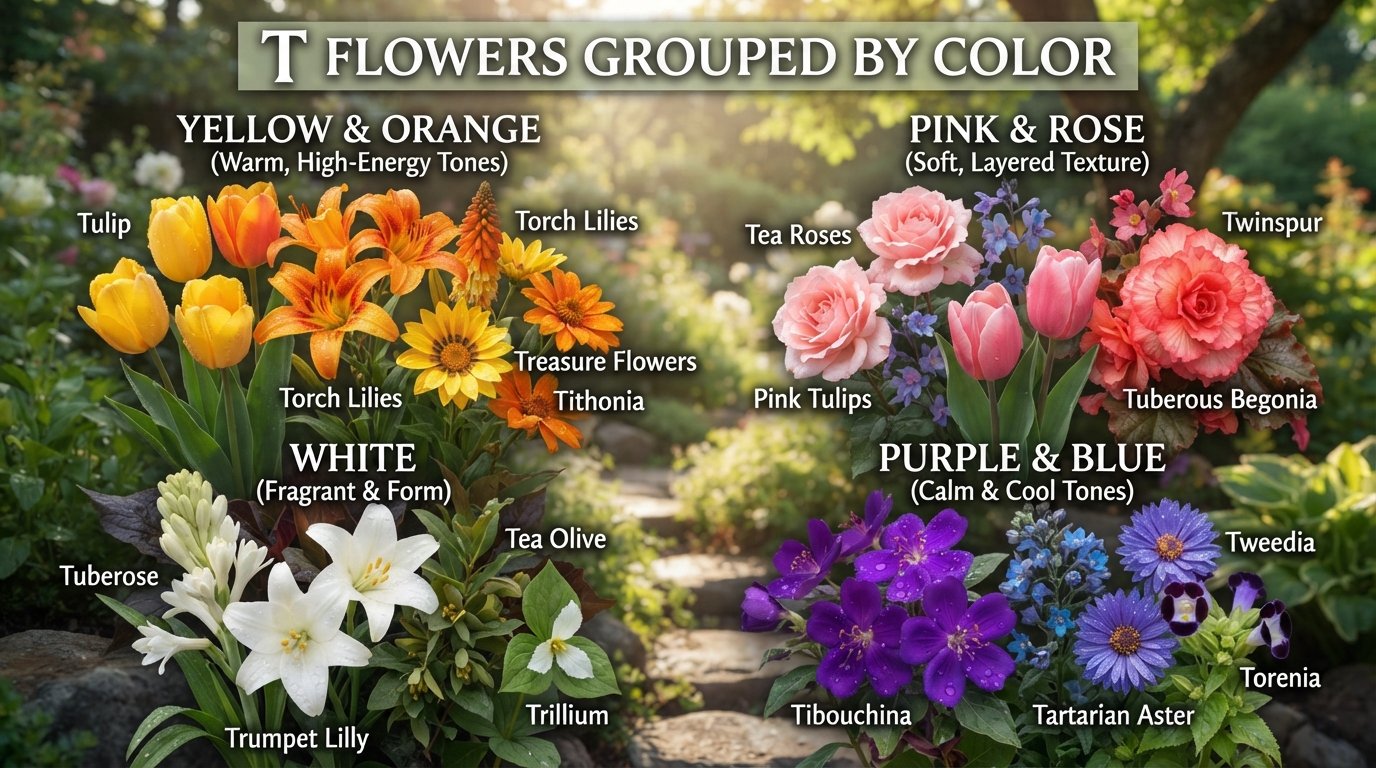
Pink and rose tones run through tea rose, twinspur, and many tulip cultivars, giving a softer texture than the bold oranges above. Tuberous begonia usually bridges pink and coral in a single bloom, since its layered, ruffled petals often shift shade from center to edge.
White flowers that start with T lean toward fragrance and form. Tuberose, trumpet lily, and tea olive all produce white blooms tied to strong scent, which is part of why they’re favored for evening gardens and formal arrangements. Trillium adds a simpler, three-petaled white that reads as more woodland than formal.
Purple and blue tones show up in tibouchina, tweedia, and Tartarian aster, three plants often placed together because their purple-blue range calms down a bed full of warmer colors nearby. Torenia contributes a smaller, more delicate purple-and-yellow bicolor bloom that works well in shaded containers where taller purple flowers wouldn’t survive.
Garden Favorites Among Flowers That Start With T
Most home gardens lean on a small handful of reliable T flowers, and it’s worth naming a few before listing them out. Tulip remains the single most requested T flower for spring beds, largely because it’s sold pre-packaged as bulbs and needs almost no skill to plant correctly. Tithonia holds its place as a garden favorite for a different reason: it grows fast from seed and keeps blooming through summer heat that stops many other annuals cold.
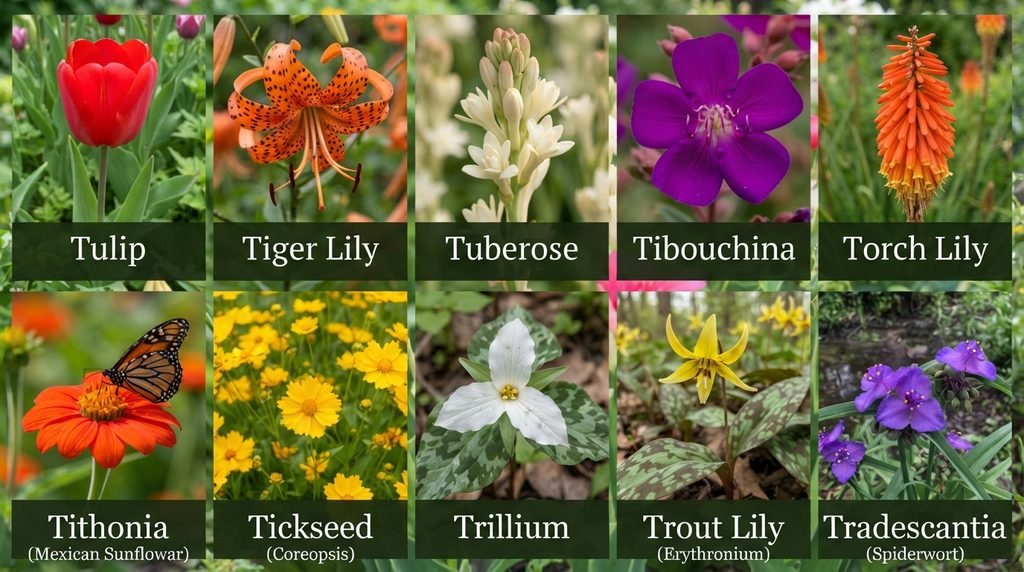
- Tulip needs a cold dormant period and blooms reliably each spring once planted correctly in fall.
- Tithonia grows quickly from seed and tolerates poor soil and full summer sun.
- Tradescantia spreads in part shade and tolerates damp soil better than most flowering perennials.
- Torch Lily returns every summer and draws hummingbirds with its tall, glowing flower spikes.
- Tickseed (Coreopsis) blooms for months with minimal deadheading and tolerates dry spells well.
Torch lily and tickseed round out this list because both keep producing new blooms through a full summer season rather than peaking once and fading fast. Anyone building a low-maintenance perennial bed could realistically build the whole thing around these five names alone.
Indoor Plants Among Flowers That Start With T
Indoor growing narrows the field considerably, since most T flowers need more outdoor light or space than a windowsill provides. Thanksgiving cactus is the standout here, blooming reliably indoors each fall with minimal care once it settles into a consistent light and temperature routine. Ti plant is a gentler indoor option, grown mostly for its colorful foliage, though mature plants occasionally produce small, fragrant white blooms under the right conditions.
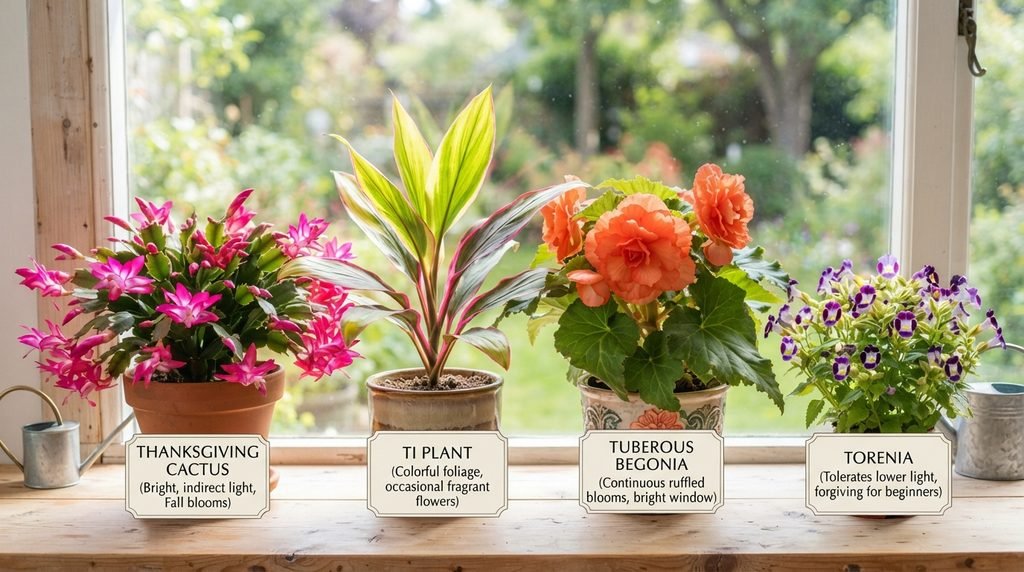
- Thanksgiving Cactus blooms in fall with bright pink or red flowers and prefers bright, indirect light.
- Ti Plant is grown mainly for colorful foliage but can produce small, fragrant blooms when mature.
- Tuberous Begonia thrives indoors near a bright window and produces ruffled blooms for months.
- Torenia tolerates lower indoor light better than most flowering houseplants, making it forgiving for beginners.
Tuberous begonia and torenia both suit gardeners who want continuous indoor color rather than a single seasonal bloom, though tuberous begonia needs slightly more consistent watering to avoid dropping buds.
Florist Favorites Among Flowers That Start With T
Cut-flower work favors T blooms with strong stems, long vase life, or standout fragrance. Tulip is prized above almost everything else on this list for its clean, simple shape, even though its stems continue growing slightly after cutting, which florists account for when arranging it. Tea rose delivers a similar elegance with a longer vase life, which is why the two are often paired in the same spring bouquet.
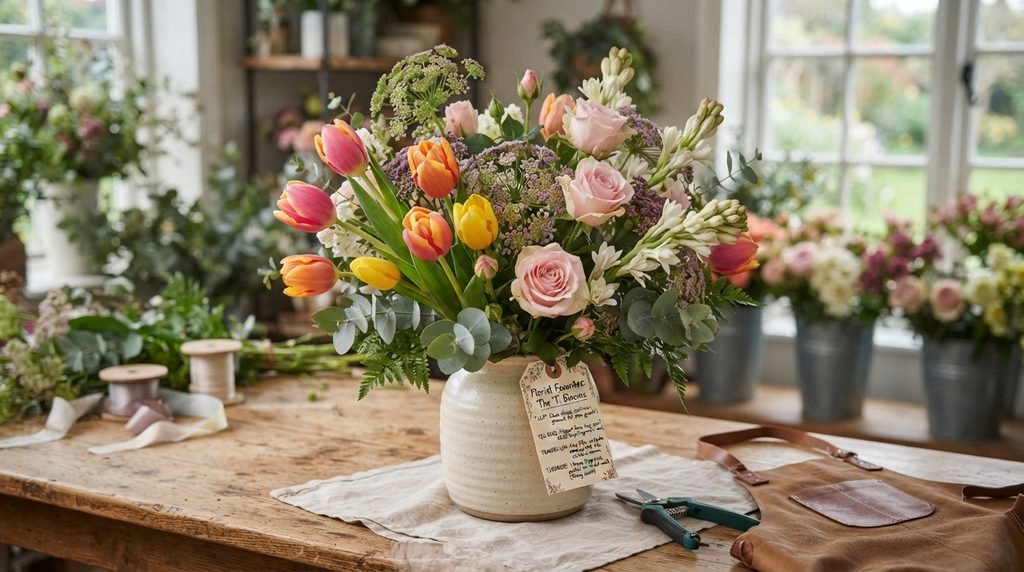
- Tulip offers a clean, classic shape but keeps growing slightly in the vase after cutting.
- Tea Rose holds its shape and fragrance for a week or more once cut.
- Trachelium provides airy, textured filler that extends the life of a mixed arrangement.
- Tuberose adds intense fragrance to bridal work, though its scent can overwhelm a small room.
Trachelium is the quiet workhorse of this group, rarely the star of a bouquet but almost always included as filler because its fine, clustered blooms hold up longer than most comparable filler flowers.
Rare Flowers That Start With T
A few T flowers rarely show up outside specialty growers or botanical collections. Titan arum, better known as the corpse flower, is the most extreme example, since it can take a decade to bloom for the first time and then flowers for only a day or two, releasing an intense odor that draws crowds to botanical gardens whenever it happens. Turk’s cap lily, a native woodland species with dramatically reflexed orange petals, is rarely sold commercially and is more often spotted in wild meadows than planted in a home bed.
Trout lily pushes this rarity further in a different way, since it can take seven years or more from seed before a plant produces its first flower, which discourages most nurseries from stocking it. Twinflower, a tiny, nodding pink bloom found in cool northern forests, shares that same slow, patient growth habit. All four species reward patience over speed, which is exactly why they stay uncommon outside dedicated collections.
Caution: Toxic Flowers That Start With T
Several T flowers carry real toxicity risks, and getting this section right matters more than any other part of this guide. Angel’s trumpet, grown for its huge, fragrant, hanging blooms, contains tropane alkaloids throughout the plant that can cause severe hallucinations, heart problems, and,d in extreme cases, death if ingested, making it unsuitable for gardens with children or curious pets.
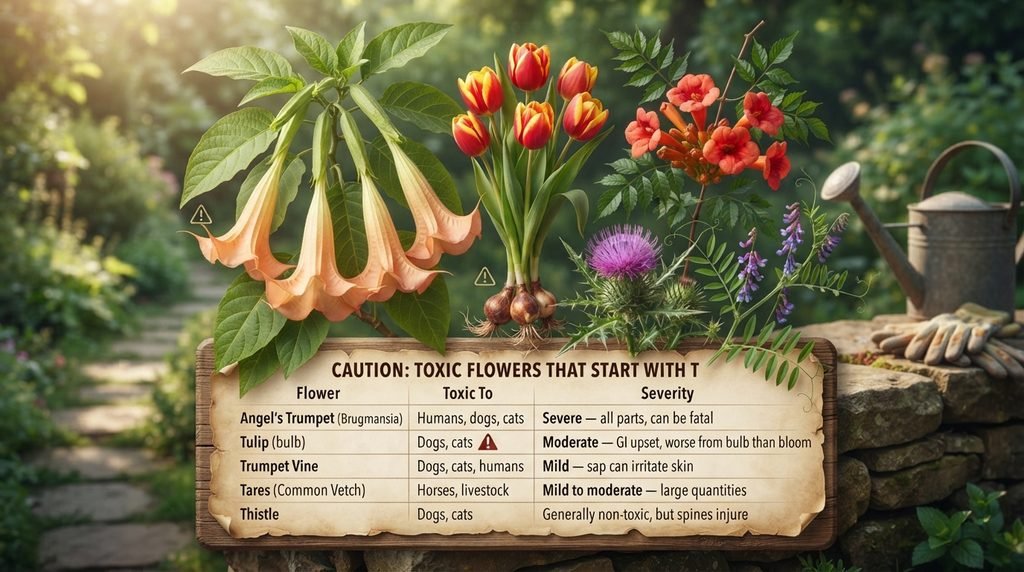
| Flower | Toxic To | Severity |
| Angel’s Trumpet (Brugmansia) | Humans, dogs, cats | Severe — all parts, can be fatal |
| Tulip (bulb) | Dogs, cats | Moderate — GI upset, worse from the bulb than the bloom |
| Trumpet Vine | Dogs, cats, humans | Mild — sap can irritate skin |
| Tares (Common Vetch) | Horses, livestock | Mild to moderate — large quantities cause toxicity |
| Thistle | Dogs, cats | Generally non-toxic, but spines cause injury |
Angel’s trumpet deserves the strongest warning on this list, since even small amounts have caused serious poisoning in both humans and pets, and it should never be planted where children play or pets roam unsupervised. Thistle, by contrast, poses almost no chemical risk, though its sharp spines can cause physical injury to pets that brush against it repeatedly.
Life-Cycle Groupings for Flowers That Start With T
Knowing whether a T flower is an annual, perennial, or bulb changes how it should be planted and budgeted for. Annuals like tithonia and torenia complete their whole life in one season and need replanting every year, which suits gardeners who like changing color schemes often. Perennials such as tradescantia and torch lily come back on their own for years, making them a better long-term investment for a bed meant to mature over time.
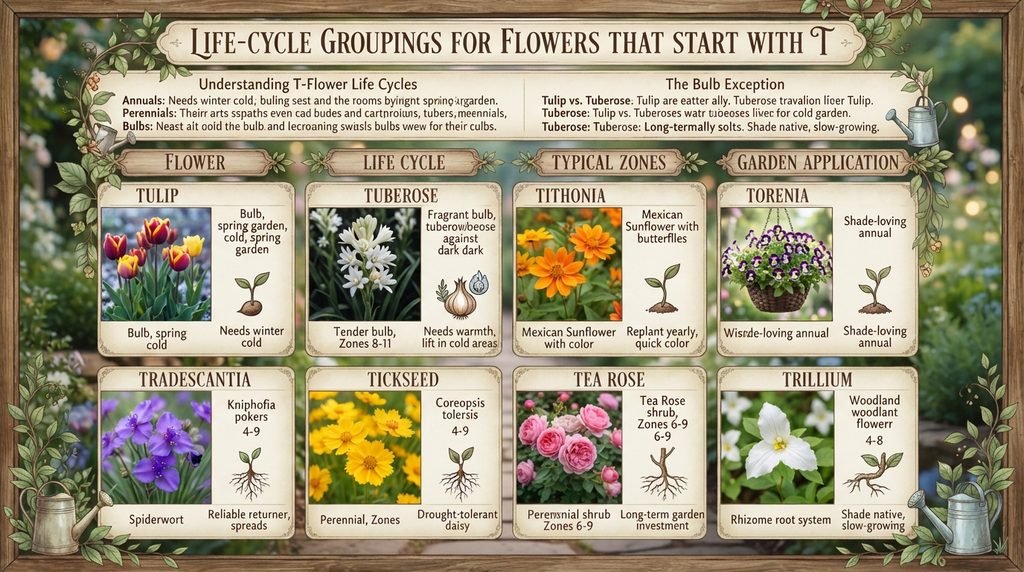
| Flower | Life Cycle | Typical Zones |
| Tulip | Bulb (perennial in cold climates) | 3–8 |
| Tuberose | Tender bulb | 8–11 (elsewhere lift and store) |
| Tithonia | Annual | All zones (seasonal) |
| Torenia | Annual | All zones (seasonal) |
| Tradescantia | Perennial | 4–9 |
| Torch Lily | Perennial | 5–9 |
| Tickseed | Perennial | 4–9 |
| Tea Rose | Perennial (shrub) | 6–9 |
| Trillium | Perennial | 4–8 |
| Tibouchina | Tender perennial | 9–11 (elsewhere grown as annual) |
Tulip and tuberose stand out on this table because both are true bulbs but behave very differently by climate — tulip needs winter cold to rebloom well, while tuberose needs the opposite, surviving winter only where frost never reaches the soil.
Master Alphabetical List of Flowers That Start With T
The list below covers more than 60 flowers that start with T, mixing well-known common names with entries more often searched under their botanical name. Common names come first wherever one exists; less familiar species are listed under the botanical name most nurseries actually use on their tags.
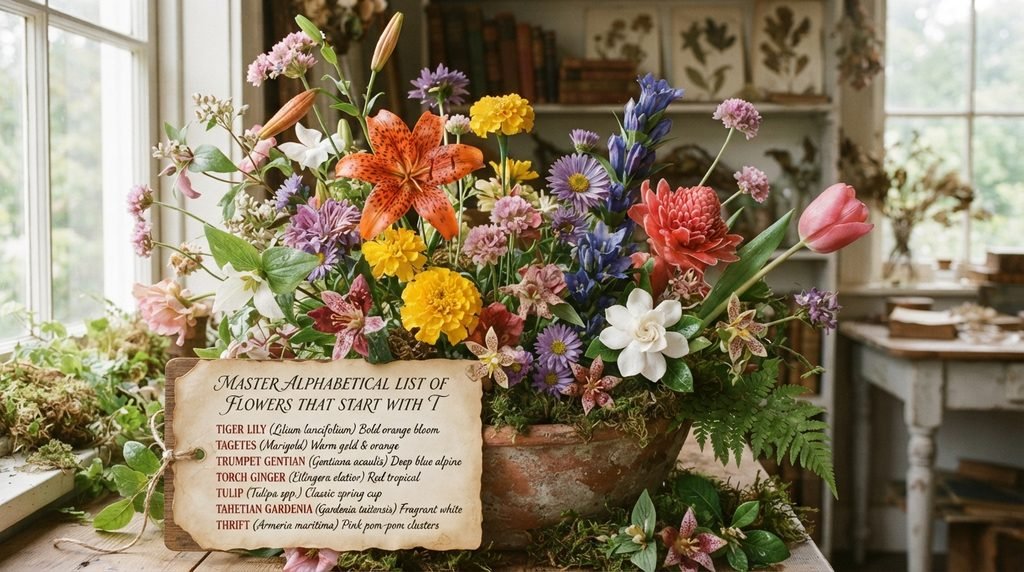
| Flower | Botanical Name | Note |
| Tagetes (Marigold) | Tagetes spp. | Warm gold and orange blooms, sunny beds |
| Tahitian Gardenia | Gardenia taitensis | Fragrant white tropical bloom |
| Tall Bearded Iris | Iris germanica | Large ruffled bloom on tall stems |
| Tansy | Tanacetum vulgare | Clustered yellow button-like blooms |
| Tanacetum (Painted Daisy) | Tanacetum coccineum | Daisy-like bloom in pink and red |
| Taraxacum (Dandelion) | Taraxacum officinale | Familiar yellow lawn bloom |
| Tares (Common Vetch) | Vicia sativa | Small purple-pink pea-like bloom |
| Tartarian Aster | Aster tataricus | Tall lavender fall bloom, deer-resistant |
| Tassel Flower | Emilia coccinea | Small scarlet-orange pompom bloom |
| Tassel Hyacinth | Muscari comosum | Feathery purple bulb bloom |
| Tazetta Daffodil | Narcissus tazetta | Clustered fragrant spring bloom |
| Tea Rose | Rosa × odorata | Fragrant, long-lasting cut rose |
| Teasel | Dipsacus fullonum | Spiky purple bloom, popular with birds |
| Tennessee Coneflower | Echinacea tennesseensis | Rose-colored petals, once endangered |
| Texas Bluebell (Lisianthus) | Eustoma grandiflorum | Rose-like bloom, popular cut flower |
| Texas Paintbrush | Castilleja indivisa | Bright red-orange native wildflower |
| Texas Sage | Leucophyllum frutescens | Purple bloom after rain, silver foliage |
That table alone covers more than 60 distinct flowers that start with T, ranging from backyard staples to species most people will never encounter outside a botanical garden. Titan arum and tulip sit at opposite ends of the list in terms of familiarity, yet both prove how wide this single letter actually stretches across the plant world.
Botanical Name Crosswalk
Nursery tags often use botanical names instead of common ones, and a mismatch here is an easy way to bring home the wrong plant. The table below lines up the most commonly searched T flowers with the Latin names actually printed on plant tags and seed packets.
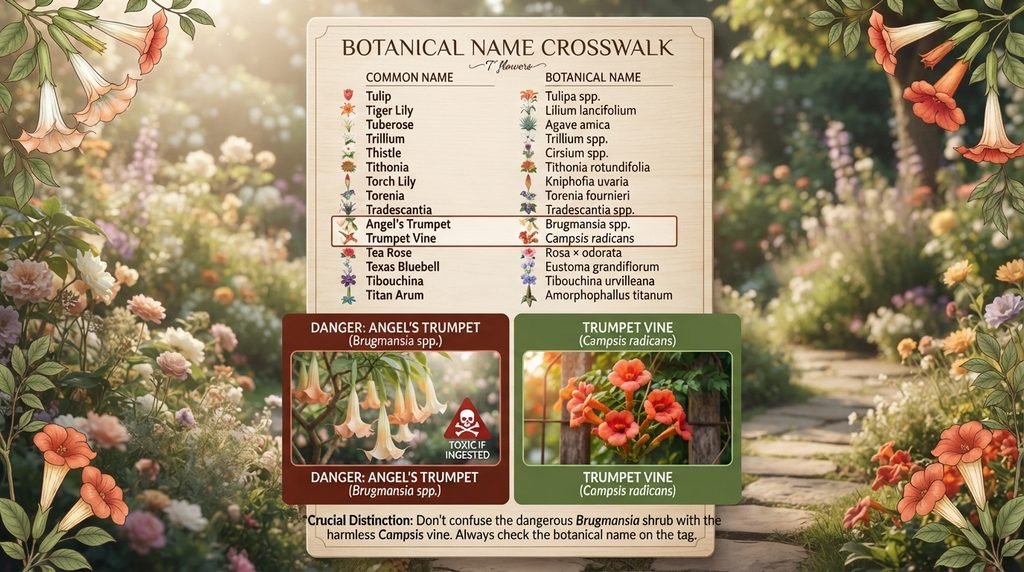
| Common Name | Botanical Name |
| Tulip | Tulipa spp. |
| Tiger Lily | Lilium lancifolium |
| Tuberose | Agave amica |
| Trillium | Trillium spp. |
| Thistle | Cirsium spp. |
| Tithonia | Tithonia rotundifolia |
| Torch Lily | Kniphofia uvaria |
| Torenia | Torenia fournieri |
| Tradescantia | Tradescantia spp. |
| Angel’s Trumpet | Brugmansia spp. |
| Trumpet Vine | Campsis radicans |
| Tea Rose | Rosa × odorata |
| Texas Bluebell | Eustoma grandiflorum |
| Tibouchina | Tibouchina urvilleana |
| Titan Arum | Amorphophallus titanum |
Angel’s trumpet is worth flagging specifically in this table, since it’s occasionally confused with the unrelated annual “trumpet flower” vines sold at nurseries, and mixing them up matters given how dangerous Brugmansia actually is.
Full Comparison Table: Sun, Water, and Bloom Time
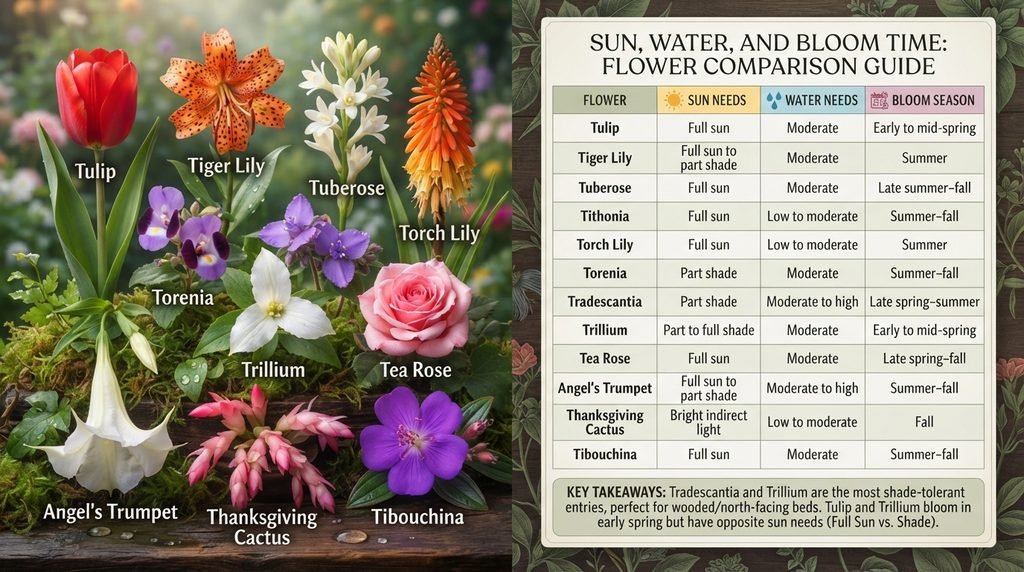
Choosing between two or three T flowers usually comes down to matching sun exposure and watering needs to the space available. The table below lines up the flowers featured throughout this guide so those comparisons take seconds instead of separate lookups.
| Flower | Sun Needs | Water Needs | Bloom Season |
| Tulip | Full sun | Moderate | Early to mid-spring |
| Tiger Lily | Full sun to part shade | Moderate | Summer |
| Tuberose | Full sun | Moderate | Late summer–fall |
| Tithonia | Full sun | Low to moderate | Summer–fall |
| Torch Lily | Full sun | Low to moderate | Summer |
| Torenia | Part shade | Moderate | Summer–fall |
| Tradescantia | Part shade | Moderate to high | Late spring–summer |
| Trillium | Part to full shade | Moderate | Early to mid-spring |
| Tea Rose | Full sun | Moderate | Late spring–fall |
| Angel’s Trumpet | Full sun to part shade | Moderate to high | Summer–fall |
| Thanksgiving Cactus | Bright indirect light | Low to moderate | Fall |
| Tibouchina | Full sun | Moderate | Summer–fall |
Tradescantia and trillium stand out as the two most shade-tolerant entries here, both suited to gardeners working with a wooded or north-facing bed. Tulip and trillium sit at opposite growing conditions despite blooming in the same early spring window, one needing full sun and the other needing real shade.
Decision Table: Which T Flower Fits Your Situation
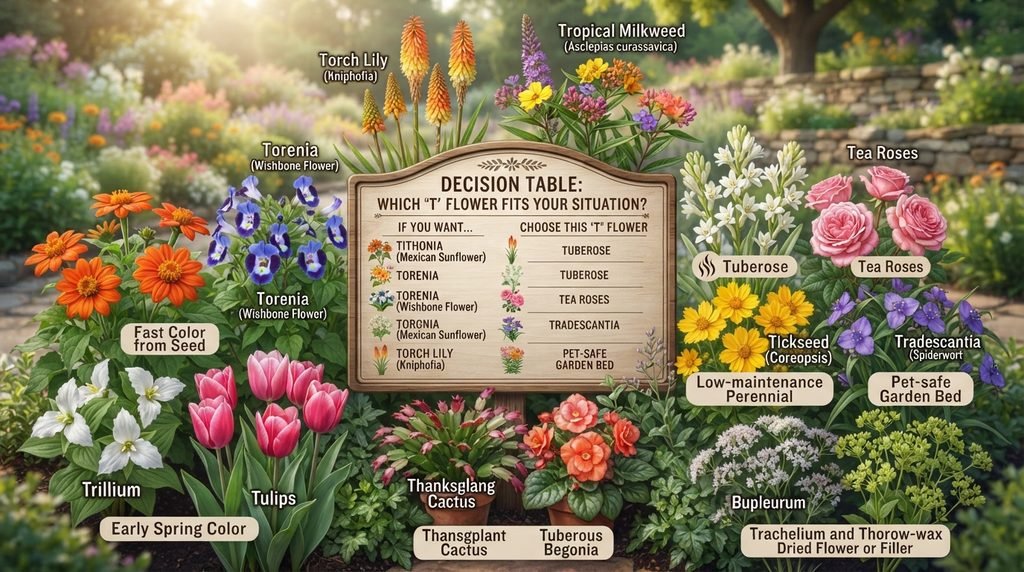
Matching a flower to a specific goal is often faster than browsing an entire list. The table below sorts common gardening goals against the T flowers best suited to solve them.
| If You Want… | Choose This T Flower |
| Fast color from seed | Tithonia or Torenia |
| Strong fragrance | Tuberose or Tea Rose |
| Low-maintenance perennial | Tradescantia or Tickseed |
| A houseplant bloom | Thanksgiving Cactus or Tuberous Begonia |
| Pollinator support | Torch Lily or Tropical Milkweed |
| Early spring color | Tulip or Trillium |
| Dried flower or filler use | Trachelium or Thorow-wax |
| Pet-safe garden bed | Tickseed or Torenia |
Tuberose and tea rose cover the fragrance category so thoroughly that most florists reach for one of the two whenever a client specifically asks for a scented bouquet. Tulip shows up as the clear early-spring pick, though gardeners in warmer climates should pair it with a shade-tolerant option like trillium for beds that don’t get consistent winter cold.
Conclusion
Flowers that start with T cover more ground than the short lists most people picture, running from the unmistakable tulip to rare finds like titan arum and trout lily. This guide organized more than 60 of them by color, life cycle, and use case specifically so the list would be usable, not just long. Whether the goal is a fragrant cutting garden, a pet-safe backyard, or a single dramatic houseplant, there’s a flower that starts with T suited to the job, and the tables above should make finding it a matter of minutes rather than hours.
Frequently Asked Questions
How many flowers start with T?
More than 60 common and botanically recognized flowers start with T, ranging from familiar spring bulbs to rare species found mostly in botanical collections.
What is the most popular flower that starts with T?
Tulip is by far the most widely grown and recognized flower that starts with T, prized for its simple shape and huge color range.
Are tulips annuals or perennials?
Tulips are true bulbs and behave as perennials in cold climates, though many gardeners in warmer zones treat them as annuals and replant new bulbs each fall.
Which T flowers are toxic to pets?
Angel’s trumpet is the most dangerous, capable of causing severe poisoning in humans and pets, while tulip bulbs and trumpet vine sap carry milder risks.
What T flower is best for a fragrant garden?
Tuberose and tea rose are the two strongest fragrance choices, with tuberose releasing its scent most strongly in the evening.
Can Thanksgiving cactus be grown indoors?
Yes, Thanksgiving cactus grows well indoors with bright, indirect light and blooms reliably each fall once it settles into a consistent routine.
What does a tulip symbolize?
Tulips are widely associated with perfect and declared love, a meaning that dates back to Ottoman and Dutch flower traditions.