50 Beautiful Flowers That Start With K: Names, Photos & Growing Tips
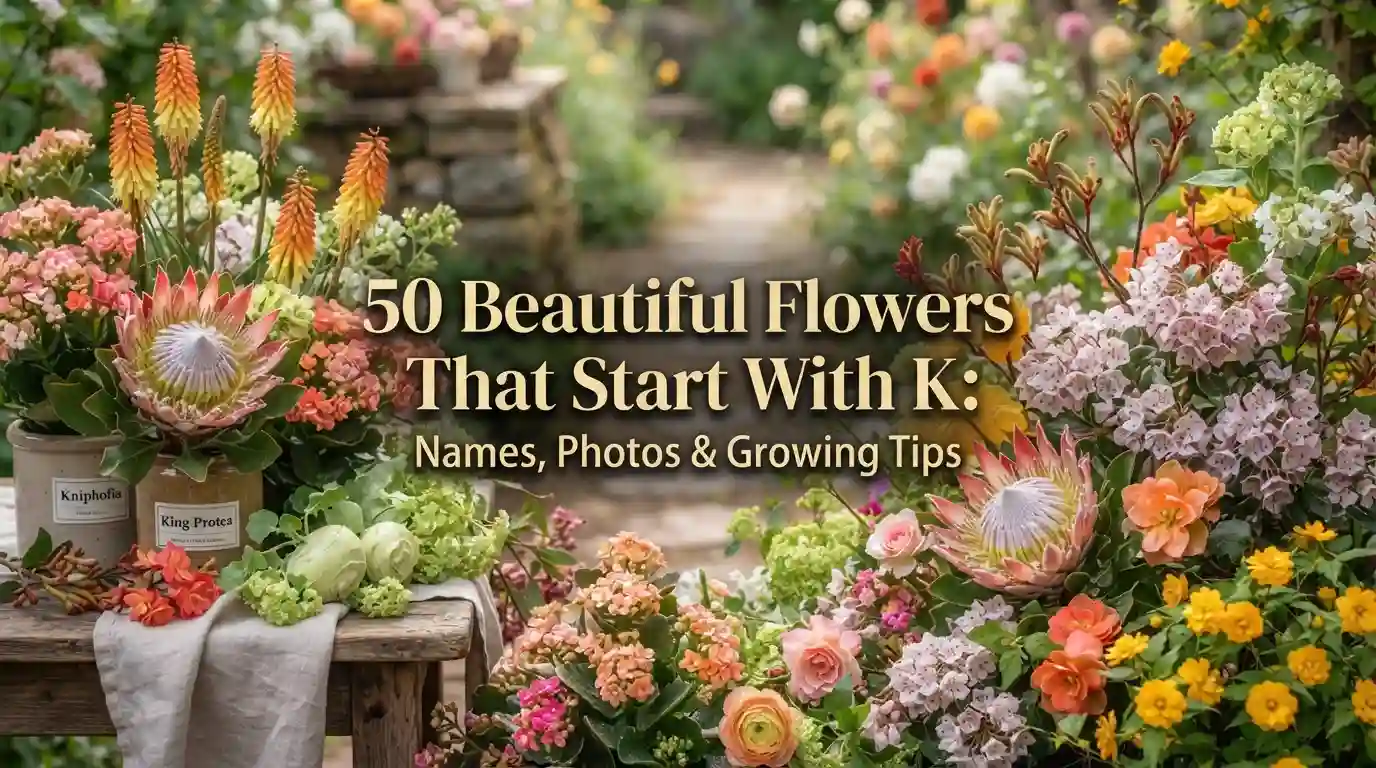
The letter K is not the easiest place to start a plant hunt. Yet flowers that start with K turn out to be one of the most varied and surprising groups in the whole garden alphabet. This list covers 50 real, verified flowers, each with a botanical name, a native home, and clear notes on whether it is safe around pets and kids.
This guide is built for real use, not just browsing. It is sorted first by meaning and color, then by where a plant fits best: garden bed, houseplant shelf, or florist’s bucket. A quick answer box up top gives you the fastest path to the most popular picks. Further down, a full alphabetical list and two data tables let you compare hex-free but botanically solid facts side by side.
People come to a list like this for very different reasons. A gardener wants a hardy pick for a sunny border. A new plant parent wants to know if a houseplant is safe near a curious cat.
Quick Answer: The Best-Known Flowers That Start With K
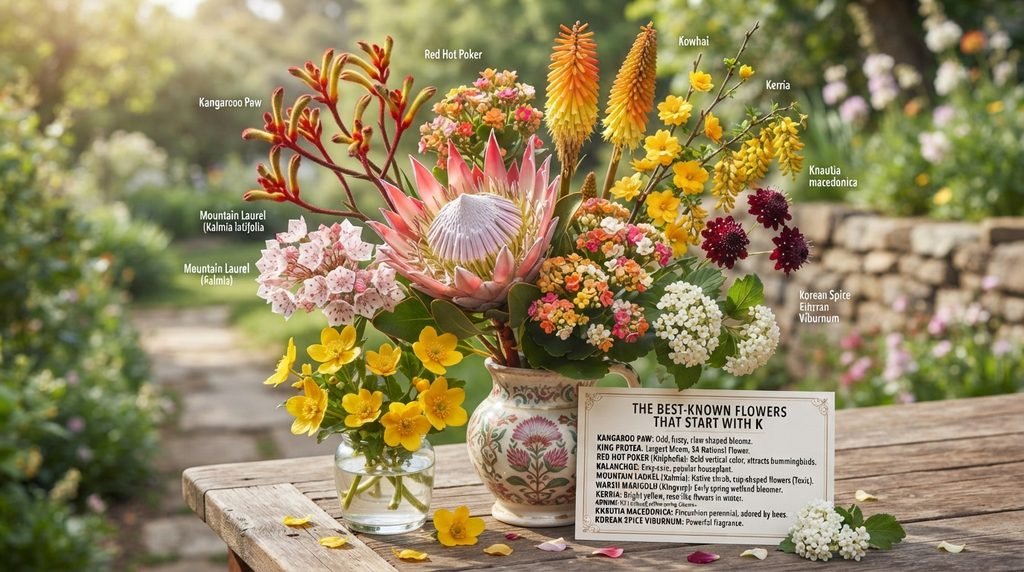
If you only remember a handful of names, make them these. Kangaroo Paw stands out for its odd, fuzzy, claw-shaped blooms and long vase life. King Protea is South Africa’s national flower and the largest bloom on this list. Red Hot Poker (Kniphofia) brings bold vertical color and pulls in hummingbirds all summer. Kalanchoe is the easy, no-fuss houseplant almost everyone has owned at least once. Mountain Laurel (Kalmia) is a native shrub prized for its cup-shaped spring flowers, though every part of the plant is toxic. Marsh Marigold, often called Kingcup, is one of the earliest wetland bloomers each spring. Kerria offers bright yellow, rose-like flowers on bare winter stems. Kowhai, New Zealand’s beloved yellow bloomer, feeds native birds each spring. Two more worth knowing are Knautia macedonica, a pincushion-style perennial that bees adore, and Korean Spice Viburnum, grown almost entirely for its powerful fragrance.
What Flowers That Start With K Symbolize
Flower meanings rarely come from nowhere. They grow out of color, shape, and long habit of use in gardens and ceremonies. Kaffir Lily and King Protea both carry a sense of royalty and status, partly from their names and partly from their bold, structured shape. A King Protea does not nod gently in the breeze the way a daisy does; it holds still and commands attention, which is likely why it became a national emblem.
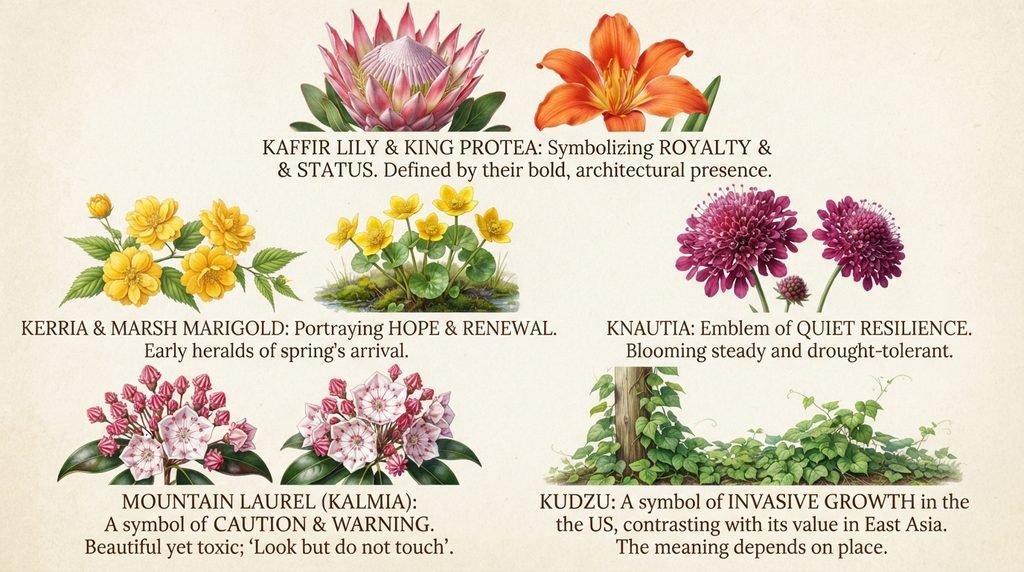
Softer flowers that start with K point toward gentler ideas. Kerria’s papery yellow blooms, arriving before most other shrubs wake up, have long been tied to hope and renewal in Japanese and Chinese garden tradition. Marsh Marigold, blooming in cold, wet ground before almost anything else, carries a similar association with early hope and the first real sign of spring.
A few names lean toward caution rather than comfort. Mountain Laurel’s beauty sits right next to real danger, since every part of the plant is toxic if eaten. That contrast, a gorgeous flower with a genuine warning label, has made Kalmia a quiet symbol of “look but do not touch” in some plant folklore. Kudzu carries almost the opposite reputation: in its native East Asia it is valued and even eaten, while in the southern United States it symbolizes uncontrolled, invasive growth.
Color-Based Groupings for K Flowers
Sorting by color is often the fastest way to shop for a garden bed or a bouquet, so it is worth grouping these flowers that start with K by hue before diving into detailed categories. Yellow is easily the best-represented color in this list. Kerria, Kowhai, King’s Spear, Golden Rain Tree, and several Kniphofia varieties all bring warm, sunny yellow into spring and summer beds, and most of them are tough, low-fuss plants that reward very little care.
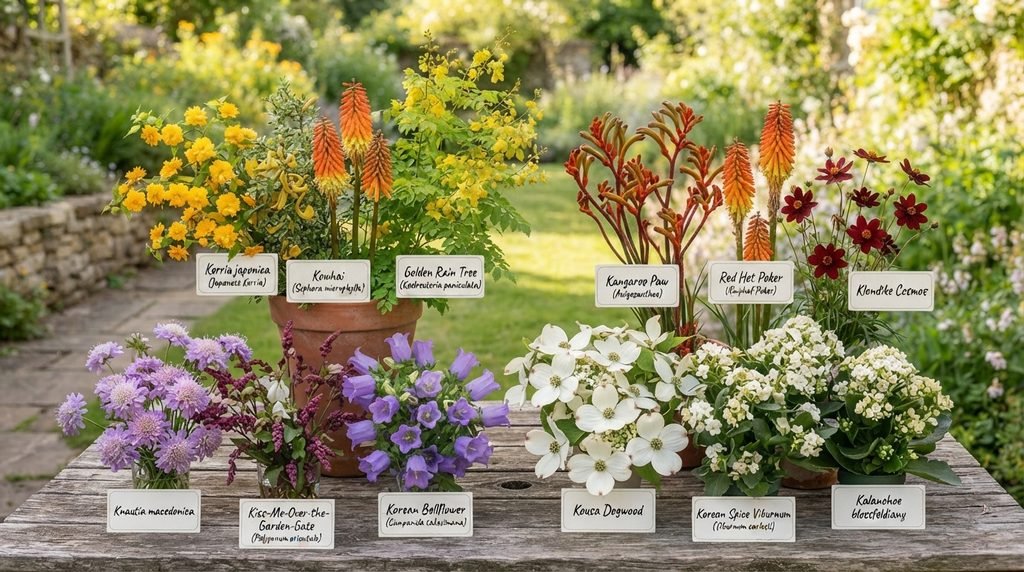
Red and orange come next, led by Kangaroo Paw, Red Hot Poker, and Klondike Cosmos. These three share a bold, saturated look that reads well from a distance, which is exactly why they show up so often along fence lines and driveways where a garden needs to make a first impression.
White and pastel flowers round out the group, led by Kousa Dogwood, Korean Spice Viburnum, and several pale Kalanchoe cultivars. These tend to work best as calming, background plants that let bolder neighbors stand out, rather than as the star of the border themselves.
Garden Favorites Among Flowers That Start With K
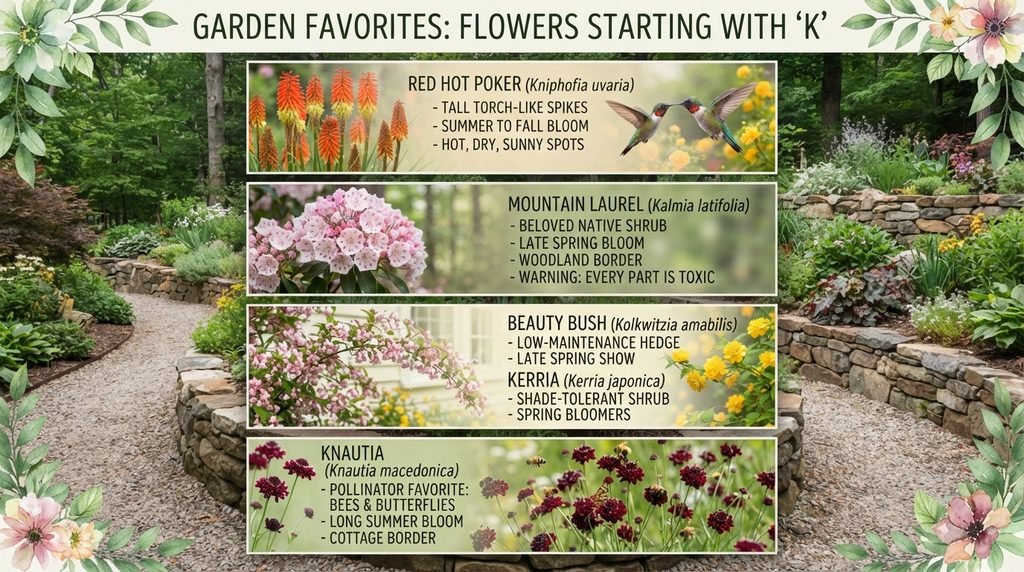
Certain flowers that start with K show up again and again in ordinary backyard gardens, and it is worth knowing why before you commit bed space to one. Mountain Laurel earns its spot as a beloved native shrub across the eastern United States, valued for its clusters of pink or white cup-shaped blooms in late spring, even though every part of the plant carries toxins that make it a poor choice near grazing animals or small children who put things in their mouths.
Beauty Bush has quietly become a favorite for gardeners who want a low-maintenance spring show without constant pruning, since its arching branches fill with small pink, bell-shaped flowers for several weeks each year.
| Flower | Botanical Name | Bloom Season | Best Garden Use |
| Mountain Laurel | Kalmia latifolia | Late spring | Woodland border, native shrub bed |
| Red Hot Poker | Kniphofia uvaria | Summer to fall | Hot, dry, sunny borders |
| Beauty Bush | Kolkwitzia amabilis | Late spring | Low-maintenance flowering hedge |
| Knautia | Knautia macedonica | Summer | Pollinator garden, cottage border |
| Kerria | Kerria japonica | Spring | Shade-tolerant flowering shrub |
Two rows in this table deserve a second look. Mountain Laurel is the only true toxic risk on the list, so it belongs in beds well away from pets and small children despite its garden popularity. Kerria stands out for a different reason: unlike most flowering shrubs, it actually tolerates partial shade well, making it one of the few reliable K flowers for a garden corner that does not get full sun.
Indoor Plants Among Flowers That Start With K
Not every K flower needs a garden bed. Several are far better suited to a sunny windowsill than an outdoor border, and Kalanchoe leads this group by a wide margin. Sold everywhere from grocery stores to garden centers, Kalanchoe blossfeldiana produces dense clusters of small flowers in red, pink, yellow, or white, and it will rebloom for years with almost no attention beyond bright light and occasional watering.
Kaffir Lily brings a different kind of indoor drama, with thick, strappy leaves and a tall stalk topped by a cluster of trumpet-shaped orange or red flowers each late winter. It is slower to reach blooming size than Kalanchoe, often taking three or four years from a small offset, but the payoff is a genuinely showy indoor display right when most other houseplants look their dullest.
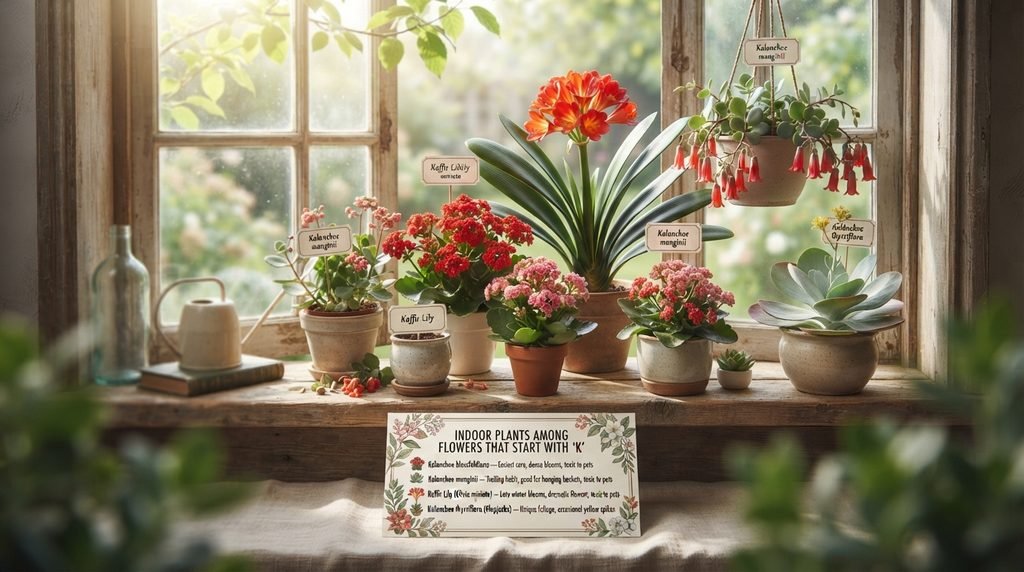
- Kalanchoe blossfeldiana — easiest care, reblooms readily, toxic to pets
- Kalanchoe manginii — trailing habit, good for hanging baskets, toxic to pets
- Kaffir Lily (Clivia miniata) — slow to bloom, dramatic winter flowers, toxic to pets
- Kalanchoe thyrsiflora (Flapjacks) — grown mainly for foliage, occasional yellow spikes
Anyone shopping for a low-light windowsill plant should note that all four of these prefer bright, indirect light rather than deep shade; a Kalanchoe kept too dark will grow leggy and stop flowering almost entirely, which is the single most common complaint people have about the plant.
Florist Favorites Among Flowers That Start With K
Cut-flower buyers reach for a much smaller set of K flowers than gardeners do, mostly because vase life and stem strength matter more than hardiness in a florist’s cooler. Kangaroo Paw tops this short list, prized for its unusual, fuzzy, claw-shaped blooms that hold their color and shape in a vase far longer than most cut flowers manage. Its stiff stems and velvety texture also photograph beautifully, which has made it a favorite for modern, textural wedding arrangements over the last decade.
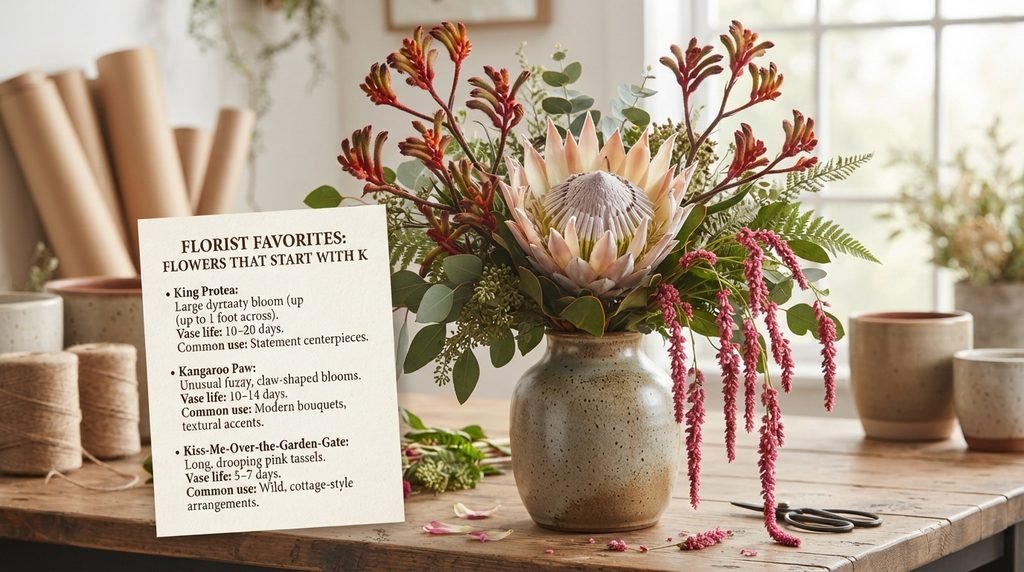
King Protea plays a similar role at the opposite end of the size scale, anchoring large arrangements with a single, dramatic bloom that can measure up to a foot across. Because a single stem does so much visual work, florists often use just one or two King Proteas per arrangement rather than a full bunch. Kiss-Me-Over-the-Garden-Gate, despite its old-fashioned cottage-garden name, has found a smaller niche among florists who want long, drooping pink tassels for a wilder, less structured bouquet style.
| Flower | Vase Life | Signature Look | Common Use |
| Kangaroo Paw | 10–14 days | Fuzzy, claw-shaped blooms | Modern bouquets, textural accents |
| King Protea | 10–20 days | Large, bold central bloom | Statement centerpieces |
| Kiss-Me-Over-the-Garden-Gate | 5–7 days | Long pink tassels | Wild, cottage-style arrangements |
Kangaroo Paw and King Protea share one practical advantage over almost every other flower in this article: both were bred for the cut-flower trade in Australia and South Africa, so growers have spent decades selecting varieties specifically for long vase life rather than garden looks alone.
Rare Flowers That Start With K
A handful of flowers that start with K rarely show up outside specialty nurseries or botanical gardens, and each has a story worth knowing. Kirengeshoma palmata, commonly called Yellow Waxbells, produces pale yellow, shuttlecock-shaped flowers in late summer, but it demands cool, moist, shaded soil that many home gardens simply cannot offer, which keeps it rare outside the Pacific Northwest and similar climates.
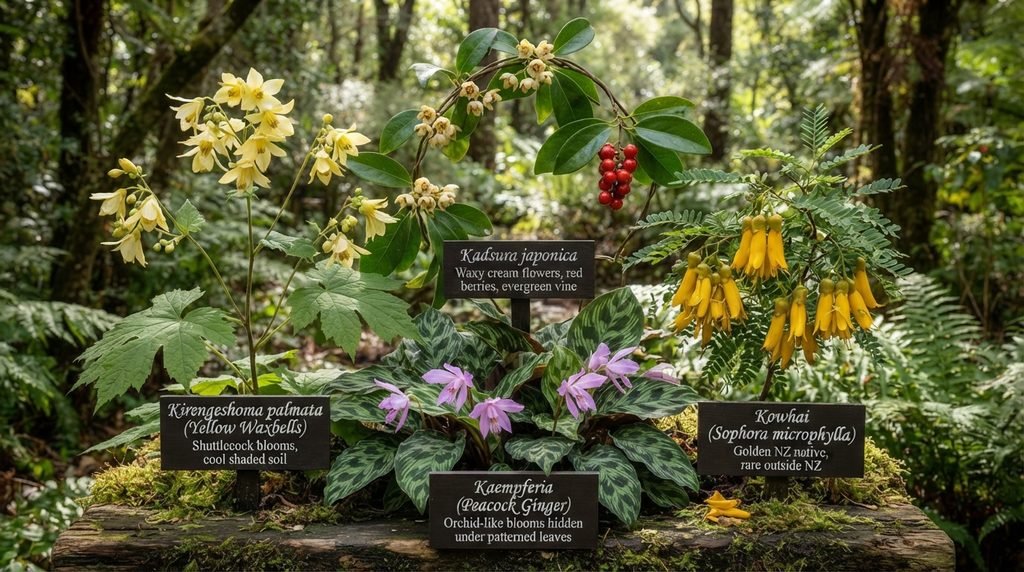
Kaempferia, sometimes called Peacock Ginger, offers a very different kind of rarity: its orchid-like flowers appear low to the ground, often hidden beneath patterned leaves, so many gardeners who actually own the plant never notice it blooming at all. Kowhai sits in a strange middle ground between rare and common; it is New Zealand’s most celebrated native flower and grows in most New Zealand gardens, yet it remains a genuine rarity almost everywhere else in the world.
- Kirengeshoma palmata — needs cool, shaded, moist soil; rare outside specific climates
- Kadsura japonica — cold-hardy evergreen vine, still nearly unknown in Western gardens
- Kaempferia (Peacock Ginger) — blooms often hidden under patterned foliage
- Kowhai — common in New Zealand, rare almost everywhere else
What ties these four together is not appearance but circumstance: each one is genuinely easy to grow under the right conditions, yet each depends on a climate, a soil type, or simple regional habit that keeps it out of most ordinary gardens.
Caution and Toxicity Among Flowers That Start With K
Not every pretty flower is a safe one, and this list includes several genuinely toxic species that deserve a clear, direct warning rather than a vague footnote. Mountain Laurel, Sheep Laurel, and Bog Laurel, the three Kalmia species covered here, all contain grayanotoxins in their leaves, flowers, and nectar, which can cause serious illness in humans, pets, and livestock if eaten in any quantity.
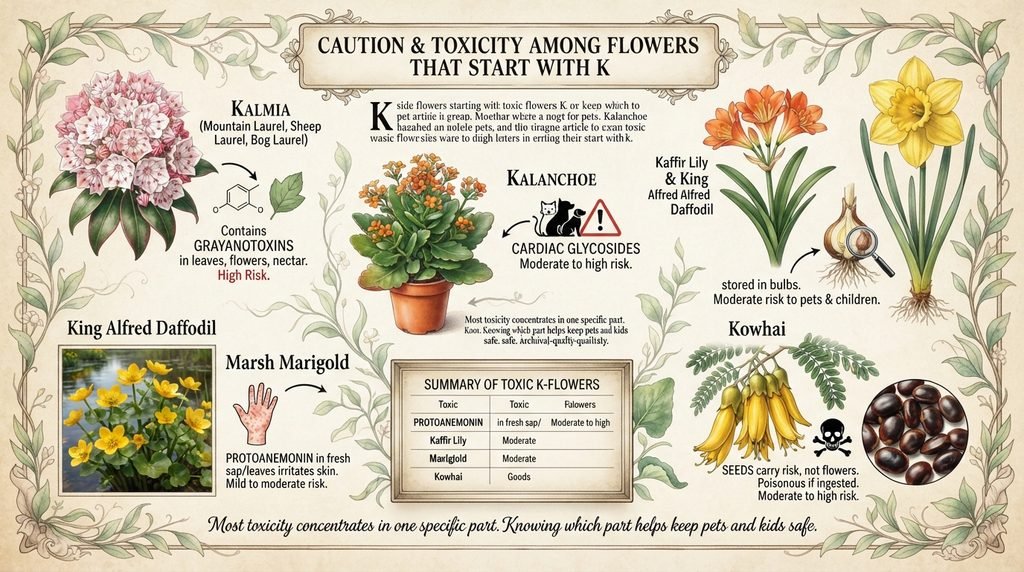
Kaffir Lily and King Alfred Daffodil both belong to bulb-forming plant families that store lycorine, a compound that causes vomiting and worse if a pet digs up and chews a bulb. Marsh Marigold contains protoanemonin, a compound that irritates skin and mucous membranes, though cooking neutralizes it enough that the young leaves have a long history of use as a cooked vegetable in parts of Europe.
| Flower | Toxic Part | Risk Level | Affected |
| Mountain Laurel | All parts | High | Humans, pets, livestock |
| Kalanchoe | All parts | Moderate to high | Pets, especially cats |
| Kaffir Lily | Bulb, leaves | Moderate | Pets, children |
| King Alfred Daffodil | Bulb | Moderate | Pets, children |
| Marsh Marigold | Fresh sap/leaves | Mild to moderate | Humans, livestock |
| Kowhai | Seeds | Moderate to high | Children, wildlife |
The clearest takeaway from this table is that toxicity in K flowers almost always concentrates in one specific part of the plant, whether that is a bulb, a seed, or fresh sap, rather than making the entire plant equally dangerous; knowing which part to keep away from pets and kids is usually enough to grow these safely.
Life-Cycle Groupings: Annual, Perennial, or Shrub
Choosing a plant by its life cycle often matters more than choosing by color, since an annual and a shrub demand completely different long-term commitments from a gardener. The table below sorts several well-known flowers that start with K by life cycle, which makes it easier to plan a bed that mixes fast, one-season color with slower, permanent structure.
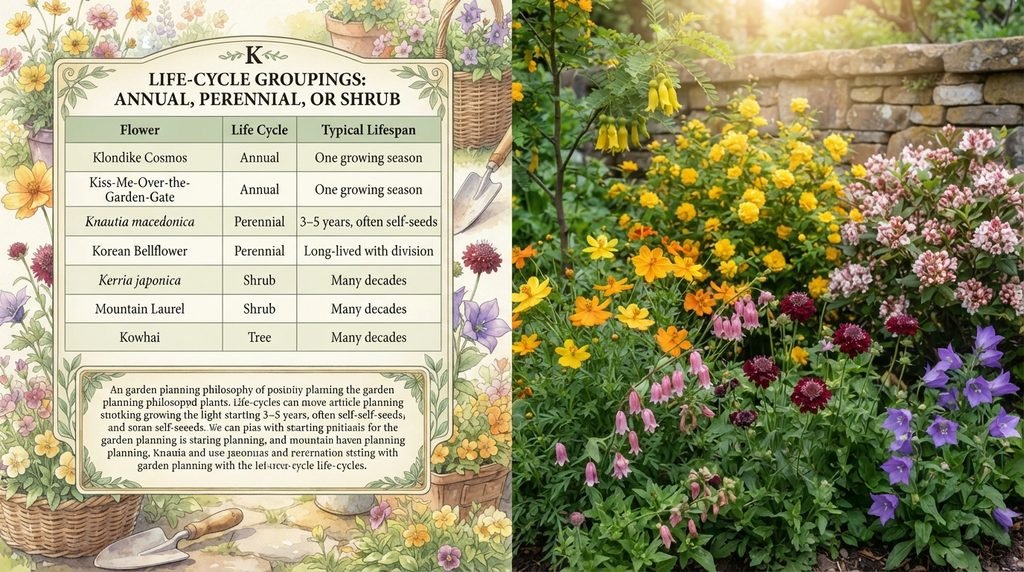
| Flower | Life Cycle | Typical Lifespan |
| Klondike Cosmos | Annual | One growing season |
| Kiss-Me-Over-the-Garden-Gate | Annual | One growing season |
| Knautia macedonica | Perennial | 3–5 years, often self-seeds |
| Korean Bellflower | Perennial | Long-lived with division |
| Kerria japonica | Shrub | Many decades |
| Mountain Laurel | Shrub | Many decades |
| Kowhai | Tree | Many decades |
Annuals like Klondike Cosmos are the fastest way to add K-flower color to a bed this season, since they bloom within weeks of planting and never need to survive a winter. Perennials such as Knautia trade that speed for a longer-term payoff, returning each year and often improving as their root systems mature, while shrubs and trees like Kerria, Mountain Laurel, and Kowhai represent a true long-term investment that will still be blooming decades from now.
Master Alphabetical List of Flowers That Start With K
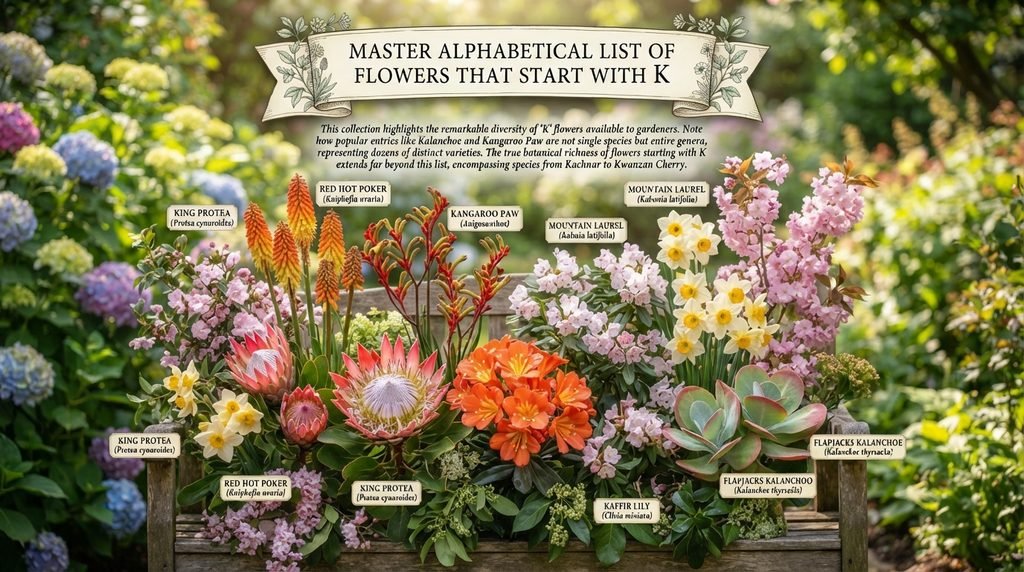
The list below runs alphabetically by common name, since that is how most gardeners search, with the botanical name listed alongside for anyone who wants to look up a plant at a nursery or seed catalog.
- Kachnar (Bauhinia variegata)
- Kadsura (Kadsura japonica)
- Kaempferia (Kaempferia pulchra)
- Kaffir Lily (Clivia miniata)
- Kalanchoe, Flaming Katy (Kalanchoe blossfeldiana)
- Kalanchoe fedtschenkoi
- Kalanchoe manginii
- Kalanchoe pumila
- Kalanchoe thyrsiflora, Flapjacks
- Kalimeris, Japanese Aster (Kalimeris incisa)
- Kalmia, Mountain Laurel (Kalmia latifolia)
- Kalmia angustifolia, Sheep Laurel
- Kalmia polifolia, Bog Laurel
- Kangaroo Paw (Anigozanthos flavidus)
- Kangaroo Paw, Cat’s Paw (Anigozanthos humilis)
- Kangaroo Paw, Red and Green (Anigozanthos manglesii)
- Kangaroo Paw, Red (Anigozanthos rufus)
- Kansas Gayfeather (Liatris pycnostachya)
- King Alfred Daffodil (Narcissus ‘King Alfred’)
- King Protea (Protea cynaroides)
- King’s Spear (Asphodeline lutea)
- Kingfisher Daisy (Felicia bergeriana)
- Kingcup, Marsh Marigold (Caltha palustris)
- Kirengeshoma, Yellow Waxbells (Kirengeshoma palmata)
- Kiss-Me-Over-the-Garden-Gate (Persicaria orientalis)
- Kiwi Flower (Actinidia deliciosa)
- Klamath Weed, St. John’s Wort (Hypericum perforatum)
- Klondike Cosmos (Cosmos sulphureus ‘Klondike’)
- Knapweed, Common (Centaurea nigra)
- Knapweed, Greater (Centaurea scabiosa)
- Knautia, Field Scabious (Knautia arvensis)
- Knautia macedonica
- Kniphofia, Red Hot Poker (Kniphofia uvaria)
- Kniphofia northiae
- Koelreuteria, Golden Rain Tree (Koelreuteria paniculata)
- Kolkwitzia, Beauty Bush (Kolkwitzia amabilis)
- Korean Bellflower (Campanula takesimana)
- Korean Clover (Kummerowia stipulacea)
- Korean Lilac (Syringa meyeri)
- Korean Mint (Agastache rugosa)
- Korean Spice Viburnum (Viburnum carlesii)
- Kosteletzkya, Sea-shore Mallow (Kosteletzkya virginica)
- Kousa Dogwood (Cornus kousa)
- Kowhai (Sophora tetraptera)
- Krigia, Virginia Dwarf-Dandelion (Krigia virginica)
- Kudzu (Pueraria montana var. lobata)
- Kwanzan Cherry (Prunus serrulata ‘Kanzan’)
Grouping the Kalanchoe and Kangaroo Paw entries together like this makes an important pattern easy to spot: several of the most popular flowers that start with K are not single species at all.
Botanical Name Crosswalk: Why Latin Names Matter
Common names change from region to region, which is exactly why serious gardeners and nursery buyers rely on botanical names instead. “Kingcup” in one country might mean Marsh Marigold, while in another it could refer to a completely different yellow wildflower, but Caltha palustris always means the same plant no matter where you buy it or who you ask.
The crosswalk below lines up common names with their correct botanical names for every flower discussed in detail so far, giving you a single reference to search by when shopping at a nursery that only labels plants in Latin.
| Common Name | Botanical Name |
| Kangaroo Paw | Anigozanthos flavidus |
| King Protea | Protea cynaroides |
| Red Hot Poker | Kniphofia uvaria |
| Mountain Laurel | Kalmia latifolia |
| Marsh Marigold / Kingcup | Caltha palustris |
| Kerria | Kerria japonica |
| Kowhai | Sophora tetraptera |
| Beauty Bush | Kolkwitzia amabilis |
| Knautia | Knautia macedonica |
| Yellow Waxbells | Kirengeshoma palmata |
Two rows are worth double-checking before you buy. Kerria is one of the rare cases where the common name and botanical name are identical, which removes any risk of confusion at checkout.
Full Comparison Table of Flowers That Start With K
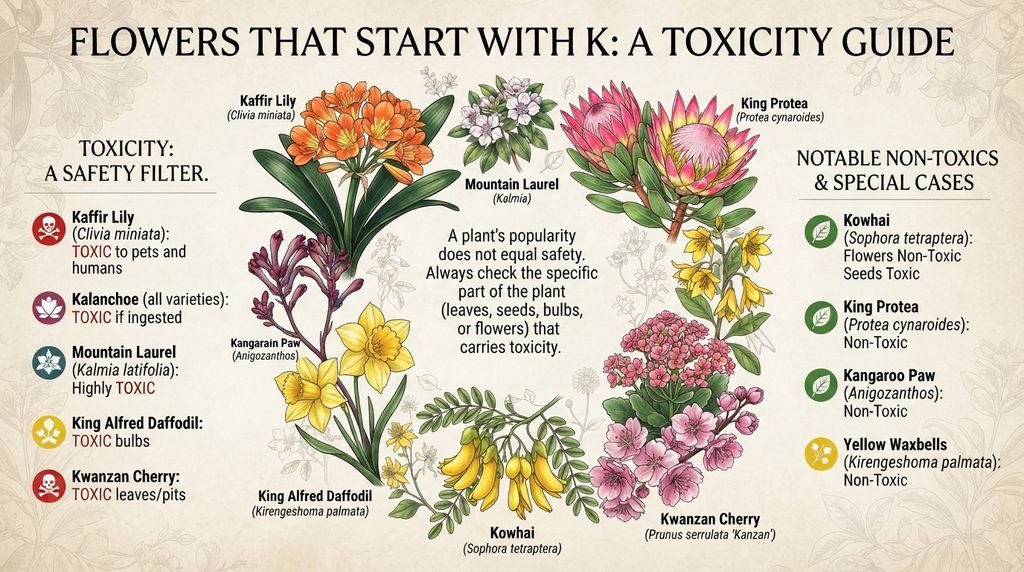
Bringing everything together, the table below lists every flower named earlier in this guide with its botanical name, native origin, bloom season, and toxicity status, so you can scan for a specific trait without flipping back through every section.
| Common Name | Botanical Name | Native Origin | Bloom Season | Toxicity |
| Kachnar | Bauhinia variegata | South Asia | Winter–spring | Non-toxic |
| Kadsura | Kadsura japonica | East Asia | Summer | Non-toxic |
| Kaempferia | Kaempferia pulchra | Southeast Asia | Summer | Non-toxic |
| Kaffir Lily | Clivia miniata | South Africa | Late winter–spring | Toxic |
| Kalanchoe | Kalanchoe blossfeldiana | Madagascar | Year-round indoors | Toxic |
| Kalanchoe fedtschenkoi | Kalanchoe fedtschenkoi | Madagascar | Winter–spring | Toxic |
| Kalanchoe manginii | Kalanchoe manginii | Madagascar | Spring | Toxic |
| Kalimeris | Kalimeris incisa | Japan, Korea, China | Summer–fall | Non-toxic |
| Mountain Laurel | Kalmia latifolia | Eastern North America | Late spring | Toxic |
| Sheep Laurel | Kalmia angustifolia | Eastern North America | Early summer | Toxic |
| Bog Laurel | Kalmia polifolia | North America | Spring–summer | Toxic |
| Kangaroo Paw | Anigozanthos flavidus | Southwest Australia | Spring–fall | Non-toxic |
| Cat’s Paw | Anigozanthos humilis | Western Australia | Spring | Non-toxic |
| Red and Green Kangaroo Paw | Anigozanthos manglesii | Western Australia | Spring | Non-toxic |
| Kansas Gayfeather | Liatris pycnostachya | Central North America | Summer | Non-toxic |
| King Alfred Daffodil | Narcissus ‘King Alfred’ | European cultivar | Early spring | Toxic |
| King Protea | Protea cynaroides | South Africa | Spring | Non-toxic |
| King’s Spear | Asphodeline lutea | Mediterranean | Late spring | Non-toxic |
| Kingfisher Daisy | Felicia bergeriana | South Africa | Spring–summer | Non-toxic |
| Marsh Marigold | Caltha palustris | Northern Hemisphere wetlands | Early spring | Mildly toxic |
| Yellow Waxbells | Kirengeshoma palmata | Japan | Late summer–fall | Non-toxic |
| Kiss-Me-Over-the-Garden-Gate | Persicaria orientalis | Asia | Summer–fall | Non-toxic |
| Kiwi Flower | Actinidia deliciosa | China | Late spring | Non-toxic |
| Klamath Weed | Hypericum perforatum | Europe, Asia | Summer | Toxic to livestock |
| Klondike Cosmos | Cosmos sulphureus ‘Klondike’ | Mexico, Central America | Summer–fall | Non-toxic |
| Common Knapweed | Centaurea nigra | Europe | Summer | Non-toxic |
| Greater Knapweed | Centaurea scabiosa | Europe | Summer | Non-toxic |
| Field Scabious | Knautia arvensis | Europe | Summer | Non-toxic |
| Knautia macedonica | Knautia macedonica | Balkans | Summer | Non-toxic |
| Red Hot Poker | Kniphofia uvaria | South Africa | Summer–fall | Non-toxic |
| Golden Rain Tree | Koelreuteria paniculata | China, Korea | Summer | Mildly toxic seeds |
| Beauty Bush | Kolkwitzia amabilis | China | Late spring | Non-toxic |
| Korean Bellflower | Campanula takesimana | Korea | Summer | Non-toxic |
| Korean Clover | Kummerowia stipulacea | Korea | Summer | Non-toxic |
| Korean Lilac | Syringa meyeri | China | Mid-spring | Non-toxic |
| Korean Mint | Agastache rugosa | Korea, China, Japan | Summer–fall | Non-toxic |
| Korean Spice Viburnum | Viburnum carlesii | Korea | Mid-spring | Mildly toxic berries |
| Sea-shore Mallow | Kosteletzkya virginica | Eastern US coast | Summer–fall | Non-toxic |
| Kousa Dogwood | Cornus kousa | East Asia | Late spring–early summer | Non-toxic |
| Kowhai | Sophora tetraptera | New Zealand | Spring | Toxic seeds |
| Virginia Dwarf-Dandelion | Krigia virginica | Eastern North America | Spring–summer | Non-toxic |
| Kudzu | Pueraria montana var. lobata | East Asia | Late summer | Non-toxic |
| Kwanzan Cherry | Prunus serrulata ‘Kanzan’ | Japanese cultivar | Mid-spring | Toxic leaves/pits |
A few standout rows deserve a closer look. Kaffir Lily and Kalanchoe both carry real toxicity risk yet remain two of the most widely sold houseplants in the world, which shows how common it is for a plant’s popularity and its safety profile to have almost nothing to do with each other. Kowhai stands out for the opposite reason: its flowers are entirely safe, but its seeds are not, which makes it a good reminder that toxicity in flowers that start with K often hides in a single plant part rather than the whole specimen.
Decision Guide: Picking the Right K Flower for Your Project
Sorting through 50 options is far easier once you filter by what you actually need the plant to do, rather than which one simply looks nicest in a photo. A pollinator garden has different needs than a pet-safe living room, and a florist choosing stems for a wedding has different priorities than a homeowner filling a shady side yard. The table below sorts a short, practical list by purpose so you can jump straight to a usable answer.
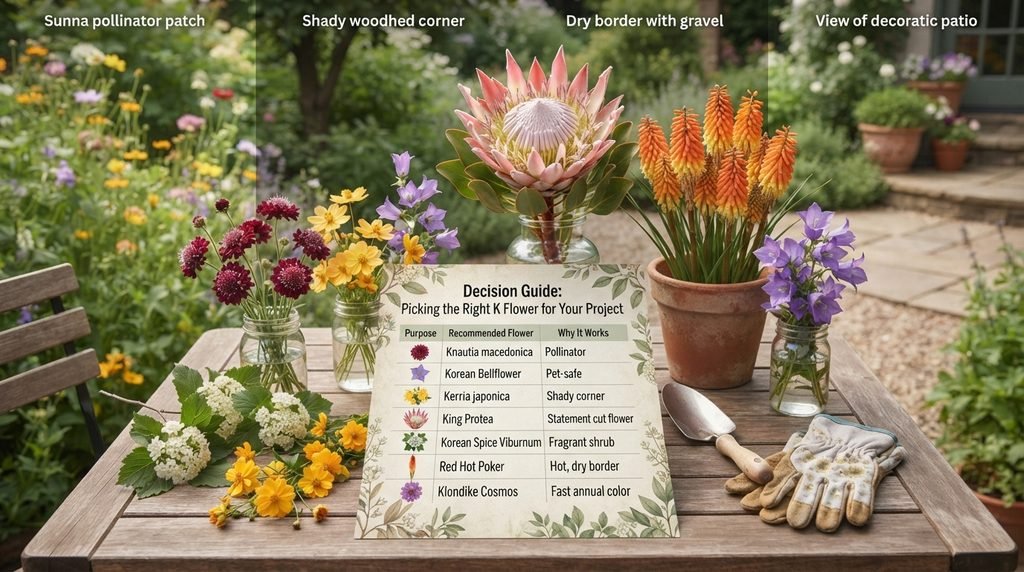
| Purpose | Recommended Flower | Why It Works |
| Pollinator garden | Knautia macedonica | Long bloom window, bees and butterflies favor it |
| Pet-safe houseplant alternative | Korean Bellflower | Non-toxic, easy in containers |
| Shady garden corner | Kerria japonica | Tolerates partial shade, still flowers well |
| Statement cut flower | King Protea | Large, dramatic, long vase life |
| Fragrant spring shrub | Korean Spice Viburnum | Powerful scent, reliable bloom |
| Hot, dry border | Red Hot Poker | Thrives in full sun and poor soil |
| Fast annual color | Klondike Cosmos | Blooms within weeks, easy from seed |
Treat this table as a starting point rather than a final answer. Korean Spice Viburnum, for example, needs a full growing season to establish before its fragrance becomes noticeable, so a gardener expecting an immediate scent payoff in year one may want to pair it with a faster-blooming annual like Klondike Cosmos in the meantime.
Conclusion
From the easy, everyday charm of Kalanchoe to the rare, shade-loving Kirengeshoma, flowers that start with K cover a genuinely wide range of gardens, budgets, and skill levels. Whether the goal is a pollinator-friendly border, a safe houseplant, or a single dramatic cut stem, the 50 verified entries above should answer most real questions, backed by botanical names and toxicity notes checked against more than one plant reference rather than a single guess.
Frequently Asked Questions
What are some popular flowers that start with K?
Kangaroo Paw, King Protea, Red Hot Poker, Kalanchoe, and Kerria are among the most recognized flowers that start with K, spanning houseplants, cut flowers, and garden shrubs. Each has a well-documented botanical name and clear growing requirements.
Are there 50 real flowers that start with K?
Yes, this guide covers 50 verified flowers and flowering plants whose common or botanical names start with K, each cross-checked for native origin and toxicity. Some sources list more names, but many of those refer to grasses or plants grown for reasons other than their flowers.
Is Kalanchoe safe for cats and dogs?
No, Kalanchoe contains cardiac glycosides in all its parts, which makes it toxic to cats and dogs if chewed or eaten. It should be kept out of reach in any home with curious pets.
What is the botanical name for Kangaroo Paw?
The most common Kangaroo Paw species is Anigozanthos flavidus, though the genus Anigozanthos includes several related species and many hybrid cultivars. All are native to southwestern Australia.
Is Mountain Laurel poisonous?
Yes, every part of Mountain Laurel (Kalmia latifolia) contains grayanotoxins, which are toxic to humans, pets, and livestock if eaten. It should be planted away from grazing animals and small children.
What flower is called Kingcup?
Kingcup is a common nickname for Marsh Marigold, botanically known as Caltha palustris. It is one of the earliest wetland flowers to bloom each spring.
What is King Protea, and why is it famous?
King Protea (Protea cynaroides) is South Africa’s national flower and the largest flower in the Protea genus. Its bold central bloom and long vase life have made it a favorite in high-end floral arrangements.