50+ Beautiful Flowers That Start With E: Names, Photos & Growing Tips
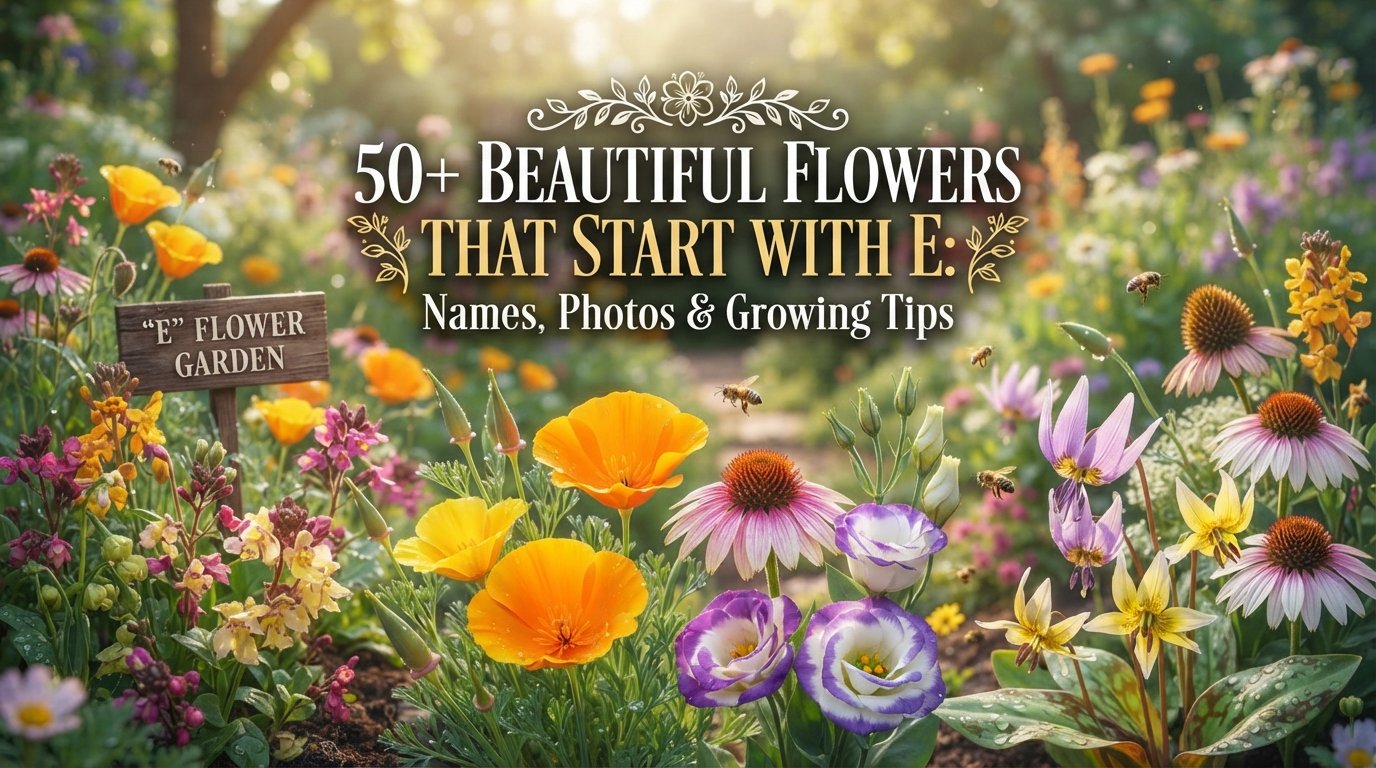
Anyone browsing flowers that start with E quickly discovers this is one of the more generous letters in the alphabet for plant names, second only to a handful of others in sheer variety. From the alpine slopes where edelweiss clings to rocky outcrops, to the cottage borders where English lavender and English roses have been staples for centuries, to the tropical greenhouses that keep Eucharis and Exacum blooming year-round, this letter spans nearly every growing environment a gardener might work with. That range is exactly what makes a single, well-organized list genuinely useful rather than just a curiosity.
This guide covers more than fifty flowers that start with E, verified individually for botanical name, native origin, and toxicity rather than compiled from a single source and lightly edited. Each entry earns its place because the flower itself is the primary reason people grow the plant, not because it happens to share a genus with something more famous. A few borderline cases, like foliage plants with only minor blooms, were deliberately left off this list for that same reason.
Quick Answer: The Standout E Flowers
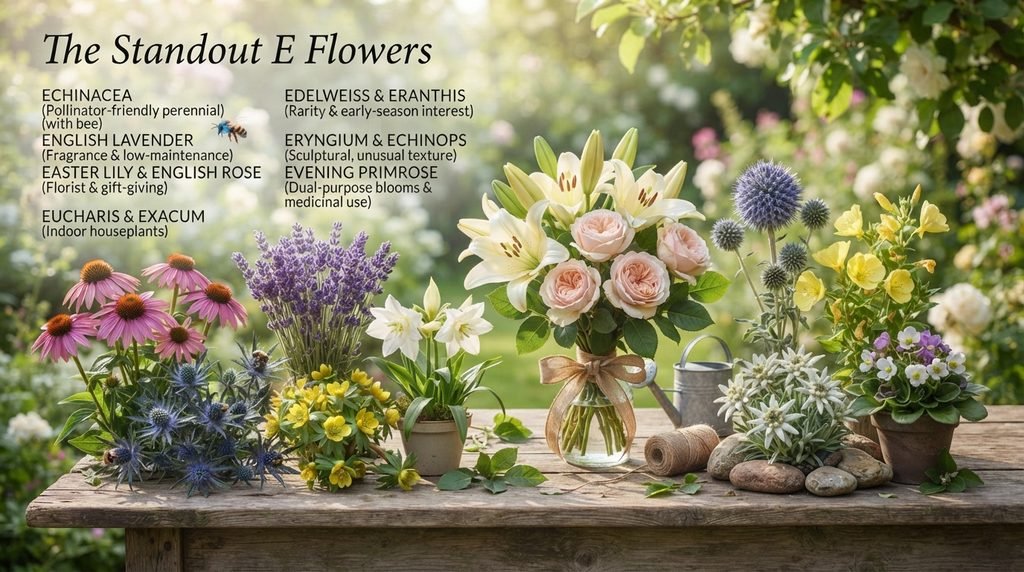
For readers short on time, a handful of entries on this list consistently rise to the top for different reasons. Echinacea earns its reputation as the most reliable pollinator-friendly perennial here, while English lavender remains the go-to choice for fragrance and low-maintenance borders. Easter lily and English rose dominate the florist and gift-giving side of this list, and Eucharis and Exacum cover the indoor houseplant niche for gardeners without outdoor space. Edelweiss and Eranthis bring genuine rarity and early-season interest, respectively, while Eryngium and Echinops add sculptural, unusual texture that few other letters offer in the same way. Evening primrose rounds out the group as one of the few genuinely useful dual-purpose flowers on this list, valued for both its blooms and its traditional medicinal use.
What These Flowers Are Said to Represent
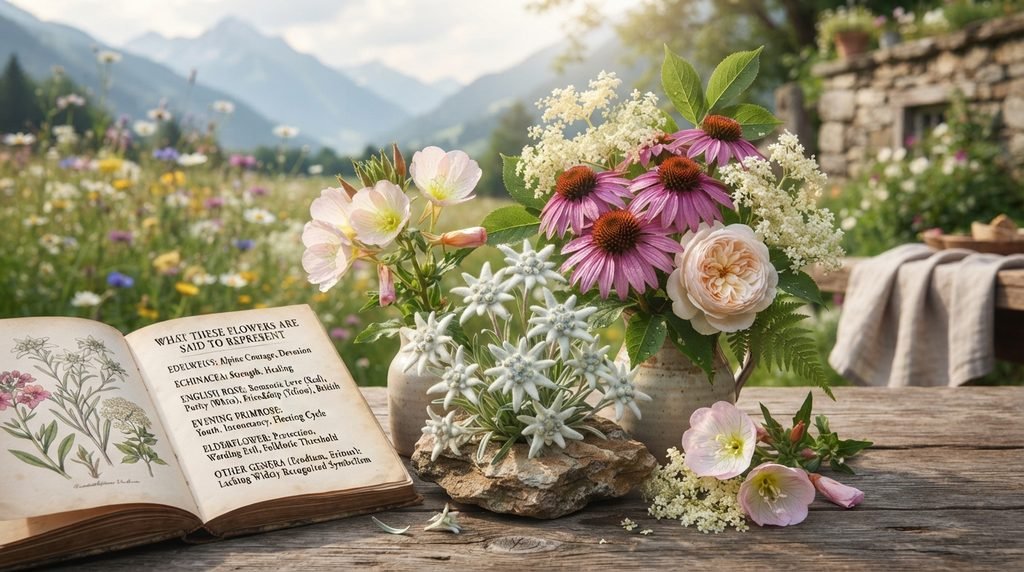
Symbolism across this letter varies enormously depending on the flower’s cultural history and how long it’s been cultivated. Echinacea, long used in traditional medicine before it became a garden staple, carries a modern symbolic association with strength and healing, a meaning that grew directly out of its practical use rather than any older flower-language tradition. Edelweiss carries perhaps the richest symbolism on this entire list, tied closely to alpine courage and devotion in Central European folklore, since the flower traditionally grew in difficult-to-reach mountain terrain that only the most determined admirers would climb to retrieve.
English rose symbolism largely mirrors general rose tradition, with color driving the specific meaning — red for romantic love, white for purity, yellow for friendship — though the “English rose” framing itself has also become a cultural shorthand for classic, understated beauty in British usage specifically. Evening primrose carries a gentler, quieter symbolism tied to youth and inconstancy, likely rooted in the fact that its flowers open in the evening and fade again by the following afternoon, a fleeting cycle that older flower-language traditions found poetic. Elderflower holds a distinct place in European folklore as a protective plant, historically associated with warding off evil and marking the threshold between the mundane and the magical in older British and Scandinavian traditions.
Sorting These Flowers by Color
White-flowering entries on this list lean toward elegance and simplicity, led by edelweiss’s fuzzy star-shaped bloom, English daisy’s classic yellow-centered white petals, and Eucharis’s fragrant, trumpet-shaped blooms that have made it a favorite in bridal bouquets. Easter lily and elderflower round out this group, both carrying strong cultural associations with purity and springtime renewal that pair naturally with their pale coloring.
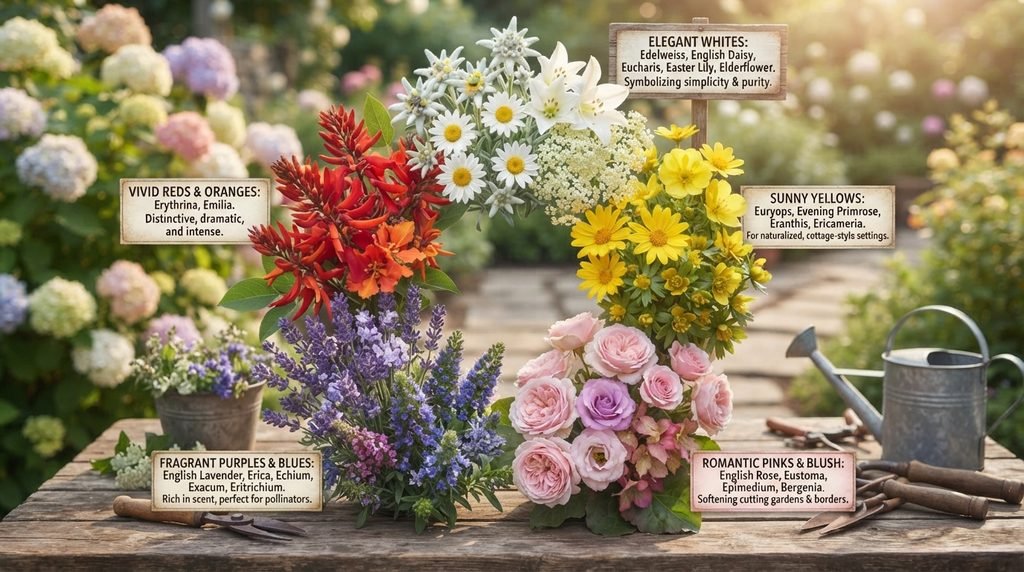
Yellow tones show up across a genuinely wide range of growing habits on this list, from Euryops and evening primrose in the garden bed to Eranthis pushing through late-winter snow and Ericameria closing out the wildflower season in autumn.
Pink appears prominently in English rose, Eustoma, and Epimedium, offering a softer, more romantic palette that suits cutting gardens and border edges alike, while Elephant’s ears (Bergenia) contributes an earlier, cooler-toned pink that bridges the gap between winter and spring.
Garden Favorites: Reliable Performers for Beds and Borders
Most home gardeners working through this letter will end up leaning on a core group of dependable border plants rather than the rarer specialty entries. Echinacea anchors this group as a genuinely low-maintenance perennial that tolerates drought, poor soil, and a wide range of climates while still drawing in bees and butterflies for months at a stretch.
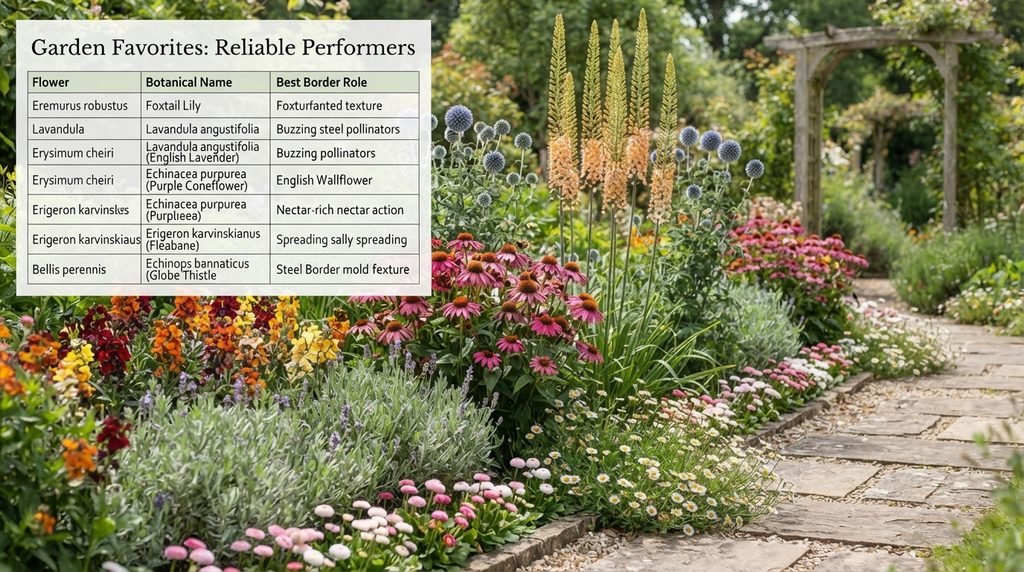
Eremurus, or foxtail lily, brings a completely different scale to a border, sending up dramatic flower spikes that can reach several feet tall from a modest rosette of strappy leaves, making it a striking vertical accent among lower-growing neighbors.
| Flower | Botanical Name | Best Border Role |
| Echinacea | Echinacea purpurea | Pollinator anchor, drought-tolerant mid-border |
| English Lavender | Lavandula angustifolia | Fragrant edging, dry sunny beds |
| English Daisy | Bellis perennis | Cool-season edging, lawn alternative |
| Eremurus | Eremurus robustus | Dramatic vertical accent |
| Erysimum (English Wallflower) | Erysimum cheiri | Early-season color, fragrance |
| Echinops (Globe Thistle) | Echinops bannaticus | Sculptural texture, cut flower |
| Erigeron (Fleabane) | Erigeron karvinskianus | Low, spreading edging and gaps in paving |
Echinops deserves particular attention within this group for its genuinely unusual look — a perfectly round, spiky steel-blue globe unlike almost anything else in a typical border — while Erigeron’s willingness to self-seed into cracks and gravel makes it one of the few plants on this list equally at home in a formal bed or an informal, weathered stone pathway.
Indoor Plants: E Flowers for Pots and Windowsills
A smaller subset of this list thrives specifically indoors, where controlled temperature and humidity make up for growing conditions that would be difficult to replicate outdoors in most climates. Eucharis, the Amazon lily, is the standout here, producing clusters of fragrant white blooms above glossy, dark green foliage, provided it gets bright indirect light and consistent warmth year-round.
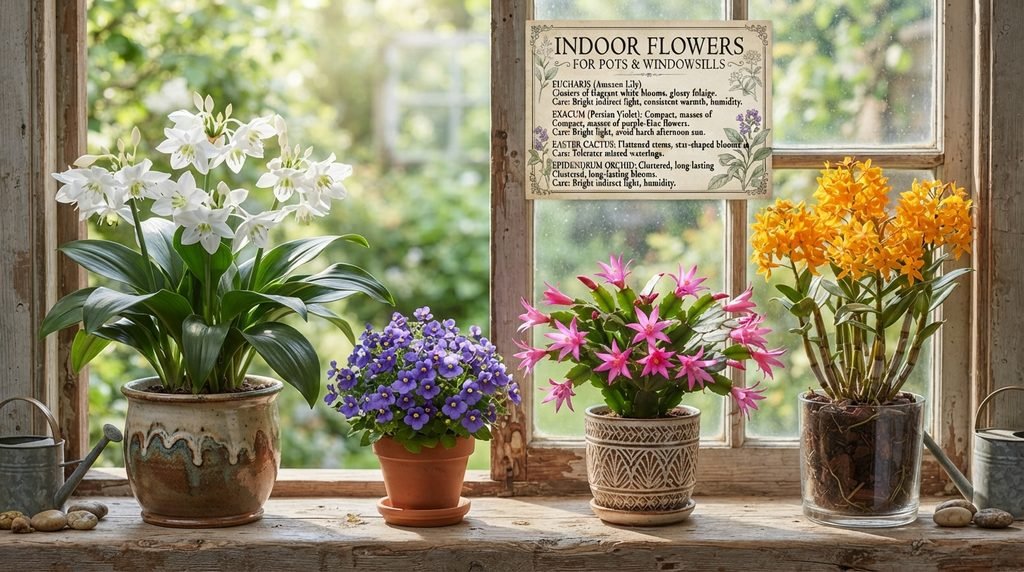
Easter cactus rounds out this indoor group with an unusual growth habit, producing star-shaped blooms in spring from flattened, segmented stems that store water efficiently, making it more forgiving of occasional missed waterings than either Eucharis or Exacum.
- Eucharis (Amazon Lily) — bright indirect light, consistent warmth and humidity
- Exacum (Persian Violet) — bright light, avoid harsh direct afternoon sun
- Easter Cactus — tolerates occasional missed watering, blooms in spring
- Epidendrum Orchid — bright indirect light, consistent humidity
Eucharis and Exacum both reward consistency over intensity of care, meaning a steady, moderate routine produces better results than infrequent heavy attention, while Easter cactus is genuinely the most forgiving of the group for anyone new to flowering houseplants specifically.
Florist Favorites: E Flowers Built for Cutting and Arranging
Cut-flower performance depends on more than just an attractive bloom — vase life, stem strength, and how well a flower holds its color after cutting all matter to florists and home arrangers alike. Eustoma, better known commercially as lisianthus, consistently ranks among the longest-lasting cut flowers available, often holding its rose-like blooms for one to two weeks in a vase, which explains its heavy use in wedding work despite a relatively high price point.
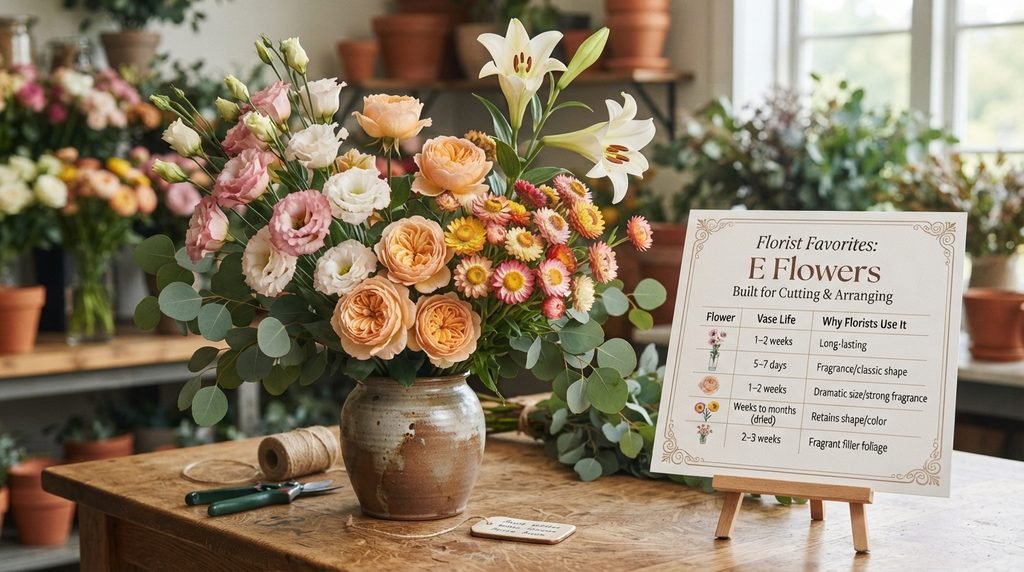
Easter lily brings dramatic size and an intense fragrance to arrangements, though its pollen can stain fabric and its scent may be overwhelming in a small, enclosed room. Everlasting flower, commonly sold as strawflower, takes a different approach entirely, retaining its shape and color even after drying completely, which makes it a favorite for dried arrangements and wreaths that need to last far longer than a fresh bouquet ever could. Eucalyptus, grown as much for its foliage and fragrance as for its fluffy, understated flowers, has become a near-universal filler in modern floral design.
| Flower | Vase Life | Why Florists Use It |
| Eustoma (Lisianthus) | 1–2 weeks | Long-lasting, rose-like form |
| English Rose | 5–7 days | Fragrance and classic shape |
| Easter Lily | 1–2 weeks | Dramatic size, strong fragrance |
| Everlasting Flower (Strawflower) | Weeks to months (dried) | Holds shape and color after drying |
| Eucalyptus | 2–3 weeks | Fragrant filler foliage |
Everlasting flower stands apart from every other entry in this table simply because it isn’t competing on fresh vase life at all — its entire value proposition is surviving well past the point where a typical cut flower would already be discarded.
Rare Flowers: The Harder-to-Find Entries on This List
A handful of E flowers are genuinely uncommon, either because they’re difficult to cultivate outside a narrow native range or because they’ve simply never entered mainstream horticultural trade in a significant way. Edelweiss is protected in parts of its native Alpine range due to overharvesting pressure in the past, and while cultivated seed is available for home gardens, the wild plant itself is a legally protected species in several European countries.
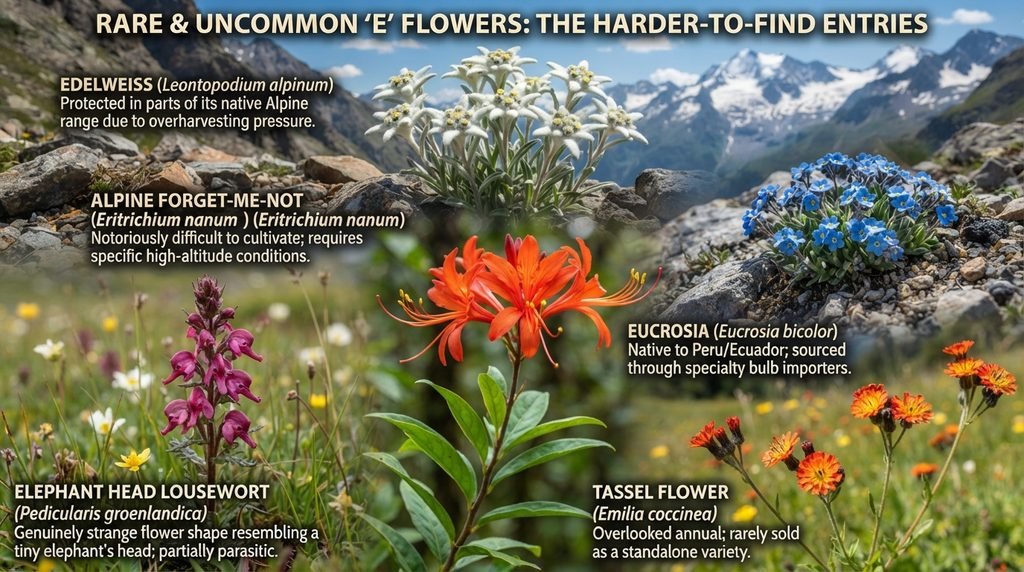
Eucrosia, a bulb native to Peru and Ecuador, rarely appears at general nurseries and is typically sourced through specialty bulb importers rather than big-box garden centers. Elephant head lousewort earns its place on this list for its genuinely strange flower shape, which resembles a tiny elephant’s head and trunk in miniature, though as a partially parasitic wildflower tied to specific host plants, it’s essentially impossible to cultivate in a typical home garden setting.
Caution: E Flowers That Need Careful Placement
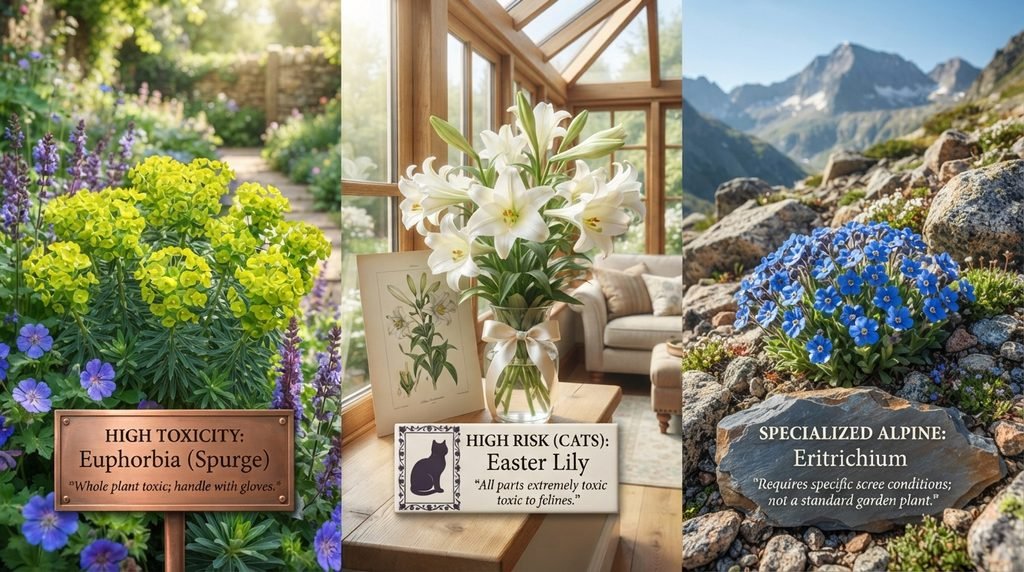
Toxicity risk on this list ranges from serious to negligible, and it’s worth being specific about which entries actually warrant caution around pets and children rather than treating the whole list with blanket suspicion. Euphorbia carries the most consistent warning across horticultural sources, since its milky sap is a genuine skin and eye irritant and can cause more serious digestive symptoms if ingested, making gloves a sensible precaution when pruning or dividing any Euphorbia species.
English bluebell’s bulb carries a moderate toxicity risk similar to other spring bulbs in the same broader plant family, generally causing digestive upset rather than anything life-threatening if chewed or ingested.
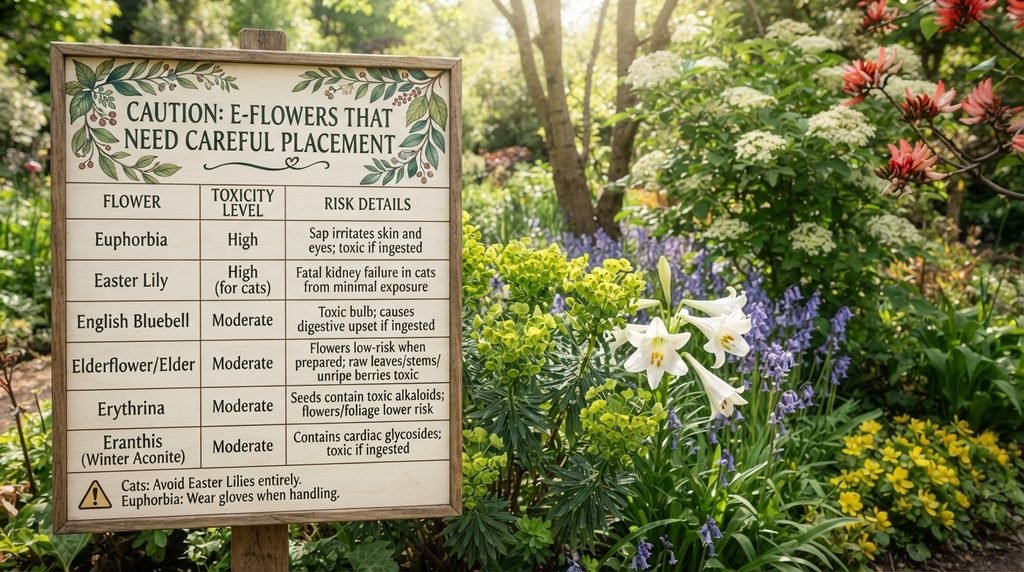
| Flower | Toxicity Level | Risk Details |
| Euphorbia | High | Sap irritates skin and eyes; toxic if ingested |
| Easter Lily | High (for cats) | Can cause fatal kidney failure in cats from minimal exposure |
| English Bluebell | Moderate | Toxic bulb; causes digestive upset if ingested |
| Elderflower/Elder | Moderate | Flowers are low-risk when prepared; raw leaves, stems, and unripe berries are toxic |
| Erythrina | Moderate | Seeds contain toxic alkaloids; flowers and foliage lower risk |
| Eranthis (Winter Aconite) | Moderate | Contains cardiac glycosides; toxic if ingested |
Households with cats should treat Easter lily as a firm no rather than a “keep it out of reach” situation, while Euphorbia is best handled with gloves by anyone regardless of pets, simply because its sap can irritate skin on contact even without ingestion.
Choosing by Life Cycle: Annuals, Perennials, Bulbs, and Beyond
Life cycle matters as much as color or size when planning a bed, since an annual that needs replanting every year serves a very different role than a shrub or tree that becomes a permanent fixture. Perennials dominate this letter by a wide margin, offering repeat blooms year after year with generally less replanting effort, which explains why so many of the garden-favorite entries discussed earlier fall into this category.
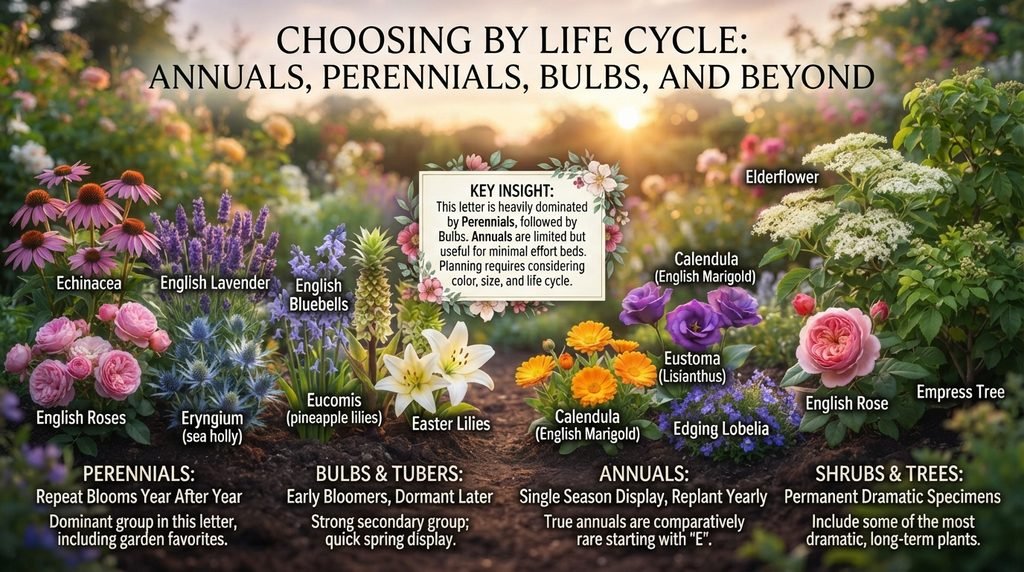
Bulbs and tubers form the next largest group, including several early-spring bloomers that finish their above-ground display quickly before going dormant for most of the year.
| Flower | Life Cycle |
| Echinacea | Perennial |
| Edelweiss | Perennial |
| Elderflower | Shrub/small tree |
| English Lavender | Perennial shrub |
| English Daisy | Perennial (often grown as biennial) |
| English Rose | Perennial shrub |
| Erica | Perennial shrub |
| Eremurus | Perennial (tuberous root) |
| Eryngium | Perennial |
| Eucharis | Bulb |
| Euphorbia | Perennial (varies by species) |
| Evening Primrose | Biennial |
| Egyptian Star Flower | Perennial (grown as annual in cold climates) |
| English Bluebell | Bulb |
| English Marigold (Calendula) | Annual |
| Epidendrum Orchid | Perennial (epiphytic) |
| Epimedium | Perennial |
| Eucomis | Bulb |
| Euryops | Perennial shrub |
| Eustoma (Lisianthus) | Annual (tender perennial) |
| Exacum | Annual (grown as houseplant) |
| Echium | Biennial or perennial (species-dependent) |
| Edging Lobelia | Annual |
| Empress Tree | Tree |
| Erysimum (English Wallflower) | Perennial (often grown as biennial) |
| Easter Lily | Bulb |
| Easter Cactus | Perennial (succulent) |
| Elephant Head Lousewort | Perennial |
| Emu Bush | Perennial shrub |
| English Primrose | Perennial |
| Everlasting Flower | Annual |
| Eranthis | Bulb (tuber) |
| Erigeron | Perennial |
| Erinus | Perennial |
| Eranthemum | Perennial shrub |
| Erythronium | Bulb |
| Erodium | Perennial |
| Echinops | Perennial |
| Ericameria | Perennial shrub |
| Erythrina | Tree/shrub |
| Eutrochium | Perennial |
| Eucalyptus | Tree |
| Eucryphia | Tree |
| Elsholtzia | Perennial |
| Eritrichium | Perennial (alpine) |
| Eugenia | Shrub/tree |
| Eucrosia | Bulb |
| English Iris | Bulb |
| Elephant’s Ears (Bergenia) | Perennial |
| Emilia | Annual |
This table makes clear just how perennial-heavy this letter really is, with bulbs forming a strong secondary group and true annuals limited mostly to Calendula, Eustoma, Edging Lobelia, Everlasting flower, and Emilia — worth remembering for anyone specifically planning a bed around minimal replanting effort.
The Master List: Every Flower on This Guide, A to Z
Some of the flowers below are best known and searched for under their common English name, particularly the “English,” “Easter,” and “Egyptian” prefixed entries, while others are almost always sold and referred to by their botanical genus name directly, since no separate common name ever caught on widely.
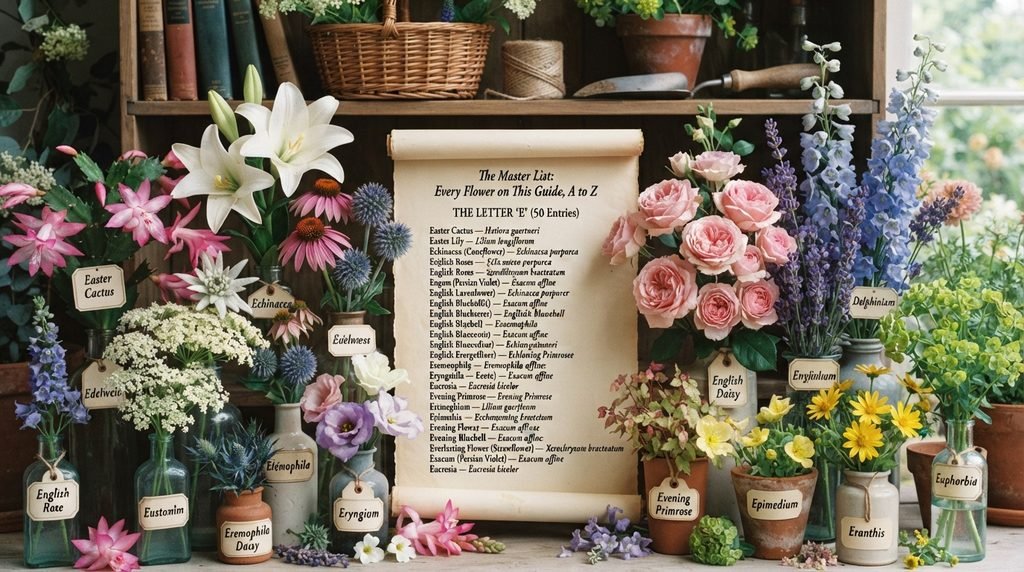
The list below reflects that natural split rather than forcing every entry into an English common name that gardeners wouldn’t actually use at a nursery.
- Easter Cactus — Hatiora gaertneri
- Easter Lily — Lilium longiflorum
- Echinacea (Coneflower) — Echinacea purpurea
- Echinops (Globe Thistle) — Echinops bannaticus
- Echium (Pride of Madeira) — Echium candicans
- Edelweiss — Leontopodium alpinum
- Edging Lobelia — Lobelia erinus
- Egyptian Star Flower — Pentas lanceolata
- Elder / Elderflower — Sambucus nigra
- Elephant Head Lousewort — Pedicularis groenlandica
- Elephant’s Ears — Bergenia crassifolia
- Elsholtzia — Elsholtzia ciliata
- Emilia (Tassel Flower) — Emilia coccinea
- Empress Tree — Paulownia tomentosa
- Emu Bush — Eremophila glabra
- English Bluebell — Hyacinthoides non-scripta
- English Daisy — Bellis perennis
- English Iris — Iris latifolia
- English Lavender — Lavandula angustifolia
- English Marigold (Calendula) — Calendula officinalis
- English Primrose — Primula vulgaris
- English Rose — Rosa (David Austin hybrids)
- English Wallflower — Erysimum cheiri
- Epidendrum Orchid — Epidendrum radicans
- Epimedium (Barrenwort) — Epimedium grandiflorum
- Eranthemum — Eranthemum pulchellum
- Eranthis (Winter Aconite) — Eranthis hyemalis
- Erica (Heath) — Erica carnea
- Erigeron (Fleabane) — Erigeron karvinskianus
- Erinus (Fairy Foxglove) — Erinus alpinus
- Eritrichium (Alpine Forget-Me-Not) — Eritrichium nanum
- Erodium (Storksbill) — Erodium reichardii
- Eryngium (Sea Holly) — Eryngium planum
- Erythrina (Coral Tree) — Erythrina crista-galli
- Erythronium (Trout Lily) — Erythronium americanum
- Eucalyptus (Flowering Gum) — Eucalyptus ficifolia
- Eucharis (Amazon Lily) — Eucharis amazonica
- Eucomis (Pineapple Lily) — Eucomis comosa
- Eucryphia — Eucryphia glutinosa
- Eugenia — Eugenia uniflora
- Euphorbia — Euphorbia characias
- Euryops (Golden Daisy Bush) — Euryops pectinatus
- Eustoma (Lisianthus) — Eustoma grandiflorum
- Eutrochium (Joe Pye Weed) — Eutrochium purpureum
- Evening Primrose — Oenothera biennis
- Everlasting Flower (Strawflower) — Xerochrysum bracteatum
- Exacum (Persian Violet) — Exacum affine
- Ericameria (Rabbitbrush) — Ericameria nauseosa
- Eucrosia — Eucrosia bicolor
That’s a full fifty entries, spanning garden perennials, bulbs, shrubs, trees, and a handful of genuinely rare specialty plants, which reflects just how much depth this particular letter offers compared to some of the sparser ones elsewhere in the alphabet.
Why Botanical Names Matter for This Letter
Searching by common name alone can cause real confusion with this letter specifically, since several E flowers share common name elements — “English,” “Easter,” and “Egyptian” all prefix multiple, entirely unrelated plants — while a large number of others are never sold under an English common name at all. Knowing the botanical name isn’t just academic precision here; it’s often the only reliable way to make sure a nursery order or online search returns the actual plant intended, rather than a similarly named but botanically unrelated substitute.
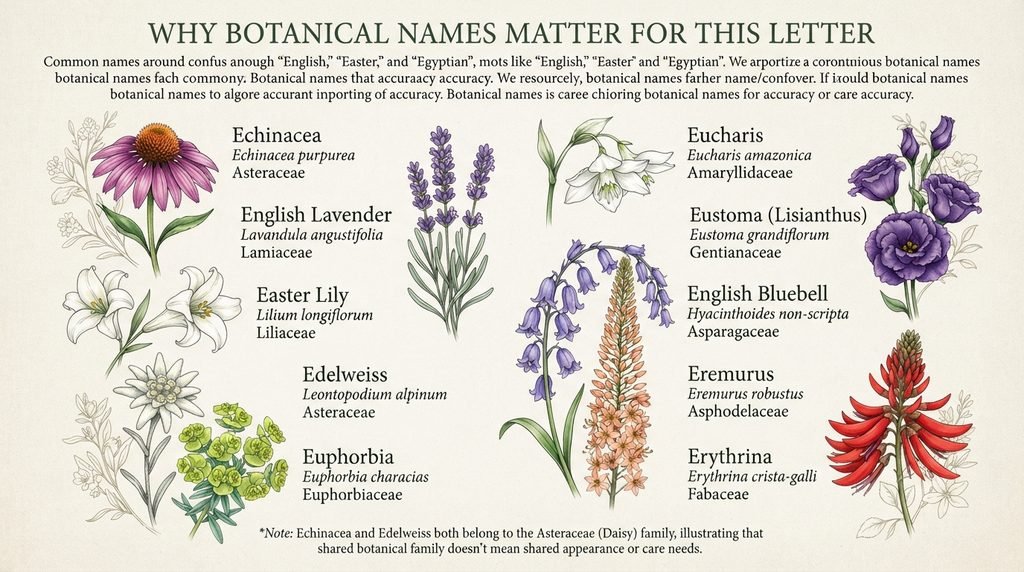
| Common Name | Botanical Name | Plant Family |
| Echinacea | Echinacea purpurea | Asteraceae |
| English Lavender | Lavandula angustifolia | Lamiaceae |
| Easter Lily | Lilium longiflorum | Liliaceae |
| Edelweiss | Leontopodium alpinum | Asteraceae |
| Euphorbia | Euphorbia characias | Euphorbiaceae |
| Eucharis | Eucharis amazonica | Amaryllidaceae |
| Eustoma (Lisianthus) | Eustoma grandiflorum | Gentianaceae |
| English Bluebell | Hyacinthoides non-scripta | Asparagaceae |
| Eremurus | Eremurus robustus | Asphodelaceae |
| Erythrina | Erythrina crista-galli | Fabaceae |
The Asteraceae family shows up twice in this short sample alone, a reminder that shared botanical family doesn’t mean shared appearance or care needs — Echinacea and edelweiss look nothing alike despite both belonging to the daisy family, which is exactly the kind of mix-up a botanical name search helps avoid.
Full Comparison Table: Bloom Time, Sun, and Safety at a Glance
The table below pulls together bloom season, sun requirements, toxicity level, and primary use for every flower covered in this guide, making it easier to scan for a specific combination of traits — a spring-blooming, full-sun, pet-safe option, for instance — without paging back through each individual section.
Toxicity levels here reflect the same research covered in the caution section above, restated in short form for quick reference alongside the other columns.
| Flower | Bloom Season | Sun | Toxicity | Primary Use |
| Echinacea | Summer–fall | Full sun | Low | Garden, pollinator |
| Edelweiss | Summer | Full sun | Non-toxic | Alpine/rock garden |
| Elderflower | Late spring | Full sun–part shade | Moderate (non-flower parts) | Garden, culinary |
| English Lavender | Summer | Full sun | Low | Garden, fragrance |
| English Daisy | Spring–fall | Full sun–part shade | Low | Edging, lawn alternative |
| English Rose | Spring–fall | Full sun | Non-toxic | Cut flower, garden |
| Erica | Winter–spring | Full sun | Non-toxic | Garden, groundcover |
| Eremurus | Early summer | Full sun | Low | Border accent |
| Eryngium | Summer | Full sun | Non-toxic | Cut flower, texture |
| Eucharis | Year-round (indoor) | Bright indirect | Moderate | Houseplant, cut flower |
| Euphorbia | Spring–summer | Full sun | High | Structural garden plant |
| Evening Primrose | Summer | Full sun | Non-toxic | Wildflower, medicinal |
| Egyptian Star Flower | Summer–fall | Full sun | Non-toxic | Garden, pollinator |
| English Bluebell | Spring | Partial shade | Moderate | Woodland garden |
| English Marigold (Calendula) | Spring–fall | Full sun | Non-toxic | Garden, edible |
| Epidendrum Orchid | Varies | Bright indirect | Non-toxic | Indoor/greenhouse |
| Epimedium | Spring | Partial shade | Non-toxic | Shade garden |
| Eucomis | Summer | Full sun | Mild | Border, cut flower |
| Euryops | Spring–fall | Full sun | Non-toxic | Garden shrub |
| Eustoma | Summer | Full sun | Non-toxic | Cut flower |
| Exacum | Summer | Bright indirect | Non-toxic | Houseplant |
| Echium | Spring–summer | Full sun | Mild | Pollinator garden |
| Edging Lobelia | Spring–fall | Full sun–part shade | Mild | Edging, containers |
| Empress Tree | Spring | Full sun | Non-toxic | Flowering shade tree |
| English Wallflower | Spring | Full sun | Mild | Border, fragrance |
| Easter Lily | Spring | Full sun–part shade | High (cats) | Cut flower, gift |
| Easter Cactus | Spring | Bright indirect | Non-toxic | Houseplant |
| Elephant Head Lousewort | Summer | Full sun–part shade | Non-toxic | Native wildflower |
| Emu Bush | Spring–summer | Full sun | Moderate (livestock) | Xeriscape garden |
| English Primrose | Spring | Partial shade | Low | Shade garden |
| Everlasting Flower | Summer | Full sun | Non-toxic | Dried arrangements |
| Eranthis | Late winter | Full sun–part shade | Moderate | Early bulb display |
| Erigeron | Spring–fall | Full sun | Non-toxic | Edging, gaps in paving |
| Erinus | Spring–summer | Full sun–part shade | Non-toxic | Rock garden |
| Eranthemum | Fall–winter | Partial shade | Non-toxic | Tropical garden |
| Erythronium | Spring | Partial shade | Non-toxic | Woodland garden |
| Erodium | Spring–summer | Full sun | Non-toxic | Rock garden |
| Echinops | Summer | Full sun | Non-toxic | Cut flower, texture |
| Ericameria | Fall | Full sun | Non-toxic (mild allergen) | Native/xeriscape garden |
| Erythrina | Summer | Full sun | Moderate (seeds) | Specimen tree |
| Eutrochium | Summer–fall | Full sun–part shade | Non-toxic | Pollinator garden |
| Eucalyptus | Varies | Full sun | Mild | Cut foliage, specimen tree |
| Eucryphia | Summer | Full sun–part shade | Non-toxic | Specimen tree |
| Elsholtzia | Late summer–fall | Full sun | Non-toxic | Border, pollinator |
| Eritrichium | Summer | Full sun | Non-toxic | Alpine garden |
| Eugenia | Spring–summer | Full sun | Non-toxic | Hedge, specimen shrub |
| Eucrosia | Spring | Bright indirect | Mild | Specialty bulb collection |
| English Iris | Early summer | Full sun | Mild | Cut flower, border |
| Elephant’s Ears (Bergenia) | Early spring | Full sun–part shade | Non-toxic | Groundcover, edging |
| Emilia | Summer | Full sun | Non-toxic | Wildflower, cut flower |
Decision Guide: Matching a Scenario to the Right E Flower
Sometimes the fastest way to choose a flower isn’t scanning a full list but starting from the actual problem that needs solving — a shaded corner, a household with a cat, a windowsill with strong afternoon light. The table below maps common gardening scenarios to the E flowers best suited to each one, based on the growing information already covered throughout this guide.
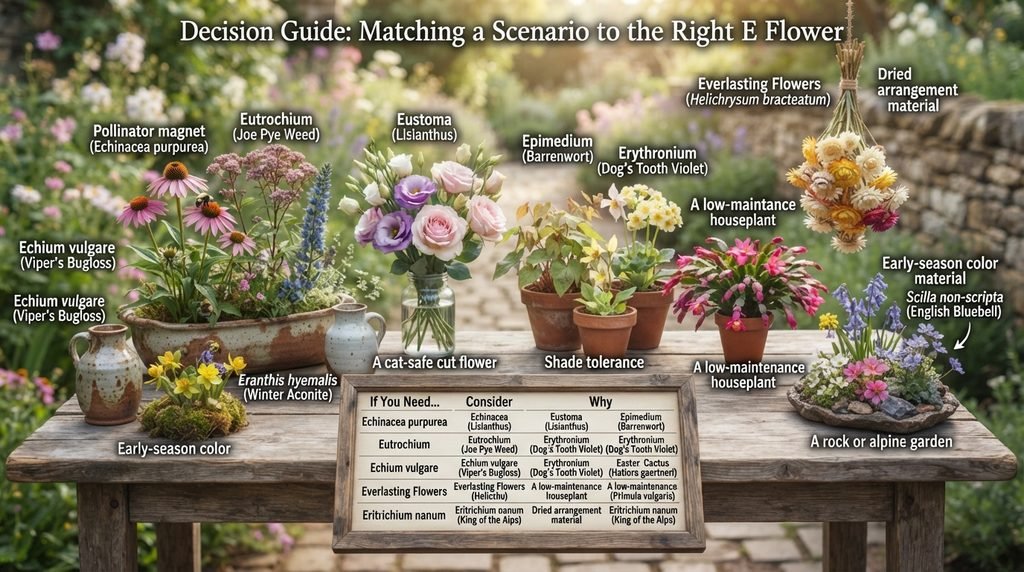
| If You Need… | Consider | Why |
| A pollinator magnet | Echinacea, Eutrochium, Echium | Long bloom windows, open flower structure bees and butterflies can access easily |
| A cat-safe cut flower | Eustoma, English Rose | No documented severe toxicity to cats, unlike true lilies |
| Shade tolerance | Epimedium, Erythronium, English Primrose | All three thrive in partial to full shade |
| A low-maintenance houseplant | Easter Cactus | Tolerates inconsistent watering better than Eucharis or Exacum |
| Dried arrangement material | Everlasting Flower | Holds color and shape indefinitely once dried |
| Early-season color | Eranthis, English Bluebell | Both bloom before most other perennials break dormancy |
| A rock or alpine garden | Erinus, Erodium, Eritrichium | All three are naturally suited to lean, fast-draining soil |
Conclusion
Flowers that start with E cover an unusually wide range of growing situations, from alpine specialists and tropical houseplants to some of the most dependable border perennials available in any letter of the alphabet. Choosing among them comes down to matching a specific flower to an actual spot, household, or use case — a cat-safe bouquet, a shaded woodland bed, a dried wreath — rather than working through the list purely in alphabetical order. With the category breakdowns, comparison table, and decision guide covered above, narrowing fifty-plus options down to the two or three that actually fit a given garden should take far less guesswork than starting from scratch.
Frequently Asked Questions
1. How many flowers that start with E are there?
This guide covers more than fifty verified flowers that start with E, ranging from common garden perennials to rare alpine and tropical specialty plants.
2. What is the easiest E flower to grow?
Echinacea is widely considered the easiest, tolerating poor soil, drought, and a wide range of climates while still blooming reliably for months.
3. Which E flowers are toxic to cats?
Easter lily is the most toxic to cats, capable of causing fatal kidney failure from even small amounts of pollen or petal exposure.
4. What does the flower edelweiss symbolize?
Edelweiss is traditionally associated with courage and devotion in Alpine folklore, largely because the flower historically grew in hard-to-reach mountain terrain.
5. Are English roses different from regular roses?
English roses, popularized by breeder David Austin, combine the classic form and strong fragrance of old garden roses with the repeat-blooming habit of modern hybrid varieties.
6. What E flowers work well indoors?
Eucharis, Exacum, and Easter cactus are the three most reliable options for indoor growing, each suited to bright indirect light.
7. Is Euphorbia safe to have in a garden with children?
It requires caution rather than outright avoidance; Euphorbia’s sap is a genuine skin and eye irritant, so gloves are recommended when handling or pruning it, and children should be taught not to touch the broken stems.
8. What’s the best E flower for cut arrangements?
Eustoma, commonly sold as lisianthus, offers one of the longest vase lives of any flower on this list, often lasting one to two weeks after cutting.
9. Can elderflower be eaten safely?
Yes, but only the flowers themselves once properly prepared; the plant’s leaves, stems, and unripe berries contain compounds that can cause digestive upset if eaten raw.
10. What are the rarest flowers that start with E?
Edelweiss, Eritrichium, and Eucrosia are among the rarest, either due to legal protection in the wild, genuinely difficult growing requirements, or limited commercial availability.
11. Do any E flowers bloom in winter?
Eranthis, or winter aconite, is one of the few, pushing through late winter snow to bloom before most other perennials have broken dormancy.
12. What’s the difference between English lavender and other lavender types?
English lavender (Lavandula angustifolia) is generally more cold-hardy and has a sweeter fragrance than French or Spanish lavender varieties, making it the more common choice for temperate garden climates.