Flowers That Start With S: 150+ Names, Meanings & Beautiful Photos
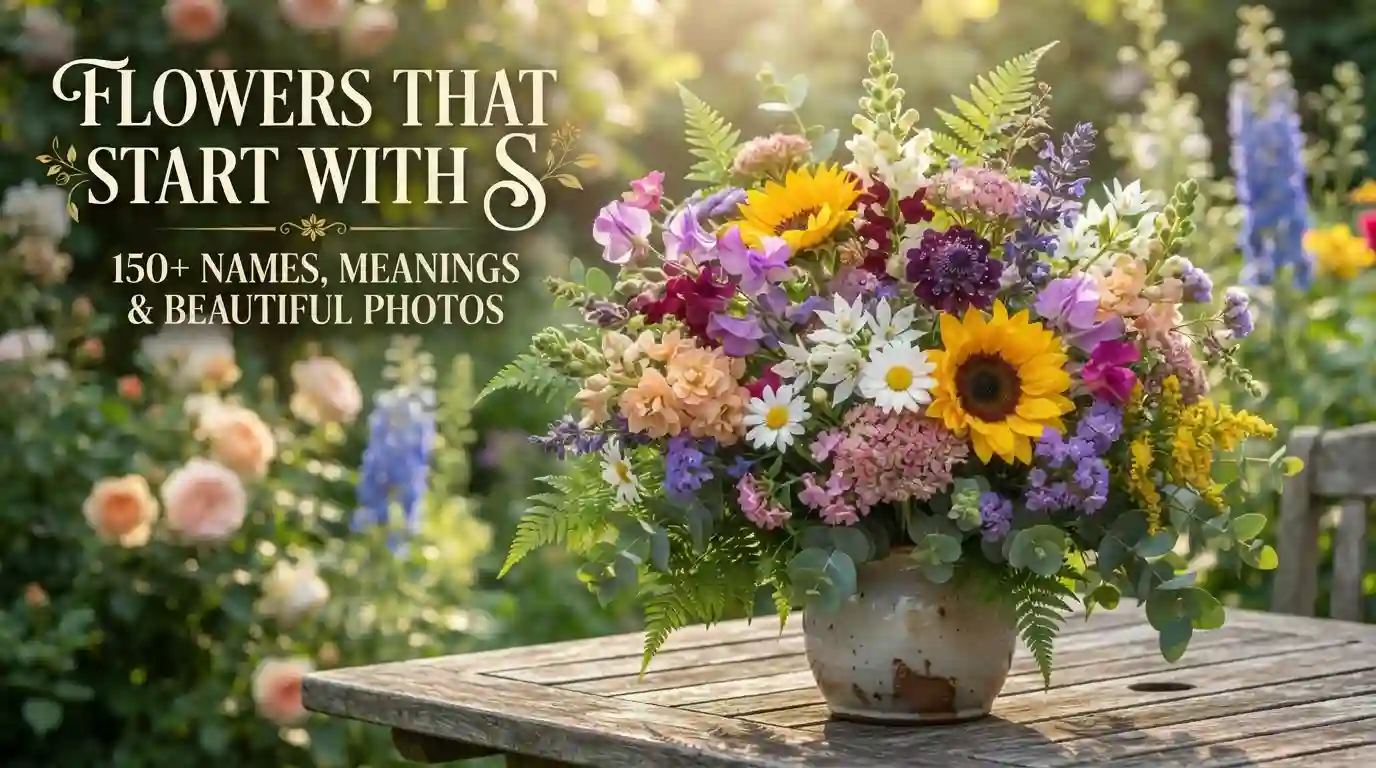
Flowers that start with S form one of the largest groups in the entire alphabet. Sunflower, snapdragon, and sweet pea are the names most people know first. But the letter S also hides quieter surprises, like sea holly, snake’s head fritillary, and stinking hellebore. This guide brings all of them together in one place.
The list below runs past 150 names. That number matters because most S flower guides stop at 30 or 40 entries and call it complete. This one goes further on purpose, covering garden staples, houseplants, florist picks, and rarer species that barely show up anywhere else online.
Names alone don’t help much without context, though. A flower’s beauty means less if it dies in your climate or turns out to be toxic to a family pet. So this guide groups flowers that start with S by color, life cycle, and use case, not just by letter. Tables are kept short and are always explained in plain sentences first, so nothing here reads like a spreadsheet dump.
By the end, you’ll have a full alphabetical reference, a botanical name crosswalk for nursery shopping, a toxicity chart, and a decision table for picking the right S flower for your specific situation.
Quick Answer: Ten Standout S Flowers
Sunflower is the obvious starting point, since its huge yellow face and easy care make it the most recognized flower on this entire list. Snapdragon earns its spot for its long bloom window and its dragon-mouth petals that snap open when gently squeezed, a detail kids love.
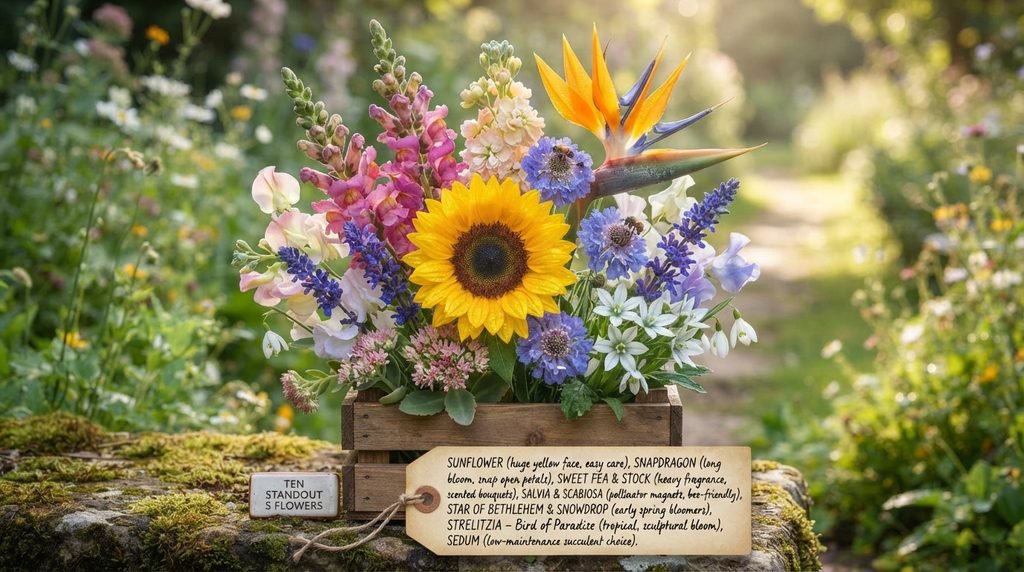
Salvia and scabiosa are pollinator magnets, drawing bees and butterflies for months at a stretch. Strelitzia, better known as bird of paradise, is the dramatic pick for anyone wanting a tropical, sculptural bloom indoors. Sedum closes the list as the low-maintenance succulent choice, thriving on neglect where most flowers would sulk.
What S Flowers Mean
Flower symbolism rarely has one fixed answer, but a handful of S flowers carry meanings consistent enough across cultures to be worth knowing. Sunflower is almost universally tied to loyalty and adoration, a meaning traced back to the myth of a nymph who turned to follow the sun across the sky. Snapdragon carries a more mixed reputation: in Victorian flower language, it represented deception or grace, depending on how the bloom was presented, since its shape was thought to hide a face when the petals were pinched shut.
Sweet pea stands for blissful pleasure and thank-you gestures, which is why it still shows up in gift bouquets today. Snowdrop, often the very first bloom of the year, symbolizes hope and the passing of winter, a meaning that comes directly from its habit of pushing through late snow. Star of Bethlehem carries a more solemn note in old traditions, linked to purity and, in some readings, reconciliation after conflict.
S Flowers Grouped by Color
Yellow dominates this letter more than any other color, led by sunflower, sundrops, and sun rose, all of which share a cheerful, sun-facing habit that makes them natural choices for cutting gardens and pollinator beds. Snow crocus and spring crocus add a smaller-scale yellow to the earliest weeks of the gardening year, often blooming while frost is still possible.
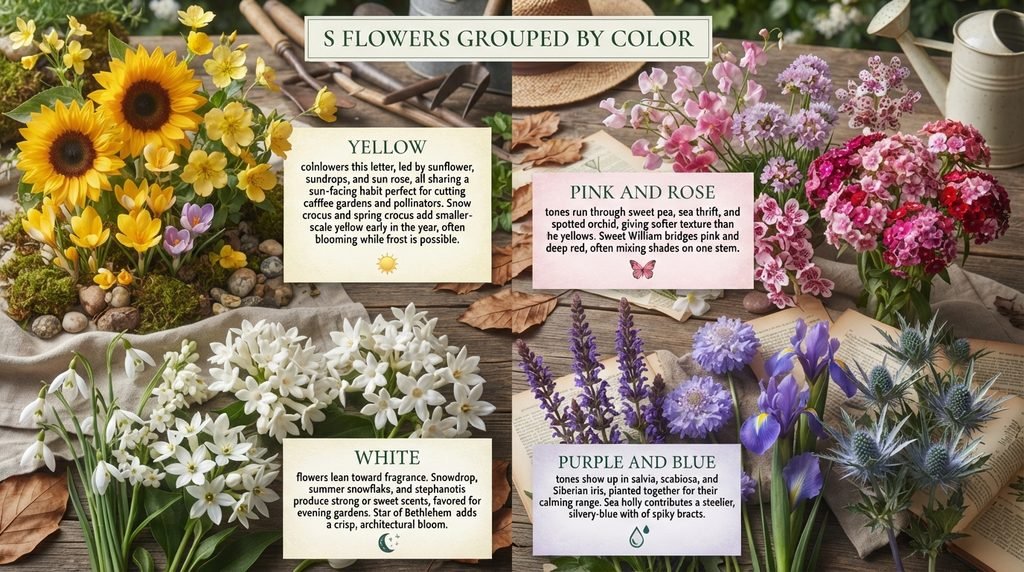
Pink and rose tones run through sweet pea, sea thrift, and spotted orchid, giving softer, more delicate texture than the bold yellows above. Sweet William usually bridges pink and deep red in a single flower head, since its clustered blooms often mix several shades on one stem.
White flowers that start with S lean toward fragrance as much as looks. Snowdrop, summer snowflake, and stephanotis all produce white blooms with a strong or sweet scent, which is part of why they’re favored for evening gardens and bridal work.
Sea holly contributes a steelier, silvery-blue that stands apart from the softer purples nearby, thanks to its spiky, almost metallic-looking bracts.
Garden Favorites Among Flowers That Start With S
Most home gardens lean on a small handful of reliable S flowers, and it’s worth naming a few by reputation before listing them out. Salvia holds its place as a garden favorite for a different reason: it blooms for months without much deadheading and rarely gets bothered by pests. Sedum earns its spot by doing the opposite of most flowers — thriving in poor, dry soil where richer beds would rot its roots.
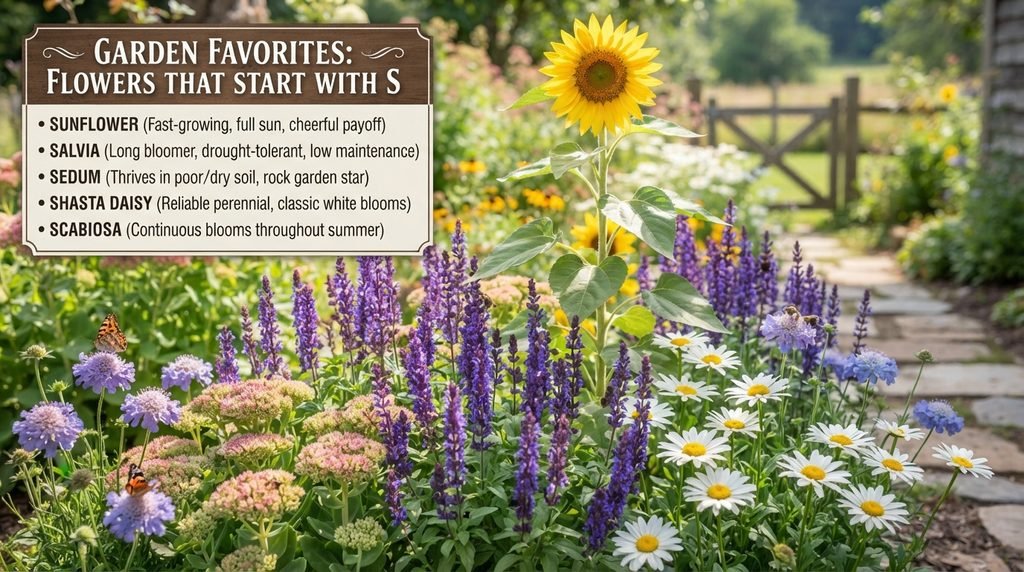
- Sunflower grows fast in full sun and needs little more than average soil and regular water.
- Salvia blooms from early summer into fall and tolerates dry spells better than most border perennials.
- Sedum handles neglect well and often looks its best in the driest, rockiest part of a yard.
- Shasta Daisy returns each year reliably and pairs naturally with taller summer perennials.
- Scabiosa keeps producing new blooms through summer as long as spent flowers are trimmed off.
Anyone building a low-maintenance perennial bed could realistically build the whole thing around these five names alone.
Indoor Plants Among Flowers That Start With S
Strelitzia, commonly sold as bird of paradise, is the standout here, tolerating bright indoor light and rewarding patience with a dramatic orange-and-blue bloom once mature. Streptocarpus is a gentler indoor option, producing repeated flushes of trumpet-shaped blooms under the same conditions African violets enjoy.
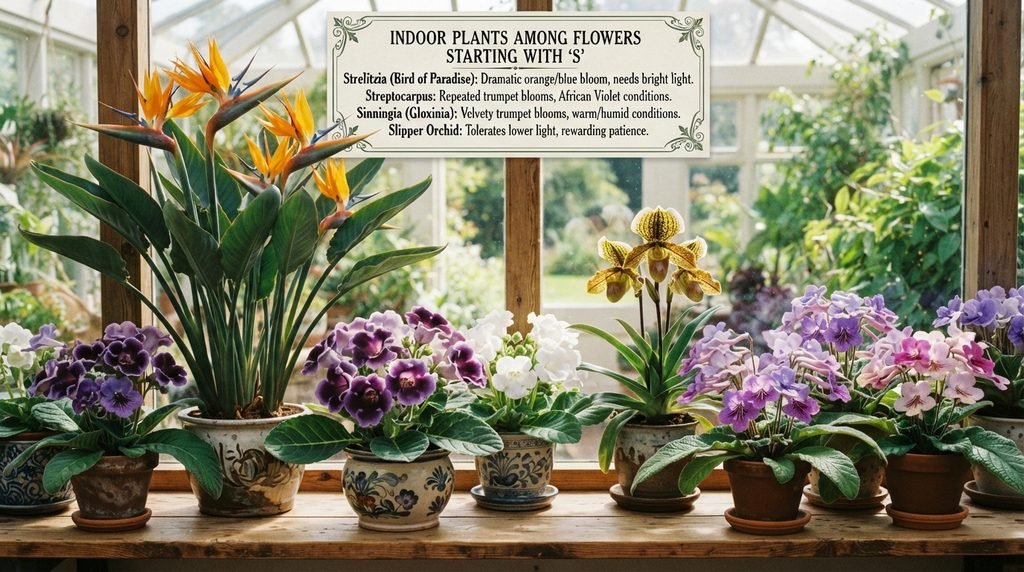
- Strelitzia (Bird of Paradise) needs bright, indirect light and can take several years to bloom from a young plant.
- Streptocarpus flowers repeatedly indoors with consistent light and light, regular watering.
- Sinningia (Gloxinia) produces velvety, trumpet-shaped blooms and prefers warm, humid indoor conditions.
- Slipper Orchid tolerates lower indoor light than most orchids, making it more forgiving for beginners.
Sinningia and slipper orchid both suit gardeners who want something a bit more unusual than the typical houseplant lineup, though slipper orchid in particular rewards patience over quick results.
Florist Favorites Among Flowers That Start With S
Cut-flower work favors S blooms with strong stems, long vase life, or standout fragrance. Sweet pea is prized above almost everything else on this list for its scent alone, even though its vase life is shorter than sturdier florist flowers.
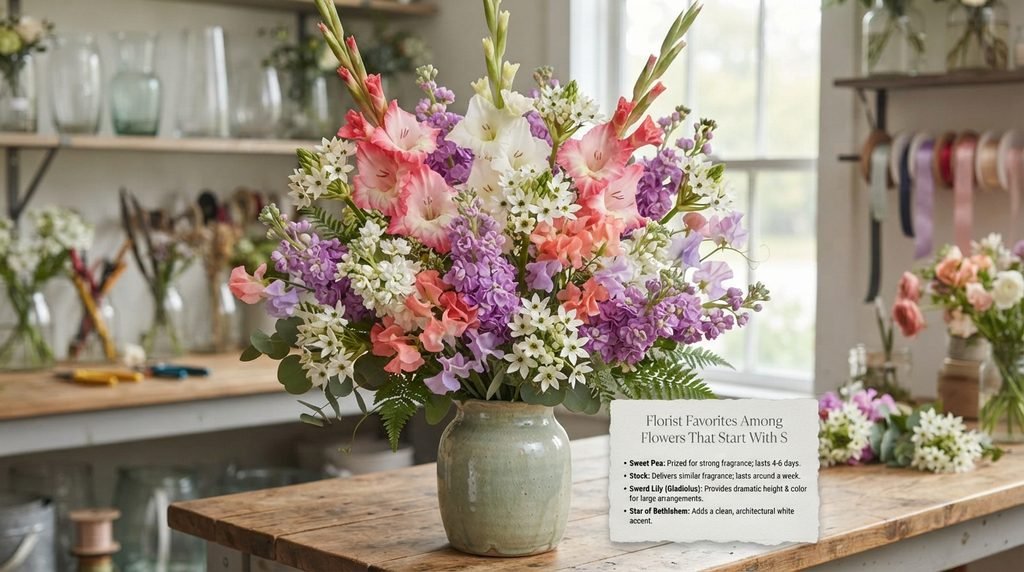
- Sweet Pea brings strong fragrance but typically lasts only four to six days in a vase.
- Stock holds its scent and shape for around a week, longer than sweet pea.
- Sword Lily (Gladiolus) provides dramatic height and color for large arrangements.
- Star of Bethlehem adds a clean, architectural white accent to mixed bouquets.
Sword lily is the go-to choice whenever a florist needs height and drama in a large arrangement.
Rare Flowers That Start With S
A few S flowers rarely show up outside specialty growers or native plant nurseries. Snake’s head fritillary is one of the more unusual entries here, its checkered, hanging petals looking almost reptilian up close, which is exactly where its name comes from. Star tulip, a small native western wildflower, is rarely sold commercially and is more often spotted on a hike than planted in a bed. Sea poppy, with its papery orange blooms and unusual coastal habitat, is similarly hard to source outside specialty seed catalogs.
Snow trillium pushes this rarity even further, since it’s a slow-growing woodland native that can take years to establish and is protected in parts of its native range. These four species share one trait: none of them tolerate being rushed, disturbed, or forced into standard garden conditions, which is exactly why they stay uncommon.
Caution: Toxic Flowers That Start With S
Several S flowers carry real toxicity risks, and getting this wrong matters more than any other section here. Sago palm, sometimes mistakenly grouped with flowering plants because of its palm-like fronds and cone-like reproductive structure, is one of the most dangerous plants a pet owner can have in reach, since every part of it can cause severe liver failure in dogs. Snow-on-the-mountain releases a milky sap that irritates skin and eyes on contact and causes gastrointestinal upset if eaten. Star of Bethlehem, despite its delicate look, contains cardiac glycosides similar to those in foxglove and should be kept away from grazing animals and pets.
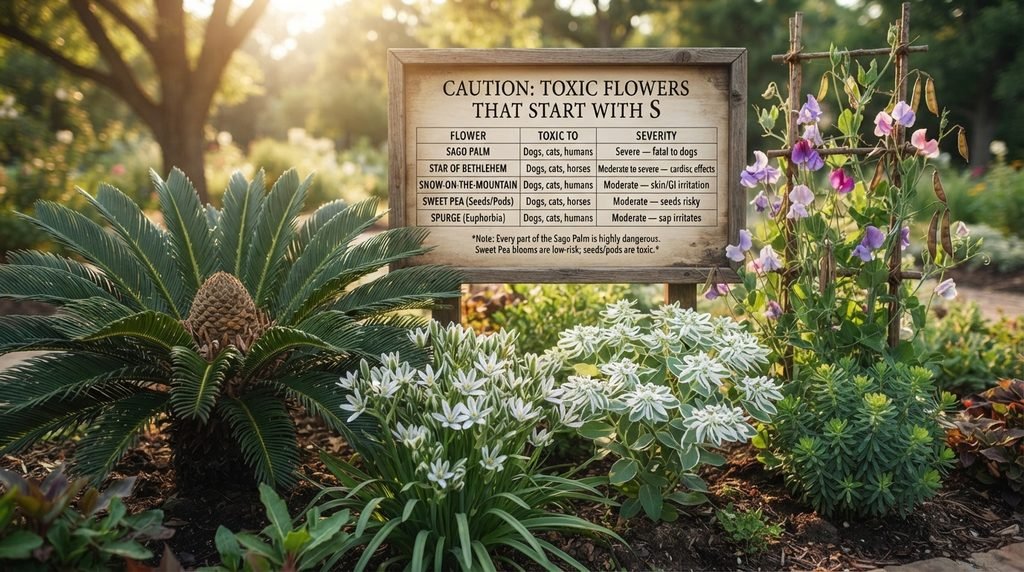
| Flower | Toxic To | Severity |
| Sago Palm | Dogs, cats, humans | Severe — can be fatal, especially to dogs |
| Star of Bethlehem | Dogs, cats, horses | Moderate to severe — cardiac effects |
| Snow-on-the-Mountain | Dogs, cats, humans | Moderate — skin and GI irritation |
| Sweet Pea (seeds/pods) | Dogs, cats, horses | Moderate — seeds are the risky part, not the bloom |
| Spurge (Euphorbia spp.) | Dogs, cats, humans | Moderate — sap irritates skin and mouth |
Sweet pea deserves a specific note here, since the flower itself is low-risk but the seeds and pods contain a compound that can cause serious symptoms if eaten in quantity, so it’s worth keeping seed pods away from pets even in a flower otherwise considered safe to grow around a family.
Life-Cycle Groupings for Flowers That Start With S
Knowing whether an S flower is an annual, perennial, or biennial changes how it should be planted and budgeted for. Annuals like sunflower and sweet alyssum complete their whole life in one season and need replanting every year, which suits gardeners who like changing up color schemes often. Perennials such as salvia and sedum come back on their own for years, making them a better investment for anyone who wants a bed to fill in and mature over time.
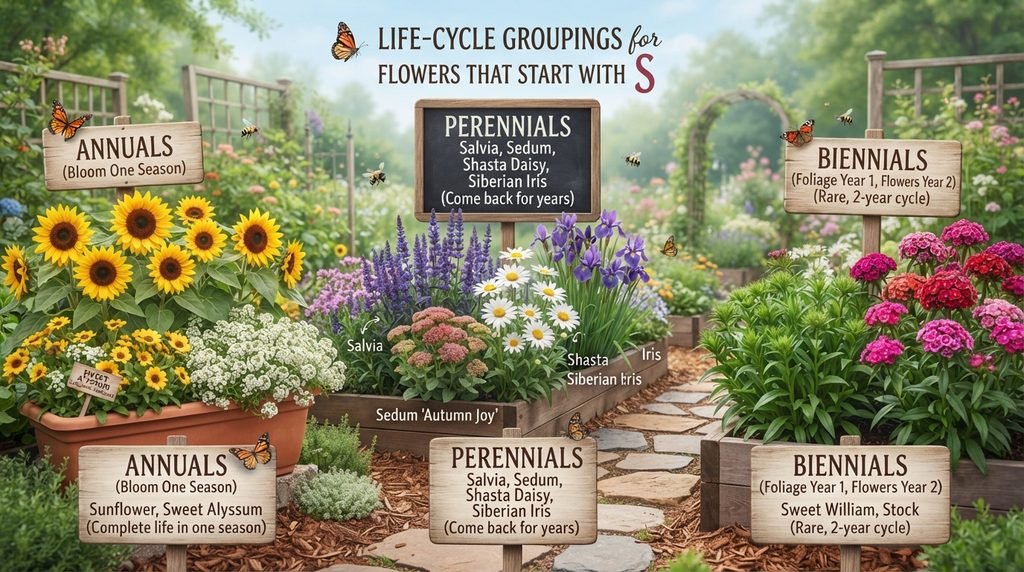
| Flower | Life Cycle | Typical Zones |
| Sunflower | Annual | All zones (seasonal) |
| Sweet Pea | Annual (cool season) | All zones (seasonal) |
| Sweet Alyssum | Annual (short-lived perennial in mild zones) | 9–11 (perennial), elsewhere annual |
| Salvia | Perennial | 4–9, varies by species |
| Sedum | Perennial | 3–9 |
| Shasta Daisy | Perennial | 4–9 |
| Scabiosa | Perennial (short-lived) | 3–7 |
| Stock | Biennial (grown as annual) | 7–10 |
| Sweet William | Biennial | 3–9 |
| Siberian Iris | Perennial | 3–8 |
Sweet William stands out on this table because most gardeners treat it as an annual bedding plant without realizing it’s naturally biennial.
Master Alphabetical List of Flowers That Start With S
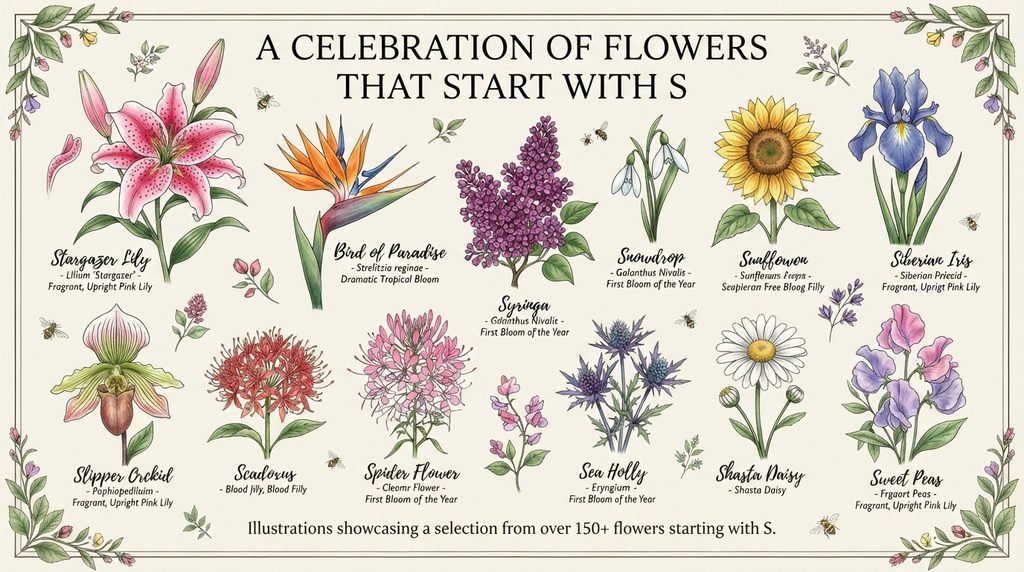
The list below covers more than 150 flowers that start with S, mixing well-known common names with entries more often searched under their botanical name. Common names come first wherever one exists; less familiar species are listed under the botanical name most nurseries actually use on their tags.
| Flower | Botanical Name | Note |
| Sacred Lotus | Nelumbo nucifera | Aquatic bloom, sacred in several cultures |
| Safflower | Carthamus tinctorius | Thistle-like, grown historically for dye and oil |
| Saffron Crocus | Crocus sativus | Source of the saffron spice, blooms in fall |
| Sage (Flowering) | Salvia officinalis | Small purple blooms on an edible herb |
| Salal | Gaultheria shallon | Small pink-white bell flowers, evergreen shrub |
| Salpiglossis (Painted Tongue) | Salpiglossis sinuata | Trumpet blooms with intricate veining |
| Salvia | Salvia spp. | Spiked blooms, major pollinator draw |
| Sand Verbena | Abronia villosa | Desert native, fragrant pink clusters |
| Sanguinaria (Bloodroot) | Sanguinaria canadensis | Early spring woodland bloom, red sap |
| Sanguisorba (Burnet) | Sanguisorba officinalis | Small bottlebrush-like maroon flower heads |
| Saponaria (Soapwort) | Saponaria officinalis | Pink clusters, historically used as soap |
Botanical Name Crosswalk
Nursery tags often use botanical names instead of common ones, and a mismatch here is an easy way to bring home the wrong plant.
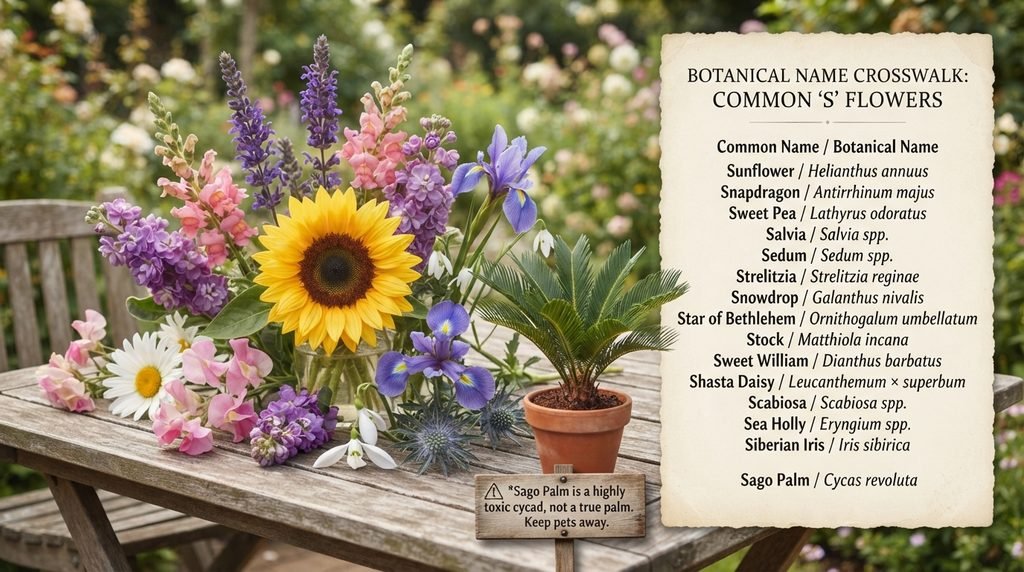
| Common Name | Botanical Name |
| Sunflower | Helianthus annuus |
| Snapdragon | Antirrhinum majus |
| Sweet Pea | Lathyrus odoratus |
| Salvia | Salvia spp. |
| Sedum | Sedum spp. |
| Strelitzia | Strelitzia reginae |
| Snowdrop | Galanthus nivalis |
| Star of Bethlehem | Ornithogalum umbellatum |
| Stock | Matthiola incana |
| Sweet William | Dianthus barbatus |
| Shasta Daisy | Leucanthemum × superbum |
| Scabiosa | Scabiosa spp. |
| Sea Holly | Eryngium spp. |
| Siberian Iris | Iris sibirica |
| Sago Palm | Cycas revoluta |
Full Comparison Table: Sun, Water, and Bloom Time
Choosing between two or three S flowers usually comes down to matching sun exposure and watering needs to the space available.
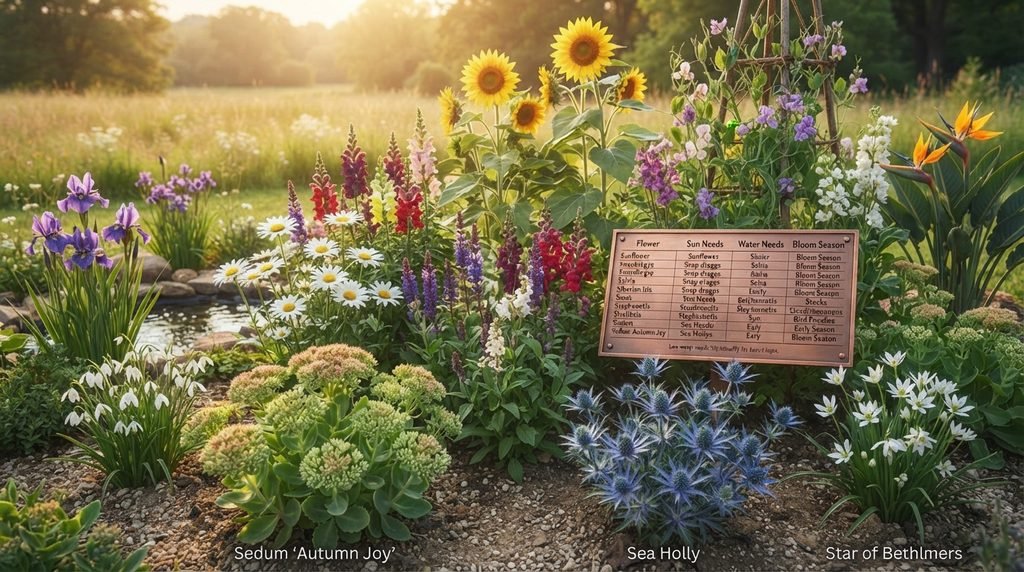
| Flower | Sun Needs | Water Needs | Bloom Season |
| Sunflower | Full sun | Moderate | Summer–fall |
| Snapdragon | Full sun to part shade | Moderate | Spring–fall (cool season) |
| Sweet Pea | Full sun | Moderate | Spring–early summer |
| Salvia | Full sun | Low to moderate | Summer–fall |
| Sedum | Full sun | Low | Late summer–fall |
| Shasta Daisy | Full sun | Moderate | Summer |
| Scabiosa | Full sun | Moderate | Summer–fall |
| Snowdrop | Part shade | Moderate | Late winter–early spring |
| Star of Bethlehem | Full sun to part shade | Low | Spring |
| Stephanotis | Bright indirect light | Moderate | Spring–summer |
| Strelitzia | Bright indirect light | Moderate | Spring–summer (mature plants) |
| Stock | Full sun | Moderate | Spring |
| Siberian Iris | Full sun to part shade | Moderate | Late spring |
| Sea Holly | Full sun | Low | Summer |
Sedum and sea holly stand out as the two lowest-water entries here, both suited to gardeners dealing with dry soil or infrequent watering schedules.
Decision Table: Which S Flower Fits Your Situation
The table below sorts common gardening goals against the S flowers best suited to solve them.
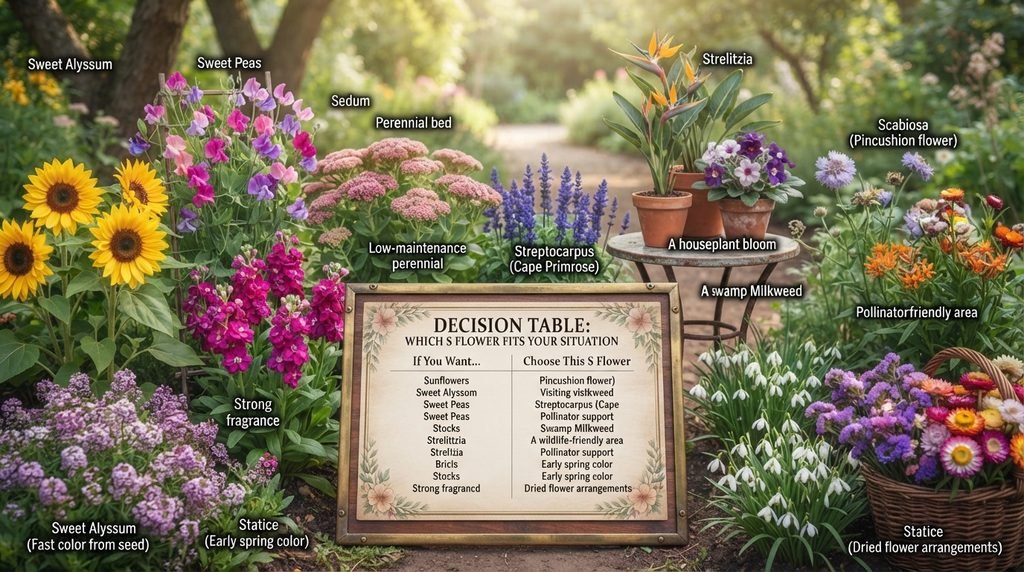
| If You Want… | Choose This S Flower |
| Fast color from seed | Sunflower or Sweet Alyssum |
| Strong fragrance | Sweet Pea or Stock |
| Low-maintenance perennial | Sedum or Salvia |
| A houseplant bloom | Strelitzia or Streptocarpus |
| Pollinator support | Scabiosa or Swamp Milkweed |
| Early spring color | Snowdrop or Star of Bethlehem |
| Dried flower arrangements | Statice or Strawflower |
| Pet-safe garden bed | Salvia or Sunflower |
Sweet pea and stock cover the fragrance category so thoroughly that most florists reach for one of the two whenever a client specifically asks for a scented bouquet. Sunflower shows up twice on this table, once for fast color and once for pet safety, which is part of why it remains the single most planted S flower in home gardens.
Conclusion
Flowers that start with S cover a wide range, from the familiar sunflower to rare woodland natives such as snow trillium. This guide organizes more than 150 varieties by color, life cycle, and use, making the list easier to navigate. Whether you want a fragrant cutting garden, a pet-safe backyard, or a dramatic houseplant, you can find an S flower that fits your needs. The tables make it easier to compare the options and find the right flower quickly.
Frequently Asked Questions
How many flowers start with S?
More than 150 common and botanically recognized flowers start with S, making it one of the largest letter groups in ornamental gardening.
What is the most popular flower that starts with S?
Sunflower is by far the most widely grown and recognized flower that starts with S, thanks to its fast growth and low care requirements.
Are sunflowers annuals or perennials?
Most garden sunflowers are annuals, completing their life cycle in one growing season, though a few perennial sunflower species exist.
Which S flowers are toxic to pets?
Sago palm is the most dangerous, capable of causing fatal liver damage in dogs, while snow-on-the-mountain and star of Bethlehem carry moderate toxicity risks.
What S flower is best for a fragrant garden?
Sweet pea and stock are the two strongest fragrance choices, with sweet pea offering a lighter scent and stock lasting longer once cut.
Can strelitzia be grown indoors?
Yes, strelitzia (bird of paradise) grows well indoors with bright, indirect light, though it can take several years to produce its first bloom.
What does a sunflower symbolize?
Sunflowers are widely associated with loyalty, adoration, and positivity, a meaning tied to the way the bloom tracks the sun across the sky.
Which S flowers bloom earliest in spring?
Snowdrop and snow crocus are typically the first S flowers to bloom, often appearing while snow is still on the ground.
Is sweet pea safe to grow around children?
The flowers themselves are low-risk, but the seeds and pods contain a toxin that can cause symptoms if eaten in quantity, so pods should be kept out of reach.