45+ Beautiful Flowers That Start With I (Names, Meanings & Photos)
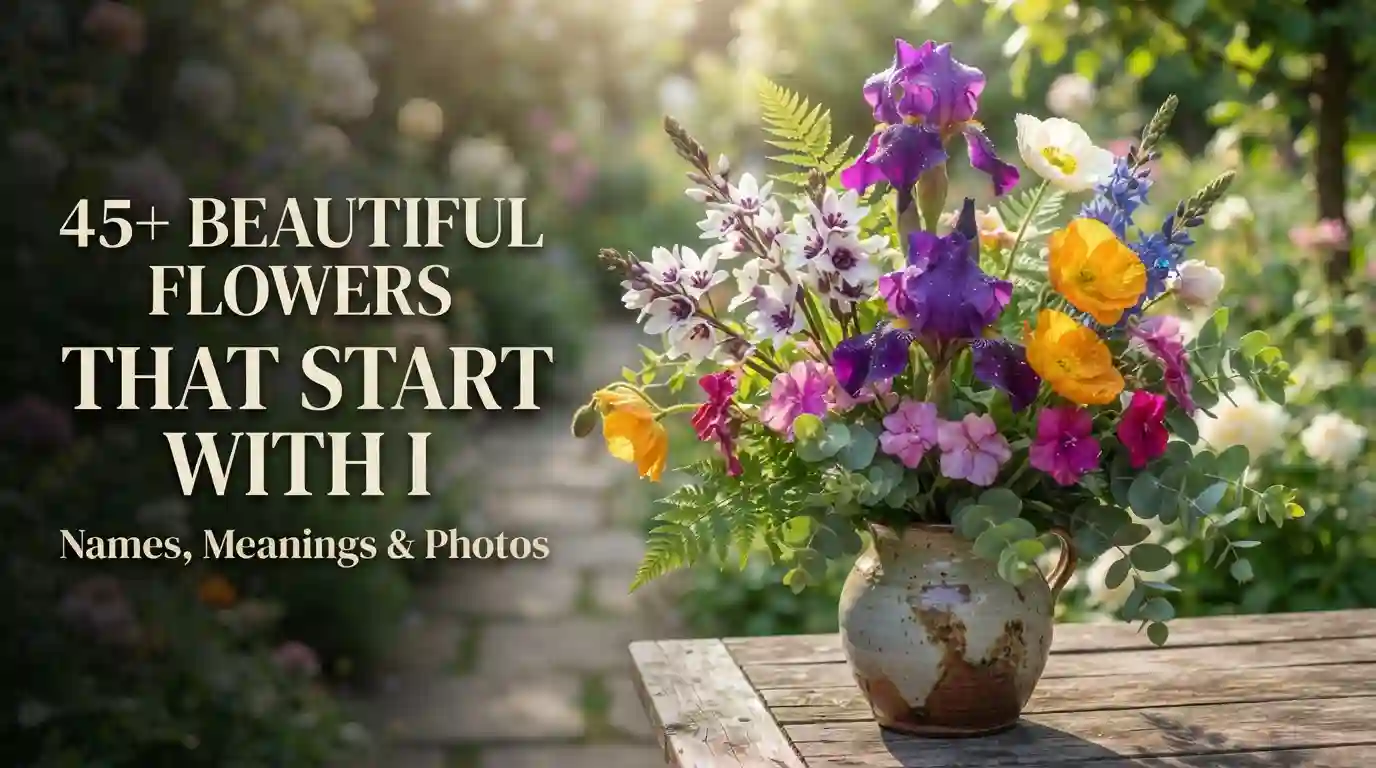
Flowers that start with I bring together an unusual mix. Iris anchors this letter as one of the most recognized garden perennials anywhere. Impatiens brightens shaded beds where little else will bloom. Indian pipe grows without any chlorophyll at all, pushing up ghostly white stems from the forest floor. This letter spans easy garden staples and genuine botanical curiosities, all within the same eight letters of the alphabet.
This guide brings together more than forty-five of these blooms. Each entry was checked individually for its botanical name, native range, and toxicity. Nothing here was copied from a single source and lightly reworded. A few I-named plants grown mainly for foliage were left off this list, since the flower itself should be the actual reason to grow a plant, not an afterthought.
Quick Answer: The Standout Flowers
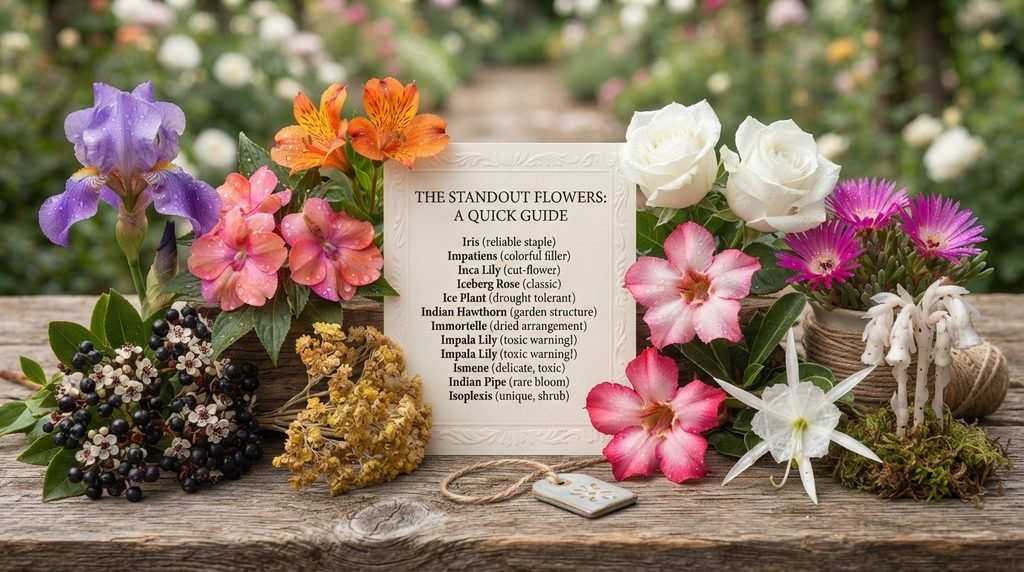
A short list of names covers the main uses in this group. Iris and impatiens serve as reliable garden staples, while Inca lily and Iceberg rose work well as cut flowers. Ice plant and Indian hawthorn offer drought tolerance and low-maintenance structure for borders. Immortelle remains popular for dried arrangements that last longer than fresh bouquets. Impala lily and Ismene require caution because both have documented toxicity risks. Indian pipe and Isoplexis complete the group with some of the rarest and most unusual blooms in this selection.
What These Flowers Are Said to Represent
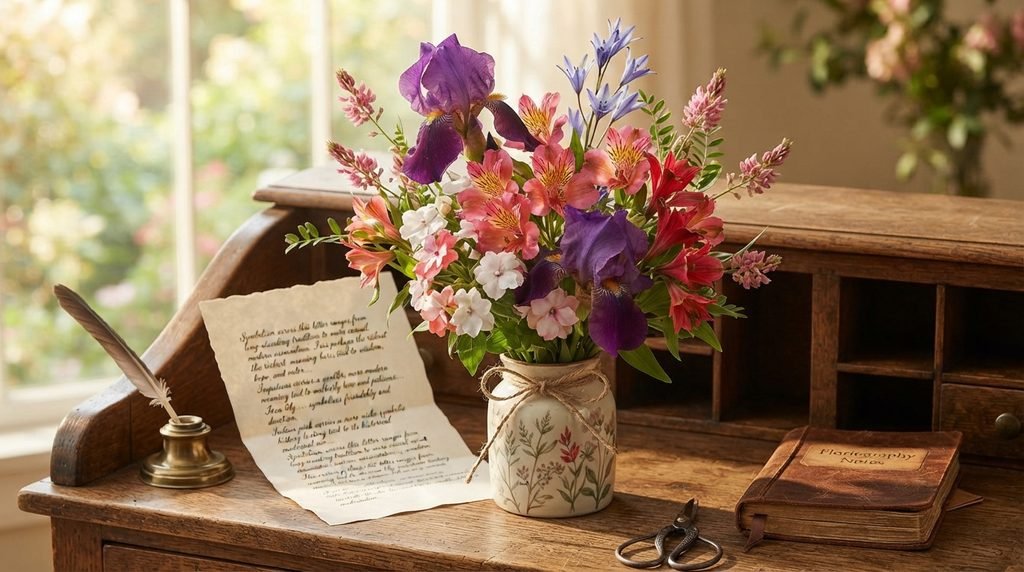
Symbolism across this letter ranges from long-standing tradition to more casual, modern association. Iris carries perhaps the richest meaning here, tied to wisdom, hope, and valor across several European traditions, a symbolism that traces back to the Greek goddess Iris, who served as a messenger between gods and mortals.
Inca lily, better known botanically as Alstroemeria, symbolizes friendship and devotion in most modern flower-language traditions, a meaning strong enough that it’s become a common alternative to roses in bouquets meant for platonic relationships.
Sorting These Flowers by Color
White and cream tones stand out clearly in this group. Indian pipe’s ghostly, translucent stems, Illinois bundleflower’s small white pom-pom clusters, and several immortelle varieties all fall into this category. Italian bellflower adds a softer white-to-blue range, and its trailing habit makes it a natural fit for hanging baskets where pale color shows well against dark foliage.
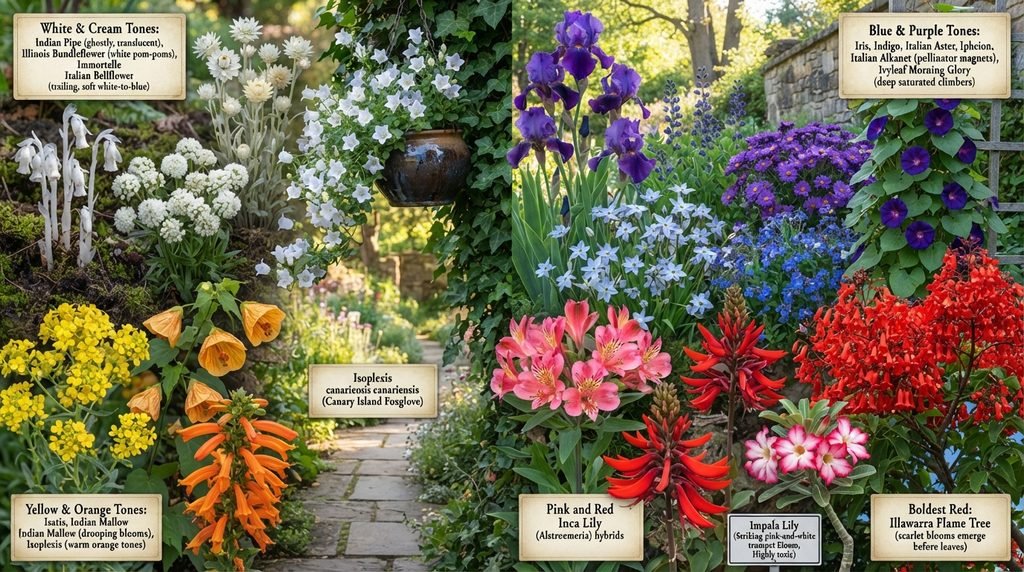
Blue and purple tones dominate a large share of this letter. Iris, indigo, Italian aster, Ipheion, and Italian alkanet all bring cooler shades to a bed, and most of these double as reliable pollinator plants. Ivyleaf morning glory adds a deeper, saturated blue-purple to this group, climbing quickly over fences and trellises through summer.
Yellow and orange tones appear less often in this group. Isatis, Indian mallow, and the orange-toned blooms of Isoplexis add warmth to the otherwise cool-toned selection. Pink and red tones come from Inca lily, Indian pink, Indian coral tree, and impala lily.
Garden Favorites Among Flowers That Start With I
A small core group of dependable plants does most of the work for gardeners exploring this letter. Iris anchors this group, tolerating a wide range of soil types while returning each spring reliably with almost no ongoing care. Impatiens performs a different but equally valuable role, filling shaded beds with color where sun-loving annuals simply fail.
Indian hawthorn brings structure to a border as a compact, evergreen shrub that blooms in spring and holds its shape year-round with minimal pruning. Iberis, commonly called candytuft, forms a low, spreading mat of white or pink flowers that works well as edging along a path or wall.
| Flower | Botanical Name | Best Border Role |
| Iris | Iris germanica | Reliable spring perennial anchor |
| Impatiens | Impatiens walleriana | Shaded bed color |
| Indian Hawthorn | Rhaphiolepis indica | Evergreen structure, low hedge |
| Iberis (Candytuft) | Iberis sempervirens | Edging, low spreading mat |
| Ironweed | Vernonia noveboracensis | Late-summer pollinator anchor |
| Ivy Geranium | Pelargonium peltatum | Trailing container and basket color |
Ironweed and impatiens sit at opposite ends of this table in terms of care. Ironweed thrives on neglect once established, while impatiens needs consistently moist soil and will wilt quickly if it dries out even briefly.
Indoor Plants: Flowers That Start With I for Pots and Windowsills
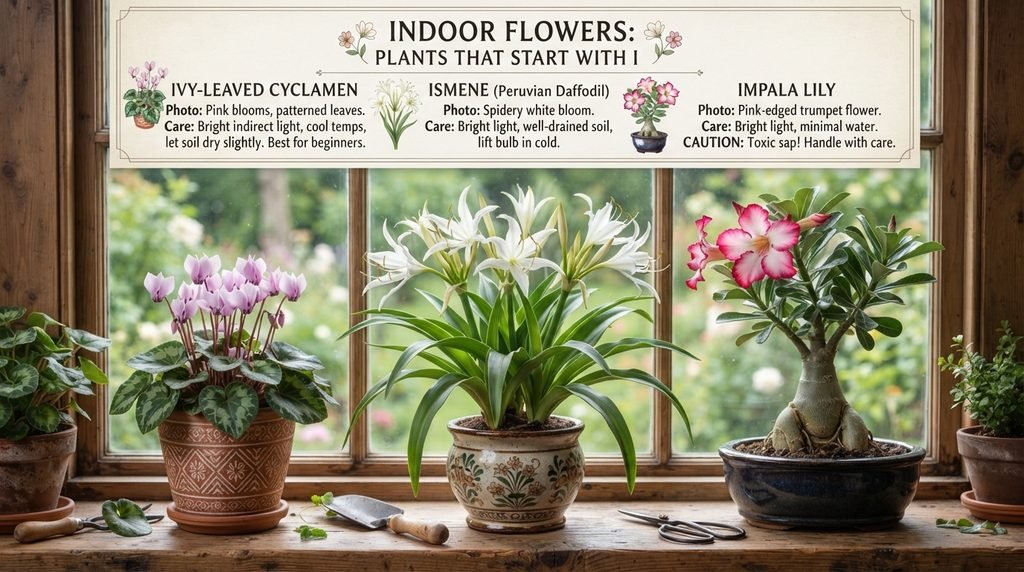
A smaller group of I flowers performs best indoors, where steady warmth and humidity make up for conditions that would be hard to sustain outdoors year-round. Ivy-leaved cyclamen leads this group, producing small, upswept pink or white blooms above patterned, heart-shaped leaves through the cooler months of the year. Ismene, also called Peruvian daffodil, offers a more dramatic option, sending up a fragrant, spidery white bloom from a bulb that can be grown in a pot and brought indoors before frost.
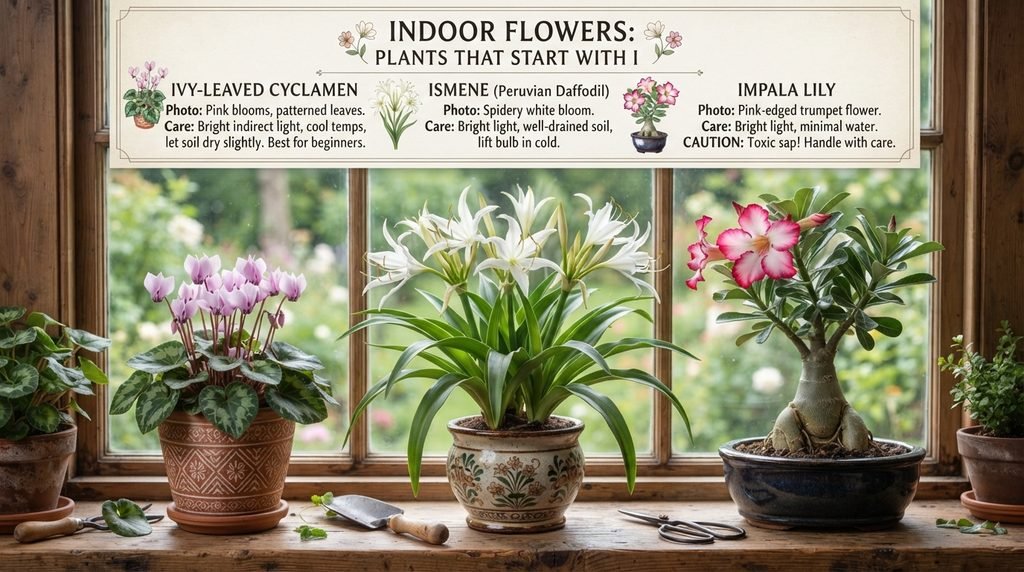
Impala lily, grown widely as a bonsai-style houseplant in warmer regions, rewards patience with a striking pink-edged trumpet flower, though its sap demands careful handling given its documented toxicity.
- Ivy-leaved Cyclamen — bright indirect light, cool temperatures, let soil dry slightly between waterings
- Ismene (Peruvian Daffodil) — bright light, well-drained soil, lift and store the bulb in cold climates
- Impala Lily — bright light, minimal watering, handle sap with care
Ivy-leaved cyclamen is the most forgiving of this trio for a beginner. Impala lily demands the most caution, both for its toxicity and for its preference for genuinely dry conditions between waterings.
Florist Favorites: I Flowers Built for Cutting and Arranging
Cut-flower value depends on vase life, stem strength, and overall versatility, and a few I flowers perform strongly across all three. Inca lily, sold commercially as Alstroemeria, ranks among the longest-lasting cut flowers available anywhere, often holding its color and form for two weeks or more in a vase. Iceberg rose, a pure white rose cultivar, remains one of the most widely grown roses specifically for its reliable repeat blooming and classic form.
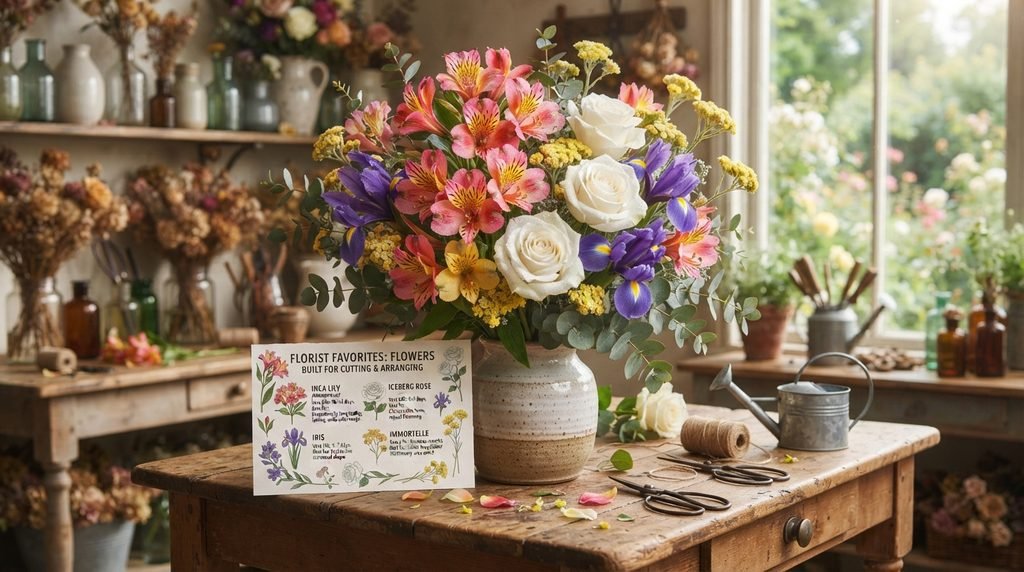
Iris brings a distinctive, sculptural shape to arrangements that few other spring flowers can match, while immortelle takes an entirely different approach, retaining its shape and color even after drying completely, which makes it a staple of wreaths and dried bouquets that need to last for months rather than days.
| Flower | Vase Life | Why Florists Use It |
| Inca Lily (Alstroemeria) | 10–14 days | Exceptionally long-lasting, wide color range |
| Iceberg Rose | 5–7 days | Classic white form, repeat blooming |
| Iris | 5–7 days | Distinctive sculptural shape |
| Immortelle | Weeks to months (dried) | Holds shape and color indefinitely once dried |
Inca lily stands out from the rest of this table for its unusually long vase life, which is exactly why it shows up so often in mixed bouquets meant to outlast the fresher, shorter-lived flowers around it.
Rare Flowers: The Harder-to-Find Entries on This List
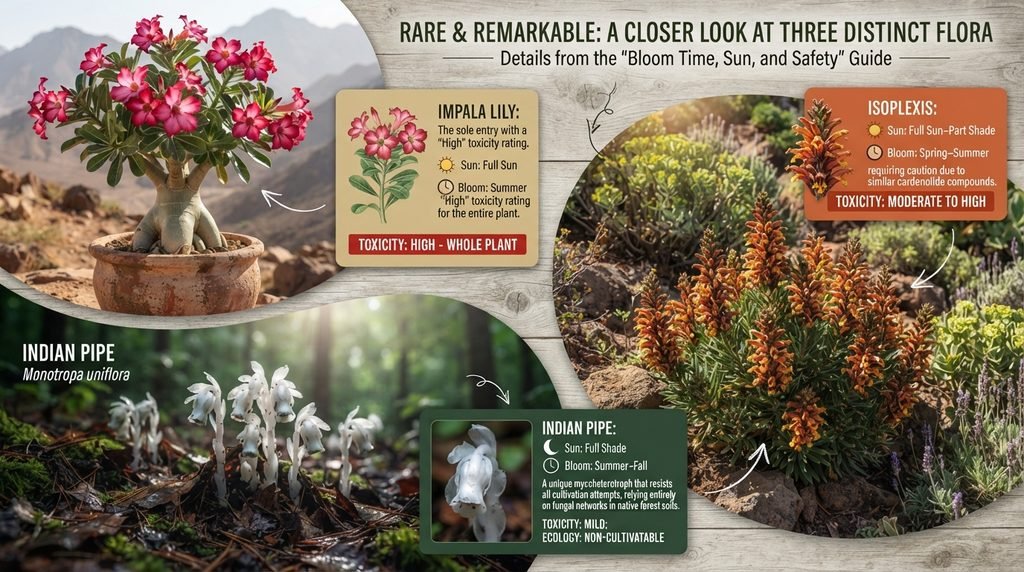
A handful of entries on this list are genuinely uncommon. Indian pipe tops this group by a wide margin, since it contains no chlorophyll and survives entirely by drawing nutrients through a fungal network connected to nearby tree roots, which makes it essentially impossible to cultivate deliberately in a home garden. Isoplexis, sometimes called Canary Island foxglove, is native to a small handful of Atlantic islands and rarely appears outside specialist collections, prized for its unusual orange, tubular blooms that set it apart from its more common purple Digitalis relatives.
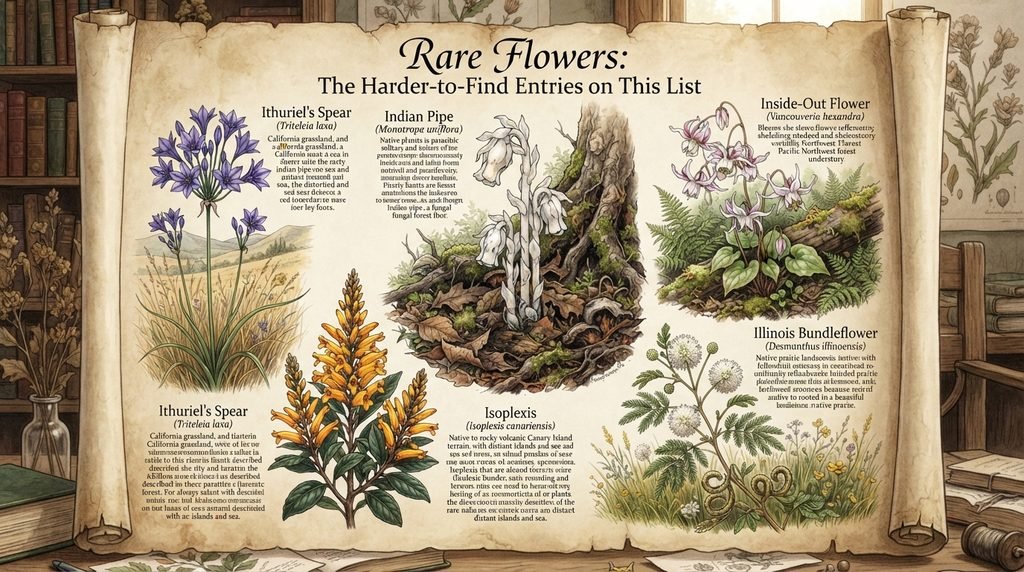
Ithuriel’s spear, a California native bulb, remains uncommon in general nurseries and is typically sourced through native-plant specialists rather than big-box garden centers. Inside-out flower, native to shaded Pacific Northwest forests, gets its name from its unusual backward-folded petals and rarely appears in cultivation outside plants sourced from specialty woodland nurseries. Illinois bundleflower, a native prairie plant, follows a similar pattern, more often found in native seed mixes than sold as a standalone potted specimen.
Caution: Flowers That Need Careful Placement
Toxicity risk varies sharply across this letter, and a few entries deserve serious, specific attention. Impala lily is the most dangerous plant on this entire list. Its sap has traditionally been used as an arrow poison in parts of Africa, and it contains cardiac glycosides potent enough to be genuinely life-threatening if ingested. Isoplexis carries a related risk, since its close relationship to Digitalis suggests it likely contains similar cardiac-affecting compounds, and it should be treated with the same caution given to any foxglove relative.
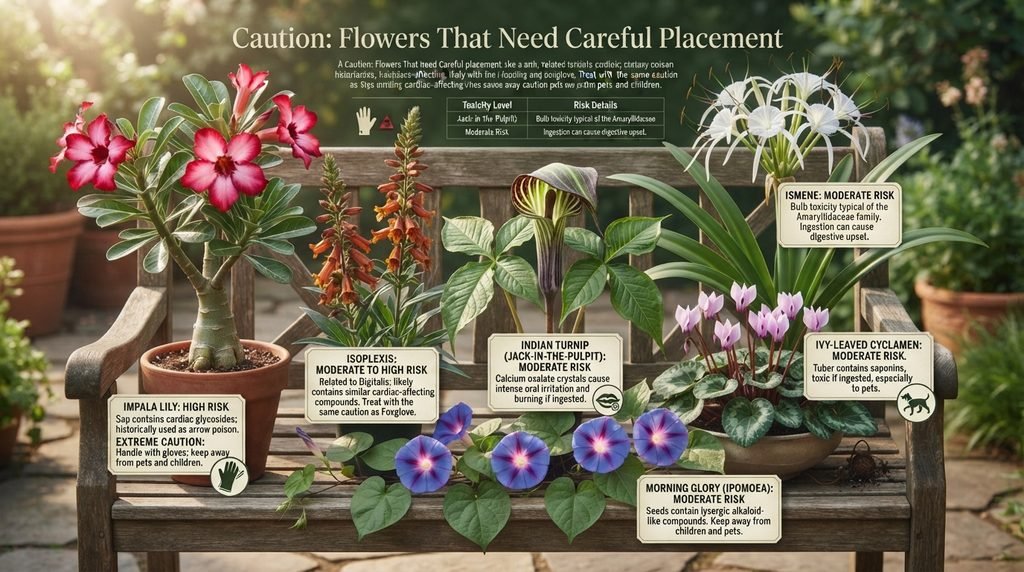
Indian turnip, better known as Jack-in-the-pulpit, causes intense burning and irritation in the mouth and throat when chewed raw because needle-like calcium oxalate crystals occur throughout the plant tissue. Ismene and ivy-leaved cyclamen also pose a moderate risk because their bulbs and tubers contain compounds that can cause digestive upset if ingested, particularly in pets that dig up and chew on these underground parts.
| Flower | Toxicity Level | Risk Details |
| Impala Lily | High | Sap contains cardiac glycosides; historically used as arrow poison |
| Isoplexis | Moderate to High | Related to Digitalis; likely contains similar cardiac-affecting compounds |
| Indian Turnip | Moderate | Calcium oxalate crystals cause intense oral irritation |
| Ismene | Moderate | Bulb toxicity typical of the Amaryllidaceae family |
| Ivy-leaved Cyclamen | Moderate | Tuber contains saponins, toxic if ingested |
| Morning Glory (Ipomoea) | Moderate | Seeds contain lysergic alkaloid-like compounds |
Households with pets or young children should treat impala lily as an outright no rather than something to simply place out of reach. Its sap is dangerous enough that even minor contact with a cut stem deserves careful handling with gloves.
Choosing by Life Cycle: Annuals, Perennials, Bulbs, and Beyond
Matching a flower’s life cycle to an actual planning horizon matters as much as matching its color. An annual that needs replanting every year plays a very different role than a shrub that becomes a permanent fixture. Perennials make up the largest group among these flowers, offering repeat blooms with less ongoing replanting effort.
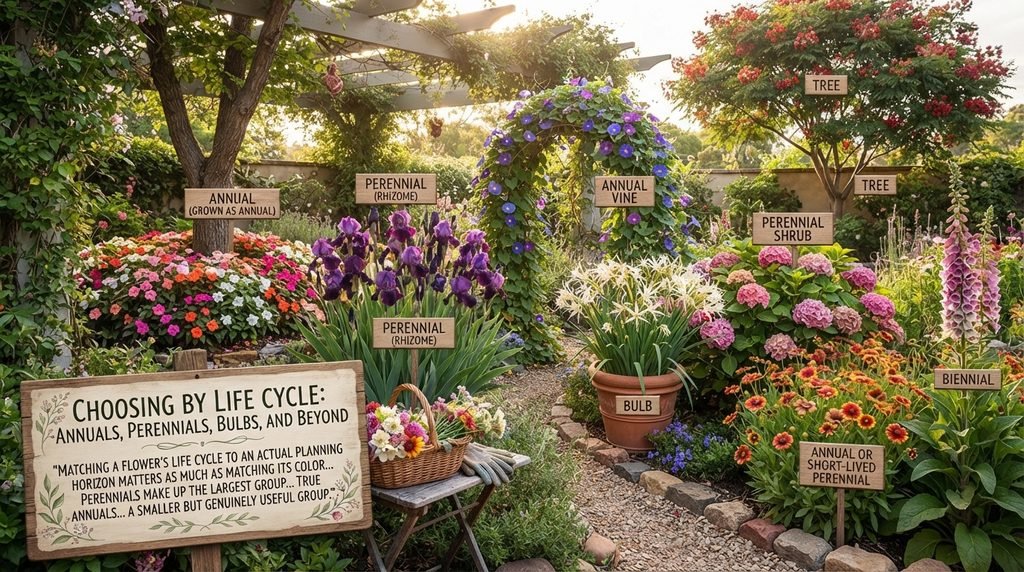
True annuals are a smaller cluster here, though a few genuinely useful ones exist for gardeners wanting single-season color.
| Flower | Life Cycle |
| Iris | Perennial (rhizome) |
| Iris versicolor | Perennial (rhizome) |
| Impatiens | Annual (perennial in warm climates) |
| Ixora | Perennial shrub |
| Ipomoea (Morning Glory) | Annual vine |
| Ivyleaf Morning Glory | Annual vine |
| Indian Paintbrush | Perennial wildflower |
| Indian Pink | Perennial |
| Ice Plant | Perennial succulent |
| Ivy Geranium | Perennial (grown as annual) |
| Immortelle | Annual |
| Inca Lily (Alstroemeria) | Perennial (tuberous root) |
| Indian Blanket | Annual or short-lived perennial |
| Indian Hawthorn | Evergreen shrub |
| Indian Shot (Canna) | Perennial (rhizome) |
| Ironweed | Perennial |
| Ismene | Bulb |
| Italian Aster | Perennial |
| Italian Bellflower | Perennial (grown as annual in cold climates) |
| Ivy-leaved Cyclamen | Perennial (tuber) |
| Icelandic Poppy | Perennial (short-lived) |
| Impala Lily | Perennial succulent shrub |
| Indigo | Shrub |
| Indian Cress (Nasturtium) | Annual |
| Iberis (Candytuft) | Perennial |
| Indian Rhubarb | Perennial |
| Illawarra Flame Tree | Tree |
| Indian Turnip | Perennial |
| Indian Pipe | Perennial (non-photosynthetic) |
| Inside-Out Flower | Perennial |
| Indian Mallow | Perennial shrub |
| Isotoma | Perennial groundcover |
| Ithuriel’s Spear | Bulb |
| Ipheion | Bulb |
| Isatis (Woad) | Biennial |
| Indian Coral Tree | Tree |
| Iceberg Rose | Perennial shrub |
| Ipomopsis (Standing Cypress) | Biennial |
| Italian Squill | Bulb |
| Indian Lotus | Perennial (aquatic) |
| Italian Sainfoin | Perennial (forage plant) |
| Indian Cork Tree | Tree |
| Isoplexis | Perennial shrub |
| Italian Alkanet | Perennial (short-lived) |
| Illinois Bundleflower | Perennial |
This table shows that most flowers in this letter are perennials.
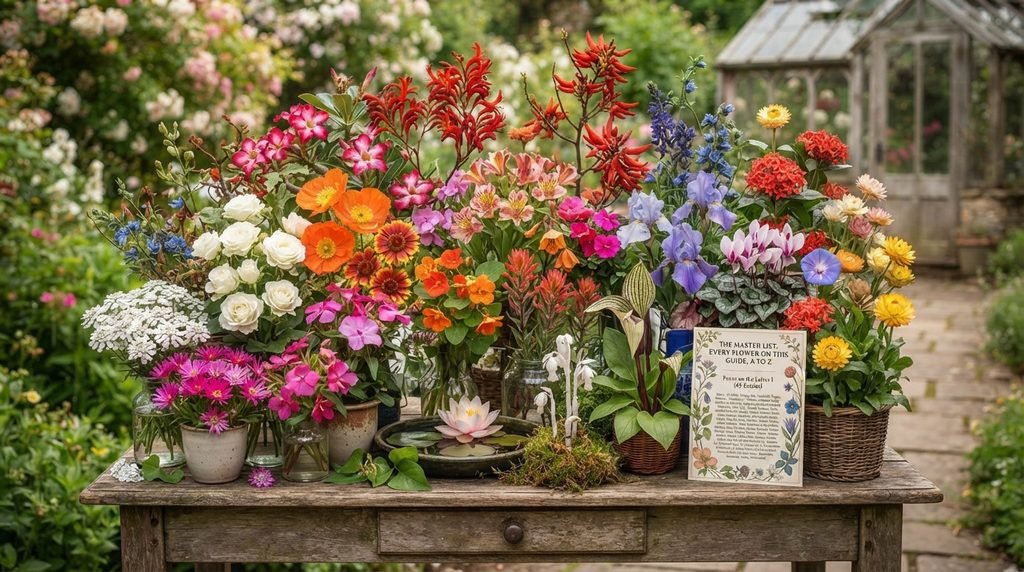
The Master List: Every Flower on This Guide, A to Z
Several entries below are best known by common English names, especially varieties with “Indian” or “Italian” in their names. Others are usually sold under their botanical genus because they never developed a widely accepted common name. The list uses the names gardeners commonly recognize rather than assigning artificial English names to every plant.
- Iberis (Candytuft) — Iberis sempervirens
- Ice Plant — Delosperma cooperi
- Iceberg Rose — Rosa ‘Iceberg’
- Icelandic Poppy — Papaver nudicaule
- Illawarra Flame Tree — Brachychiton acerifolius
- Illinois Bundleflower — Desmanthus illinoensis
- Impala Lily — Adenium multiflorum
- Impatiens — Impatiens walleriana
- Inca Lily — Alstroemeria aurea
- Indian Blanket — Gaillardia pulchella
- Indian Coral Tree — Erythrina variegata
- Indian Cork Tree — Millingtonia hortensis
- Indian Cress — Tropaeolum majus
- Indian Hawthorn — Rhaphiolepis indica
- Indian Lotus — Nelumbo nucifera
- Indian Mallow — Abutilon indicum
- Indian Paintbrush — Castilleja coccinea
- Indian Pink — Spigelia marilandica
- Indian Pipe — Monotropa uniflora
- Indian Rhubarb — Darmera peltata
- Indian Shot — Canna indica
- Indian Turnip — Arisaema triphyllum
- Indigo — Indigofera tinctoria
- Inside-Out Flower — Vancouveria hexandra
- Iris — Iris germanica
- Iris versicolor (Blue Flag) — Iris versicolor
- Isatis (Woad) — Isatis tinctoria
- Ismene (Peruvian Daffodil) — Hymenocallis narcissiflora
- Isoplexis — Isoplexis canariensis
- Isotoma — Isotoma fluviatilis
- Italian Alkanet — Anchusa azurea
- Italian Aster — Aster amellus
- Italian Bellflower — Campanula isophylla
- Italian Sainfoin — Hedysarum coronarium
- Italian Squill — Hyacinthoides italica
- Ithuriel’s Spear — Triteleia laxa
- Ivy Geranium — Pelargonium peltatum
- Ivy-leaved Cyclamen — Cyclamen hederifolium
- Ivyleaf Morning Glory — Ipomoea hederacea
- Ipheion (Spring Starflower) — Ipheion uniflorum
- Ipomoea (Morning Glory) — Ipomoea tricolor
- Ipomopsis (Standing Cypress) — Ipomopsis rubra
- Ironweed — Vernonia noveboracensis
- Ixora — Ixora coccinea
- Immortelle — Xerochrysum bracteatum
This list holds forty-five entries in total. It spans garden perennials, spring bulbs, tropical shrubs, and several true rarities, showing how much practical range flowers that start with I actually offer.
Why Botanical Names Matter for This Letter
Common-name confusion is a real risk with this letter. Several unrelated flowers share the same descriptive prefix, and “Indian” alone covers more than ten genuinely different plants on this list, from a shrub to a wildflower to a carnivorous-adjacent parasite. A large number of other entries are rarely sold under any English common name at all. Searching by botanical name is often the only reliable way to confirm that a nursery listing actually matches the plant intended.
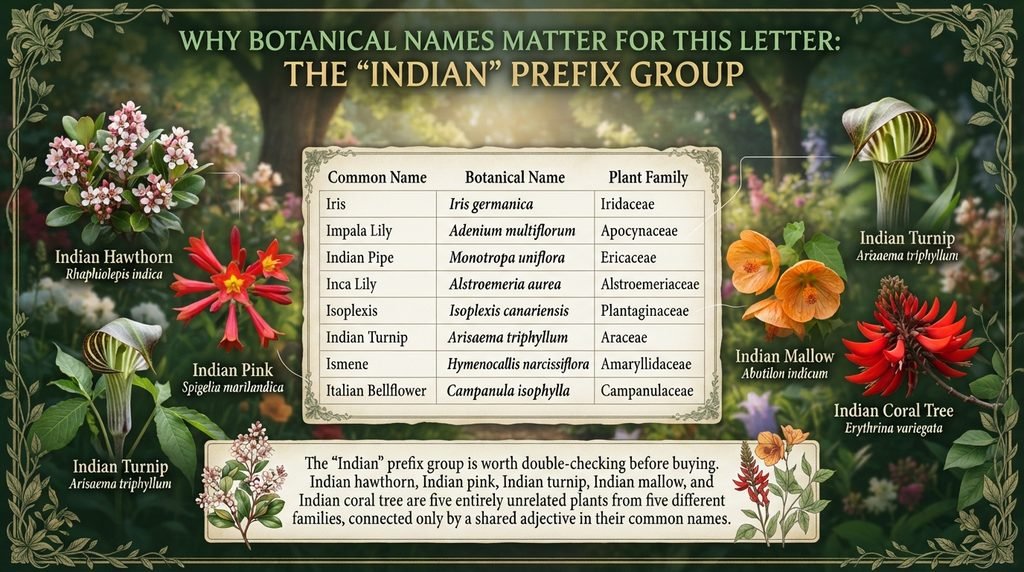
| Common Name | Botanical Name | Plant Family |
| Iris | Iris germanica | Iridaceae |
| Impala Lily | Adenium multiflorum | Apocynaceae |
| Indian Pipe | Monotropa uniflora | Ericaceae |
| Inca Lily | Alstroemeria aurea | Alstroemeriaceae |
| Isoplexis | Isoplexis canariensis | Plantaginaceae |
| Indian Turnip | Arisaema triphyllum | Araceae |
| Ismene | Hymenocallis narcissiflora | Amaryllidaceae |
| Italian Bellflower | Campanula isophylla | Campanulaceae |
The “Indian” prefix group is worth double-checking before buying. Indian hawthorn, Indian pink, Indian turnip, Indian mallow, and Indian coral tree are five entirely unrelated plants from five different families, connected only by a shared adjective in their common names.
Full Comparison Table: Bloom Time, Sun, and Safety at a Glance
The table below summarizes the bloom season, sun requirements, toxicity level, and primary use of every flower in this guide. Use it to quickly find a specific combination of traits, such as a spring-blooming, full-sun, pet-safe flower, without searching through each section.
| Flower | Bloom Season | Sun | Toxicity | Primary Use |
| Iris | Spring | Full sun | Mild | Border, cut flower |
| Iris versicolor | Late spring | Full sun–part shade | Mild | Wetland garden |
| Impatiens | Spring–fall | Partial to full shade | Non-toxic | Shaded bedding |
| Ixora | Nearly year-round (warm) | Full sun | Non-toxic | Tropical hedge |
| Ipomoea (Morning Glory) | Summer–fall | Full sun | Moderate | Trellis, fence cover |
| Ivyleaf Morning Glory | Summer–fall | Full sun | Moderate | Naturalized vine |
| Indian Paintbrush | Spring–summer | Full sun | Mild | Native meadow |
| Indian Pink | Late spring–summer | Partial shade | Moderate | Woodland border |
| Ice Plant | Summer | Full sun | Non-toxic | Groundcover, rock garden |
| Ivy Geranium | Spring–fall | Full sun–part shade | Mild | Hanging baskets |
| Immortelle | Summer | Full sun | Non-toxic | Dried arrangements |
| Inca Lily | Spring–summer | Full sun–part shade | Mild | Cut flower |
| Indian Blanket | Summer–fall | Full sun | Non-toxic | Wildflower meadow |
| Indian Hawthorn | Spring | Full sun–part shade | Non-toxic | Low hedge |
| Indian Shot | Summer–fall | Full sun | Non-toxic | Tropical border |
| Ironweed | Late summer–fall | Full sun | Non-toxic | Pollinator border |
| Ismene | Summer | Full sun | Moderate | Fragrant bulb display |
| Italian Aster | Late summer–fall | Full sun | Non-toxic | Cottage border |
| Italian Bellflower | Summer–fall | Partial shade | Non-toxic | Hanging baskets |
| Ivy-leaved Cyclamen | Fall | Partial shade | Moderate | Woodland, houseplant |
| Icelandic Poppy | Spring–summer | Full sun | Mild | Cottage border |
| Impala Lily | Summer | Full sun | High | Specimen container |
| Indigo | Summer | Full sun | Moderate | Shrub border |
| Indian Cress | Summer–fall | Full sun–part shade | Non-toxic | Edible garden |
| Iberis (Candytuft) | Spring | Full sun | Mild | Edging, rock garden |
| Indian Rhubarb | Spring | Partial shade | Non-toxic | Streamside, bog garden |
| Illawarra Flame Tree | Spring–summer | Full sun | Non-toxic | Specimen tree |
| Indian Turnip | Spring | Partial to full shade | Moderate | Native woodland garden |
| Indian Pipe | Summer–fall | Full shade | Mild | Native forest floor |
| Inside-Out Flower | Spring | Full shade | Non-toxic | Woodland groundcover |
| Indian Mallow | Summer | Full sun | Non-toxic | Border, medicinal garden |
| Isotoma | Spring–summer | Full sun–part shade | Moderate | Groundcover between pavers |
| Ithuriel’s Spear | Late spring | Full sun | Non-toxic | Native meadow, bulb display |
| Ipheion | Spring | Full sun–part shade | Mild | Naturalized bulb display |
| Isatis (Woad) | Spring–summer | Full sun | Non-toxic | Dye garden, cottage border |
| Indian Coral Tree | Summer | Full sun | Moderate | Specimen flowering tree |
| Iceberg Rose | Spring–fall | Full sun | Non-toxic | Cut flower, hedge rose |
| Ipomopsis (Standing Cypress) | Summer | Full sun | Non-toxic | Native wildflower accent |
| Italian Squill | Spring | Full sun–part shade | Mild | Naturalized bulb display |
| Indian Lotus | Summer | Full sun | Non-toxic | Pond, water garden |
| Italian Sainfoin | Spring–summer | Full sun | Non-toxic | Forage, pollinator garden |
| Indian Cork Tree | Spring | Full sun | Non-toxic | Fragrant shade tree |
| Isoplexis | Spring–summer | Full sun–part shade | Moderate to High | Rare specimen shrub |
| Italian Alkanet | Spring–summer | Full sun–part shade | Mild | Cottage border |
| Illinois Bundleflower | Summer | Full sun | Non-toxic | Native prairie planting |
Decision Guide: Matching a Scenario to the Right I Flower
Sometimes the fastest way to choose a flower isn’t scrolling through a full list. Choosing a flower can be easier when you start with your gardening needs instead of working through a long list. The table below matches common gardening needs with flowers that suit each situation. The table below maps common gardening scenarios to the flowers best suited to each one.
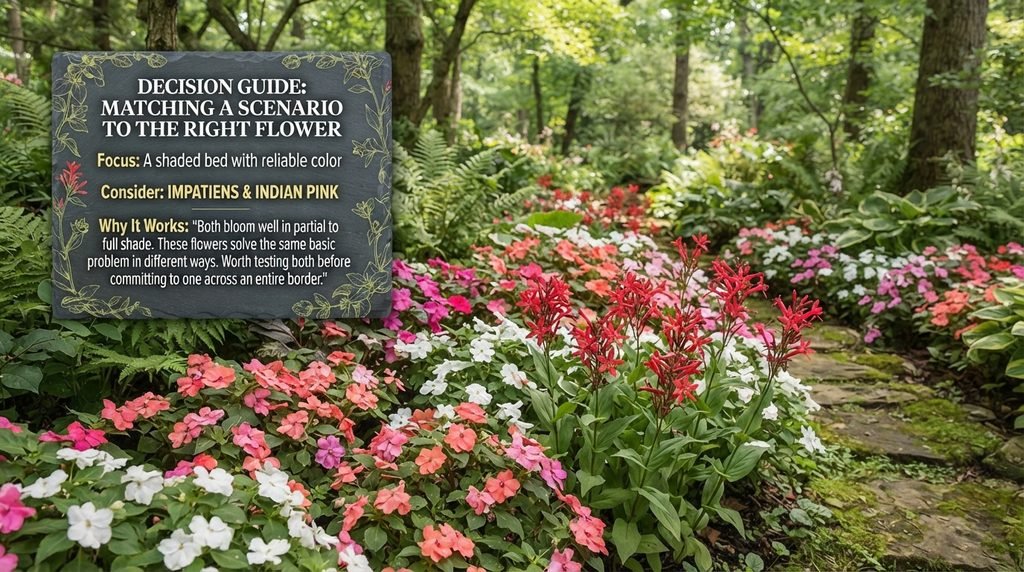
| If You Need… | Consider | Why |
| A shaded bed with reliable color | Impatiens, Indian Pink | Both bloom well in partial to full shade |
| A pet-safe cut flower | Inca Lily, Iceberg Rose | No documented severe toxicity |
| A drought-tolerant groundcover | Ice Plant | Thrives in poor, dry, rocky soil |
| A pollinator magnet | Ironweed, Italian Sainfoin | Long bloom windows, easy access for bees |
| A genuine rarity to chase | Indian Pipe, Isoplexis | Both are difficult to source and grow |
| A plant to avoid around pets | Impala Lily, Isoplexis | Both carry documented high toxicity |
| Dried arrangement material | Immortelle | Holds shape and color indefinitely once dried |
Conclusion
Flowers that start with I cover a wide range, from dependable garden perennials and shade-loving bedding plants to rare botanical curiosities and species that require extra caution. The right choice depends on the flower’s growing conditions, your available space, household needs, and intended purpose. The category breakdowns, comparison table, and decision guide make it easier to compare these flowers and choose the varieties that best suit your garden.
Frequently Asked Questions
1. How many flowers that start with I are there?
This guide covers forty-five verified flowers that start with I, ranging from common garden perennials to rare botanical specialties and a few plants that require serious caution.
2. What is the easiest I flower to grow?
Iris and impatiens are both excellent choices for beginners, tolerating a wide range of conditions while still blooming each year reliably.
3. Which flowers are toxic to pets?
Impatiens is the most dangerous, containing cardiac glycosides potent enough to have been used historically as an arrow poison. Isoplexis and Ismene also carry moderate to high risk.
4. What does the iris flower symbolize?
Iris is tied to wisdom, hope, and valor in several European traditions, a meaning rooted in the Greek messenger goddess the flower was named after.
5. What flowers work well indoors?
Ivy-leaved cyclamen, Ismene, and impala lily are the most common indoor choices, though impala lily demands the most careful handling due to its toxic sap.
6. Is Indian pipe safe to touch?
Yes, casual contact is generally considered low risk, though the plant is not recommended for ingestion and should mainly be admired rather than handled or transplanted.
7. What’s the best I flower for a fragrant garden?
Indian cork tree and Ismene are both strong fragrance performers, the former as a flowering tree and the latter as a spidery-bloomed bulb.
8. Are any I-named flowers genuinely rare?
Yes. Indian pipe and Isoplexis are both considered rare, the former due to its dependence on a fungal network and the latter due to its narrow native range on the Canary Islands.