Flowers That Start With H: 80+ Beautiful Varieties With Pictures
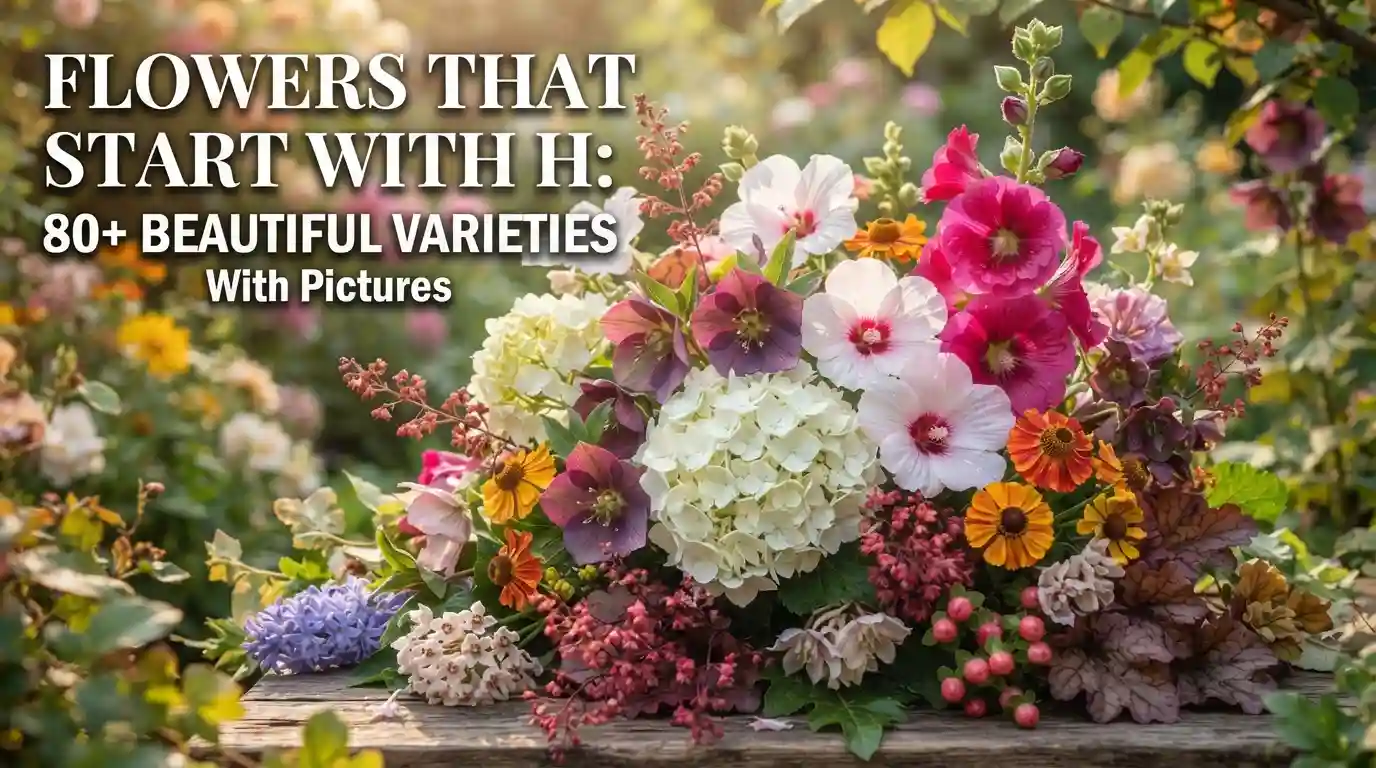
Gardeners often build their plant lists around color or season, but there is a simpler, more surprising way to discover new species: by letter. Flowers that start with H happen to cover an unusually wide range of the plant kingdom, stretching from tropical shrubs like hibiscus to alpine perennials like hepatica, from fragrant spring bulbs like hyacinth to shade-loving woodland natives like hairy toad lily. This guide pulls that scattered family together into one organized reference, so you can browse by name, by color, by growing habit, or by how much sun a plant needs.
The list below moves in layers rather than one long alphabetical dump: a quick-answer summary, flower meanings, color groupings, and use-based categories such as garden favorites, houseplants, cut flowers, rare finds, and plants that need a caution label, followed by reference material — a life-cycle breakdown, a master list, a botanical-name crosswalk, a full comparison table, and a decision-flow table.
Quick Answer: The Most Notable H Flowers
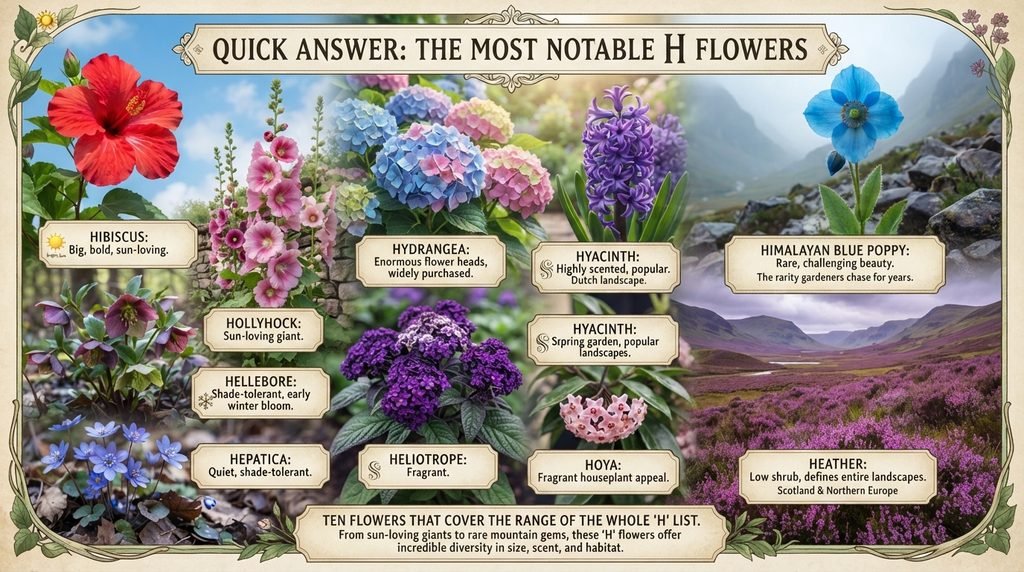
If you only have a minute, these ten cover the range of the whole list. Hibiscus and hollyhock represent the big, bold, sun-loving side of the family, while hellebore and hepatica represent the quiet, shade-tolerant side that blooms when almost nothing else will. Hydrangea and hyacinth are the two most widely purchased H flowers in North America and Europe, one for its enormous flower heads and the other for its scent. Heliotrope and Hoya bring fragrance and houseplant appeal, Himalayan blue poppy is the rarity gardeners chase for years, and heather anchors the list as the low shrub that defines entire landscapes in Scotland and northern Europe.
- Hibiscus
- Hydrangea
- Hyacinth
- Hellebore
- Hollyhock
- Heather
- Heliotrope
- Hepatica
- Himalayan Blue Poppy
- Hoya
What Flowers That Start With H Symbolize
Flower symbolism clusters around a few recurring themes for this letter. In Hawaiian and broader Pacific culture, hibiscus is linked to hospitality, beauty, and delicate power, which is why it appears so often on leis and in resort branding. Hyacinth carries a heavier story: Greek mythology holds that the flower grew from the blood of Hyacinthus, a young man accidentally killed by Apollo, so the bloom has long stood for sorrow and remembrance.
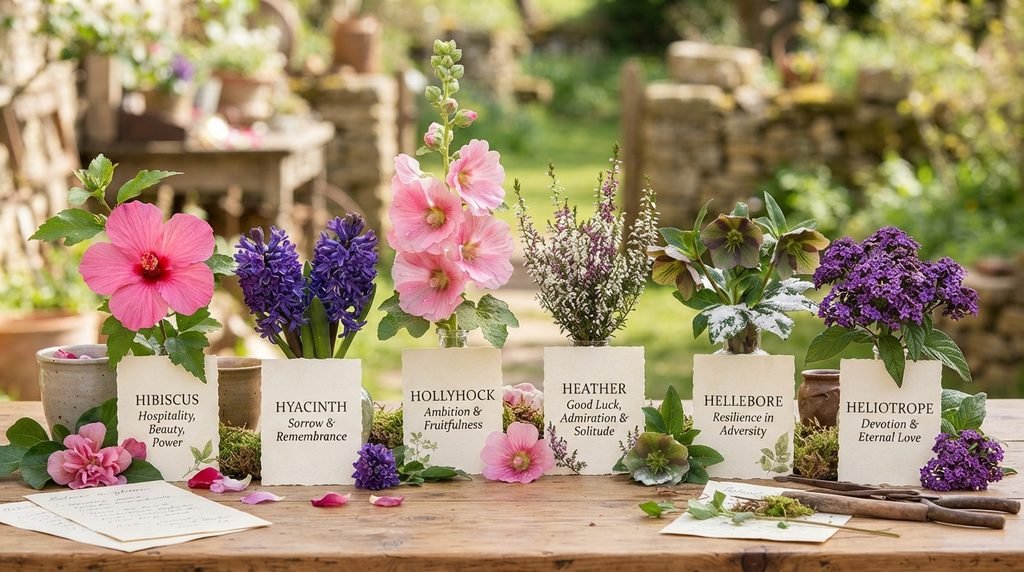
Hollyhock symbolism runs the other way. Victorian flower language associated it with ambition and fruitfulness, since the plant grows tall quickly and seeds abundantly. Heather carries its own regional meaning in Scotland, where white heather is a good-luck charm and purple heather signals admiration and solitude. Hellebore, blooming through frost and snow, has picked up associations with resilience, since it flowers when the rest of the garden is dormant.
Even lesser-known H flowers carry meaning in specific traditions. Heliotrope’s name comes from the Greek for “turning toward the sun,” and the plant became a symbol of devotion and eternal love because its flower heads appear to track the sun’s path across the sky.
H Flowers Grouped By Color
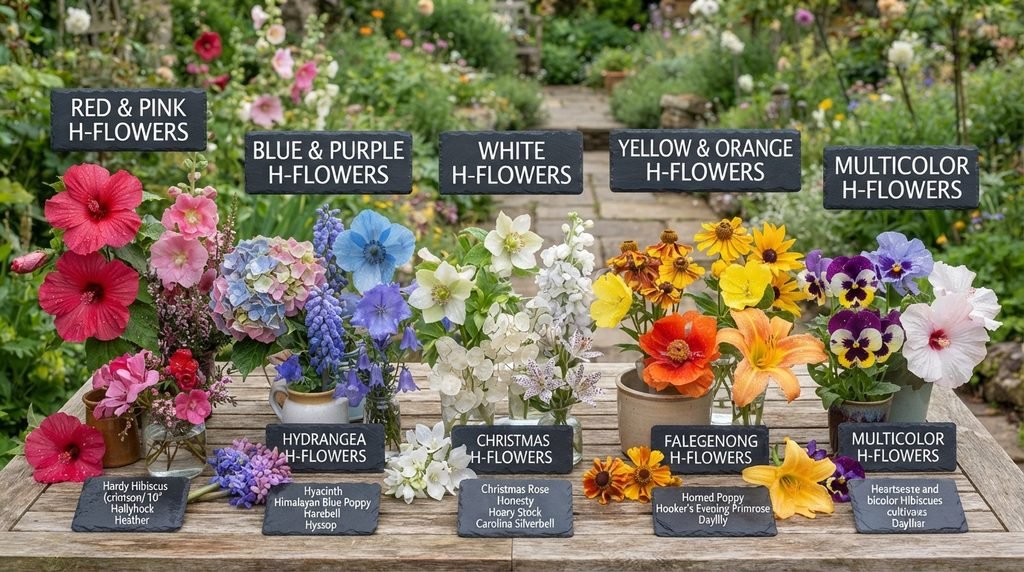
Color is usually the first filter a shopper or a garden designer applies, and this letter offers real depth in every major category. Grouping the flowers this way also makes it easier to spot which species solve a specific design problem, such as needing a true blue bloom or a plant that reads well in a monochrome white garden.
Red and pink flowers
Dominate this letter’s warm end. Hibiscus, hardy hibiscus, hollyhock, and heather all produce dependable reds and pinks, and hardy hibiscus in particular is prized for flowers that can stretch to ten inches across in shades of hot pink and crimson. These varieties suit borders and focal points where you want color visible from a distance.
Blue and purple flowers
Rarer in the plant world generally, which makes this letter’s contribution notable. Hydrangea can shift between blue and pink depending on soil pH, hyacinth offers some of the most saturated blue-violet tones available in a spring bulb, and Himalayan blue poppy is famous specifically because true blue pigment is so uncommon in flowers.
White flowers
Bring a calming, formal quality, and several H flowers specialize in it. Christmas rose, honesty, hoary stock, and Carolina silverbell all bloom in clean white, making them useful in moon gardens or evening landscapes where pale color reflects available light.
Yellow and orange flowers
Lean toward the wild and the pollinator-friendly. Sneezeweed, false sunflower, horned poppy, and hooker’s evening primrose all produce warm yellow or orange blooms and tend to attract bees and butterflies more readily than their showier red and pink counterparts.
Multicolor and bicolor flowers
Finish the palette. Heartsease is the classic example, with its characteristic purple, yellow, and white face packed into a single small bloom, and many hibiscus cultivars now come in bicolor combinations bred specifically for that layered look.
Garden Favorites Among H Flowers
Certain H flowers have become garden staples because they combine easy care with long bloom windows. Hollyhock is the classic cottage-garden anchor, sending up flower spikes that can reach six feet and self-seeding readily enough that many gardens keep a patch going for decades without replanting. Hydrangea earns its favorite status differently, through sheer flower size and the fact that a single well-placed shrub can define an entire corner of a yard.
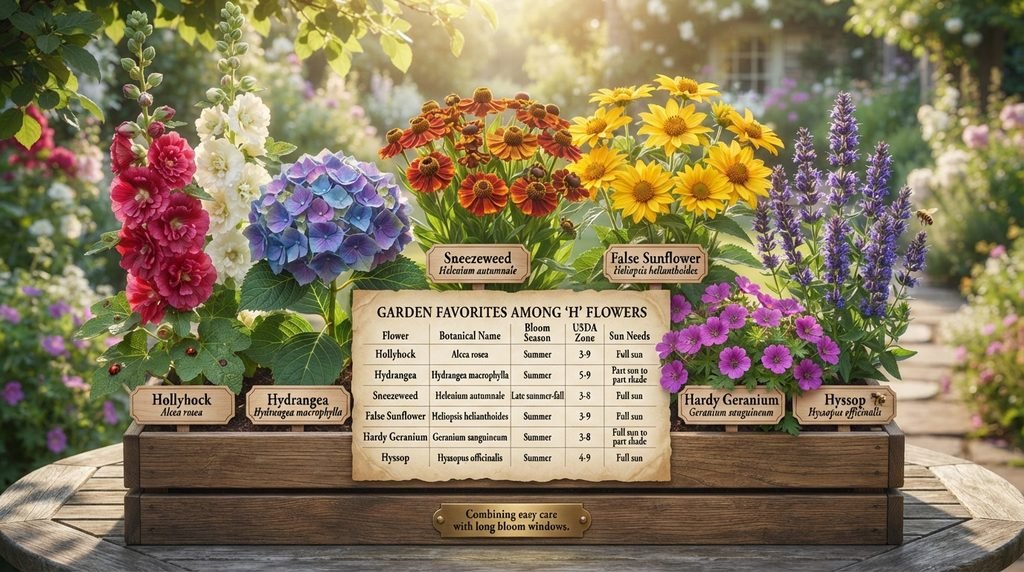
The table below lists these garden favorites along with the basic information a shopper needs before buying: which USDA zones they tolerate, when they bloom, and how much sun they expect. Hardiness zone ranges are approximate and can shift slightly depending on microclimate and cultivar, so treat them as a starting point rather than a guarantee.
| Flower | Botanical Name | Bloom Season | USDA Zone | Sun Needs |
| Hollyhock | Alcea rosea | Summer | 3-9 | Full sun |
| Hydrangea | Hydrangea macrophylla | Summer | 5-9 | Part sun to part shade |
| Sneezeweed | Helenium autumnale | Late summer-fall | 3-8 | Full sun |
| False Sunflower | Heliopsis helianthoides | Summer | 3-9 | Full sun |
| Hardy Geranium | Geranium sanguineum | Summer | 3-8 | Full sun to part shade |
| Hyssop | Hyssopus officinalis | Summer | 4-9 | Full sun |
Hollyhock and hydrangea are the two names most likely to show up on a beginner’s shopping list, largely because both are widely stocked at garden centers and forgiving of minor care mistakes. Hardy geranium is worth calling out separately, since it is one of the few entries here that thrives in part shade as well as full sun, giving it more placement flexibility than the others in this group.
Indoor Favorites Among H Flowers
Not every H flower needs a garden bed. Tropical hibiscus is one of the most common flowering houseplants sold in North America, prized for blooms that can open in a single day and close by evening, cycling through new flowers all summer if it gets enough light. Wax plant, better known by its genus name Hoya, has built a dedicated following among houseplant collectors for its thick, waxy leaves and clusters of star-shaped flowers that release a honey-like scent at night.
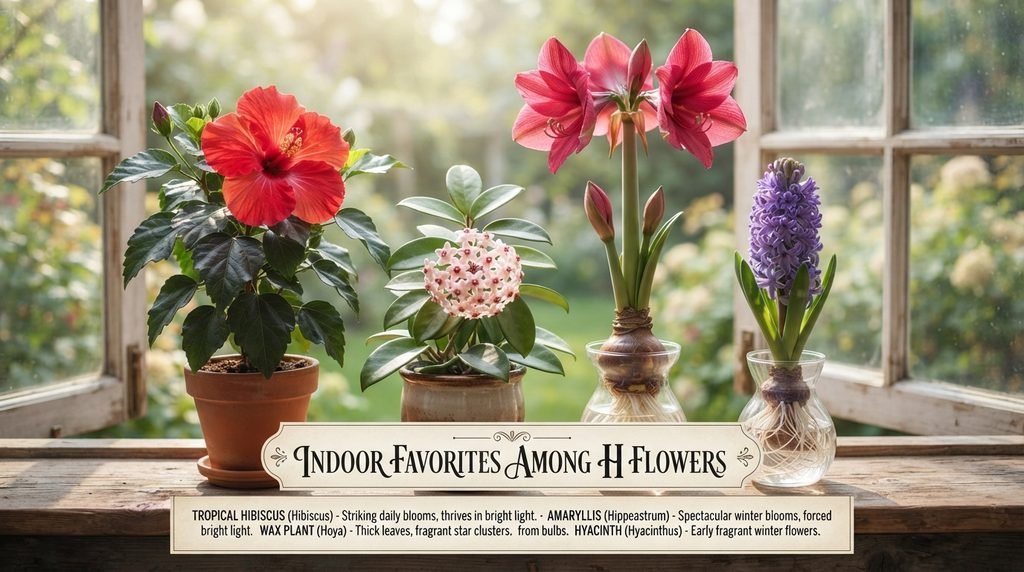
Hyacinth also crosses over into indoor territory when it is grown in bulb vases for forced winter blooms, a tradition that lets gardeners enjoy its fragrance weeks before outdoor bulbs would ever emerge. These four plants cover different needs: hibiscus and hoya both want bright light and steady warmth as long-term houseplants, while amaryllis and forced hyacinth are more like seasonal projects that bloom once and then either go dormant or get composted.
Florist Favorites Among H Flowers
Cut-flower use narrows this list considerably, since not every attractive garden flower holds up in a vase. Hydrangea remains the most widely used H flower in professional floristry, valued for the way a single stem can fill out an arrangement the way five or six smaller flowers would. Hyacinth appears constantly in spring bouquets and wedding work specifically for its scent, which most florist flowers cannot match.
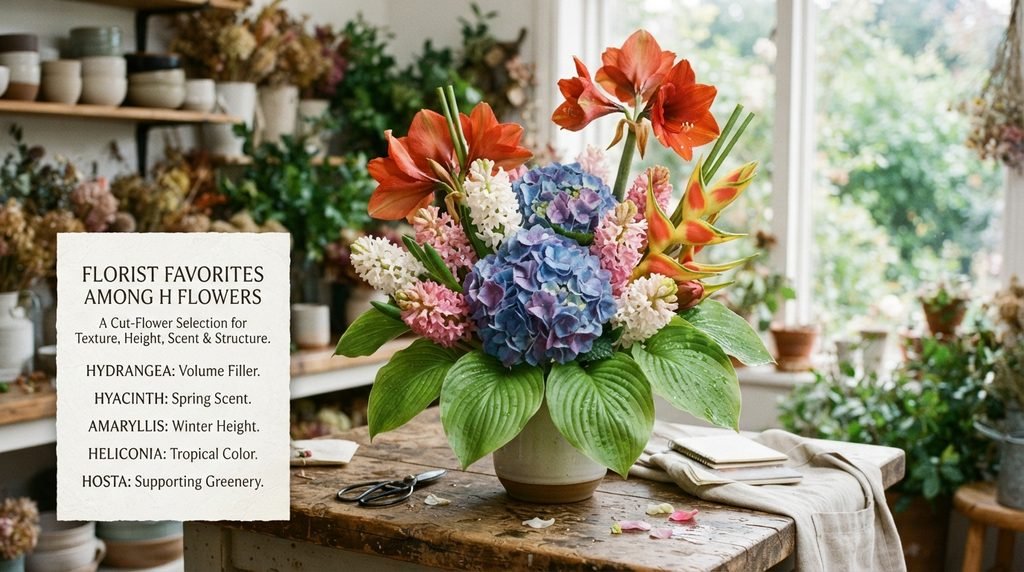
Hosta earns a place in this category too, though not for its flowers. Its broad, ribbed leaves are a workhorse greenery choice in mixed bouquets, prized for the way they frame more delicate blooms without wilting quickly. Between these five, a florist working entirely within this letter could cover texture, height, scent, tropical color, and supporting greenery, which says something about how genuinely varied this letter’s flowers turn out to be once you look past the obvious choices.
Rare and Unusual H Flowers
Some entries in this group are rare because they are difficult to grow, and others are rare because most gardeners have simply never encountered them. Himalayan blue poppy sits firmly in the first category: it demands cool summers, acidic soil, and consistent moisture that most home gardens cannot reliably provide, which is exactly why serious gardeners chase it for years before finally getting it to bloom. Blood lily, grown from the bulb genus Haemanthus, produces a strange pom-pom-shaped red flower head that looks more like a firework than a typical bloom, and it remains uncommon outside of South African native plant collections and specialty bulb catalogs.
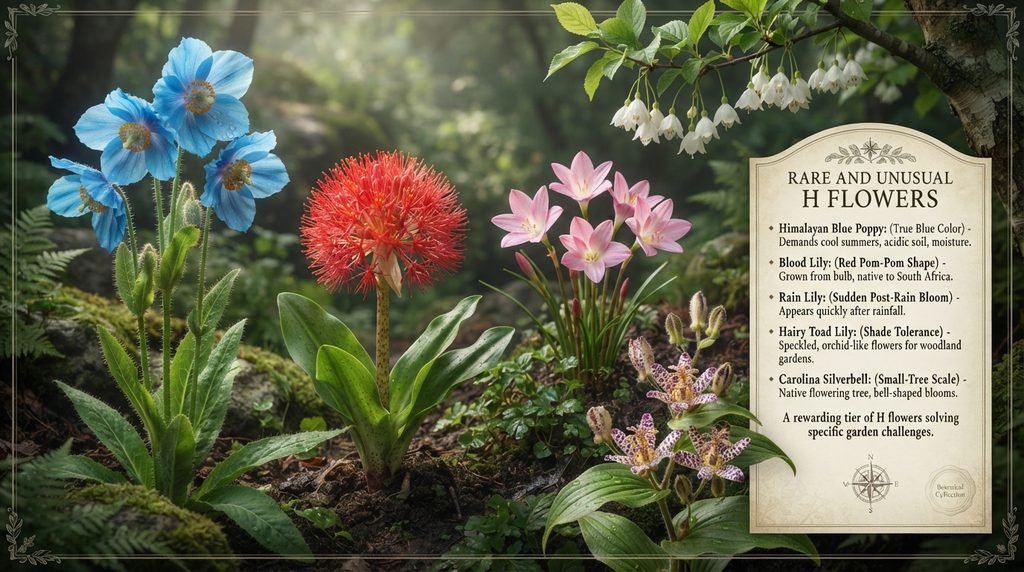
Rain lily, from the genus Habranthus, is rare in a different sense, appearing suddenly after rainfall and then vanishing again, which makes it feel more like a weather event than a planted flower. Hairy toad lily is rare mostly by unfamiliarity rather than difficulty, since it grows readily in shaded, moist woodland gardens but rarely gets planted because its speckled, orchid-like flowers do not photograph as well as splashier blooms.
- Himalayan Blue Poppy (Meconopsis betonicifolia)
- Blood Lily (Haemanthus coccineus)
- Rain Lily (Habranthus robustus)
- Hairy Toad Lily (Tricyrtis hirta)
- Carolina Silverbell (Halesia carolina)
What connects these five is that each one solves a very specific gardening problem that mainstream flowers do not: true blue color, a red pom-pom bloom shape, surprise post-rain flowering, deep shade tolerance, or small-tree scale flowering.
H Flowers You Should Handle With Caution
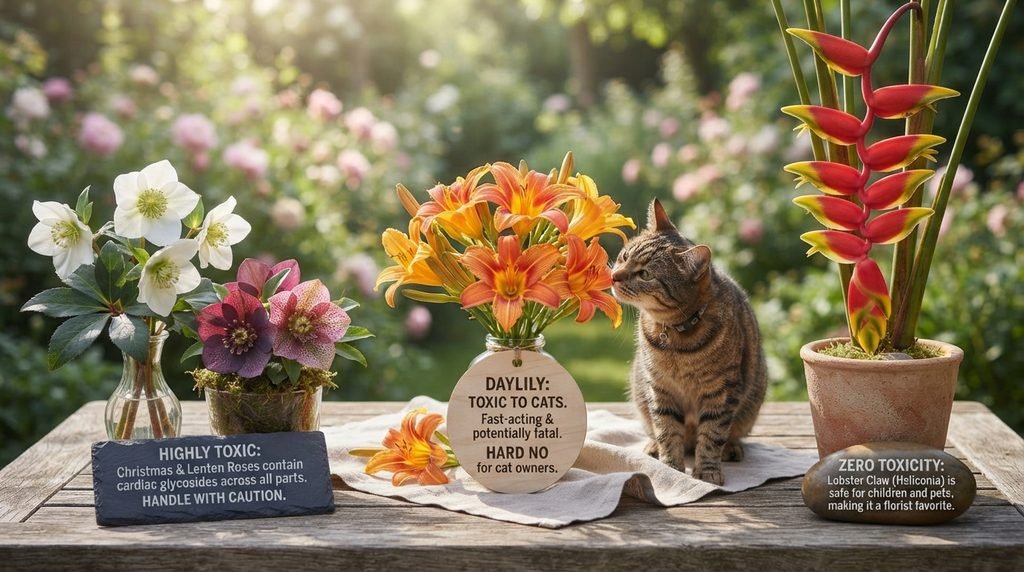
Toxicity is not a reason to avoid a plant outright, but it is information every gardener with pets, small children, or livestock nearby needs before buying. Hellebore sits at the top of this caution list, since every part of the plant contains cardiac glycosides that are toxic if ingested by humans or animals, and even the sap can irritate skin during pruning. Henbane is more serious still: this plant contains tropane alkaloids historically used in poisoning cases, and it should not be grown anywhere children or grazing animals have access.
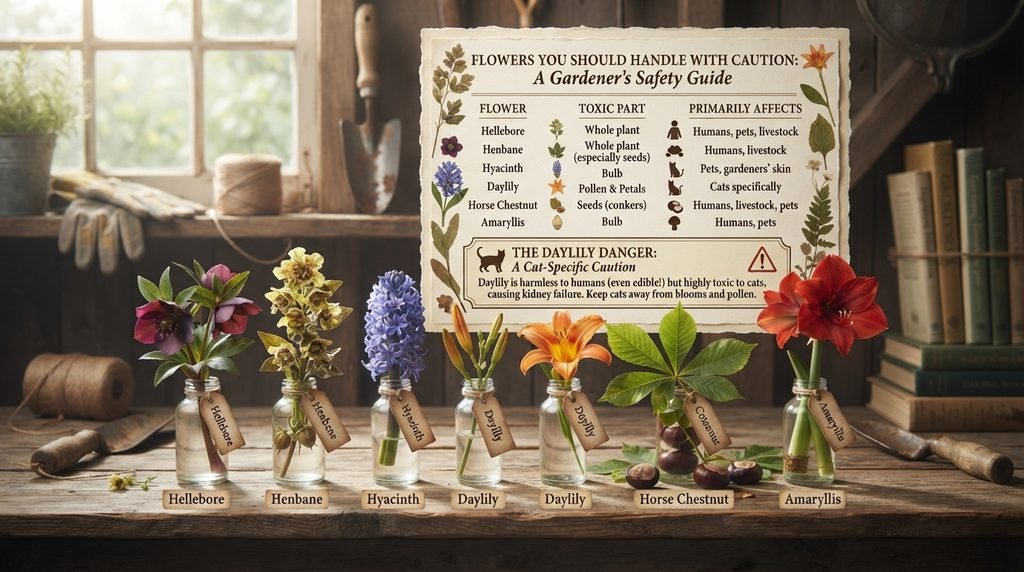
Hyacinth and daylily both surprise people because their danger is selective. Hyacinth bulbs contain calcium oxalate crystals that cause gastrointestinal upset in pets and can trigger a contact rash in gardeners who handle bulbs bare-handed, often called “hyacinth itch” among bulb growers. Daylily is essentially harmless to humans, whose flowers are even edible in some cuisines, but it is acutely toxic to cats, capable of causing kidney failure from even small amounts of pollen or petals. Horse chestnut and amaryllis round out the list as ornamental plants whose seeds and bulbs, respectively, carry enough toxic compounds that they warrant keeping away from curious pets and children.
| Flower | Toxic Part | Primarily Affects |
| Hellebore | Whole plant | Humans, pets, livestock |
| Henbane | Whole plant, especially seeds | Humans, livestock |
| Hyacinth | Bulb | Pets, gardeners’ skin |
| Daylily | Pollen, petals | Cats specifically |
| Horse Chestnut | Seeds (conkers) | Humans, livestock, pets |
| Amaryllis | Bulb | Humans, pets |
Daylily’s entry on this table deserves a second look, since it is the one case here where a plant is essentially safe for people while being dangerous specifically to one common household pet. That asymmetry is exactly why toxicity data has to be checked per species and per audience, not assumed from a plant’s reputation as a garden or florist favorite.
H Flowers By Life Cycle
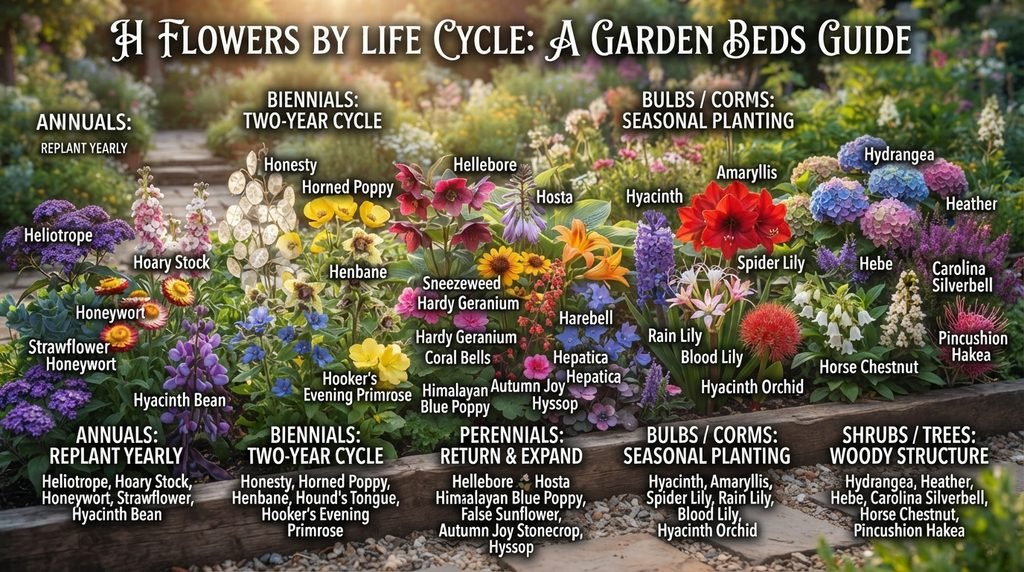
Knowing whether a plant is an annual, biennial, perennial, bulb, or woody shrub changes how you plan a garden bed, since it determines whether you are buying something once or replanting it every year. Bulbs like hyacinth and amaryllis need to be planted at a specific depth and season and often benefit from digging up and storing in colder climates, while perennials like hellebore and hosta are a one-time investment that returns and expands for years.
The table below sorts the most common H flowers into these five life-cycle categories, which should make replanting decisions faster for anyone building out a new bed.
| Life Cycle | Flowers |
| Annual | Heliotrope (in cold climates), Hoary Stock (in warm climates), Honeywort, Strawflower, Hyacinth Bean |
| Biennial | Honesty, Horned Poppy, Henbane, Hound’s Tongue, Hooker’s Evening Primrose |
| Perennial | Hellebore, Hosta, Daylily, Sneezeweed, Hardy Geranium, Coral Bells, Harebell, Hepatica, Himalayan Blue Poppy, False Sunflower, Autumn Joy Stonecrop, Hyssop |
| Bulb / Corm | Hyacinth, Amaryllis, Spider Lily, Rain Lily, Blood Lily, Hyacinth Orchid |
| Shrub / Tree | Hydrangea, Heather, Hebe, Carolina Silverbell, Horse Chestnut, Pincushion Hakea |
Perennials clearly dominate this letter, which is useful to know if you are trying to build a low-maintenance bed, since it means most H flowers will come back on their own without annual replanting.
Master List of H Flowers
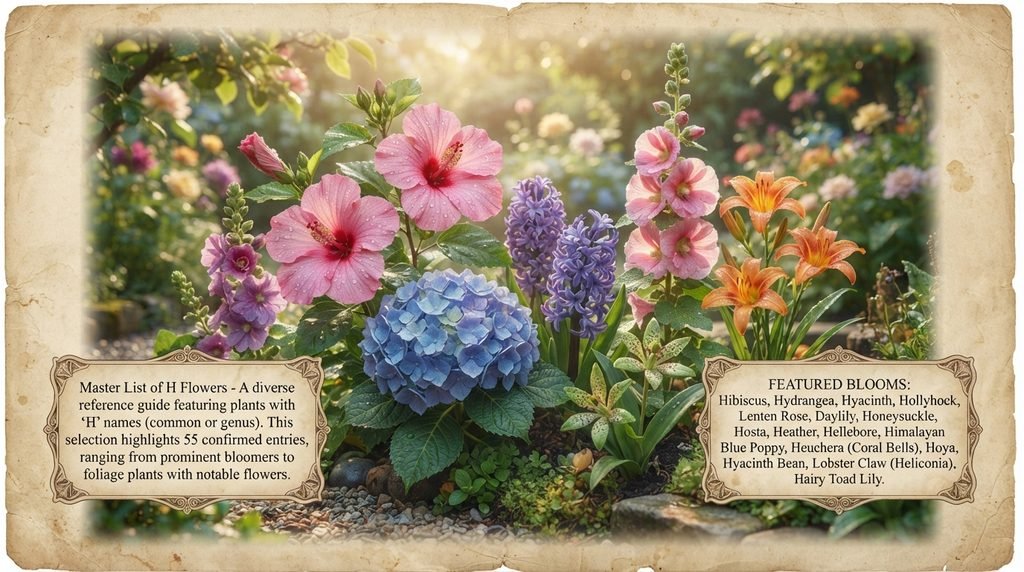
This reference list mixes two naming conventions. Some entries are best known by a common name that happens to start with H, such as hollyhock or hyacinth, while others are more commonly known by an entirely different common name and only start with H in their botanical genus, such as daylily, whose genus Hemerocallis is the reason it belongs on this list at all.
- Hibiscus — Hibiscus rosa-sinensis
- Hardy Hibiscus (Rose Mallow) — Hibiscus moscheutos
- Hydrangea — Hydrangea macrophylla
- Hyacinth — Hyacinthus orientalis
- Lenten Rose (Hellebore) — Helleborus orientalis
- Christmas Rose — Helleborus niger
- Hollyhock — Alcea rosea
- Japanese Honeysuckle — Lonicera japonica
- European Honeysuckle — Lonicera periclymenum
- Heather — Calluna vulgaris
- Heliotrope — Heliotropium arborescens
- Sneezeweed — Helenium autumnale
- Coral Bells — Heuchera sanguinea
- Hosta — Hosta plantaginea
- Daylily — Hemerocallis fulva
- Hemp Agrimony — Eupatorium cannabinum
- Henbane — Hyoscyamus niger
- Horned Poppy — Glaucium flavum
- Honesty — Lunaria annua
- Hoary Stock — Matthiola incana
- Honeywort — Cerinthe major
- Himalayan Blue Poppy — Meconopsis betonicifolia
- Amaryllis — Hippeastrum spp.
- Hoary Alyssum — Berteroa incana
- Hound’s Tongue — Cynoglossum officinale
- Harebell — Campanula rotundifolia
- Heartsease — Viola tricolor
- Horned Violet — Viola cornuta
- Hardy Geranium — Geranium sanguineum
- Hebe — Hebe speciosa
- Hyacinth Bean — Lablab purpureus
- Wax Plant (Hoya) — Hoya carnosa
- Spider Lily — Hymenocallis littoralis
- St. John’s Wort — Hypericum perforatum
- Chameleon Plant — Houttuynia cordata
- Lobster Claw — Heliconia rostrata
- Hepatica — Hepatica nobilis
- Hairy Toad Lily — Tricyrtis hirta
- Carolina Silverbell — Halesia carolina
- Horse Chestnut — Aesculus hippocastanum
- Hottentot Fig — Carpobrotus edulis
- Hedge Bindweed — Calystegia sepium
- Strawflower — Xerochrysum bracteatum
- False Sunflower — Heliopsis helianthoides
- Hyacinth Orchid — Bletilla striata
- Rain Lily — Habranthus robustus
- Blood Lily — Haemanthus coccineus
- Ginger Lily — Hedychium coronarium
- Pincushion Hakea — Hakea laurina
- Happy Wanderer — Hardenbergia violacea
- Autumn Joy Stonecrop — Hylotelephium spectabile
- Hedge Woundwort — Stachys sylvatica
- White Horehound — Marrubium vulgare
- Hyssop — Hyssopus officinalis
- Hooker’s Evening Primrose — Oenothera elata ssp. hookeri
This list runs to fifty-five confirmed entries, and it deliberately leaves out plants like hosta and coral bells’ close cousin heuchera in any expanded form beyond what is shown, since both are grown primarily for foliage rather than flowers and only earn a spot here because their flowers are still a genuine, if secondary, feature.
Botanical Name Crosswalk for H Flowers
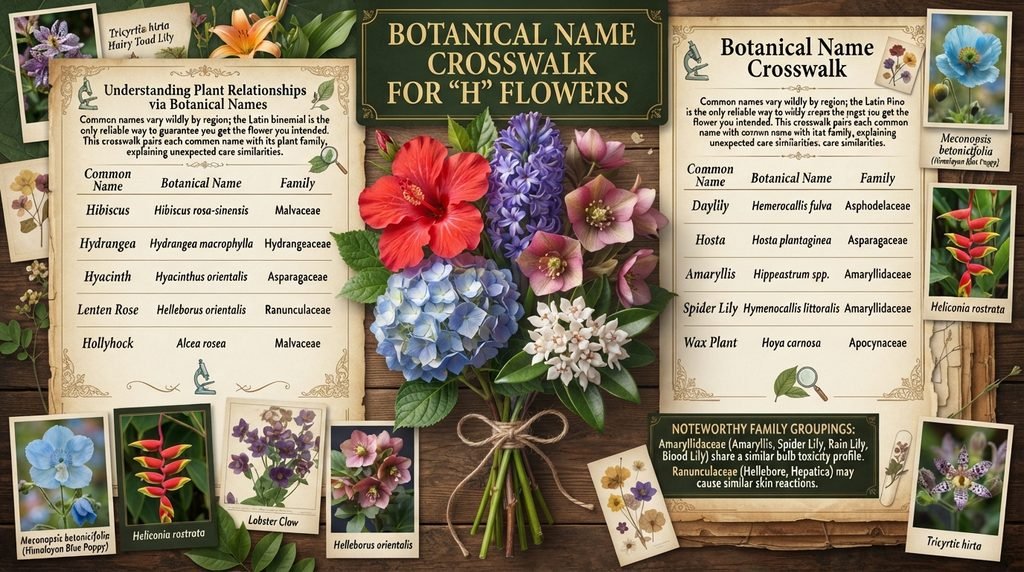
Common names vary by region, sometimes wildly, which is exactly why botanical names matter when you are ordering seeds or bulbs online or asking a nursery to special-order something specific. The crosswalk below pairs each common name from the master list with its plant family, which also helps explain unexpected care similarities between flowers that otherwise look nothing alike.
| Common Name | Botanical Name | Family |
| Hibiscus | Hibiscus rosa-sinensis | Malvaceae |
| Hardy Hibiscus | Hibiscus moscheutos | Malvaceae |
| Hydrangea | Hydrangea macrophylla | Hydrangeaceae |
| Hyacinth | Hyacinthus orientalis | Asparagaceae |
| Lenten Rose | Helleborus orientalis | Ranunculaceae |
| Christmas Rose | Helleborus niger | Ranunculaceae |
| Hollyhock | Alcea rosea | Malvaceae |
| Japanese Honeysuckle | Lonicera japonica | Caprifoliaceae |
| European Honeysuckle | Lonicera periclymenum | Caprifoliaceae |
| Heather | Calluna vulgaris | Ericaceae |
| Heliotrope | Heliotropium arborescens | Boraginaceae |
| Sneezeweed | Helenium autumnale | Asteraceae |
| Coral Bells | Heuchera sanguinea | Saxifragaceae |
| Hosta | Hosta plantaginea | Asparagaceae |
| Daylily | Hemerocallis fulva | Asphodelaceae |
| Hemp Agrimony | Eupatorium cannabinum | Asteraceae |
| Henbane | Hyoscyamus niger | Solanaceae |
| Horned Poppy | Glaucium flavum | Papaveraceae |
| Honesty | Lunaria annua | Brassicaceae |
| Hoary Stock | Matthiola incana | Brassicaceae |
| Honeywort | Cerinthe major | Boraginaceae |
| Himalayan Blue Poppy | Meconopsis betonicifolia | Papaveraceae |
| Amaryllis | Hippeastrum spp. | Amaryllidaceae |
| Hoary Alyssum | Berteroa incana | Brassicaceae |
| Hound’s Tongue | Cynoglossum officinale | Boraginaceae |
| Harebell | Campanula rotundifolia | Campanulaceae |
| Heartsease | Viola tricolor | Violaceae |
| Horned Violet | Viola cornuta | Violaceae |
| Hardy Geranium | Geranium sanguineum | Geraniaceae |
| Hebe | Hebe speciosa | Plantaginaceae |
| Hyacinth Bean | Lablab purpureus | Fabaceae |
| Wax Plant | Hoya carnosa | Apocynaceae |
| Spider Lily | Hymenocallis littoralis | Amaryllidaceae |
| St. John’s Wort | Hypericum perforatum | Hypericaceae |
| Chameleon Plant | Houttuynia cordata | Saururaceae |
| Lobster Claw | Heliconia rostrata | Heliconiaceae |
| Hepatica | Hepatica nobilis | Ranunculaceae |
| Hairy Toad Lily | Tricyrtis hirta | Liliaceae |
| Carolina Silverbell | Halesia carolina | Styracaceae |
| Horse Chestnut | Aesculus hippocastanum | Sapindaceae |
| Hottentot Fig | Carpobrotus edulis | Aizoaceae |
| Hedge Bindweed | Calystegia sepium | Convolvulaceae |
| Strawflower | Xerochrysum bracteatum | Asteraceae |
| False Sunflower | Heliopsis helianthoides | Asteraceae |
| Hyacinth Orchid | Bletilla striata | Orchidaceae |
| Rain Lily | Habranthus robustus | Amaryllidaceae |
| Blood Lily | Haemanthus coccineus | Amaryllidaceae |
| Ginger Lily | Hedychium coronarium | Zingiberaceae |
| Pincushion Hakea | Hakea laurina | Proteaceae |
| Happy Wanderer | Hardenbergia violacea | Fabaceae |
| Autumn Joy Stonecrop | Hylotelephium spectabile | Crassulaceae |
| Hedge Woundwort | Stachys sylvatica | Lamiaceae |
| White Horehound | Marrubium vulgare | Lamiaceae |
| Hyssop | Hyssopus officinalis | Lamiaceae |
| Hooker’s Evening Primrose | Oenothera elata ssp. hookeri | Onagraceae |
A few families repeat often enough to be worth noticing on their own. Amaryllidaceae shows up four separate times across this letter, in amaryllis, spider lily, rain lily, and blood lily, which explains why all four share the same bulb toxicity profile despite looking quite different.
Full Comparison Table of H Flowers
The table below is the densest reference in this guide, combining native range, bloom season, hardiness zone, and toxicity status for the fifty-five flowers covered in the master list. Native range matters beyond trivia value, since a plant native to your region will usually need less irrigation and fewer pest treatments than one imported from a very different climate.
| Flower | Native Range | Bloom Season | USDA Zone | Toxicity |
| Hibiscus | East Asia | Summer-fall | 9-11 | Non-toxic (mild GI upset possible) |
| Hardy Hibiscus | Eastern/Central North America | Mid-late summer | 4-9 | Non-toxic |
| Hydrangea | Japan, East Asia | Summer | 5-9 | Toxic (cyanogenic glycosides) |
| Hyacinth | Eastern Mediterranean | Early spring | 4-8 | Toxic (bulb) |
| Lenten Rose | Greece, Turkey, Caucasus | Late winter-early spring | 4-9 | Highly toxic |
| Christmas Rose | Central/Southern Europe | Winter | 3-8 | Highly toxic |
| Hollyhock | Western Asia | Summer | 3-9 | Non-toxic |
| Japanese Honeysuckle | East Asia | Summer | 4-9 | Mildly toxic (berries) |
| European Honeysuckle | Europe | Summer | 5-9 | Mildly toxic (berries) |
| Heather | Europe | Late summer-fall | 4-6 | Non-toxic |
| Heliotrope | Peru | Summer | 10-11 | Toxic |
| Sneezeweed | North America | Late summer-fall | 3-8 | Mildly toxic/irritant |
| Coral Bells | Southwestern US/Mexico | Late spring-summer | 4-9 | Non-toxic |
| Hosta | East Asia | Late summer | 3-9 | Toxic to cats/dogs |
| Daylily | East Asia | Summer | 3-9 | Toxic to cats only |
| Hemp Agrimony | Europe, Western Asia | Summer | 4-8 | Mildly toxic |
| Henbane | Europe, Western Asia | Summer | 4-8 | Highly toxic |
| Horned Poppy | Coastal Europe | Summer | 6-9 | Toxic |
| Honesty | Southeast Europe, Western Asia | Spring | 4-8 | Mildly toxic in quantity |
| Hoary Stock | Mediterranean | Spring-summer | 7-10 | Non-toxic |
| Honeywort | Mediterranean | Summer | Annual | Non-toxic |
| Himalayan Blue Poppy | Himalayas | Late spring-early summer | 3-9 | Mildly irritant sap |
| Amaryllis | South America | Winter-spring | 9-11 | Toxic (bulb) |
| Hoary Alyssum | Europe | Summer | Widespread weed | Toxic to horses |
| Hound’s Tongue | Europe | Late spring-summer | 3-8 | Toxic |
| Harebell | Northern Hemisphere temperate zones | Summer | 3-8 | Non-toxic |
| Heartsease | Europe | Spring-fall | 4-8 | Non-toxic |
| Horned Violet | Pyrenees | Spring-summer | 6-9 | Non-toxic |
| Hardy Geranium | Europe | Summer | 3-8 | Non-toxic |
| Hebe | New Zealand | Summer-fall | 8-10 | Generally non-toxic |
| Hyacinth Bean | Africa | Summer-fall | Annual | Toxic raw (seeds/pods) |
| Wax Plant | East Asia, Australia | Summer | 10-12 | Mildly toxic to pets |
| Spider Lily | Caribbean, Central America | Summer | 8-11 | Toxic (bulb) |
| St. John’s Wort | Europe, Asia | Summer | 3-8 | Toxic to livestock |
| Chameleon Plant | East/Southeast Asia | Summer | 5-11 | Non-toxic |
| Lobster Claw | Central/South America | Year-round (tropics) | 10-12 | Non-toxic |
| Hepatica | Europe, temperate Asia, North America | Early spring | 4-8 | Mildly toxic |
| Hairy Toad Lily | Japan | Late summer-fall | 4-9 | Non-toxic |
| Carolina Silverbell | Southeastern US | Spring | 5-8 | Non-toxic |
| Horse Chestnut | Balkans | Spring | 3-8 | Toxic (seeds) |
| Hottentot Fig | South Africa | Spring-summer | 9-11 | Non-toxic |
| Hedge Bindweed | Europe, temperate regions | Summer | 4-9 | Mildly toxic |
| Strawflower | Australia | Summer-fall | Annual | Non-toxic |
| False Sunflower | North America | Summer | 3-9 | Non-toxic |
| Hyacinth Orchid | China, Japan, Korea | Late spring | 5-9 | Non-toxic |
| Rain Lily | South America | Summer, after rain | 7-10 | Toxic (bulb) |
| Blood Lily | South Africa | Late summer-fall | 9-11 | Toxic (bulb) |
| Ginger Lily | Himalayas, tropical Asia | Summer-fall | 8-11 | Non-toxic |
| Pincushion Hakea | Western Australia | Fall-winter | 9-11 | Non-toxic (sharp foliage) |
| Happy Wanderer | Australia | Winter-spring | 9-11 | Mildly toxic seeds |
| Autumn Joy Stonecrop | East Asia | Late summer-fall | 4-9 | Non-toxic |
| Hedge Woundwort | Europe | Summer | 4-8 | Non-toxic |
| White Horehound | Europe, Asia | Summer | 4-9 | Generally safe |
| Hyssop | Southern Europe, Middle East | Summer | 4-9 | Non-toxic |
| Hooker’s Evening Primrose | Western North America | Summer | 4-9 | Non-toxic |
Three rows stand out from this table for opposite reasons. Christmas rose and lenten rose are rated “highly toxic” rather than the more common “toxic” or “mildly toxic,” which reflects the concentration of cardiac glycosides across every part of the plant, not just the flower or seed.
Decision-Flow Table for H Flowers
Sometimes the fastest way to choose a plant is to start from the constraint rather than the flower. The table below works backward from common gardening situations, whether that is a shaded yard, a household with cats, or a desire for fragrance, and points to which flowers that start with H actually fit.
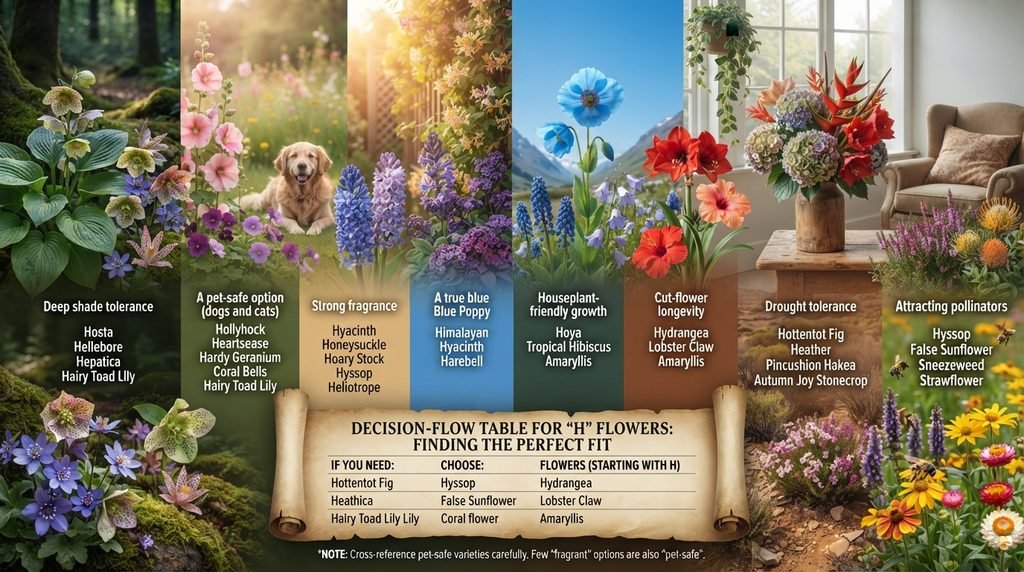
| If You Need… | Choose |
| Deep shade tolerance | Hosta, Hellebore, Hepatica, Hairy Toad Lily |
| A pet-safe option (dogs and cats) | Hollyhock, Heartsease, Hardy Geranium, Coral Bells, Hairy Toad Lily |
| Strong fragrance | Hyacinth, Honeysuckle, Hoary Stock, Hyssop, Heliotrope |
| A true blue flower | Himalayan Blue Poppy, Hyacinth, Harebell |
| Houseplant-friendly growth | Hoya, Tropical Hibiscus, Amaryllis |
| Cut-flower longevity | Hydrangea, Lobster Claw, Amaryllis |
| Drought tolerance | Hottentot Fig, Heather, Pincushion Hakea, Autumn Joy Stonecrop |
| Attracting pollinators | Hyssop, False Sunflower, Sneezeweed, Strawflower |
The pet-safe row is worth double-checking against the caution table above before planting, since “pet-safe” here specifically excludes hellebore, hyacinth, daylily, amaryllis, and horse chestnut, all of which appear elsewhere on this list as attractive options for gardeners without animals in the household. Anyone cross-referencing both tables at once will notice that very few H flowers satisfy both “fragrant” and “pet-safe” simultaneously, which is a genuine trade-off worth planning around rather than a gap in the data.
Conclusion
From towering hollyhocks to the quiet, frost-defying blooms of hellebore, flowers that start with H cover nearly every growing condition, color, and use case a gardener could ask for. This guide organizes more than fifty-five verified varieties by color, life cycle, toxicity, and practical use so that the list works as a real planning tool rather than just a name-dropping exercise. Whether the goal is a fragrant cutting garden, a shade bed, or a single dramatic houseplant, there is an H flower suited to the job, and the reference tables above should make it straightforward to match the right one to the right spot.
Frequently Asked Questions
What are the most popular flowers that start with H?
Hibiscus, hydrangea, and hyacinth are the three most widely grown and purchased flowers in this letter group. All three are stocked at most general garden centers, unlike many of the rarer entries on this list that require a specialty nursery.
Are hydrangeas toxic to dogs?
Yes. Hydrangea contains cyanogenic glycosides throughout the plant, and ingestion by dogs can cause vomiting, diarrhea, and lethargy. Keeping dogs from chewing on hydrangea leaves or flowers is the simplest way to avoid a problem.
Is hibiscus safe to eat?
Hibiscus flowers are generally considered safe and are commonly dried for tea or used fresh as an edible garnish, particularly Hibiscus sabdariffa and Hibiscus rosa-sinensis. As with any edible flower, it should only be eaten if it was grown without pesticide treatment.
What flower starting with H is toxic to cats specifically?
Daylily is the flower gardeners with cats need to worry about most, since even a small amount of pollen or petal can cause acute kidney failure in cats. This makes it one of the more dangerous common garden flowers for households with indoor-outdoor cats.
Why does hellebore bloom in winter when other flowers don’t?
Hellebore has evolved cold tolerance that lets its buds survive frost and even light snow cover, opening as soon as temperatures allow rather than waiting for full spring warmth.
Can you grow Himalayan blue poppy outside of the Himalayas?
Yes, but it requires cool summers, consistently moist and slightly acidic soil, and partial shade, conditions most easily replicated in northern coastal climates or mountain gardens.