80 Beautiful Flowers That Start With C: Names, Photos & Growing Tips
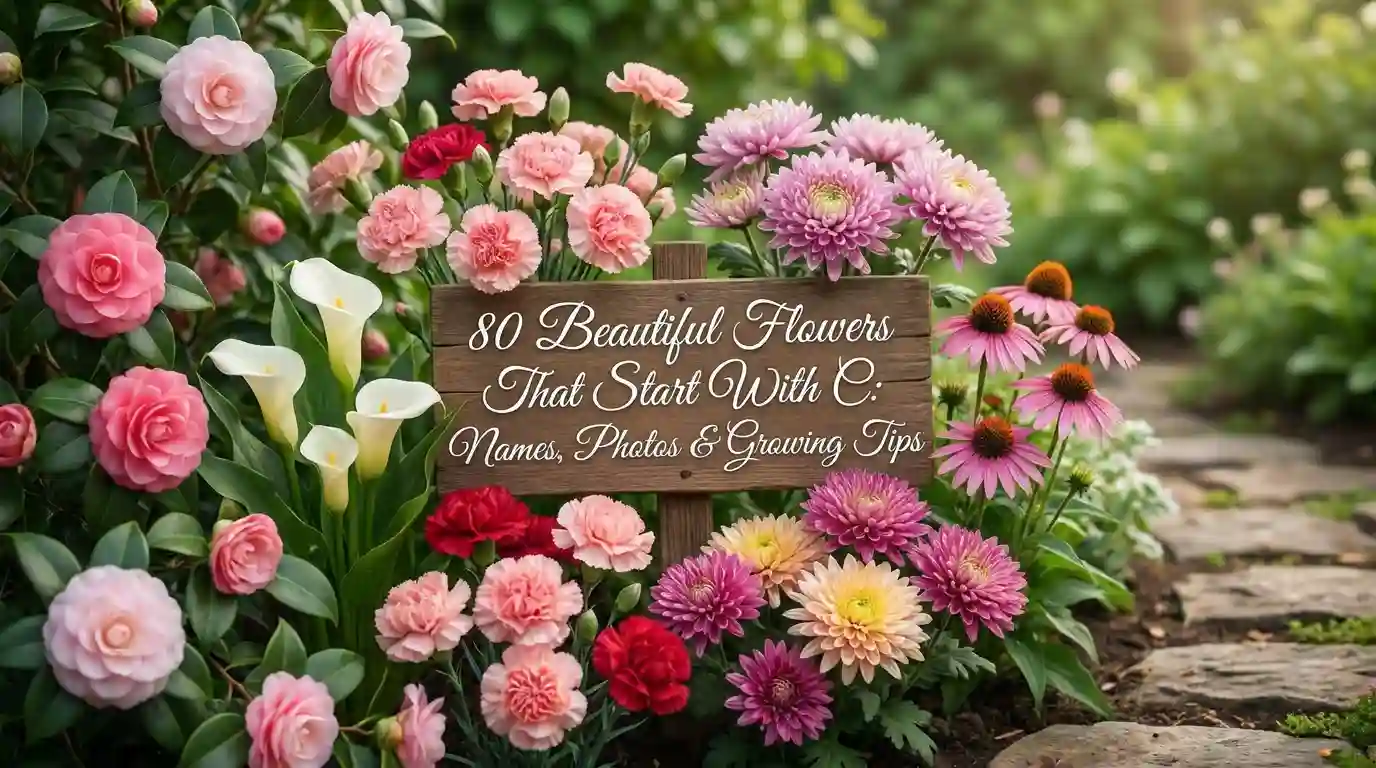
Somewhere between the calendula in a herb bed and the Cattleya orchid on a windowsill, the letter C turns out to be one of the richest in the entire flower alphabet. Most gardeners searching for flowers that start with C stop at carnations and chrysanthemums, but the letter actually stretches across shrubs, vines, bulbs, herbs, orchids, and houseplants that rarely make it into shorter lists. This guide brings together 80 verified names, each checked for its botanical name and safety around pets or children, so the information can be trusted rather than skimmed.
The organization here is practical rather than strictly alphabetical. Instead of one long scroll of names, the guide groups these flowers that start with C by what a reader actually needs: a symbolic meaning for a gift, a color scheme for a border, a pet-safe houseplant, or a name that will flower indoors through a gray winter. Every table below sits inside a paragraph that explains what it shows, and by the end you should be able to name a strong pick for almost any color, season, or growing space — plus know which popular ones deserve a second look before going near a curious pet.
Quick Answer: The Standout Picks
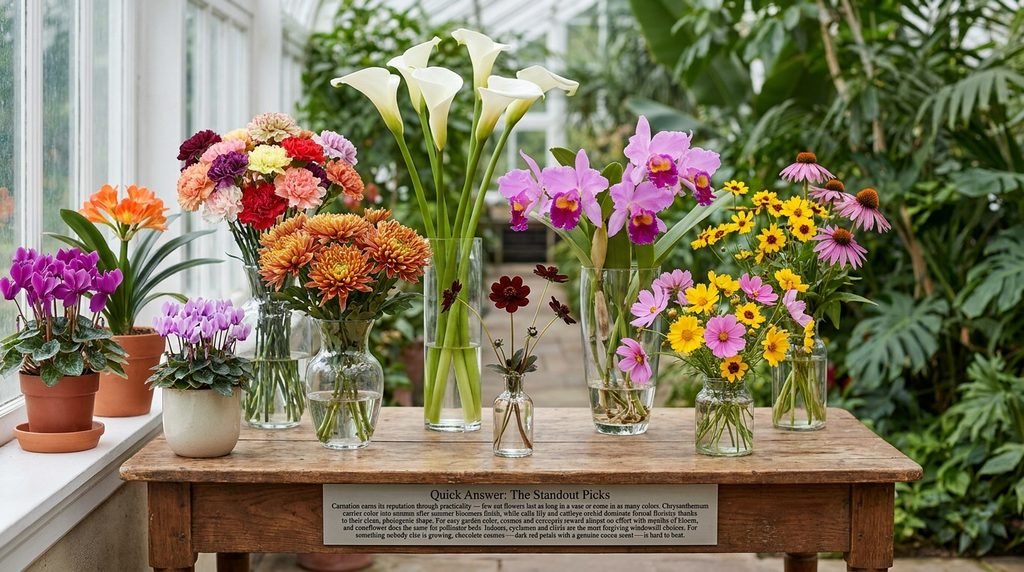
Carnation earns its reputation through practicality — few cut flowers last as long in a vase or come in as many colors. Chrysanthemum carries color into autumn after summer bloomers finish, while calla lily and cattleya orchid dominate formal floristry thanks to their clean, photogenic shape. For easy garden color, cosmos and coreopsis reward almost no effort with months of bloom, and coneflower does the same for pollinator beds. Indoors, cyclamen and clivia are the most forgiving windowsill choices. For something nobody else is growing, chocolate cosmos — dark red petals with a genuine cocoa scent — is hard to beat.
What Flowers That Start With C Symbolize
Flower meanings shift across cultures, so none of this is a fixed rulebook. Carnation is layered: red leans toward romantic love, while white is tied more to remembrance. Chrysanthemum flips meaning by geography — a symbol of longevity across much of East Asia, but associated with mourning in several European countries. Calla lily has settled into a reputation for quiet elegance, columbine suggests resilience thanks to its odd spurred petals, and crocus, usually the first bulb through late-winter soil, has become shorthand for renewal.
Color Groups at a Glance
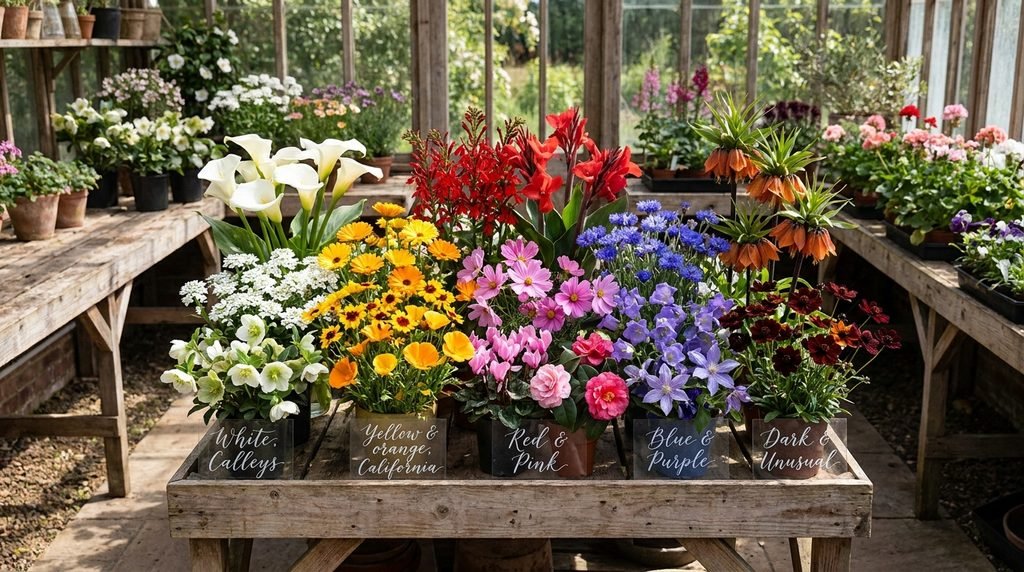
White is well covered by calla lily, candytuft, and Christmas rose, all suited to shaded or evening gardens. Yellow and orange are the workhorses — calendula and coreopsis bloom for months with little care, while crocosmia and California poppy add taller or sunnier accents. Red belongs to cardinal flower and canna lily, pink to cosmos, cyclamen, and camellia. Blue and purple are where this letter gets genuinely competitive: cornflower is one of the clearest true blues anywhere, while campanula, clematis, and clitoria (the butterfly pea vine) round out cooler tones. For dark, unusual color, chocolate cosmos and crown imperial lean into deep maroon and burnt orange.
Garden Favorites
Coneflower and coreopsis are North American perennials that tolerate poor soil and neglect while still feeding pollinators for months. Cosmos does the annual version of the same job — scatter seed in a sunny bed, and it blooms until frost. Catmint has become a landscaper’s default edging plant thanks to tidy silver foliage and lavender spikes that bounce back hard after a trim.
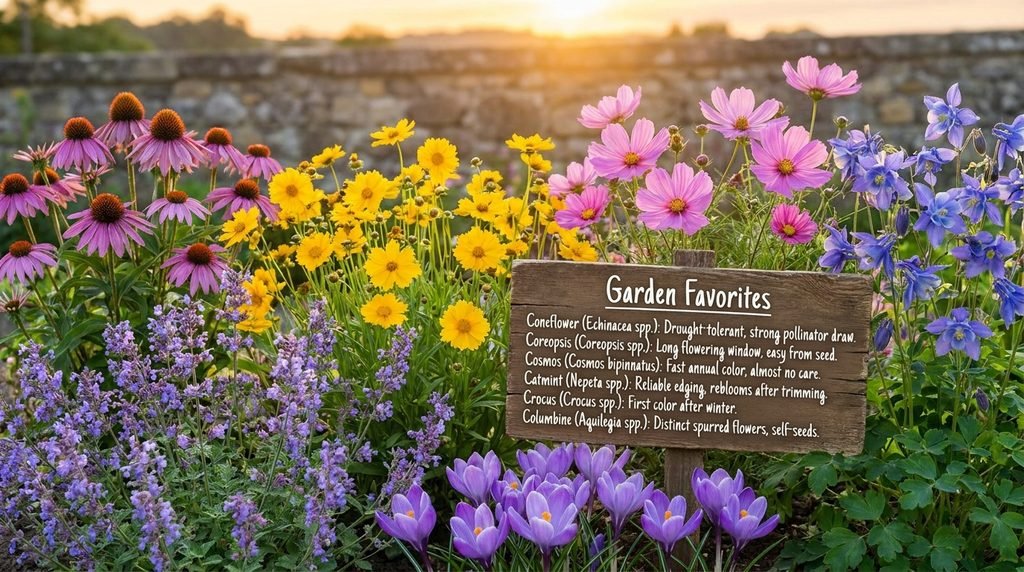
| Garden Favorite | Botanical Name | Why It’s Chosen |
| Coneflower | Echinacea spp. | Drought-tolerant, strong pollinator draw |
| Coreopsis | Coreopsis spp. | Long flowering window, easy from seed |
| Cosmos | Cosmos bipinnatus | Fast annual color, almost no care |
| Catmint | Nepeta spp. | Reliable edging, reblooms after trimming |
| Crocus | Crocus spp. | First color after winter |
| Columbine | Aquilegia spp. | Distinct spurred flowers, self-seeds |
Indoor and Container Picks
Cyclamen blooms through the coolest months indoors, given bright light and careful watering. Clivia tolerates low light better than most flowering plants and rewards patience with winter blooms. Christmas cactus flowers almost on cue in December, and Cattleya or Cymbidium orchids remain the go-to for a showy indoor bloom without a greenhouse.
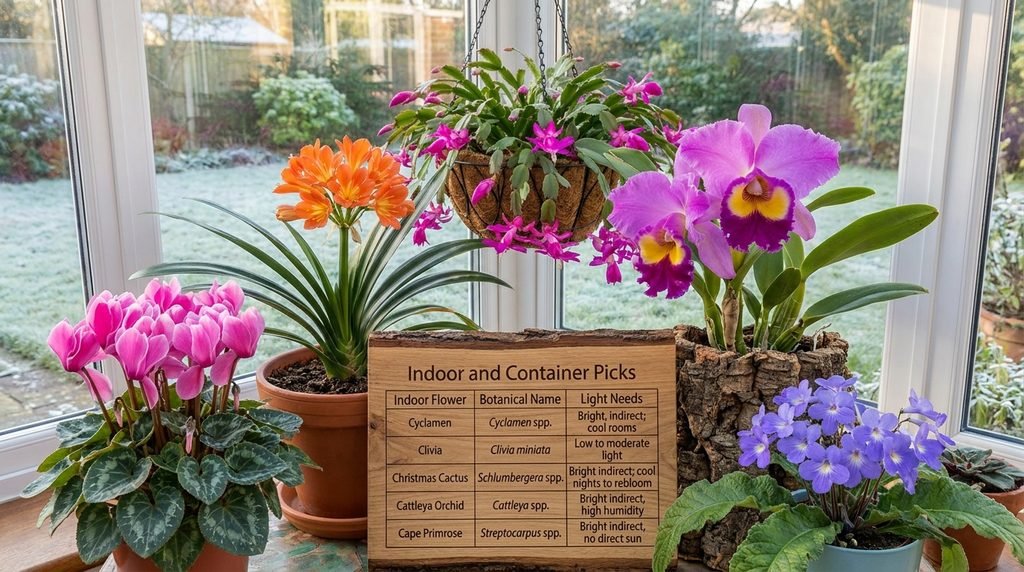
| Indoor Flower | Botanical Name | Light Needs |
| Cyclamen | Cyclamen spp. | Bright, indirect; cool rooms |
| Clivia | Clivia miniata | Low to moderate light |
| Christmas Cactus | Schlumbergera spp. | Bright indirect; cool nights to rebloom |
| Cattleya Orchid | Cattleya spp. | Bright indirect, high humidity |
| Cape Primrose | Streptocarpus spp. | Bright indirect, no direct sun |
Florist Favorites
Carnation is the industry workhorse — it ships well and lasts two weeks or more in water. Chrysanthemum fills the same role for fuller, textured arrangements, calla lily anchors modern minimalist bouquets, and cosmos and cornflower have become popular in farm-style arrangements as an alternative to stiffer, formal designs.
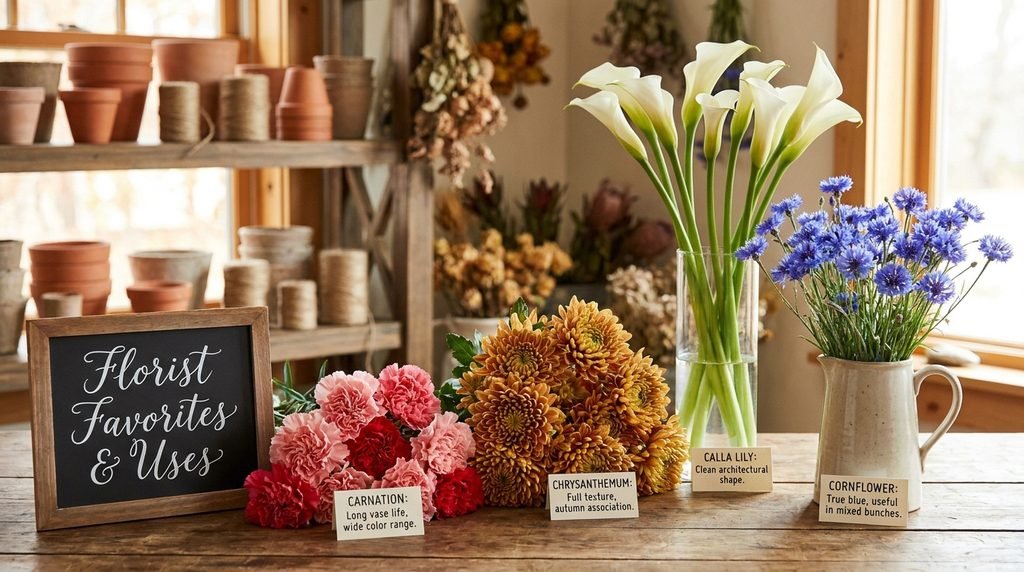
| Florist Favorite | Why It’s Used |
| Carnation | Long vase life, wide color range |
| Chrysanthemum | Full texture, autumn association |
| Calla Lily | Clean architectural shape |
| Cornflower | True blue, useful in mixed bunches |
Rare Finds Worth Seeking Out
Chocolate cosmos is the clearest standout — deep maroon petals with a real chocolate scent, usually grown from tubers rather than seed. Crown imperial is a tall spring bulb topped with hanging bells and a musky smell some gardeners love and others avoid. Checkered lily is easy to miss in a catalog but has an unusual checkerboard petal pattern, and clitoria offers a genuinely rare true-blue bloom more commonly known as a natural food dye in parts of Asia than as an ornamental in the West.
A Caution on Toxicity
Not every attractive bloom is safe around pets or kids. Castor bean seeds contain ricin and are dangerous even in small amounts. Convallaria (lily of the valley) looks harmless but contains cardiac glycosides that can affect heart rhythm.
Cyclamen and Christmas rose are toxic if eaten, and calla lily’s oxalate crystals cause mouth and throat irritation. Chrysanthemum, by contrast, usually causes only mild skin or stomach irritation rather than a genuine emergency — worth knowing before assuming every name on this caution list carries equal risk.
Life Cycle at a Glance
Annuals like calendula, cosmos, and cornflower give fast first-year color with no long-term commitment. Perennials such as coneflower, coreopsis, and catmint take longer to establish but return yearly. Tender perennials like canna lily and calla lily behave as true perennials in warm climates but need lifting and storage everywhere else — a distinction that trips up more gardeners than any other on this list.
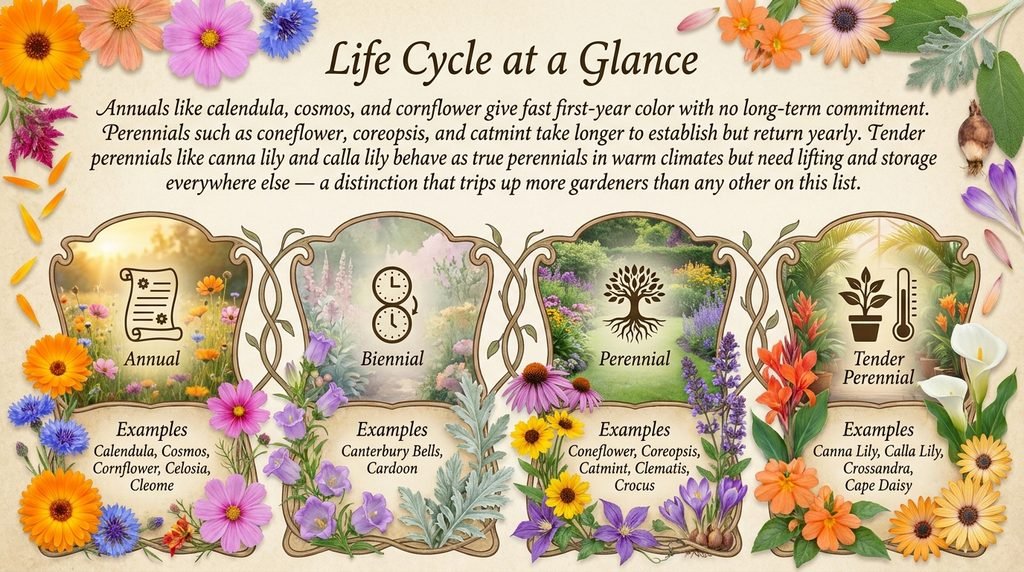
| Life Cycle | Examples |
| Annual | Calendula, Cosmos, Cornflower, Celosia, Cleome |
| Biennial | Canterbury Bells, Cardoon |
| Perennial | Coneflower, Coreopsis, Catmint, Clematis, Crocus |
| Tender Perennial | Canna Lily, Calla Lily, Crossandra, Cape Daisy |
Full Comparison Table
The table below is the master reference for this guide, listing all 80 flowers that start with C alphabetically, with botanical name, type, primary color, and a safety note in one place. It doubles as both a quick nursery lookup and a safety check — read the safety column even for flowers you already know, since a few common garden names carry mild toxicity that many people miss.
A quick note before you scan it: calla lily and canna lily sound alike but aren’t related at all, and camas lily should never be foraged casually since it closely resembles the toxic death camas in the wild.
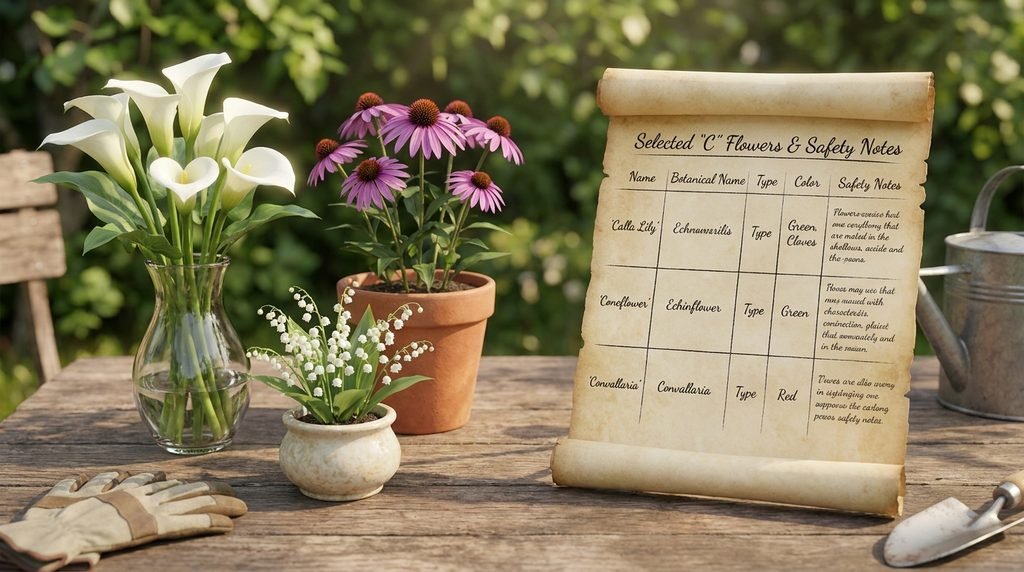
| Flower | Botanical Name | Type | Color | Safety Note |
| Cactus Flower | Cactaceae family | Succulent | Varies | Spines are the main hazard |
| Caladium | Caladium spp. | Tuberous | White/green blooms | Toxic if chewed |
| Calceolaria | Calceolaria spp. | Tender perennial | Yellow, orange, red | Low risk |
| Calendula | Calendula officinalis | Annual | Orange, yellow | Non-toxic; edible |
| Calibrachoa | Calibrachoa spp. | Tender perennial | Many shades | Low risk |
| California Flannel Bush | Fremontodendron californicum | Shrub | Yellow | Leaf hairs irritate skin |
| California Poppy | Eschscholzia californica | Annual | Orange, yellow | Mildly toxic if eaten |
| Calla Lily | Zantedeschia spp. | Tender perennial | White, pink, yellow | Toxic; oxalate irritation |
| Calluna (Heather) | Calluna vulgaris | Shrub | Pink, purple, white | Non-toxic |
| Camas Lily | Camassia spp. | Bulb | Blue, violet, white | Toxic look-alikes exist |
| Camellia | Camellia japonica | Shrub | White, pink, red | Non-toxic |
| Campanula | Campanula spp. | Perennial | Blue, purple, white | Non-toxic |
| Campion | Silene spp. | Perennial/biennial | Pink, red, white | Non-toxic |
| Canada Violet | Viola canadensis | Perennial | White | Non-toxic |
| Canadian Goldenrod | Solidago canadensis | Perennial | Yellow | Non-toxic |
| Candytuft | Iberis spp. | Perennial/annual | White, pink | Non-toxic |
| Canna Lily | Canna spp. | Tender perennial | Red, orange, yellow | Non-toxic |
| Canterbury Bells | Campanula medium | Biennial | Blue, purple, pink | Non-toxic |
| Cape Daisy | Osteospermum spp. | Tender perennial | White, purple, yellow | Low risk |
| Cape Primrose | Streptocarpus spp. | Perennial | Purple, pink, blue | Non-toxic |
| Cardinal Flower | Lobelia cardinalis | Perennial | Red | Mildly toxic |
| Cardoon | Cynara cardunculus | Perennial | Purple | Non-toxic; edible stalks |
| Carnation | Dianthus caryophyllus | Perennial | Pink, red, white | Mildly toxic to pets |
| Carolina Allspice | Calycanthus floridus | Shrub | Burgundy | Non-toxic |
| Carpet Bugle | Ajuga reptans | Perennial | Blue, purple | Non-toxic |
| Carthamus (Safflower) | Carthamus tinctorius | Annual | Orange, yellow | Non-toxic |
| Castor Bean | Ricinus communis | Tender perennial | Red, cream | Highly toxic (ricin) |
| Catmint | Nepeta spp. | Perennial | Lavender, blue | Non-toxic |
| Cattleya Orchid | Cattleya spp. | Orchid | Purple, white, pink | Non-toxic |
| Celandine | Chelidonium majus | Perennial | Yellow | Toxic sap |
| Celosia | Celosia argentea | Annual | Red, orange, pink | Non-toxic |
| Chamomile | Matricaria chamomilla | Annual/perennial | White, yellow | Non-toxic |
| Checkered Lily | Fritillaria meleagris | Bulb | Purple, white | Mildly toxic |
| Cherry Blossom | Prunus spp. | Flowering tree | Pink, white | Pits/leaves toxic to pets |
| Chicory | Cichorium intybus | Perennial | Blue | Non-toxic |
| China Aster | Callistephus chinensis | Annual | Pink, purple, white | Non-toxic |
| Chinese Forget-Me-Not | Cynoglossum amabile | Annual | Blue, pink, white | Mildly toxic in quantity |
| Chinese Lantern | Physalis alkekengi | Perennial | White; orange pods | Toxic unripe fruit |
| Chionodoxa | Chionodoxa forbesii | Bulb | Blue, white, pink | Non-toxic |
| Chives | Allium schoenoprasum | Perennial herb | Purple | Toxic to cats/dogs |
| Chocolate Cosmos | Cosmos atrosanguineus | Tender perennial | Dark red, brown | Non-toxic |
| Christmas Cactus | Schlumbergera spp. | Succulent | Pink, red, white | Low risk |
| Christmas Rose | Helleborus niger | Perennial | White, pink-tinted | Toxic if ingested |
| Chrysanthemum | Chrysanthemum spp. | Perennial | Many shades | Mildly toxic to pets |
| Cineraria | Pericallis × hybrida | Tender perennial | Blue, purple, pink | Toxic if ingested |
| Cistus (Rock Rose) | Cistus spp. | Shrub | White, pink, purple | Non-toxic |
| Clarkia | Clarkia spp. | Annual | Pink, purple, white | Non-toxic |
| Clary Sage | Salvia sclarea | Biennial | Pink, lavender, white | Non-toxic |
| Clematis | Clematis spp. | Vine | Purple, white, pink | Mildly toxic sap |
| Cleome | Cleome hassleriana | Annual | Pink, white, purple | Non-toxic |
| Clitoria (Butterfly Pea) | Clitoria ternatea | Vine | Blue, white, purple | Non-toxic; used as dye |
| Clivia | Clivia miniata | Perennial | Orange, yellow, cream | Toxic if ingested |
| Columbine | Aquilegia spp. | Perennial | Blue, red, yellow | Mildly toxic seeds/roots |
| Comfrey | Symphytum officinale | Perennial | Purple, pink, cream | Toxic if eaten |
| Coneflower | Echinacea spp. | Perennial | Purple, pink, white | Non-toxic |
| Convallaria (Lily of the Valley) | Convallaria majalis | Perennial | White, pink | Highly toxic; heart rhythm risk |
| Coral Bells | Heuchera spp. | Perennial | Pink, white, red | Non-toxic |
| Coral Vine | Antigonon leptopus | Vine | Pink, coral | Non-toxic |
| Coreopsis | Coreopsis spp. | Perennial/annual | Yellow, gold, red | Non-toxic |
| Cornflower | Centaurea cyanus | Annual | Blue, pink, white | Non-toxic |
| Corydalis | Corydalis spp. | Perennial | Yellow, pink, blue | Mildly toxic |
| Cosmos | Cosmos bipinnatus | Annual | Pink, white, magenta | Non-toxic |
| Cowslip | Primula veris | Perennial | Yellow | Non-toxic |
| Cranesbill | Geranium spp. | Perennial | Blue, purple, pink | Non-toxic |
| Creeping Jenny | Lysimachia nummularia | Perennial | Yellow | Mildly toxic to pets |
| Creeping Phlox | Phlox subulata | Perennial | Pink, purple, white | Non-toxic |
| Crepe Myrtle | Lagerstroemia indica | Shrub/tree | Pink, red, purple | Non-toxic |
| Crinum Lily | Crinum spp. | Bulb | White, pink, red | Toxic bulb |
| Crocosmia | Crocosmia spp. | Perennial corm | Orange, red, yellow | Non-toxic |
| Crocus | Crocus spp. | Bulb/corm | Purple, yellow, white | Autumn species toxic |
| Crossandra | Crossandra infundibuliformis | Tender perennial | Orange, coral, yellow | Non-toxic |
| Crown Imperial | Fritillaria imperialis | Bulb | Orange, yellow, red | Bulb toxic if eaten |
| Cuckoo Flower | Cardamine pratensis | Perennial | Pale pink, white | Non-toxic |
| Cup and Saucer Vine | Cobaea scandens | Vine | Purple, white | Non-toxic |
| Cuphea | Cuphea spp. | Annual/perennial | Red, purple, orange | Non-toxic |
| Cupid’s Dart | Catananche caerulea | Perennial | Blue, lavender, white | Non-toxic |
| Cyclamen | Cyclamen spp. | Perennial | Pink, white, red | Toxic tubers |
| Cymbidium Orchid | Cymbidium spp. | Orchid | White, green, pink | Non-toxic |
| Cypress Vine | Ipomoea quamoclit | Vine | Red | Seeds mildly toxic |
| Ceanothus | Ceanothus spp. | Shrub | Blue, white, pink | Non-toxic |
Two rows deserve extra attention: Convallaria carries the strongest warning on this entire table, serious enough that some gardeners skip it entirely around pets or toddlers. Coneflower, cosmos, and calendula sit at the opposite end — non-toxic, easy, and forgiving of inconsistent care.
Which One Should You Choose?
Matching a situation to the right pick is often faster than scrolling back through every section above. The table below shortlists the best flowers that start with C for the most common reasons people search for them in the first place.
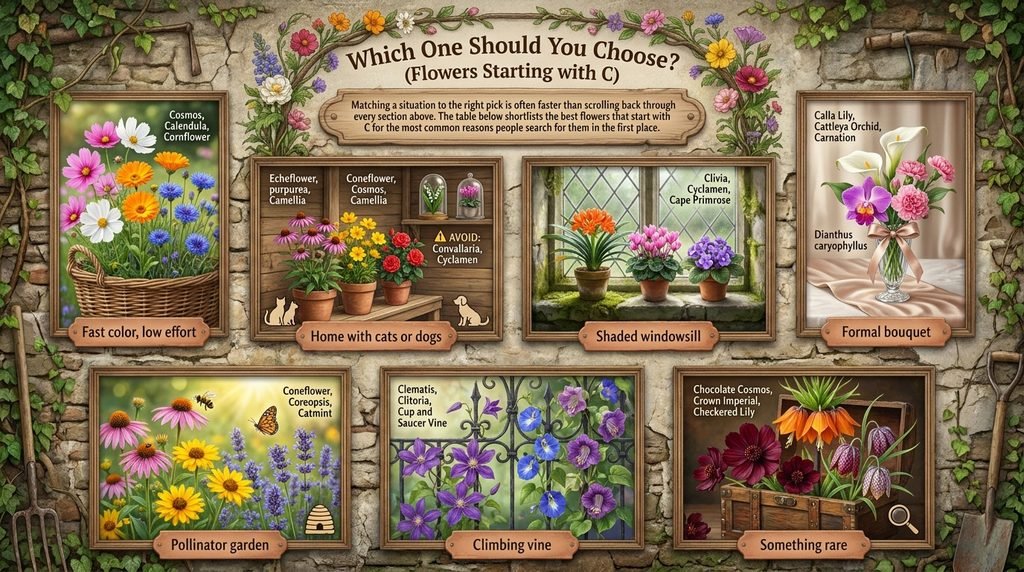
| Your Situation | Recommended Pick(s) |
| Fast color, low effort | Cosmos, Calendula, Cornflower |
| Home with cats or dogs | Coneflower, Cosmos, Camellia (avoid Convallaria, Cyclamen) |
| Shaded windowsill | Clivia, Cyclamen, Cape Primrose |
| Formal bouquet | Calla Lily, Cattleya Orchid, Carnation |
| Pollinator garden | Coneflower, Coreopsis, Catmint |
| Climbing vine | Clematis, Clitoria, Cup and Saucer Vine |
| Something rare | Chocolate Cosmos, Crown Imperial, Checkered Lily |
Conclusion
Flowers that start with C cover far more ground than carnation and chrysanthemum alone, stretching across annual beds, indoor pots, climbing vines, and rare finds like chocolate cosmos and checkered lily. Whether the goal is a pollinator border, a pet-safe houseplant, or one showstopping bouquet flower, this list of 80 should cover the search — match the plant to your growing conditions and household first, and let color or name appeal be the second filter.
FAQ
How many flowers that start with C are there?
This guide covers 80 distinct names, from common annuals to shrubs, vines, bulbs, orchids, and houseplants. The true count is higher once cultivars are added, but 80 gives a thorough, non-repetitive base list.
What is the most popular one?
Carnation, thanks to long vase life, wide color range, and low cost. Chrysanthemum and calla lily follow closely for autumn and formal-event use.
Which are toxic to pets?
Convallaria, cyclamen, Christmas rose, calla lily, chrysanthemum, and chives all carry documented pet toxicity. Convallaria and castor bean are the most serious; chrysanthemum and calla lily usually cause milder irritation.
Which are best for beginners?
Calendula, cosmos, coreopsis, and cornflower grow easily from seed and bloom for months with little care. Coneflower is a strong beginner perennial for the same reasons.
Which grow well indoors?
Cyclamen, clivia, Christmas cactus, Cattleya orchid, and cape primrose are common houseplant choices, most needing bright but indirect light.
Which are considered rare?
Chocolate cosmos, crown imperial, checkered lily, and clitoria are less available at standard nurseries rather than difficult to grow.
Which are safe around children?
Calendula, cosmos, coreopsis, coneflower, and cornflower are non-toxic. Convallaria, castor bean, and Christmas rose should be kept out of reach.
Which blooms the longest?
Coreopsis and cosmos often flower from early summer to first frost with regular deadheading; coneflower runs a close second.
Are calla lily and canna lily the same plant?
No. Despite the similar name, they’re unrelated and belong to different plant families, though both prefer similar warm, sunny conditions.
Which are native to North America?
Coneflower, coreopsis, cardinal flower, columbine, camas lily, coral bells, and creeping phlox are all native to the continent.