Flowers That Start With G: Popular, Rare & Wild Varieties
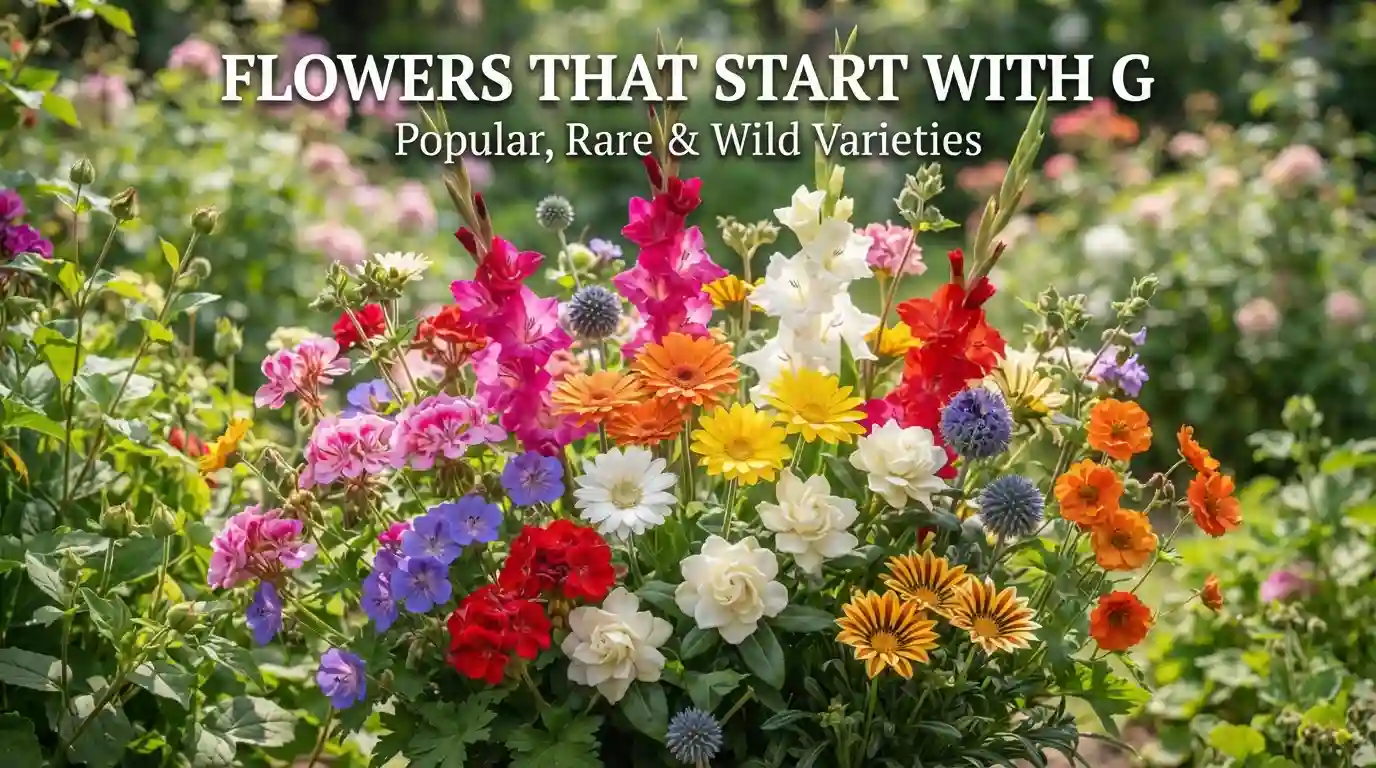
Flowers that start with G cover an impressive range. Gardenia brings fragrance to a shaded patio. Gladiolus adds height to a summer border. Goldenrod feeds pollinators late into fall. Ghost orchid hides deep in Florida swamps, rarely seen by anyone outside a dedicated botanist. This letter offers garden staples and genuine rarities side by side, which makes a single, well-organized guide genuinely useful.
This article brings together more than forty of these blooms. Each entry was checked individually for its botanical name, native range, and toxicity. Nothing here was pulled from one source and lightly rewritten. A few G-named plants grown mainly for foliage were left off this list on purpose, since the flower itself should be the actual reason to grow a plant.
Rather than opening with a flat alphabetical dump, this guide sorts them by how people actually use them. Garden staples come first. Indoor options follow, then florist favorites, rare specialty blooms, and a dedicated caution section for anything that needs careful placement around pets or children. Color groupings and life-cycle categories come next, giving two more practical ways to narrow down a choice. The full alphabetical index and botanical name reference sit near the end, working as a quick lookup rather than a starting point.
Quick Answer: The Standout G Flowers
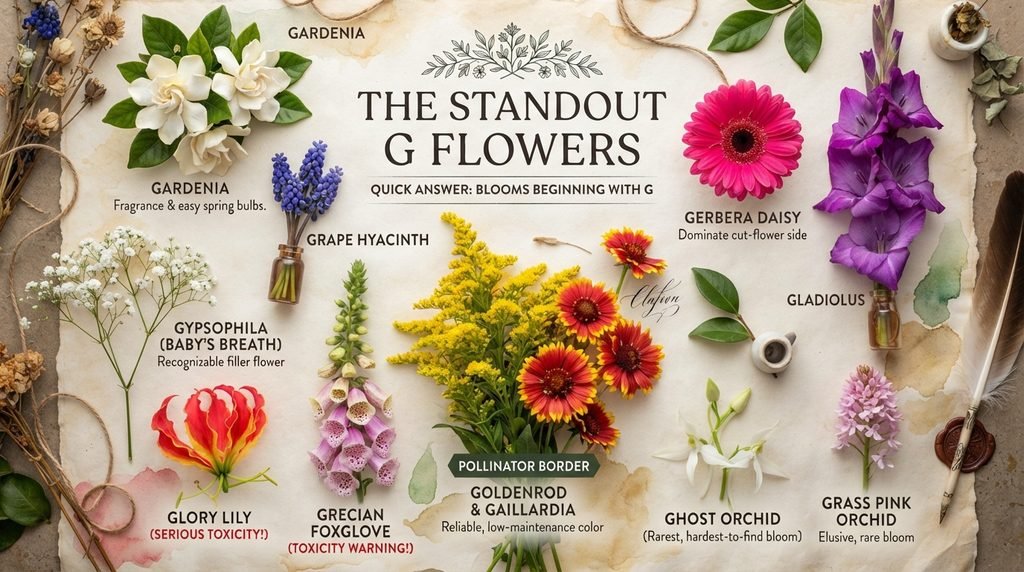
A short list of names does most of the heavy lifting for anyone searching flowers that start with G. Gardenia and grape hyacinth cover fragrance and easy spring bulbs, while gerbera daisy and gladiolus dominate the cut-flower side of this list. Goldenrod and gaillardia bring reliable, low-maintenance color to a pollinator border, and gypsophila, better known as baby’s breath, remains one of the most recognizable filler flowers in floral design. Glory lily and grecian foxglove deserve real caution, since both carry serious toxicity. Ghost orchid and grass pink orchid round out the group as two of the rarest, hardest-to-find blooms this letter has to offer.
What These Flowers Are Said to Represent
Symbolism across this letter ranges from centuries-old tradition to more casual, modern associations. Gardenia carries one of the richest meanings here, tied to secret love and purity in Victorian flower language, a tradition that still shapes how the flower gets used in bouquets today. Geranium symbolism shifts by color, much like roses do, with red geraniums linked to comfort and pink varieties linked to preference or partiality.
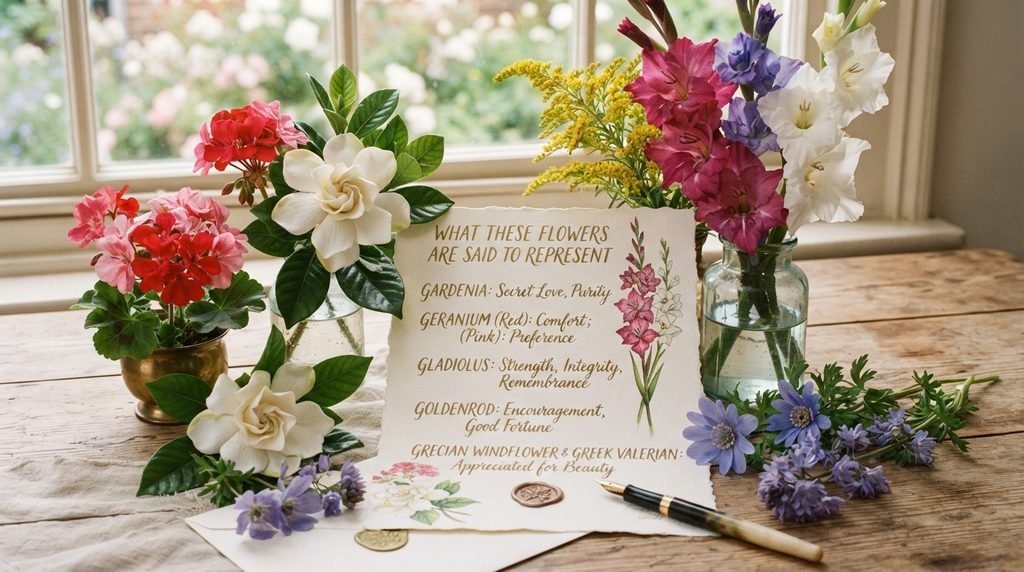
Gladiolus takes its name from the Latin word for sword, and that root shaped its symbolism directly. The flower has long stood for strength, moral integrity, and remembrance, which explains its frequent use in memorial arrangements. Goldenrod carries a gentler, more modern meaning tied to encouragement and good fortune, likely because the plant blooms so reliably even in poor soil and difficult conditions.
Grecian windflower and Greek valerian have not built up the same depth of symbolic history. Both are simply appreciated for their appearance rather than any inherited meaning, and it’s worth saying that plainly instead of inventing a tradition that doesn’t really exist.
Sorting These Flowers by Color
White and cream tones show up clearly across this letter. Gardenia’s waxy white petals, ghost orchid’s pale, otherworldly bloom, and gypsophila’s tiny clustered flowers all fall into this group. Guelder rose adds a different white shape entirely, with its rounded clusters resembling a snowball more than a typical flower head. This color group works well in evening gardens, where pale petals stay visible after dusk.
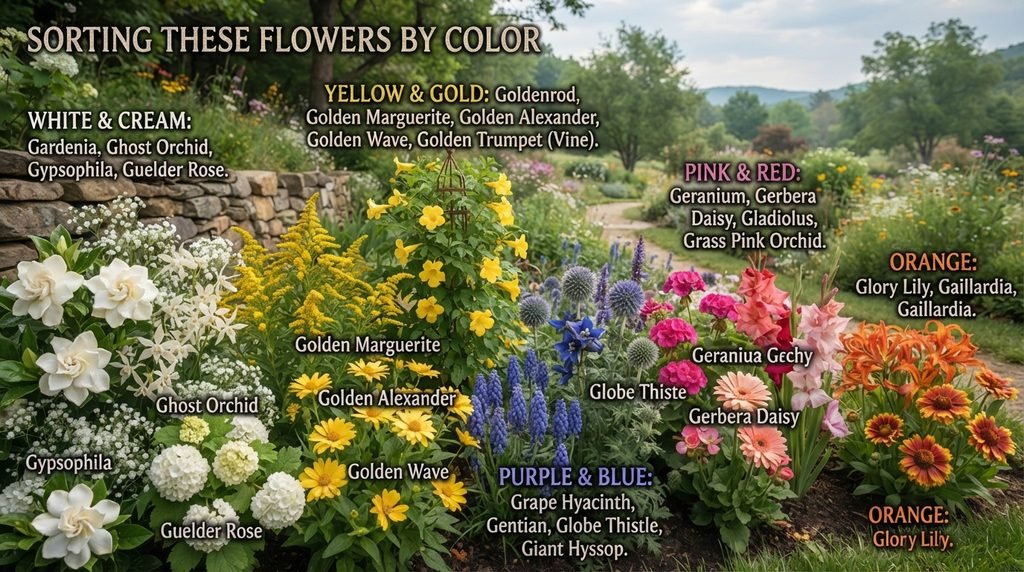
Yellow and gold tones dominate a large share of this letter’s blooms. Goldenrod, golden marguerite, golden alexanders, and golden wave all bring warm, sunny color to a border. Golden trumpet, a fast-growing tropical vine, adds a bolder, glossier yellow to this group. Most of these bloom in mid to late summer, which makes them useful for extending color once earlier spring flowers have already faded.
Purple and blue tones cluster around a few genuinely fragrant or textural picks. Grape hyacinth, gentian, globe thistle, and giant hyssop all bring cooler tones to a bed, and several double as strong pollinator plants. Pink and red tones appear in geranium, gerbera daisy, gladiolus, and grass pink orchid, offering a warmer, more romantic palette suited to cutting gardens. Orange tones are rarer here, though glory lily and gaillardia both bring genuine heat to this part of the color wheel, standing out precisely because so few other G flowers share their intensity.
Garden Favorites Among Flowers That Start With G
Most home gardeners lean on a small core group of dependable plants. Geranium anchors this group, tolerating heat, poor soil, and inconsistent watering while still blooming for months. Gaillardia performs a similar role in hot, dry beds, producing daisy-like flowers in fiery red and yellow tones that hold up well through summer heat. Goldenrod brings reliable fall color and feeds pollinators when few other plants are still blooming.
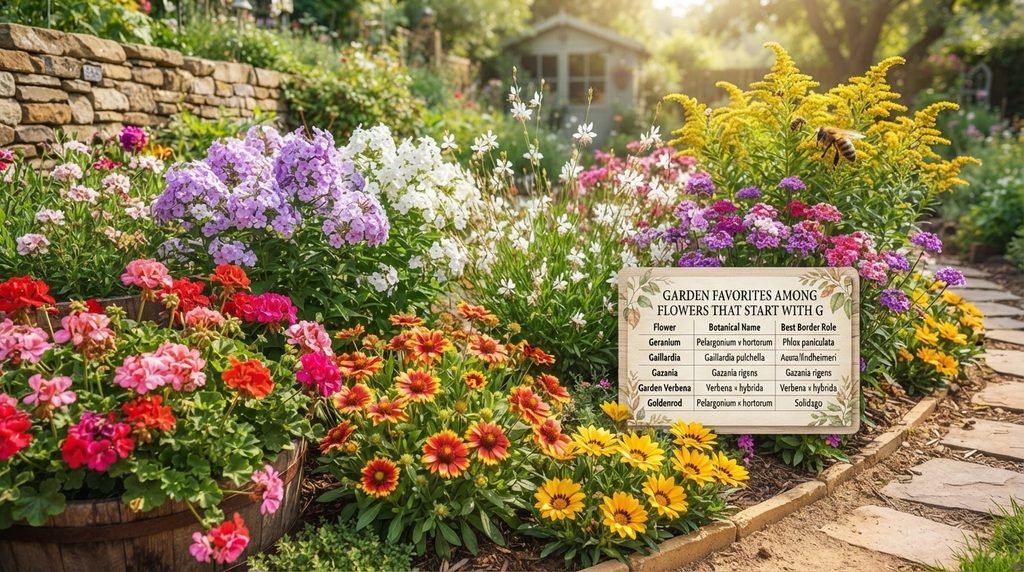
Garden phlox and garden verbena both fill in mid-summer gaps with dense, colorful clusters, while gaura adds a lighter, airier texture with its small, butterfly-shaped blooms dancing on thin stems. Gazania closes out this group as a genuinely tough, drought-tolerant daisy that closes its petals at night and reopens each morning in full sun.
| Flower | Botanical Name | Best Border Role |
| Geranium | Pelargonium × hortorum | Long-blooming container and bed color |
| Gaillardia | Gaillardia pulchella | Heat-tolerant, drought-friendly bed color |
| Goldenrod | Solidago | Fall pollinator anchor |
| Garden Phlox | Phlox paniculata | Mid-summer fragrance and color |
| Garden Verbena | Verbena × hybrida | Low, spreading bed and container filler |
| Gaura | Gaura lindheimeri | Airy texture, light movement |
| Gazania | Gazania rigens | Drought-tolerant edging |
Gazania and Gaillardia share more than a similar look. Both close up in low light and both tolerate poor, sandy soil far better than richer garden loam, which makes them a natural pair for the driest, sunniest part of a yard.
Indoor Plants: Flowers That Start With G for Pots and Windowsills
A smaller group of these blooms performs best indoors. Gardenia leads this group, though it demands consistent humidity and acidic soil to bloom reliably away from its native subtropical climate. Golden shrimp plant offers an easier alternative, producing curved, shrimp-shaped yellow bracts almost continuously under bright indoor light.
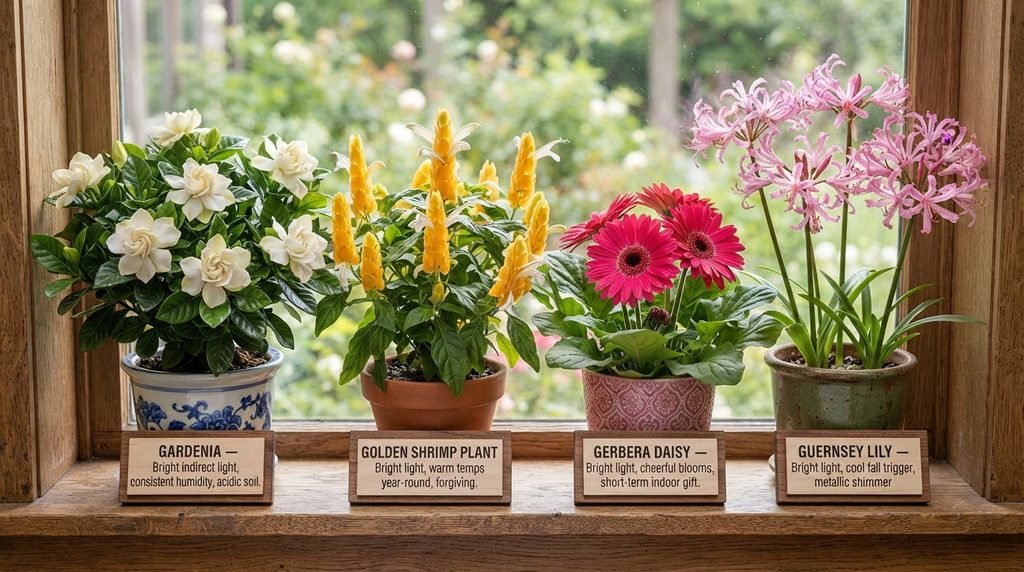
Gerbera daisy is often sold as a potted gift plant rather than a permanent houseplant, since its bright, cheerful blooms tend to fade after a few weeks indoors without the outdoor sun it prefers. Guernsey lily, a bulb native to South Africa, is sometimes forced into bloom indoors during fall, producing shimmering pink flower clusters that catch light in an unusual, almost metallic way.
- Gardenia — bright indirect light, consistent humidity, acidic soil
- Golden Shrimp Plant — bright light, warm temperatures year-round
- Gerbera Daisy — bright light, best treated as a short-term potted gift
- Guernsey Lily — bright light, cool temperatures to trigger fall bloom
Gardenia remains the most demanding of this group by far. Golden shrimp plant, by comparison, tolerates a wider range of indoor conditions and forgives a missed watering far more easily.
Florist Favorites: G Flowers Built for Cutting and Arranging
Cut-flower performance depends on vase life, stem strength, and overall versatility, and several G-named blooms perform strongly across all three. Gladiolus brings dramatic height to an arrangement, with each spike opening gradually from the bottom up over a week or more. Gerbera daisy offers one of the widest color ranges of any cut flower on this list, which is part of why it shows up so often in modern, casual bouquets.
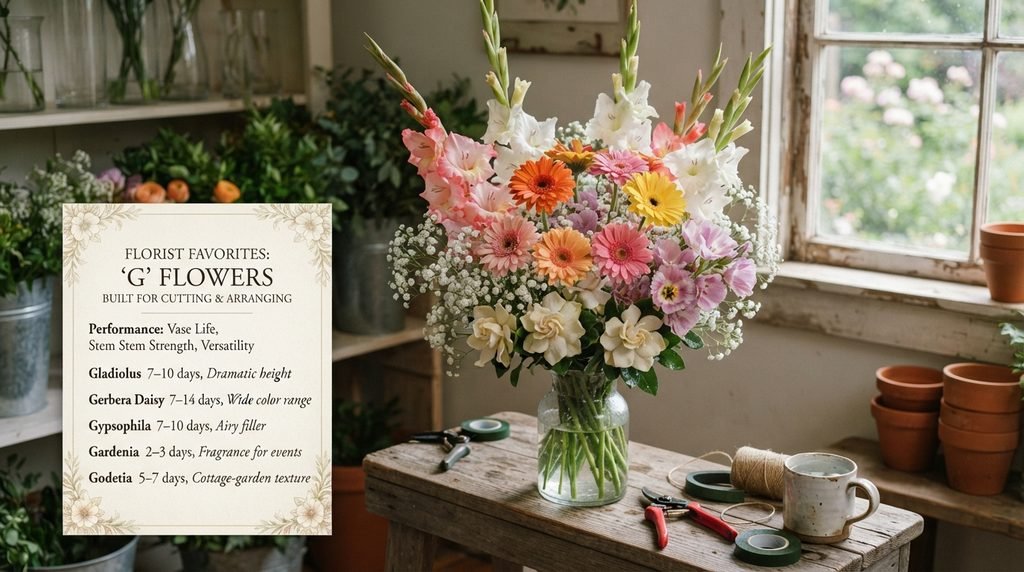
Gypsophila, sold almost everywhere as baby’s breath, remains the most recognizable filler flower in the entire floral trade, prized for its airy texture and long vase life. Gardenia, though shorter-lived once cut, still appears regularly in corsages and bridal work because of its fragrance. Godetia rounds out this group with delicate, cup-shaped blooms that add a softer, cottage-garden feel to mixed arrangements.
| Flower | Vase Life | Why Florists Use It |
| Gladiolus | 7–10 days | Dramatic height, gradual bottom-up bloom |
| Gerbera Daisy | 7–14 days | Wide color range, bold simple shape |
| Gypsophila (Baby’s Breath) | 7–10 days | Airy filler, long-lasting |
| Gardenia | 2–3 days | Fragrance for corsages and bridal work |
| Godetia | 5–7 days | Soft, cottage-garden texture |
Gardenia stands apart from the rest of this table with by far the shortest vase life. That short window is exactly why it’s used fresh for same-day events rather than shipped or stored the way the other flowers here typically are.
Rare Flowers: The Harder-to-Find Entries on This List
A handful of entries on this list are genuinely uncommon. Ghost orchid tops this group by a wide margin, growing without leaves and drawing nutrients almost entirely from a fungal partner in the soil, which makes it nearly impossible to cultivate outside its narrow native range in Florida and Cuba. The grass pink orchid is easier to find than the ghost orchid but still uncommon, since it grows almost exclusively in undisturbed bogs and wet meadows that have become increasingly rare habitats.
Guernsey lily earns a spot in this group for historical reasons as much as current scarcity. The bulb was once so hard to source outside the Channel Islands that its name became tied to rarity itself. Greek valerian, while not endangered, rarely appears at general nurseries and is usually sourced through native-plant specialists instead. Golden wave, a regional wildflower native to parts of the American South, follows a similar pattern, more often found in native seed mixes than sold as a standalone potted plant.
Caution: G Flowers That Need Careful Placement
Toxicity risk varies sharply across this letter, and a few entries deserve serious, specific attention. Garland flower, botanically Daphne, is genuinely dangerous. Every part of the plant is toxic, and its berries have caused documented poisonings in children who mistook them for something edible. Glory lily carries an equally serious risk from a different source. Its tubers contain colchicine, a compound toxic enough to cause fatalities when mistaken for an edible root in regions where the plant grows wild.
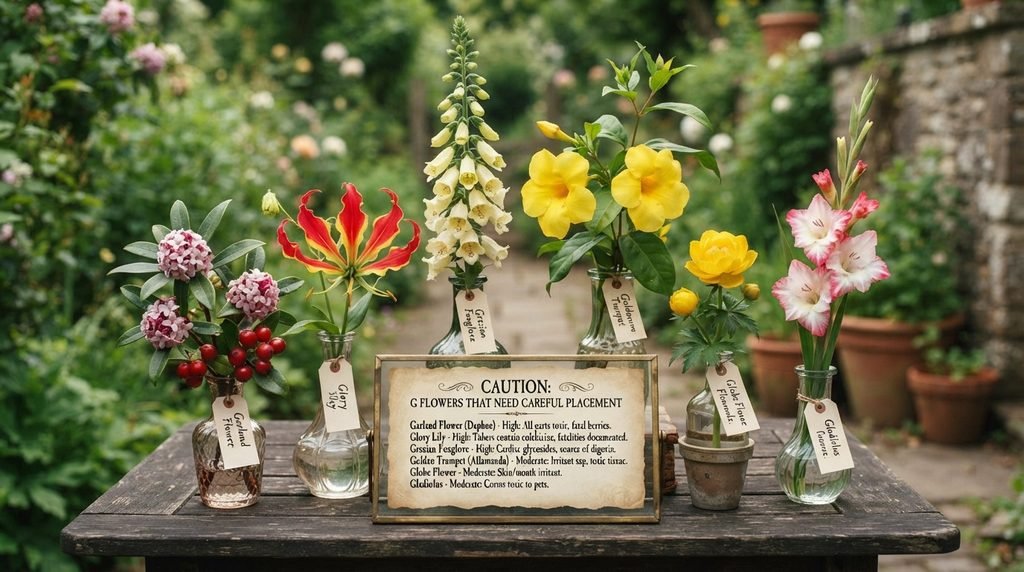
Grecian foxglove deserves the same level of caution as its more familiar purple relative. It contains cardiac glycosides strong enough that the plant is actually used as a pharmaceutical source for the heart medication digoxin, which says everything about how seriously its toxicity should be treated in a home garden. Golden trumpet, or Allamanda, carries a milder but still real risk, since its sap can irritate skin and its plant tissue is toxic if ingested. Globe flower, a member of the buttercup family, causes irritation to skin and mouth tissue if handled or chewed carelessly.
| Flower | Toxicity Level | Risk Details |
| Garland Flower (Daphne) | High | All parts are toxic; berries have caused fatal poisonings in children |
| Glory Lily | High | Tubers contain colchicine; documented human fatalities |
| Grecian Foxglove | High | Cardiac glycosides; source plant for digoxin medication |
| Golden Trumpet (Allamanda) | Moderate | Irritant sap; toxic plant tissue if ingested |
| Globe Flower | Moderate | Irritant to skin and mouth tissue |
| Gladiolus | Moderate | Corms toxic if ingested, especially by cats and dogs |
Any household with young children should treat garland flower as an outright no rather than something to simply place out of reach. Its berries look enough like ordinary fruit to invite exactly the kind of accidental tasting that makes this plant so risky.
Choosing by Life Cycle: Annuals, Perennials, Bulbs, and Beyond
Matching a flower’s life cycle to an actual planning horizon matters as much as matching its color. An annual that needs replanting every year serves a very different role than a shrub that becomes a permanent fixture. Perennials make up the largest group among this letter’s flowers, offering repeat blooms with less ongoing replanting effort. Bulbs form a strong secondary group, including several early spring bloomers that finish quickly before going dormant.
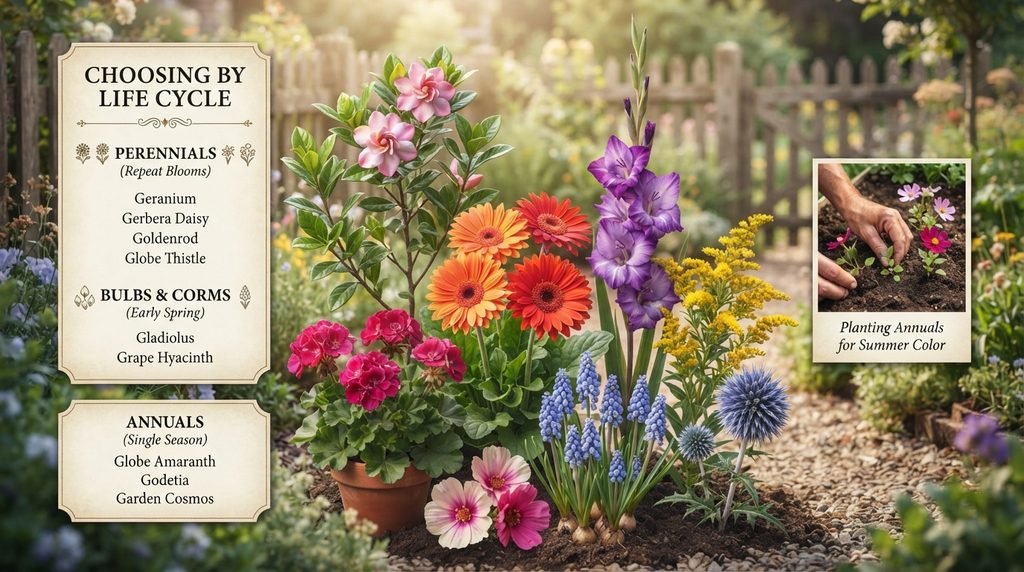
True annuals are a smaller cluster here, though a few reliable ones exist for gardeners who want single-season color without a long commitment. Shrubs and a few specialty orchids round out the list, including some of its most fragrant and most demanding entries.
| Flower | Life Cycle |
| Gardenia | Evergreen shrub |
| Geranium | Perennial (often grown as annual) |
| Gerbera Daisy | Perennial (often grown as annual) |
| Gladiolus | Bulb (corm) |
| Grape Hyacinth | Bulb |
| Globe Amaranth | Annual |
| Goldenrod | Perennial |
| Gazania | Perennial (grown as annual in cold climates) |
| Gaillardia | Annual or short-lived perennial |
| Globe Thistle | Perennial |
| Golden Trumpet | Perennial vine (tropical) |
| Ginger Lily | Perennial (rhizome) |
| Guernsey Lily | Bulb |
| Glory Lily | Perennial (tuberous climber) |
| Godetia | Annual |
| Golden Poppy | Annual or short-lived perennial |
| Grass Pink Orchid | Perennial |
| Green Rose | Perennial shrub |
| Guelder Rose | Shrub |
| Gum Rockrose | Shrub |
| Gypsophila | Annual or perennial (species-dependent) |
| Globe Flower | Perennial |
| Golden Shrimp Plant | Perennial shrub |
| Garland Flower | Shrub |
| Garland Chrysanthemum | Annual |
| Gaura | Perennial |
| Gentian | Perennial |
| Geum | Perennial |
| Ghost Orchid | Perennial (epiphytic) |
| Giant Allium | Bulb |
| Giant Hyssop | Perennial |
| Globe Gilia | Annual |
| Golden Alexanders | Perennial |
| Golden Marguerite | Perennial |
| Greek Valerian | Perennial |
| Grecian Windflower | Bulb (tuber) |
| Garden Phlox | Perennial |
| Garden Cosmos | Annual |
| Garden Nasturtium | Annual |
| Golden Columbine | Perennial |
| Gooseneck Loosestrife | Perennial |
| Grecian Foxglove | Perennial (short-lived) |
| Gloriosa Daisy | Perennial (often grown as annual) |
| Golden Wave | Annual |
| Garden Verbena | Perennial (grown as annual in cold climates) |
This table makes the perennial-heavy nature of this letter clear at a glance. True annuals — globe amaranth, godetia, garland chrysanthemum, globe gilia, garden cosmos, garden nasturtium, and golden wave among them — remain a smaller but genuinely useful group for single-season planning.
The Master List: Every Flower on This Guide, A to Z
Several entries below are best known by common English names, particularly the “garden,” “golden,” and “grecian” prefixed varieties. Others are almost always sold under their botanical genus name directly, since no separate common name ever became standard. This list reflects that natural split.
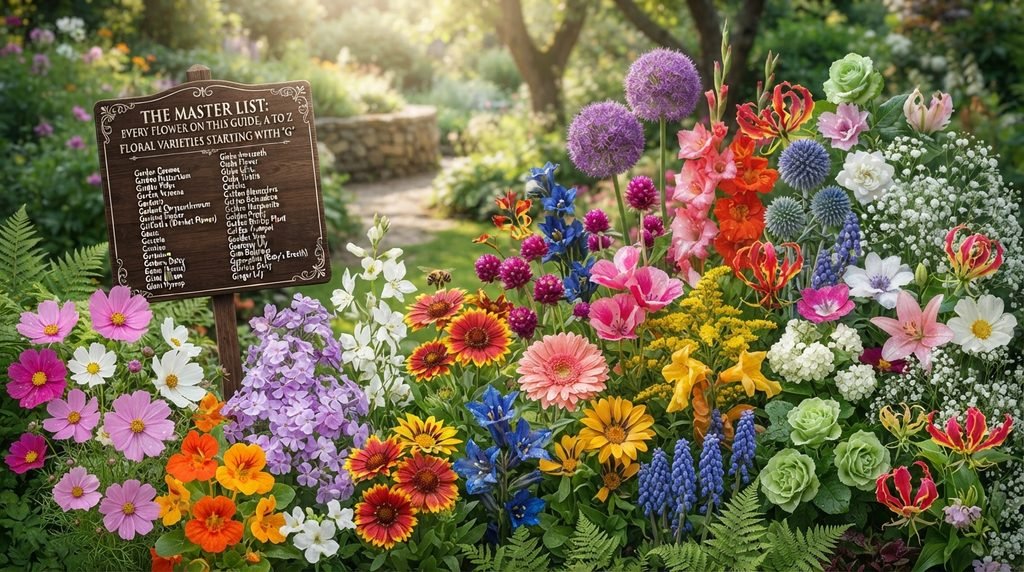
- Garden Cosmos — Cosmos bipinnatus
- Garden Nasturtium — Tropaeolum majus
- Garden Phlox — Phlox paniculata
- Garden Verbena — Verbena × hybrida
- Gardenia — Gardenia jasminoides
- Garland Chrysanthemum — Glebionis coronaria
- Garland Flower — Daphne cneorum
- Gaillardia (Blanket Flower) — Gaillardia pulchella
- Gaura — Gaura lindheimeri
- Gazania — Gazania rigens
- Gentian — Gentiana acaulis
- Geranium — Pelargonium × hortorum
- Gerbera Daisy — Gerbera jamesonii
- Geum (Avens) — Geum coccineum
- Ghost Orchid — Dendrophylax lindenii
- Giant Allium — Allium giganteum
- Giant Hyssop — Agastache foeniculum
- Gladiolus — Gladiolus × hortulanus
- Globe Amaranth — Gomphrena globosa
- Globe Flower — Trollius europaeus
- Globe Gilia — Gilia capitata
- Globe Thistle — Echinops bannaticus
- Glory Lily — Gloriosa superba
- Godetia — Clarkia amoena
- Golden Alexanders — Zizia aurea
- Golden Columbine — Aquilegia chrysantha
- Golden Marguerite — Cota tinctoria
- Golden Poppy — Eschscholzia californica
- Golden Shrimp Plant — Pachystachys lutea
- Golden Trumpet — Allamanda cathartica
- Golden Wave — Coreopsis basalis
- Goldenrod — Solidago canadensis
- Gooseneck Loosestrife — Lysimachia clethroides
- Grape Hyacinth — Muscari armeniacum
- Grass Pink Orchid — Calopogon tuberosus
- Grecian Foxglove — Digitalis lanata
- Grecian Windflower — Anemone blanda
- Greek Valerian — Polemonium reptans
- Green Rose — Rosa chinensis viridiflora
- Guelder Rose — Viburnum opulus
- Guernsey Lily — Nerine sarniensis
- Gum Rockrose — Cistus ladanifer
- Gypsophila (Baby’s Breath) — Gypsophila paniculata
- Gloriosa Daisy — Rudbeckia hirta ‘Gloriosa’
- Ginger Lily — Hedychium coronarium
This list holds forty-five entries in total. It spans garden perennials, spring bulbs, tropical shrubs, and several true rarities, showing just how much practical range flowers that start with G actually offer.
Why Botanical Names Matter for This Letter
Common-name confusion is a real risk here. Several unrelated flowers share the same descriptive prefix, and “garden,” “golden,” and “grecian” alone cover more than a dozen genuinely different plants on this list. A large number of others are rarely sold under any English common name at all. Searching by botanical name is often the only reliable way to confirm a nursery listing actually matches the plant intended.
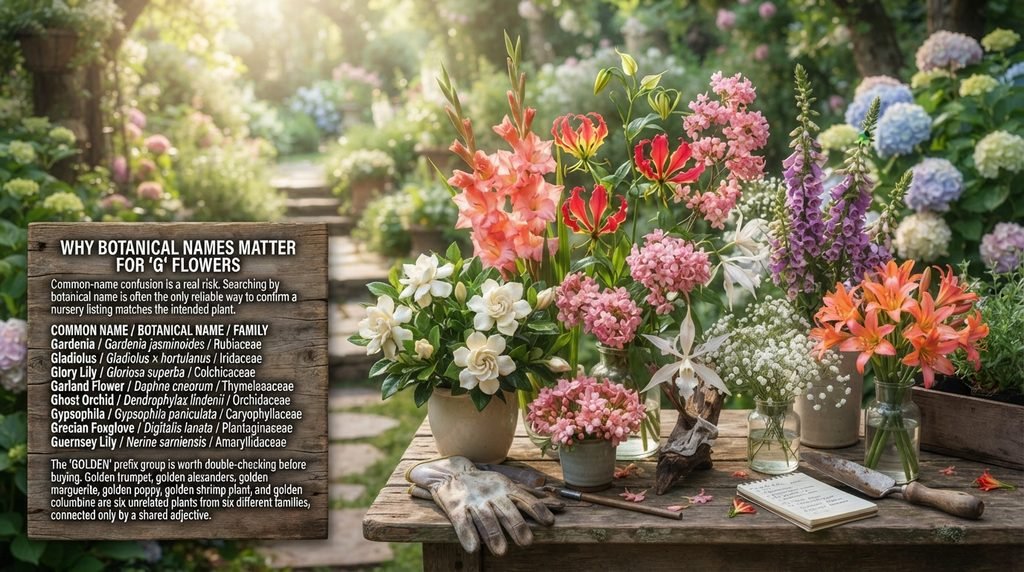
| Common Name | Botanical Name | Plant Family |
| Gardenia | Gardenia jasminoides | Rubiaceae |
| Gladiolus | Gladiolus × hortulanus | Iridaceae |
| Glory Lily | Gloriosa superba | Colchicaceae |
| Garland Flower | Daphne cneorum | Thymelaeaceae |
| Ghost Orchid | Dendrophylax lindenii | Orchidaceae |
| Gypsophila | Gypsophila paniculata | Caryophyllaceae |
| Grecian Foxglove | Digitalis lanata | Plantaginaceae |
| Guernsey Lily | Nerine sarniensis | Amaryllidaceae |
The “golden” prefix group is worth double-checking before buying. Golden trumpet, golden alexanders, golden marguerite, golden poppy, golden shrimp plant, and golden columbine are six entirely unrelated plants from six different families, connected only by a shared adjective in their common names.
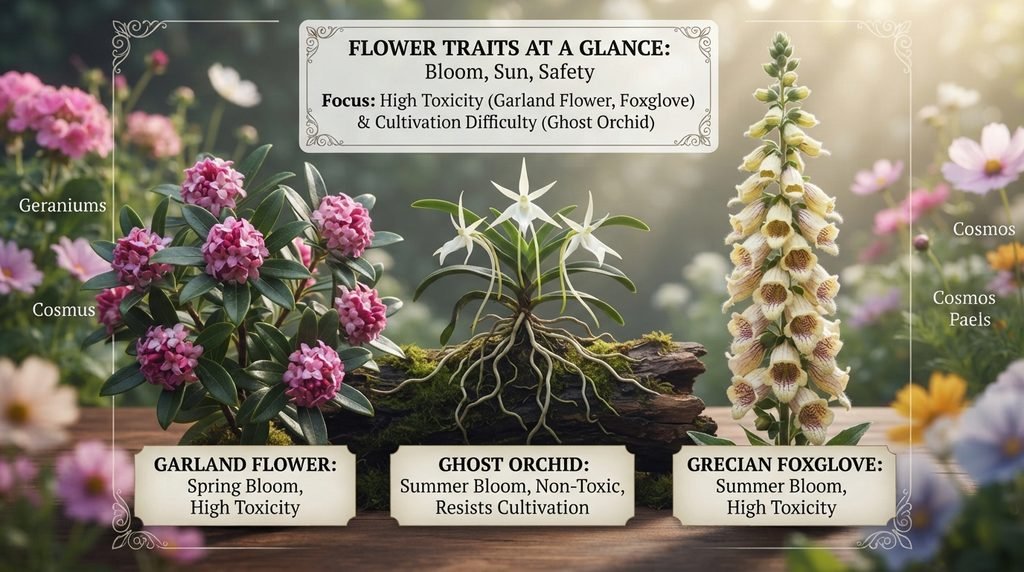
Full Comparison Table: Bloom Time, Sun, and Safety at a Glance
The table below brings together bloom season, sun needs, toxicity level, and primary use for every flower covered in this guide. It makes it easy to scan for a specific combination of traits, such as a spring-blooming, full-sun, pet-safe option, without flipping back through each section above.
| Flower | Bloom Season | Sun | Toxicity | Primary Use |
| Gardenia | Summer | Full sun–part shade | Mild | Fragrance, corsages |
| Geranium | Spring–fall | Full sun | Mild | Bedding, containers |
| Gerbera Daisy | Spring–fall | Full sun | Non-toxic | Cut flower, gift plant |
| Gladiolus | Summer | Full sun | Moderate | Cut flower, border accent |
| Grape Hyacinth | Spring | Full sun–part shade | Mild | Naturalized bulb display |
| Globe Amaranth | Summer–fall | Full sun | Non-toxic | Dried arrangements, bedding |
| Goldenrod | Late summer–fall | Full sun | Non-toxic | Pollinator border |
| Gazania | Summer–fall | Full sun | Non-toxic | Drought-tolerant edging |
| Gaillardia | Summer–fall | Full sun | Non-toxic | Heat-tolerant bedding |
| Globe Thistle | Summer | Full sun | Non-toxic | Cut flower, texture |
| Golden Trumpet | Nearly year-round (warm) | Full sun | Moderate | Trellis, tropical garden |
| Ginger Lily | Summer–fall | Partial shade | Non-toxic | Tropical border, fragrance |
| Guernsey Lily | Fall | Full sun | Moderate | Cut flower, indoor forcing |
| Glory Lily | Summer | Full sun–part shade | High | Climbing accent |
| Godetia | Summer | Full sun | Non-toxic | Cut flower, cottage border |
| Golden Poppy | Spring–summer | Full sun | Mild | Wildflower meadow |
| Grass Pink Orchid | Summer | Full sun | Non-toxic | Native bog garden |
| Green Rose | Spring–fall | Full sun | Non-toxic | Novelty specimen |
| Guelder Rose | Late spring | Full sun–part shade | Mild | Hedge, wildlife garden |
| Gum Rockrose | Spring–summer | Full sun | Non-toxic | Xeriscape, Mediterranean garden |
| Gypsophila | Summer | Full sun | Mild | Cut flower filler |
| Globe Flower | Spring–early summer | Full sun–part shade | Moderate | Moist border, pond edge |
| Golden Shrimp Plant | Nearly year-round (indoor) | Bright light | Non-toxic | Houseplant |
| Garland Flower | Spring | Full sun–part shade | High | Fragrant specimen shrub |
| Garland Chrysanthemum | Spring–summer | Full sun | Non-toxic | Edible garden |
| Gaura | Summer–fall | Full sun | Non-toxic | Airy border texture |
| Gentian | Summer–fall | Full sun–part shade | Non-toxic | Rock garden |
| Geum | Spring–summer | Full sun–part shade | Non-toxic | Border edging |
| Ghost Orchid | Summer | Deep shade (native habitat) | Non-toxic | Extremely rare specimen |
| Giant Allium | Late spring | Full sun | Mild | Border accent, pollinator |
| Giant Hyssop | Summer | Full sun | Non-toxic | Pollinator garden, herb use |
| Globe Gilia | Summer | Full sun | Non-toxic | Wildflower meadow |
| Golden Alexanders | Spring | Full sun–part shade | Mild | Native pollinator garden |
| Golden Marguerite | Summer | Full sun | Non-toxic | Border, cut flower |
| Greek Valerian | Spring | Partial shade | Non-toxic | Woodland garden |
| Grecian Windflower | Early spring | Full sun–part shade | Mild | Naturalized bulb display |
| Garden Phlox | Summer | Full sun–part shade | Non-toxic | Fragrance, border |
| Garden Cosmos | Summer–fall | Full sun | Non-toxic | Cutting garden |
| Garden Nasturtium | Summer–fall | Full sun–part shade | Non-toxic | Edible garden, containers |
| Golden Columbine | Spring–summer | Partial shade | Mild | Woodland garden |
| Gooseneck Loosestrife | Summer | Full sun–part shade | Non-toxic | Border, cut flower |
| Grecian Foxglove | Summer | Full sun–part shade | High | Ornamental (extreme caution) |
| Gloriosa Daisy | Summer–fall | Full sun | Non-toxic | Border, cut flower |
| Golden Wave | Spring–summer | Full sun | Non-toxic | Native wildflower meadow |
| Garden Verbena | Spring–fall | Full sun | Non-toxic | Bedding, containers |
Three rows stand out on a closer look at this table. Garland flower and grecian foxglove are the only two entries rated high toxicity for the entire plant. Ghost orchid is the only entry that genuinely resists cultivation outside its native habitat, regardless of how much care it receives.
Decision Guide: Matching a Scenario to the Right G Flower
Sometimes the fastest way to choose a flower isn’t scrolling through a full list. It helps to start from the actual problem that needs solving, whether that’s a shaded corner, a fragrance-focused bed, or a household with pets. The table below maps common gardening scenarios to the G blooms best suited to each one.
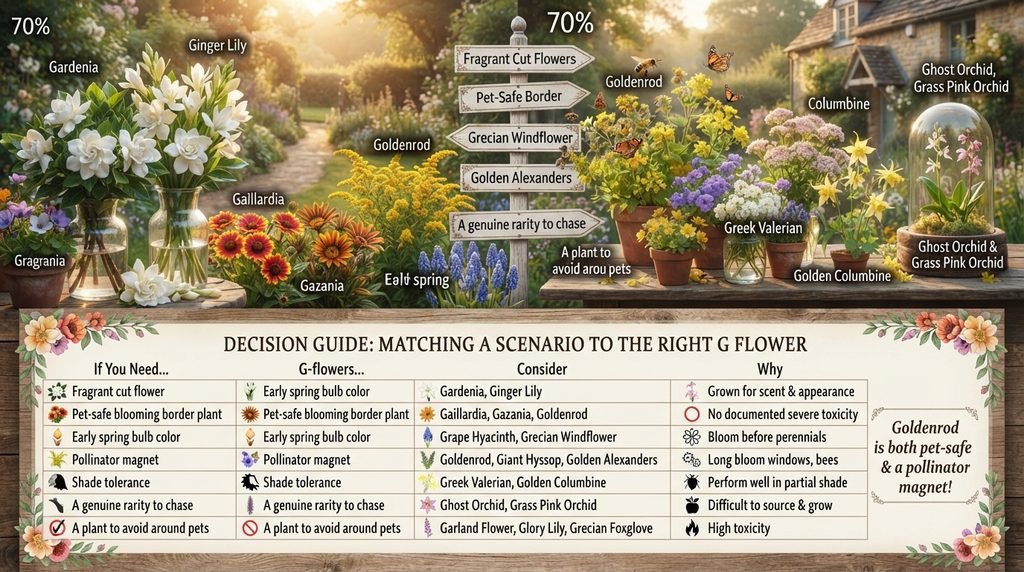
| If You Need… | Consider | Why |
| A fragrant cut flower | Gardenia, Ginger Lily | Both are grown as much for scent as for appearance |
| A pet-safe blooming border plant | Gaillardia, Gazania, Goldenrod | No documented severe toxicity |
| Early spring bulb color | Grape Hyacinth, Grecian Windflower | Both bloom before most perennials break dormancy |
| A pollinator magnet | Goldenrod, Giant Hyssop, Golden Alexanders | Long bloom windows, easy access for bees |
| Shade tolerance | Greek Valerian, Golden Columbine | Both perform well in partial shade |
| A genuine rarity to chase | Ghost Orchid, Grass Pink Orchid | Both are difficult to source and grow |
| A plant to avoid around pets | Garland Flower, Glory Lily, Grecian Foxglove | All three carry documented high toxicity |
Anyone planning a bed with both pollinator interest and pet safety in mind should note that goldenrod satisfies both goals at once. That makes it a more efficient choice than combining two separate specialty plants.
Conclusion
Flowers that start with G span an unusually wide range, from fragrant shrubs and dependable border perennials to a handful of genuinely rare orchids and a few plants that demand real caution. Choosing among them comes down to matching a specific flower to an actual spot, household, or purpose. With the category breakdowns, comparison table, and decision guide covered above, narrowing this list down to the few that genuinely fit a given garden should take far less guesswork than starting from scratch.
Frequently Asked Questions
1. How many flowers that start with G are there?
This guide covers forty-five verified flowers that start with G, ranging from common garden perennials to rare orchids and a few plants that require serious caution.
2. What is the easiest G flower to grow?
Geranium and gaillardia are both excellent choices for beginners. They tolerate poor soil, heat, and inconsistent watering while still blooming reliably.
3. Which G flowers are toxic to pets?
Garland flower and glory lily are both highly toxic. Gladiolus corms also pose a moderate risk if dug up and chewed by a curious pet.
4. What does gardenia symbolize?
Gardenia is tied to secret love and purity in traditional Victorian flower language. That meaning still shapes how the flower gets used in bouquets and gifts today.
5. What G flowers work well indoors?
Gardenia, golden shrimp plant, and gerbera daisy are the most common indoor choices, though gardenia demands the most consistent humidity of the three.
6. Is glory lily safe to plant in a home garden?
No, it requires serious caution. Its tubers contain colchicine, a compound toxic enough to have caused human fatalities when mistaken for an edible root.
7. What’s the best G flower for a fragrant garden?
Gardenia and ginger lily are the two strongest fragrance performers on this list, both widely used in perfumery as well as ornamental gardening.
8. Are any G-named flowers genuinely rare?
Yes. Ghost orchid and grass pink orchid are both considered rare, the former due to its dependence on a fungal partner and narrow native range.
9. What’s the difference between goldenrod and golden alexanders?
Both bloom yellow, but goldenrod flowers in late summer and fall, while golden alexanders blooms earlier in spring and belongs to an entirely different plant family.
10. Can grape hyacinth survive outdoors year-round?
Yes, in most temperate climates. Grape hyacinth is a hardy, cold-tolerant bulb that naturalizes easily and returns reliably each spring.
11. What G flower is best for a pollinator garden?
Goldenrod, giant hyssop, and golden alexanders are all strong choices, each offering an easy landing spot for bees and butterflies over a long bloom window.
12. Is gladiolus the same as sword lily?
Yes, sword lily is simply an older common name for gladiolus, referencing the plant’s tall, blade-shaped leaves.
13. What’s the biggest mistake people make with garland flower?
Underestimating its toxicity is the most common mistake. It’s an attractive, fragrant shrub, but every part of the plant is genuinely dangerous if ingested.