Flowers That Start With P: 100+ Names, Meanings & Beautiful Photos
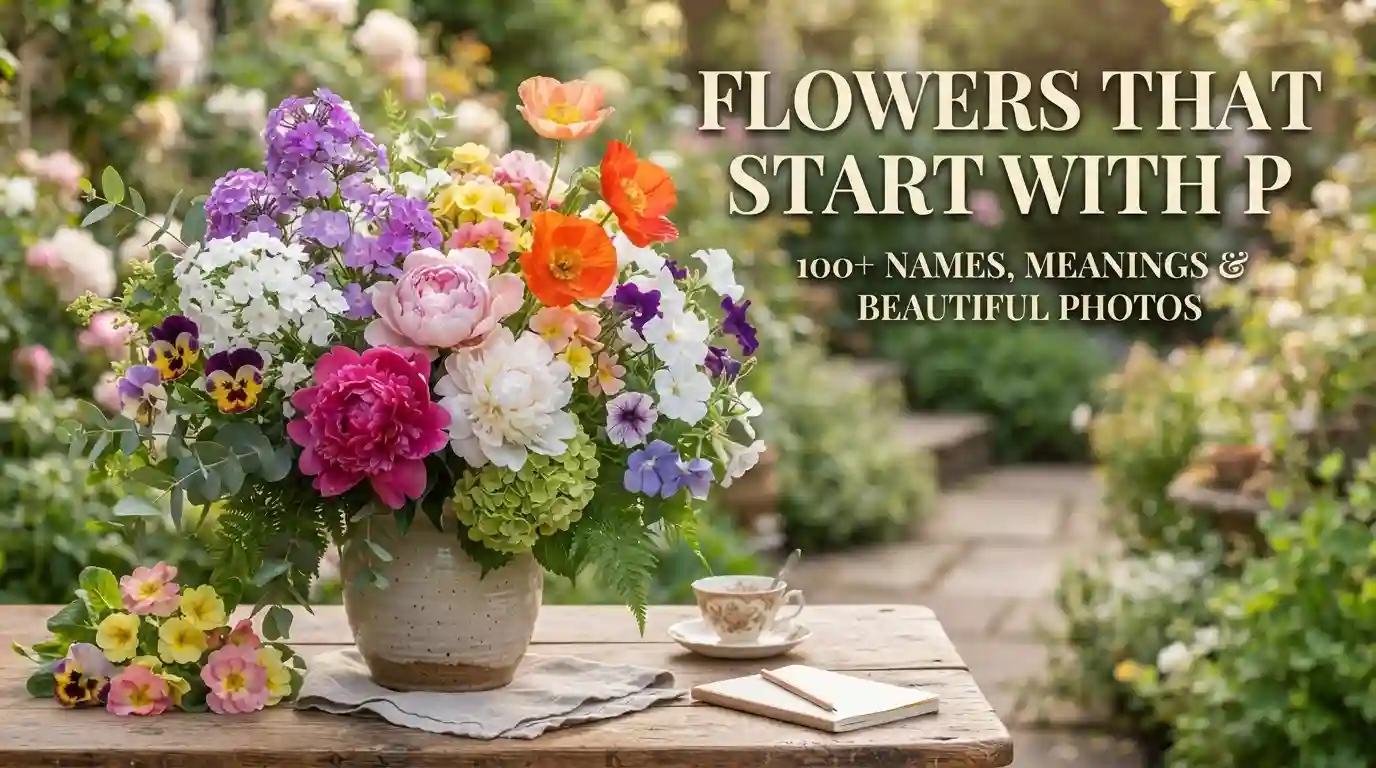
Flowers that start with P reach further than almost any other letter in the alphabet. Peony anchors early summer with its heavy, fragrant blooms. Poppy scatters papery color across wildflower meadows. Protea, native to South Africa, produces some of the most sculptural flower heads in the entire plant world. This letter spans easy annuals, dramatic specimen shrubs, and a genuine cluster of plants that demand real caution around pets and children.
This guide brings together more than one hundred of these blooms. Each entry was checked individually for its botanical name, native range, and toxicity. Nothing here was pulled from a single source and lightly reworded. A few P-named plants grown mainly for foliage, such as Persian shield and polka dot plant, were left off this list, since the flower itself should be the actual reason to grow a plant.
Rather than opening with a flat alphabetical dump, this guide sorts its recommendations by how gardeners actually use these plants. Garden staples come first, followed by indoor options, florist favorites, genuinely rare specialty blooms, and a dedicated section flagging which entries need careful placement around pets and children. Color groupings and life-cycle categories follow next. The full alphabetical index and botanical name reference sit near the end, working as a quick lookup once the groundwork has already been covered.
Quick Answer: The Standout P Flowers
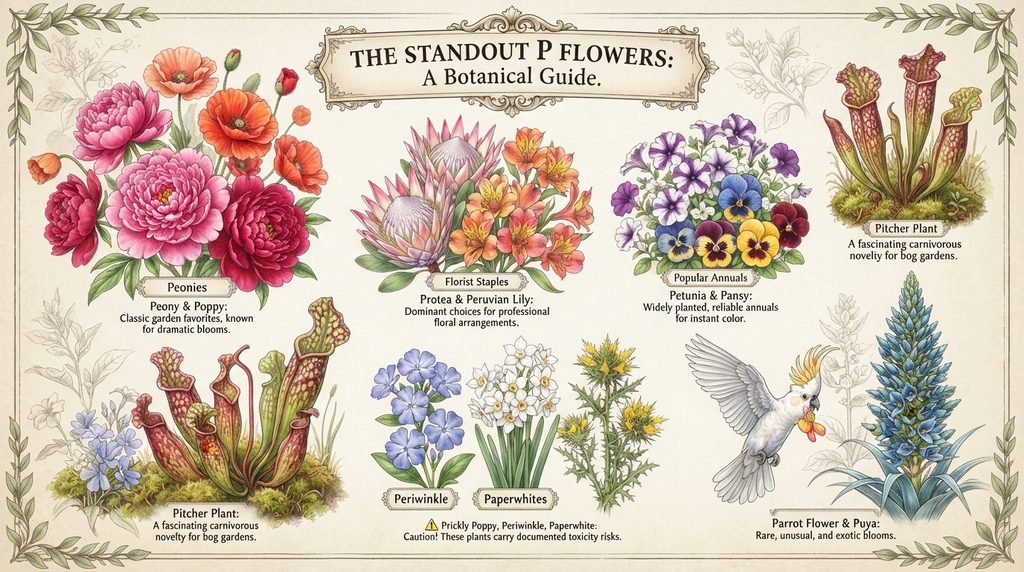
A short list of names does most of the heavy lifting here. Peony and poppy cover the classic garden-favorite role, while protea and Peruvian lily dominate the florist side of this letter. Petunia and pansy remain two of the easiest, most widely planted annuals anywhere, and pitcher plant brings genuine botanical novelty to a bog garden or windowsill. Prickly poppy, periwinkle, and paperwhite all deserve real caution, since each carries documented toxicity risk. Parrot flower and puya round out the group as two of the rarest, most unusual blooms this letter has to offer.
What These Flowers Are Said to Represent
Symbolism across this letter ranges from deep historical tradition to more casual, modern association. Peony carries rich meaning across several cultures, tied to prosperity and honor in Chinese tradition, where it has been cultivated for over a thousand years, and to romance and bashfulness in Victorian flower language. Poppy symbolism shifts by context, associated with remembrance in war memorials worldwide and with eternal sleep in older literary tradition, a duality rooted in the plant’s long medicinal and cultural history.
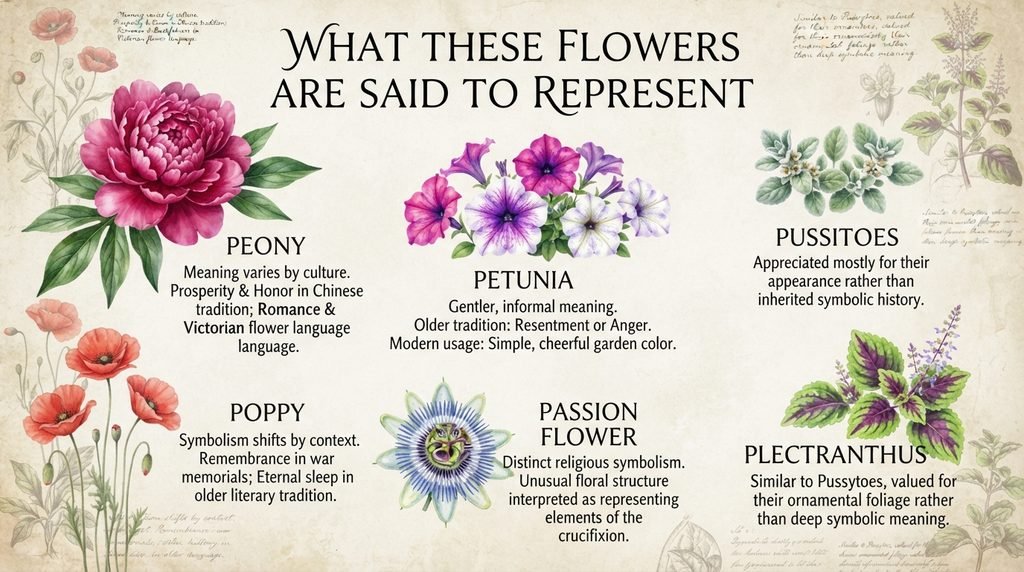
Petunia carries a gentler, more informal meaning tied to resentment or anger in some older flower-language traditions, though modern usage has largely softened that association into simple, cheerful garden color. Passion flower holds a distinct religious symbolism in Christian tradition, where its unusual floral structure was historically interpreted as representing elements of the crucifixion.
Several smaller entries on this list, including pussytoes and plectranthus, have not built up the same depth of symbolic history. Both are appreciated mostly for their appearance rather than any inherited meaning, and it’s worth saying that plainly instead of manufacturing a tradition that doesn’t really exist.
Sorting These Flowers by Color
White tones appear throughout this letter. Peace lily’s simple white spathe, paperwhite’s clustered fragrant blooms, and pearly everlasting’s papery petals all fall into this group, and several bring fragrance along with their pale color. Poached egg plant contributes a different kind of white, with a yellow center that gives the flower its whimsical common name.
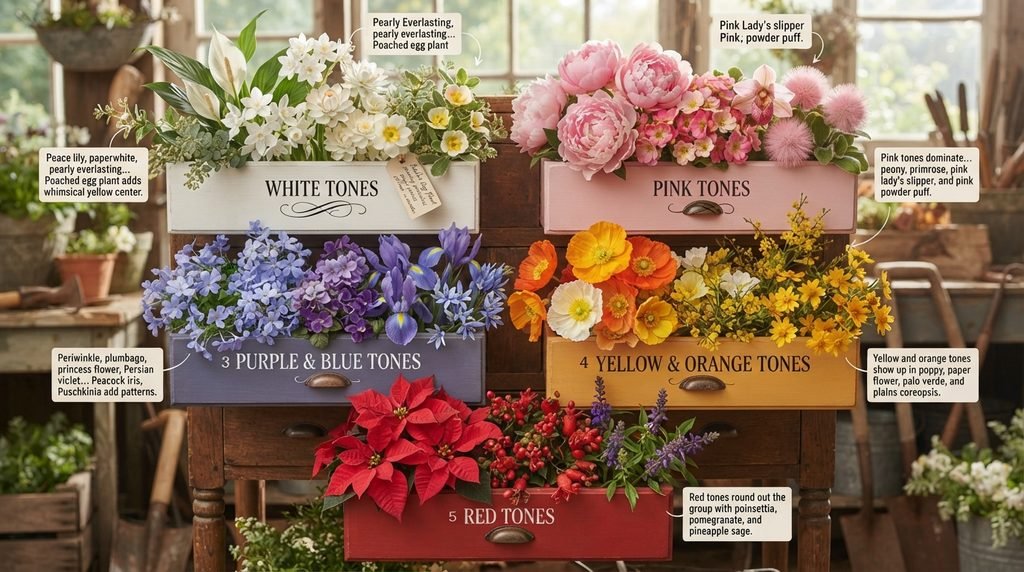
Pink tones dominate a large share of this letter, led by peony, primrose, pink lady’s slipper, and pink powder puff, all of which bring soft, romantic color to a border or container. Purple and blue tones cluster around periwinkle, plumbago, princess flower, and Persian violet, offering a cooler palette that suits shaded or woodland-style plantings. Peacock iris and Puschkinia both add striped or veined purple-blue patterns that stand out from more solid-colored neighbors.
Garden Favorites Among Flowers That Start With P
A core group of dependable plants carries most of the weight for gardeners exploring this letter. Peony anchors this group as a long-lived perennial that returns each year reliably, often outliving the gardener who first planted it. Petunia performs a different, more immediate role, filling containers and beds with continuous color from spring through the first hard frost.
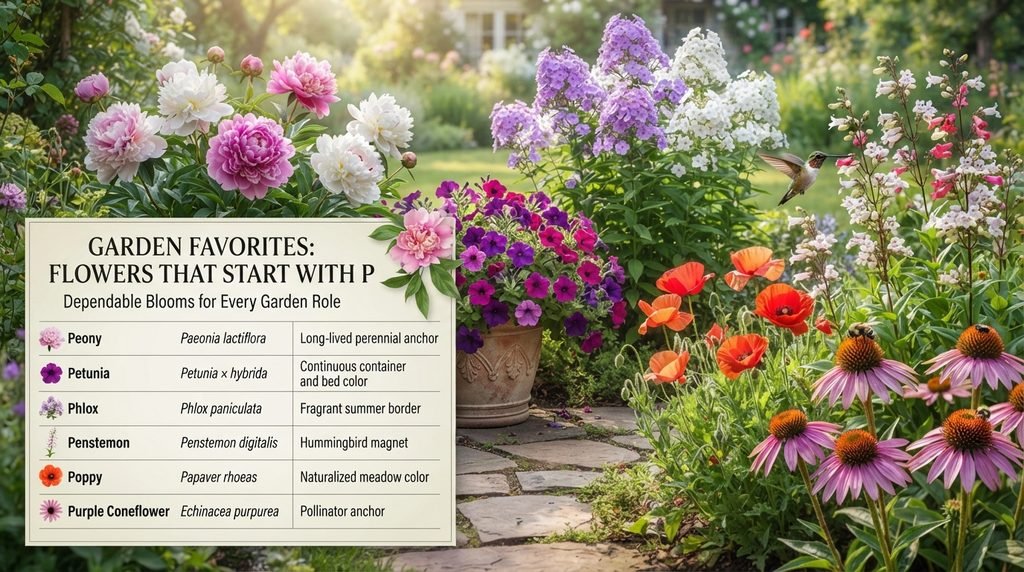
Phlox brings fragrance and reliable summer color to a border, while penstemon draws hummingbirds with its tubular, brightly colored blooms. Poppy rounds out this group as a self-seeding annual or perennial, depending on the species chosen, that naturalizes easily once established in a sunny, well-drained bed.
| Flower | Botanical Name | Best Border Role |
| Peony | Paeonia lactiflora | Long-lived perennial anchor |
| Petunia | Petunia × hybrida | Continuous container and bed color |
| Phlox | Phlox paniculata | Fragrant summer border |
| Penstemon | Penstemon digitalis | Hummingbird magnet |
| Poppy | Papaver rhoeas | Naturalized meadow color |
| Purple Coneflower | Echinacea purpurea | Pollinator anchor |
Peony and petunia sit at opposite ends of this table in terms of commitment. Peony rewards patience as a decades-long perennial investment, while petunia delivers fast, disposable color that needs replanting every single year.
Indoor Plants: Flowers That Start With P for Pots and Windowsills
A smaller group of P flowers performs best indoors, where steady warmth and controlled light make up for conditions that would be hard to sustain outdoors in most climates. Peace lily leads this group by a wide margin, tolerating low light better than almost any other flowering houseplant while still producing its simple white spathe reliably. Poinsettia, grown almost exclusively as a seasonal holiday plant, produces colorful bracts rather than true flowers, and it needs a specific period of darkness each fall to develop its signature red color.
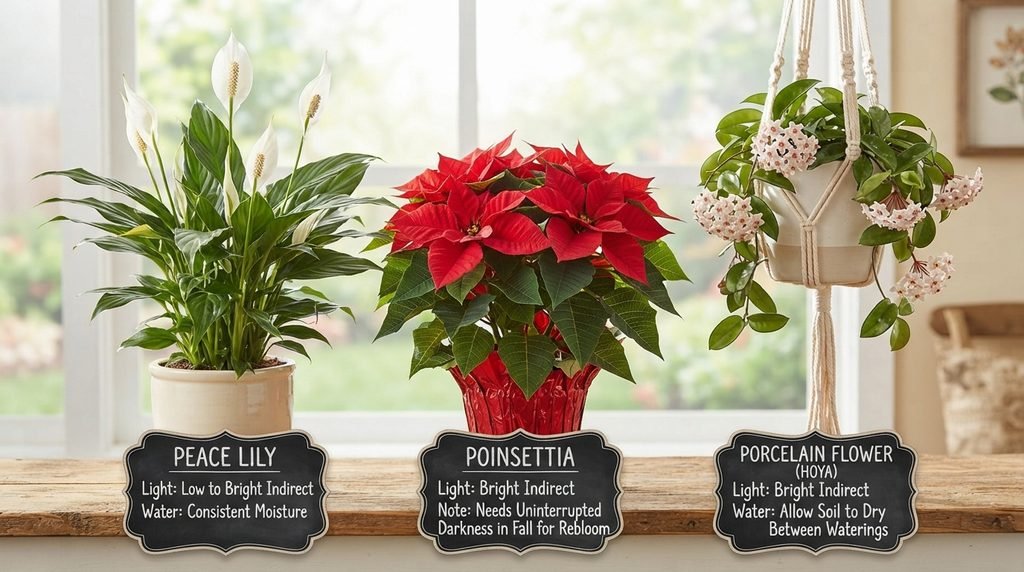
Porcelain flower, botanically Hoya, rounds out this group with clusters of small, waxy, star-shaped blooms that release a strong fragrance in the evening, tolerating a wide range of indoor light conditions better than most flowering houseplants.
- Peace Lily — low to bright indirect light, consistent moisture, avoid overwatering
- Poinsettia — bright indirect light, needs uninterrupted darkness in fall to rebloom
- Porcelain Flower (Hoya) — bright indirect light, allow soil to dry between waterings
Peace lily remains the most forgiving of this trio for a beginner, signaling clearly through drooping leaves when it needs water, unlike poinsettia, which can decline quickly if its light and temperature needs aren’t met consistently.
Florist Favorites: P Flowers Built for Cutting and Arranging
Cut-flower value depends on vase life, stem strength, and overall versatility, and several P flowers perform strongly across all three. Peony remains one of the most requested flowers in modern floral design, prized for its enormous, ruffled blooms and relatively long vase life once cut at the right stage. Protea brings dramatic, sculptural texture to an arrangement, holding its shape and color for weeks, far longer than most traditional cut flowers.
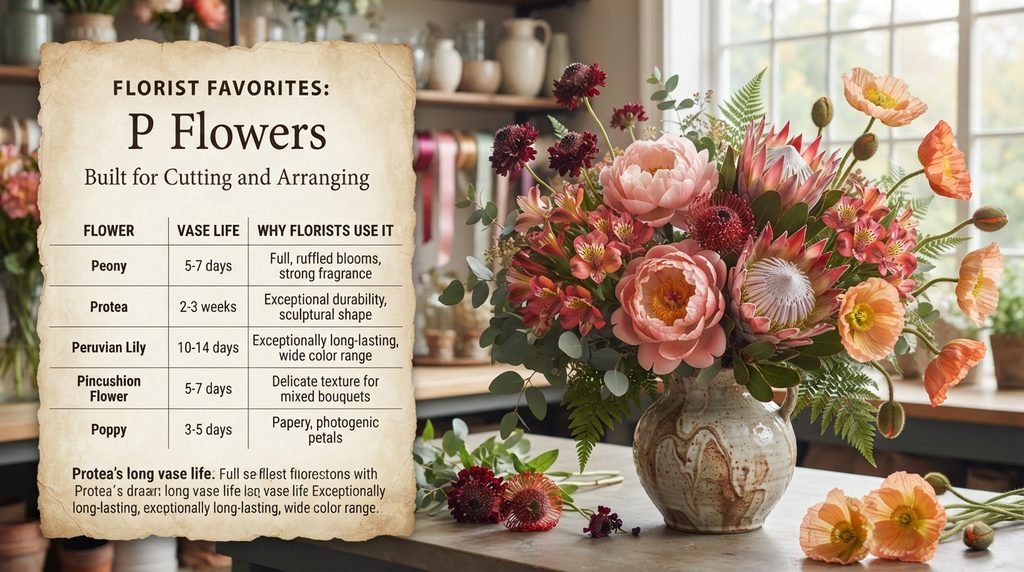
Peruvian lily, sold commercially as Alstroemeria, ranks among the longest-lasting cut flowers available anywhere, often holding its color and form for two weeks or more. Pincushion flower, or Scabiosa, adds delicate texture to mixed bouquets, while poppy, despite its short individual bloom life, remains popular for its papery, translucent petals that photograph beautifully even in a single day of use.
| Flower | Vase Life | Why Florists Use It |
| Peony | 5–7 days | Full, ruffled blooms, strong fragrance |
| Protea | 2–3 weeks | Exceptional durability, sculptural shape |
| Peruvian Lily | 10–14 days | Exceptionally long-lasting, wide color range |
| Pincushion Flower | 5–7 days | Delicate texture for mixed bouquets |
| Poppy | 3–5 days | Papery, photogenic petals |
Protea stands out from the rest of this table for its unusually long vase life, which is exactly why it shows up so often in dried arrangements as well as fresh bouquets that need to last well beyond a typical week.
Rare Flowers: The Harder-to-Find Entries on This List
A handful of entries on this list are genuinely uncommon. Parrot flower tops this group for sheer novelty, since its unusual bloom shape resembles a small parrot in flight, a resemblance striking enough that the plant has drawn global attention despite remaining endangered and difficult to cultivate outside specialist collections in Southeast Asia. Puya, a spiny Chilean relative of the pineapple, produces an otherworldly blue-green flower spike that can take years to appear, which keeps it firmly in the realm of botanical garden curiosities rather than everyday landscaping.
Pheasant’s eye, a spring bulb with a distinctive red-rimmed center, remains uncommon in general nurseries and is typically sourced through specialty bulb importers. Painted trillium, a native woodland wildflower, grows slowly and specifically in the acidic, undisturbed forest conditions of its native range, which makes it a poor candidate for typical garden cultivation despite its striking white-and-pink bloom.
Caution: P Flowers That Need Careful Placement
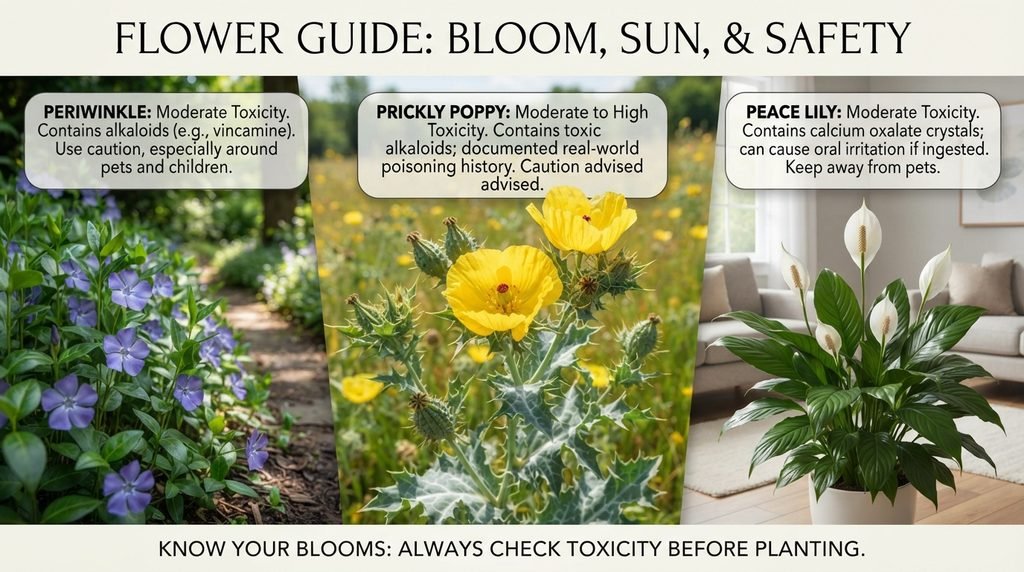
Toxicity risk varies sharply across this letter, and a few entries deserve serious, specific attention. Prickly poppy carries a genuinely documented history of harm, since its seeds have contaminated cooking oil in real-world cases, causing a condition known as epidemic dropsy that affects the heart and kidneys. Periwinkle, more precisely Vinca, contains potent alkaloids used in cancer medications at controlled doses, but the whole plant is toxic enough in its natural form that ingestion can cause serious symptoms in pets and humans alike.
Paperwhite and parrot tulip both carry bulb toxicity typical of their respective plant families, causing digestive upset if dug up and chewed by a curious pet. Pigeon berry deserves specific mention for its attractive purple berries, which have caused documented poisoning incidents in children who mistook them for something edible.
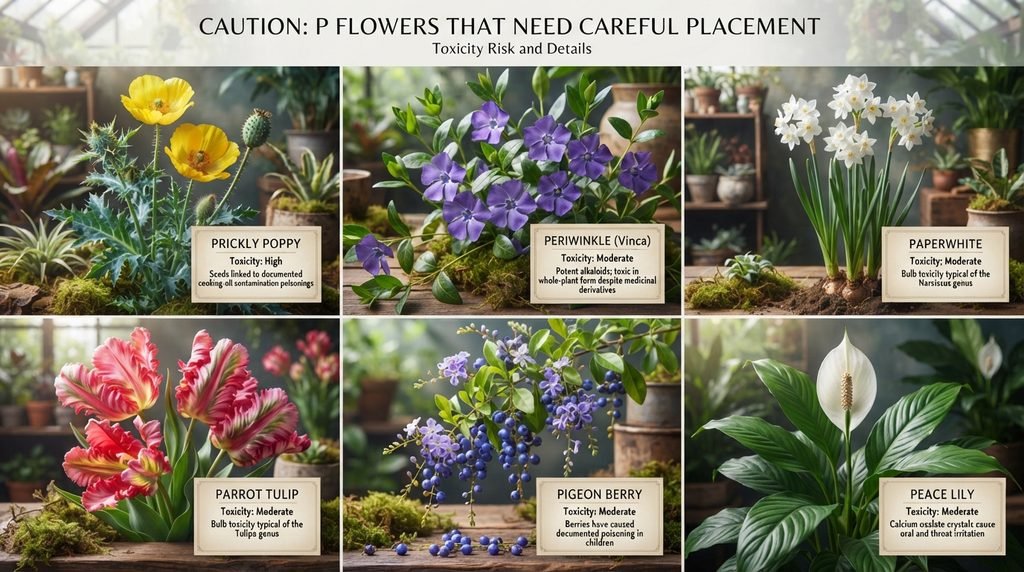
| Flower | Toxicity Level | Risk Details |
| Prickly Poppy | Moderate to High | Seeds linked to documented cooking-oil contamination poisonings |
| Periwinkle (Vinca) | Moderate | Potent alkaloids; toxic in whole-plant form despite medicinal derivatives |
| Paperwhite | Moderate | Bulb toxicity typical of the Narcissus genus |
| Parrot Tulip | Moderate | Bulb toxicity typical of the Tulipa genus |
| Pigeon Berry | Moderate | Berries have caused documented poisoning in children |
| Peace Lily | Moderate | Calcium oxalate crystals cause oral and throat irritation |
Peace lily is worth a specific clarification, since its name causes confusion. It’s not a true lily and doesn’t carry the severe, cat-specific kidney failure risk associated with true lilies, but it still deserves caution for the irritation it can cause on contact.
Choosing by Life Cycle: Annuals, Perennials, Bulbs, and Beyond
Matching a flower’s life cycle to an actual planning horizon matters as much as matching its color. An annual that needs replanting every year plays a very different role than a shrub or tree that becomes a permanent fixture. Perennials make up the largest group among these flowers, offering repeat blooms with less ongoing replanting effort. Bulbs form a meaningful secondary group, including several spring and fall bloomers that finish quickly before going dormant.
True annuals are a genuinely useful cluster here, led by petunia, pansy, and painted tongue. Trees and shrubs round out the list with some of its most dramatic entries, including several specimens that take years to mature but reward that patience.
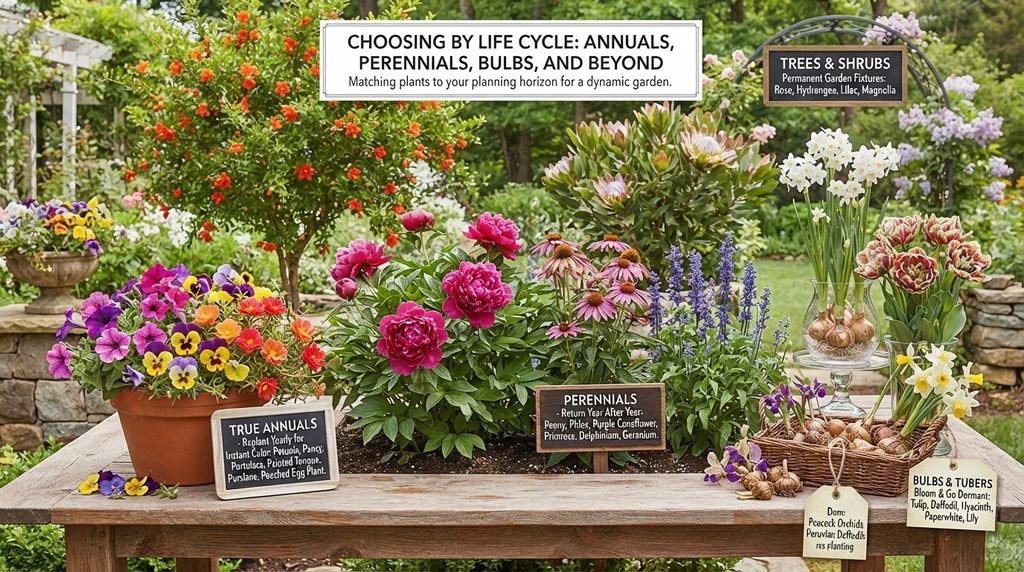
| Flower | Life Cycle |
| Peony | Perennial |
| Petunia | Annual |
| Poppy | Annual or perennial (species-dependent) |
| Pansy | Annual (biennial in mild climates) |
| Primrose | Perennial |
| Protea | Evergreen shrub |
| Phlox | Perennial |
| Periwinkle | Perennial |
| Poinsettia | Perennial shrub (grown as annual houseplant) |
| Passion Flower | Perennial vine |
| Peace Lily | Perennial |
| Plumeria | Deciduous shrub/small tree |
| Portulaca (Moss Rose) | Annual |
| Pincushion Flower | Perennial |
| Pentas | Perennial (grown as annual) |
| Penstemon | Perennial |
| Pink (Dianthus) | Perennial |
| Pitcher Plant | Perennial |
| Plumbago | Perennial shrub |
| Purple Coneflower | Perennial |
| Prairie Smoke | Perennial |
| Painted Daisy | Perennial |
| Painted Tongue | Annual |
| Pineapple Sage | Perennial (tender) |
| Pincushion Protea | Evergreen shrub |
| Peruvian Lily | Perennial (tuberous root) |
| Persian Buttercup | Tuberous perennial |
| Peacock Flower | Perennial shrub |
| Pagoda Flower | Perennial shrub |
| Paper Flower | Woody vine/shrub |
| Paperwhite | Bulb |
| Parrot Flower | Perennial |
| Parrot Tulip | Bulb |
| Peacock Orchid | Bulb (corm) |
| Pearl Bush | Deciduous shrub |
| Pearly Everlasting | Perennial |
| Pelargonium | Perennial (grown as annual) |
| Persian Violet | Annual (grown as houseplant) |
| Peruvian Daffodil | Bulb |
| Pheasant’s Eye | Bulb or annual (species-dependent) |
| Pickerelweed | Perennial (aquatic) |
| Pig Face | Perennial succulent |
| Pigeon Berry | Perennial shrub |
| Pincushion Cactus | Perennial succulent |
| Pineapple Lily | Bulb |
| Pinwheel Flower | Perennial shrub |
| Pitcher Sage | Perennial |
| Plains Coreopsis | Annual |
| Poached Egg Plant | Annual |
| Pocketbook Flower | Annual (grown as houseplant) |
| Poinciana | Tree |
| Pomegranate | Deciduous shrub/tree |
| Poppy Anemone | Tuberous perennial |
| Porcelain Flower | Perennial vine |
| Powder Puff Tree | Perennial shrub |
| Prairie Coneflower | Perennial |
| Prickly Poppy | Annual or short-lived perennial |
| Pride of Madeira | Biennial or perennial |
| Primrose Jasmine | Perennial shrub |
| Prince’s Feather | Annual |
| Princess Flower | Perennial shrub |
| Prophet Flower | Perennial (alpine) |
| Puya | Perennial (bromeliad) |
| Purple Bell Vine | Perennial vine |
| Purple Loosestrife | Perennial |
| Purple Prairie Clover | Perennial |
| Purslane | Annual |
| Pussytoes | Perennial |
| Peacock Iris | Bulb (rhizome) |
| Persian Cyclamen | Perennial (tuber) |
| Peach-Leaved Bellflower | Perennial |
| Prairie Gentian | Annual (tender perennial) |
| Painted Trillium | Perennial |
| Pink Powder Puff | Perennial shrub |
| Plume Poppy | Perennial |
| Plumed Cockscomb | Annual |
| Podranea | Perennial vine |
| Poor Man’s Orchid | Annual |
| Poppy Mallow | Perennial |
| Potentilla (Cinquefoil) | Perennial shrub |
| Passiflora (Maypop) | Perennial vine |
| Peruvian Squill | Bulb |
| Pink Evening Primrose | Perennial |
| Panama Rose | Perennial shrub |
| Palo Verde | Tree |
| Pink Rice Flower | Perennial shrub |
| Prostrate Speedwell | Perennial |
| Persian Silk Tree | Tree |
| Plectranthus | Perennial |
| Pigsqueak | Perennial |
| Pink Lady’s Slipper | Perennial (terrestrial orchid) |
| Persian Speedwell | Annual |
| Pink Trumpet Tree | Tree |
| Pussy Ears | Perennial (bulb) |
| Pink Quill | Perennial (bromeliad) |
| Peruvian Apple Cactus | Perennial succulent |
| Pink Jasmine | Perennial vine |
| Prairie Rose | Perennial shrub |
| Puschkinia | Bulb |
| Patrinia (Golden Lace) | Perennial |
This table makes the perennial-heavy nature of this letter clear at a glance. True annuals, including petunia, pansy, portulaca, painted tongue, purslane, and poached egg plant, remain a genuinely useful group for gardeners planning single-season color.
The Master List: Every Flower on This Guide, A to Z
Several entries below are best known by common English names, particularly the “Peruvian,” “Persian,” and “Prairie” prefixed varieties. Others are almost always sold under their botanical genus name directly, since no separate common name ever became standard. This list reflects that natural split.
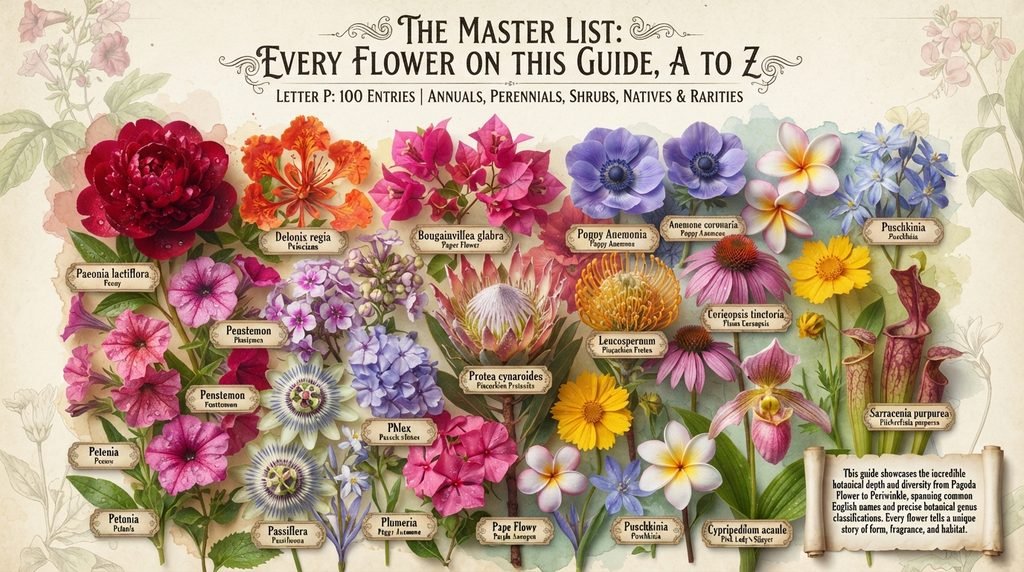
- Pagoda Flower — Clerodendrum paniculatum
- Painted Daisy — Tanacetum coccineum
- Painted Tongue — Salpiglossis sinuata
- Painted Trillium — Trillium undulatum
- Palo Verde — Parkinsonia florida
- Panama Rose — Rondeletia leucophylla
- Paper Flower — Bougainvillea glabra
- Paperwhite — Narcissus papyraceus
- Parrot Flower — Impatiens psittacina
- Parrot Tulip — Tulipa ‘Parrot’ hybrids
- Passiflora (Maypop) — Passiflora incarnata
- Passion Flower — Passiflora caerulea
- Patrinia (Golden Lace) — Patrinia scabiosifolia
- Peace Lily — Spathiphyllum wallisii
- Peach-Leaved Bellflower — Campanula persicifolia
- Peacock Flower — Caesalpinia pulcherrima
- Peacock Iris — Moraea aristata
- Peacock Orchid — Gladiolus murielae
- Pearl Bush — Exochorda racemosa
- Pearly Everlasting — Anaphalis margaritacea
- Pelargonium — Pelargonium zonale
- Pentas — Pentas lanceolata
- Penstemon — Penstemon digitalis
- Peony — Paeonia lactiflora
- Persian Buttercup — Ranunculus asiaticus
- Persian Cyclamen — Cyclamen persicum
- Persian Silk Tree — Albizia julibrissin
- Persian Speedwell — Veronica persica
- Persian Violet — Exacum affine
- Peruvian Apple Cactus — Cereus repandus
- Peruvian Daffodil — Hymenocallis narcissiflora
- Peruvian Lily — Alstroemeria aurea
- Peruvian Squill — Scilla peruviana
- Petunia — Petunia × hybrida
- Pheasant’s Eye — Narcissus poeticus var. recurvus
- Pickerelweed — Pontederia cordata
- Pig Face — Carpobrotus edulis
- Pigeon Berry — Duranta erecta
- Pigsqueak — Bergenia crassifolia
- Pincushion Cactus — Mammillaria bocasana
- Pincushion Flower — Scabiosa columbaria
- Pincushion Protea — Leucospermum cordifolium
- Pineapple Lily — Eucomis comosa
- Pineapple Sage — Salvia elegans
- Pink (Dianthus) — Dianthus plumarius
- Pink Evening Primrose — Oenothera speciosa
- Pink Jasmine — Jasminum polyanthum
- Pink Lady’s Slipper — Cypripedium acaule
- Pink Powder Puff — Calliandra haematocephala
- Pink Quill — Tillandsia cyanea
- Pink Rice Flower — Pimelea ferruginea
- Pink Trumpet Tree — Tabebuia rosea
- Pinwheel Flower — Tabernaemontana divaricata
- Pitcher Plant — Sarracenia purpurea
- Pitcher Sage — Lepechinia hastata
- Plains Coreopsis — Coreopsis tinctoria
- Plectranthus — Plectranthus scutellarioides
- Plume Poppy — Macleaya cordata
- Plumed Cockscomb — Celosia argentea var. plumosa
- Plumbago — Plumbago auriculata
- Plumeria — Plumeria rubra
- Poached Egg Plant — Limnanthes douglasii
- Pocketbook Flower — Calceolaria crenatiflora
- Poinciana — Delonix regia
- Poinsettia — Euphorbia pulcherrima
- Pomegranate — Punica granatum
- Poor Man’s Orchid — Schizanthus pinnatus
- Poppy — Papaver rhoeas
- Poppy Anemone — Anemone coronaria
- Poppy Mallow — Callirhoe involucrata
- Porcelain Flower — Hoya carnosa
- Portulaca (Moss Rose) — Portulaca grandiflora
- Potentilla (Cinquefoil) — Potentilla fruticosa
- Powder Puff Tree — Calliandra eriophylla
- Prairie Coneflower — Ratibida columnifera
- Prairie Gentian — Eustoma grandiflorum
- Prairie Rose — Rosa setigera
- Prairie Smoke — Geum triflorum
- Prickly Poppy — Argemone mexicana
- Pride of Madeira — Echium candicans
- Primrose — Primula vulgaris
- Primrose Jasmine — Jasminum mesnyi
- Prince’s Feather — Amaranthus cruentus
- Princess Flower — Tibouchina urvilleana
- Prophet Flower — Arnebia pulchra
- Prostrate Speedwell — Veronica prostrata
- Protea — Protea cynaroides
- Purple Bell Vine — Rhodochiton atrosanguineus
- Purple Coneflower — Echinacea purpurea
- Purple Loosestrife — Lythrum salicaria
- Purple Prairie Clover — Dalea purpurea
- Purslane — Portulaca oleracea
- Pussy Ears — Calochortus tolmiei
- Pussytoes — Antennaria dioica
- Puschkinia — Puschkinia scilloides
- Puya — Puya berteroniana
- Periwinkle — Vinca minor
This list holds one hundred entries in total. It spans easy annuals, fragrant perennials, dramatic shrubs, native wildflowers, and several genuinely dangerous plants, which reflects just how much depth this letter actually offers.
Why Botanical Names Matter for This Letter
Common-name confusion is a real risk with this letter. Several unrelated flowers share the same descriptive prefix, and “Peruvian,” “Persian,” and “prairie” each cover multiple genuinely different plants on this list. A large number of other entries are rarely sold under any English common name at all.
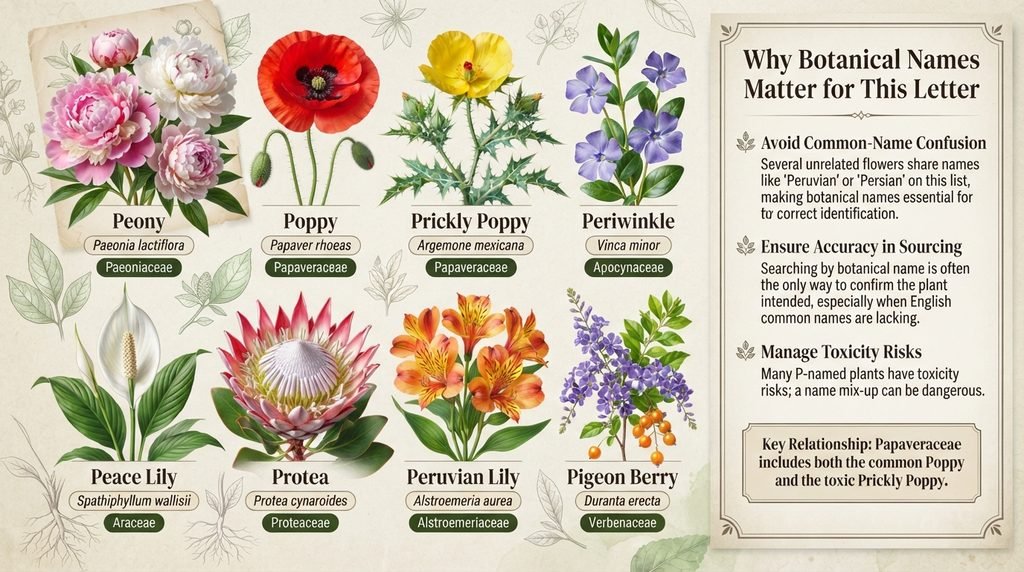
Searching by botanical name is often the only reliable way to confirm that a nursery listing actually matches the plant intended, especially given how many P-named plants carry toxicity risks that a name mix-up could make worse.
| Common Name | Botanical Name | Plant Family |
| Peony | Paeonia lactiflora | Paeoniaceae |
| Poppy | Papaver rhoeas | Papaveraceae |
| Prickly Poppy | Argemone mexicana | Papaveraceae |
| Periwinkle | Vinca minor | Apocynaceae |
| Peace Lily | Spathiphyllum wallisii | Araceae |
| Protea | Protea cynaroides | Proteaceae |
| Peruvian Lily | Alstroemeria aurea | Alstroemeriaceae |
| Pigeon Berry | Duranta erecta | Verbenaceae |
The Papaveraceae family shows up twice in this short sample, a useful reminder that both true poppy and prickly poppy share a botanical relationship, even though prickly poppy carries a considerably more serious documented toxicity history than its more common garden relative.
Full Comparison Table: Bloom Time, Sun, and Safety at a Glance
The table below brings together bloom season, sun needs, toxicity level, and primary use for every flower covered in this guide. It makes it possible to scan for a specific combination of traits, such as a spring-blooming, full-sun, pet-safe option, without flipping back through each section above. Toxicity ratings here mirror the research covered in the caution section, condensed for quick reference.
| Flower | Bloom Season | Sun | Toxicity | Primary Use |
| Peony | Late spring | Full sun | Non-toxic | Cut flower, perennial anchor |
| Petunia | Spring–fall | Full sun | Non-toxic | Bedding, containers |
| Poppy | Late spring–summer | Full sun | Moderate | Meadow, cut flower |
| Pansy | Spring and fall | Full sun–part shade | Non-toxic | Cool-season bedding |
| Primrose | Spring | Partial shade | Mild | Shade border |
| Protea | Winter–spring | Full sun | Non-toxic | Cut flower, specimen shrub |
| Phlox | Summer | Full sun–part shade | Non-toxic | Fragrant border |
| Periwinkle | Spring–summer | Full sun–part shade | Moderate | Groundcover (caution) |
| Poinsettia | Winter | Bright indirect | Mild | Holiday houseplant |
| Passion Flower | Summer | Full sun | Non-toxic | Trellis, vine |
| Peace Lily | Nearly year-round (indoor) | Low to bright indirect | Moderate | Houseplant |
| Plumeria | Summer–fall | Full sun | Mild | Tropical specimen, leis |
| Portulaca (Moss Rose) | Summer | Full sun | Non-toxic | Groundcover, rock garden |
| Pincushion Flower | Summer–fall | Full sun | Non-toxic | Cutting garden |
| Pentas | Summer–fall | Full sun | Non-toxic | Pollinator bedding |
| Penstemon | Late spring–summer | Full sun–part shade | Non-toxic | Hummingbird border |
| Pink (Dianthus) | Spring–summer | Full sun | Mild | Border, cut flower |
| Pitcher Plant | Spring–summer | Full sun | Non-toxic | Bog garden, novelty |
| Plumbago | Summer–fall | Full sun | Mild | Border, container |
| Purple Coneflower | Summer–fall | Full sun | Non-toxic | Pollinator border |
| Prairie Smoke | Spring | Full sun | Non-toxic | Native rock garden |
| Painted Daisy | Early summer | Full sun | Mild | Cut flower, border |
| Painted Tongue | Summer | Full sun | Non-toxic | Cottage annual |
| Pineapple Sage | Fall | Full sun | Non-toxic | Culinary, hummingbird garden |
| Pincushion Protea | Winter–spring | Full sun | Non-toxic | Cut flower, xeriscape |
| Peruvian Lily | Spring–summer | Full sun–part shade | Mild | Cut flower |
| Persian Buttercup | Spring | Full sun–part shade | Moderate | Cut flower, bedding |
| Peacock Flower | Summer–fall | Full sun | Moderate | Tropical border |
| Pagoda Flower | Summer | Full sun–part shade | Mild | Tropical specimen |
| Paper Flower | Nearly year-round (warm) | Full sun | Non-toxic | Trellis, Mediterranean garden |
| Paperwhite | Winter (forced indoors) | Full sun | Moderate | Fragrant holiday bulb |
| Parrot Flower | Summer | Partial shade | Non-toxic | Rare specimen |
| Parrot Tulip | Mid-spring | Full sun | Moderate | Dramatic spring bulb |
| Peacock Orchid | Summer | Full sun | Mild | Fragrant cut flower |
| Pearl Bush | Mid-spring | Full sun–part shade | Non-toxic | Specimen shrub |
| Pearly Everlasting | Summer | Full sun | Non-toxic | Dried arrangements |
| Pelargonium | Spring–fall | Full sun | Mild | Container, bedding |
| Persian Violet | Summer | Bright indirect | Non-toxic | Houseplant |
| Peruvian Daffodil | Summer | Full sun | Moderate | Fragrant bulb display |
| Pheasant’s Eye | Late spring | Full sun | Moderate | Naturalized bulb display |
| Pickerelweed | Summer | Full sun | Non-toxic | Pond, water garden |
| Pig Face | Spring–summer | Full sun | Non-toxic | Coastal groundcover |
| Pigeon Berry | Summer–fall | Full sun | Moderate | Butterfly hedge (caution) |
| Pincushion Cactus | Spring | Full sun | Non-toxic | Desert specimen |
| Pineapple Lily | Summer | Full sun | Mild | Border, cut flower |
| Pinwheel Flower | Nearly year-round (warm) | Full sun–part shade | Moderate | Fragrant tropical shrub |
| Pitcher Sage | Summer | Full sun | Non-toxic | Pollinator border |
| Plains Coreopsis | Summer | Full sun | Non-toxic | Wildflower meadow |
| Poached Egg Plant | Spring–summer | Full sun | Non-toxic | Groundcover, pollinator |
| Pocketbook Flower | Spring | Bright indirect | Mild | Houseplant, gift plant |
| Poinciana | Summer | Full sun | Non-toxic | Dramatic shade tree |
| Pomegranate | Late spring–summer | Full sun | Non-toxic | Edible ornamental shrub |
| Poppy Anemone | Early spring | Full sun–part shade | Mild | Bouquet, spring bed |
| Porcelain Flower | Summer | Bright indirect | Non-toxic | Fragrant houseplant vine |
| Powder Puff Tree | Spring | Full sun | Non-toxic | Xeriscape shrub |
| Prairie Coneflower | Summer–fall | Full sun | Non-toxic | Native prairie garden |
| Prickly Poppy | Summer | Full sun | Moderate to High | Caution wildflower |
| Pride of Madeira | Spring–summer | Full sun | Mild | Coastal, pollinator border |
| Primrose Jasmine | Winter–spring | Full sun | Non-toxic | Early color, fragrance |
| Prince’s Feather | Summer–fall | Full sun | Non-toxic | Dramatic border accent |
| Princess Flower | Summer–fall | Full sun–part shade | Non-toxic | Tropical specimen shrub |
| Prophet Flower | Spring | Full sun | Non-toxic | Alpine rock garden |
| Puya | Late spring | Full sun | Non-toxic | Rare specimen bromeliad |
| Purple Bell Vine | Summer–fall | Full sun–part shade | Non-toxic | Trellis, hanging basket |
| Purple Loosestrife | Summer | Full sun | Non-toxic | Wetland (invasive risk) |
| Purple Prairie Clover | Summer | Full sun | Non-toxic | Native prairie garden |
| Purslane | Summer | Full sun | Non-toxic | Edible groundcover |
| Pussytoes | Spring | Full sun | Non-toxic | Rock garden groundcover |
| Peacock Iris | Spring | Full sun | Moderate | Specialty bulb display |
| Persian Cyclamen | Fall–winter | Partial shade | Moderate | Houseplant, woodland |
| Peach-Leaved Bellflower | Early summer | Full sun–part shade | Non-toxic | Cottage border |
| Prairie Gentian | Summer | Full sun | Non-toxic | Cut flower |
| Painted Trillium | Spring | Partial to full shade | Mild | Native woodland specimen |
| Pink Powder Puff | Summer–fall | Full sun | Non-toxic | Tropical specimen shrub |
| Plume Poppy | Summer | Full sun–part shade | Moderate | Dramatic back-border accent |
| Plumed Cockscomb | Summer–fall | Full sun | Non-toxic | Bedding, dried arrangements |
| Podranea | Summer–fall | Full sun | Non-toxic | Climbing vine |
| Poor Man’s Orchid | Spring–summer | Full sun–part shade | Mild | Cottage annual |
| Poppy Mallow | Summer | Full sun | Non-toxic | Groundcover, rock garden |
| Potentilla | Summer | Full sun | Non-toxic | Low border shrub |
| Passiflora (Maypop) | Summer | Full sun | Non-toxic | Native vine, edible fruit |
| Peruvian Squill | Spring | Full sun | Mild | Naturalized bulb display |
| Pink Evening Primrose | Summer | Full sun | Non-toxic | Groundcover, border |
| Panama Rose | Summer–fall | Full sun–part shade | Non-toxic | Fragrant tropical shrub |
| Palo Verde | Spring | Full sun | Non-toxic | Desert specimen tree |
| Pink Rice Flower | Spring | Full sun | Non-toxic | Xeriscape shrub |
| Prostrate Speedwell | Late spring | Full sun | Non-toxic | Rock garden groundcover |
| Persian Silk Tree | Summer | Full sun | Mild | Specimen flowering tree |
| Plectranthus | Summer–fall | Partial shade | Non-toxic | Shade border, container |
| Pigsqueak | Early spring | Full sun–part shade | Non-toxic | Groundcover, edging |
| Pink Lady’s Slipper | Late spring | Partial shade | Non-toxic | Native woodland specimen |
| Persian Speedwell | Spring–summer | Full sun | Non-toxic | Lawn alternative, groundcover |
| Pink Trumpet Tree | Spring | Full sun | Non-toxic | Specimen flowering tree |
| Pussy Ears | Spring | Full sun–part shade | Non-toxic | Native bulb specialty |
| Pink Quill | Summer | Bright indirect | Non-toxic | Houseplant, bromeliad display |
| Peruvian Apple Cactus | Summer (night-blooming) | Full sun | Non-toxic | Desert specimen |
| Pink Jasmine | Spring | Full sun–part shade | Non-toxic | Fragrant climbing vine |
| Prairie Rose | Summer | Full sun | Non-toxic | Native climbing rose |
| Puschkinia | Early spring | Full sun–part shade | Mild | Naturalized bulb display |
| Patrinia (Golden Lace) | Summer–fall | Full sun–part shade | Non-toxic | Airy border accent |
Three rows stand out on a closer look at this table. Prickly poppy carries the only moderate-to-high toxicity rating tied to a documented real-world poisoning history, while periwinkle and peace lily follow with moderate ratings tied to alkaloid content and oxalate crystals, respectively.
Decision Guide: Matching a Scenario to the Right P Flower
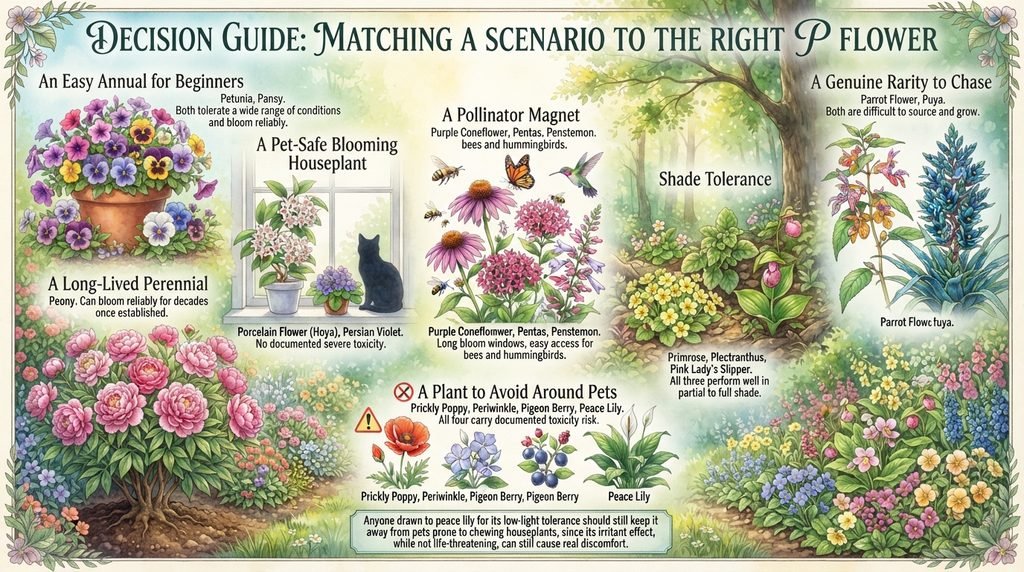
Sometimes the fastest way to choose a flower isn’t scrolling through a full list. It helps to start from the actual problem that needs solving, whether that’s a shaded corner, a fragrant border, or a household with pets. The table below maps common gardening scenarios to the P flowers best suited to each one.
| If You Need… | Consider | Why |
| An easy annual for beginners | Petunia, Pansy | Both tolerate a wide range of conditions and bloom reliably |
| A pet-safe blooming houseplant | Porcelain Flower (Hoya), Persian Violet | No documented severe toxicity |
| A long-lived perennial investment | Peony | Can bloom reliably for decades once established |
| A pollinator magnet | Purple Coneflower, Pentas, Penstemon | Long bloom windows, easy access for bees and hummingbirds |
| Shade tolerance | Primrose, Plectranthus, Pink Lady’s Slipper | All three perform well in partial to full shade |
| A genuine rarity to chase | Parrot Flower, Puya | Both are difficult to source and grow |
| A plant to avoid around pets | Prickly Poppy, Periwinkle, Pigeon Berry, Peace Lily | All four carry documented toxicity risk |
Anyone drawn to peace lily for its low-light tolerance should still keep it away from pets prone to chewing houseplants, since its irritant effect, while not life-threatening, can still cause real discomfort.
Conclusion
Flowers that start with P span an extraordinary range, from easy annual bedding plants and long-lived perennials to dramatic shrubs, native wildflowers, and a cluster of genuinely toxic species. Choosing among them comes down to matching a specific flower to an actual spot, household, or purpose, rather than working straight down an alphabetical list. With the category breakdowns, comparison table, and decision guide covered above, narrowing this list down to the few that genuinely fit a given garden should take far less trial and error than starting from scratch.
Frequently Asked Questions
1. How many flowers that start with P are there?
This guide covers one hundred verified flowers that start with P, ranging from common garden annuals to rare specialty blooms and several plants that require caution.
2. What is the easiest P flower to grow?
Petunia and pansy are both excellent choices for beginners, tolerating a wide range of conditions while still blooming reliably for months.
3. Which P flowers are toxic to pets?
Prickly poppy, periwinkle, and pigeon berry are among the more seriously toxic entries, while peace lily causes milder but still real irritation.
4. What does peony symbolize?
Peony is tied to prosperity and honor in Chinese tradition and to romance and bashfulness in Victorian flower language.
5. What P flowers work well indoors?
Peace lily, poinsettia, and porcelain flower are the most common indoor choices, with peace lily tolerating the widest range of light conditions.
6. Is prickly poppy dangerous to grow at home?
Yes, it deserves real caution. Its seeds have a documented history of contaminating cooking oil and causing serious illness, so it should be kept away from anywhere food is prepared or stored.
7. What’s the best P flower for a fragrant garden?
Peony and phlox are both strong fragrance performers, alongside porcelain flower for anyone with space for a fragrant indoor vine.
8. Are any flowers that start with P genuinely rare?
Yes. Parrot flower and puya are both considered rare, the former due to its endangered status and unusual bloom shape, and the latter due to its very slow, infrequent flowering habit.
9. Is peace lily a true lily?
No, peace lily belongs to a different plant family entirely, which means it doesn’t carry the severe, cat-specific kidney failure risk associated with true lilies, though it still causes irritation if chewed.
10. Can peony survive in most climates?
Yes, peony is a hardy perennial in most temperate zones, though it does need a period of winter chill to bloom each spring reliably.
11. What P flower is best for a pollinator garden?
Purple coneflower and pentas are both strong choices, offering long bloom windows that draw in bees, butterflies, and hummingbirds.
12. Is periwinkle the same as vinca?
Yes, periwinkle is the common name most often used for Vinca minor, a groundcover that carries moderate toxicity despite its popularity.
13. What’s the biggest mistake people make with poinsettia?
Assuming it needs constant bright light to rebloom is a common mistake. It actually needs a strict period of uninterrupted darkness each fall to develop its red color again.
14. Do any P flowers bloom in winter?
Yes. Protea, primrose jasmine, and paperwhite all bloom in winter or very early spring, offering color when many other plants are dormant.
15. What’s a good starter combination of P flowers for a new gardener?
Petunia for easy container color, phlox for summer fragrance, and peony for a long-term perennial investment cover a wide range of needs without demanding much prior experience.