Flowers That Start With V: 50+ Names, Meanings & Beautiful Photos
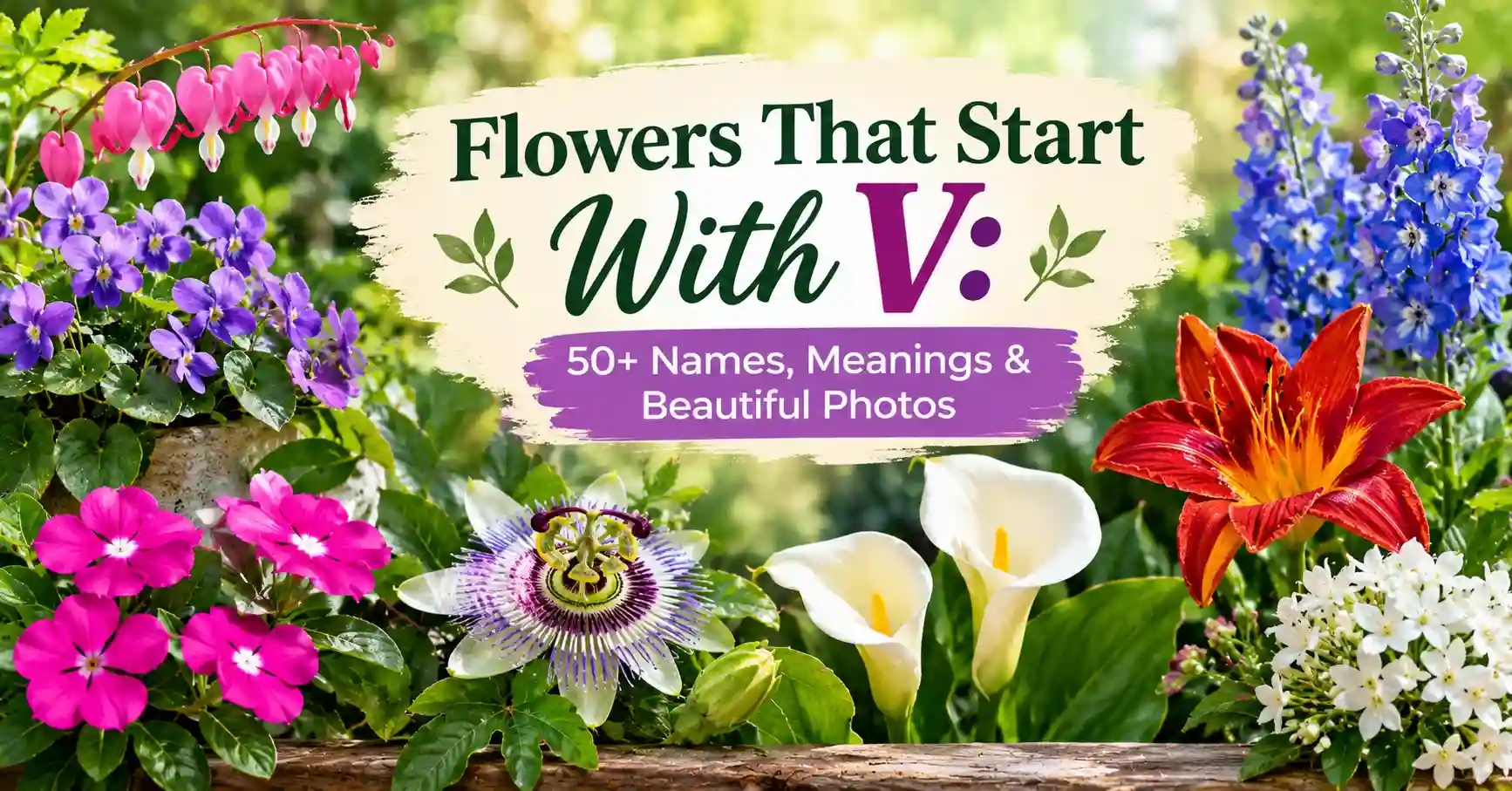
Flowers that start with V cover more range than a short list would suggest. Violet and verbena are the names most people already know. But the letter V also holds real surprises, like a giant Amazonian water lily and a foul-smelling voodoo lily grown purely for shock value. This guide brings all of them together in one place.
The list below runs past 50 names, and that number is not padding. Most V flower guides stop at 20 or 25 entries built around a handful of garden bedding plants. This one goes further on purpose, covering garden staples, native wildflowers, houseplants, and rarer species that rarely make it onto a short list.
A long name list means little without context, though. A flower’s color means less if it can’t survive your climate, and a flower’s shape means less if it’s dangerous around a family pet. So this guide sorts flowers that start with V by color, life cycle, and use case, not just by letter. Every table here is explained in plain sentences first, so nothing reads like an unexplained spreadsheet.
By the end, you’ll have a full alphabetical reference, a botanical name crosswalk for nursery shopping, a toxicity chart, and a decision table for matching a V flower to your exact situation. Readers chasing a specific color or growing style can skip straight to the grouped sections further down.
Quick Answer: Ten Standout V Flowers
Violet is the obvious starting point, since its small, fragrant purple bloom has been a garden and perfume staple for centuries. Verbena earns its spot for blooming nonstop through summer heat with almost no deadheading required. Viburnum and Virginia bluebell cover the shrub-and-woodland side of this letter, one offering fragrant spring clusters on a shrub and the other carpeting shaded ground in clear blue. Vinca solves a specific problem: it’s one of the few flowering groundcovers that thrives in dry shade where most other flowers struggle.
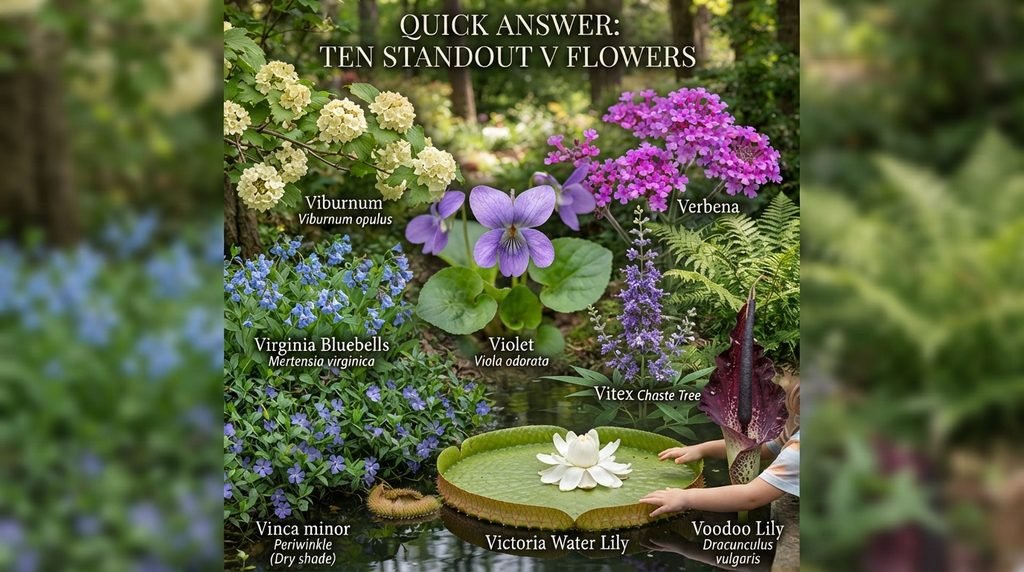
Vitex, commonly called chaste tree, brings a shrub-sized purple bloom spike that draws bees for months. Victoria water lily closes this list as the dramatic outlier, a single leaf pad large enough to support a child’s weight, grown in botanical gardens more than backyard ponds. Voodoo lily rounds things out as the flower most people plant for novelty rather than beauty, valued for its strange, almost reptilian appearance.
What V Flowers Mean
Flower symbolism rarely has one fixed answer, but a handful of V flowers carry meanings solid enough to show up consistently across old flower-language traditions and modern florist guides. Violet is tied closely to modesty and faithfulness, a meaning that traces back to Greek mythology, where the flower was associated with hidden or protected love. Verbena carries an older, more formal meaning of enchantment and healing, once used in ceremonial and medicinal contexts across several ancient cultures.
Vervain, closely related to verbena, shares much of that same symbolic weight, historically believed to ward off negative energy when hung over a doorway. Viburnum, thanks to its heavy spring bloom and later berries, has picked up an association with togetherness and family bonds in more recent garden folklore. Virginia bluebell, given how briefly it blooms before disappearing back underground each summer, is sometimes read as a symbol of fleeting beauty worth noticing while it lasts.
Vitex, long used in traditional herbal medicine for women’s health, carries a meaning tied to balance and resilience, a connection drawn directly from its medicinal history rather than its purple bloom alone.
V Flowers Grouped by Color
Purple and violet tones dominate this letter more than any other, led by violet itself, verbena, and vinca, all three of which produce shades ranging from soft lavender to deep royal purple. Vitex adds a taller, spikier purple to this group, standing out in a border the way the lower, mounding verbena and vinca can’t.
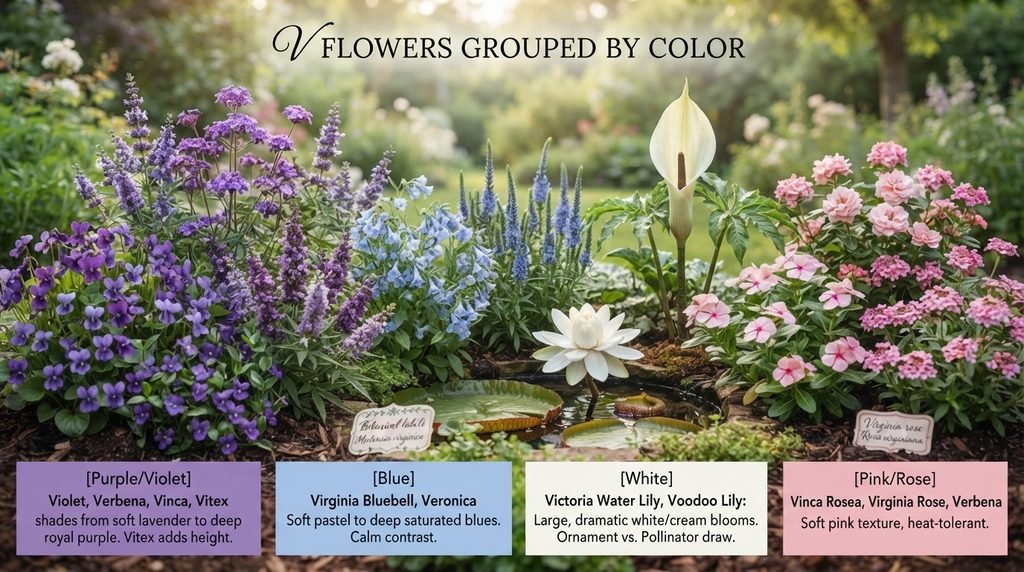
Blue tones show up distinctly in Virginia bluebell and Veronica, two flowers often planted together specifically because their blue range reads as calming against the warmer colors nearby. Virginia bluebell leans softer and more pastel, while Veronica’s spiked blooms read as a slightly deeper, more saturated blue.
White flowers that start with V lean toward drama and scale. Victoria water lily and voodoo lily both produce large white or cream blooms, though for very different reasons — one is a genuine ornamental showpiece, while the other draws pollinators with a smell most people find unpleasant rather than beauty alone.
Pink and rose shades appear in vinca rosea, Virginia rose, and several verbena cultivars, giving softer texture than the bold purples above. Vinca rosea, better known as Madagascar periwinkle, is especially useful here since it tolerates heat and drought that would wilt most other pink-flowering annuals.
Garden Favorites Among Flowers That Start With V
Most home gardens lean on a small handful of reliable V flowers, and it’s worth naming a few before listing them out. Verbena remains one of the most requested V flowers for containers and borders alike, largely because it blooms from late spring through frost with minimal upkeep. Vinca holds its place as a garden favorite for a different reason: it fills dry, shaded ground where grass and most flowering perennials struggle to establish. Viburnum earns its spot as the shrub anchor of this group, offering spring bloom, summer structure, and often fall berries or color in a single plant.
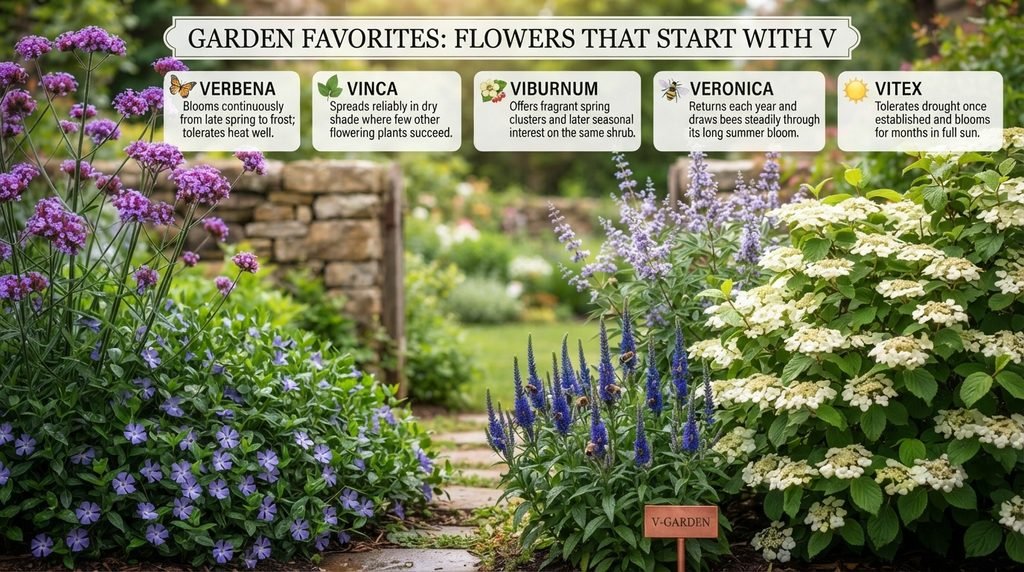
- Verbena blooms continuously from late spring to frost and tolerates heat well.
- Vinca spreads reliably in dry shade where few other flowering plants succeed.
- Viburnum offers fragrant spring clusters and later seasonal interest on the same shrub.
- Veronica returns each year and draws bees steadily through its long summer bloom.
- Vitex tolerates drought once established and blooms for months in full sun.
Veronica and vitex round out this list because both keep producing new blooms through a full season rather than peaking once and fading fast. Anyone building a low-maintenance perennial bed could realistically build much of it around these five names alone.
Indoor Plants Among Flowers That Start With V
Indoor growing narrows the field considerably for this letter, but a few names cover most of what’s realistically available. Vanda orchid is the standout here, prized for large, long-lasting blooms and often grown bare-root in a hanging basket rather than in soil. Vriesea, a bromeliad relative of the more common urn plant, produces a colorful flower spike that holds its look for weeks at a time indoors.
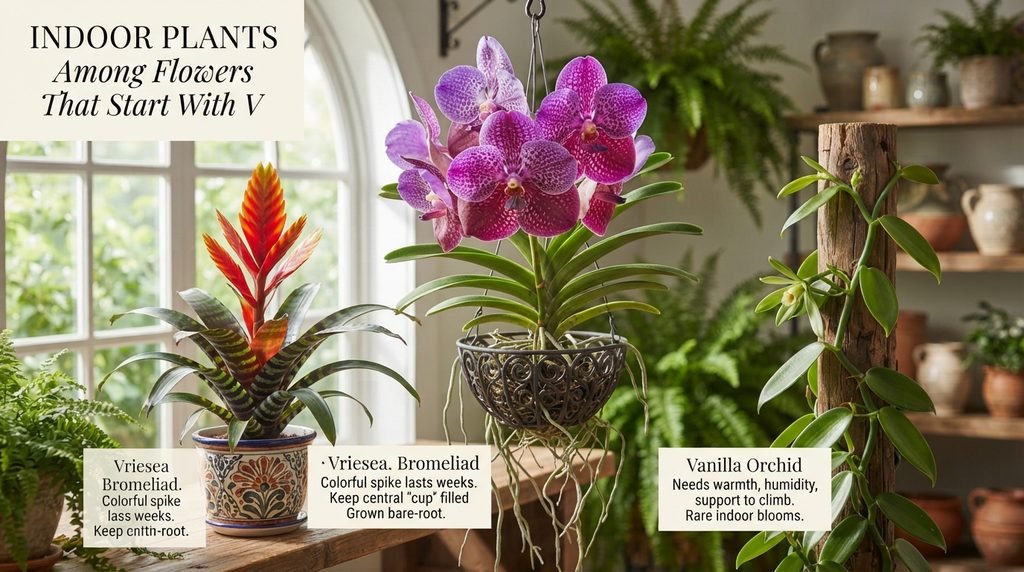
- Vanda Orchid needs bright, indirect light and high humidity to rebloom well.
- Vriesea thrives in bright indirect light with a central “cup” kept lightly filled with water.
- Vanilla Orchid is grown mainly by hobbyists, needing warmth, humidity, and a support to climb.
Vanilla orchid is included here mainly for gardeners curious about growing the plant behind real vanilla flavoring, though it rarely blooms indoors without very specific warmth and humidity conditions.
Florist Favorites Among Flowers That Start With V
Cut-flower work favors V blooms with strong stems, long vase life, or standout fragrance. Violet is prized above almost everything else on this list for its delicate fragrance, even though its short stems mean it’s more often used in small posies than large arrangements. Verbena delivers a different kind of value, offering airy filler clusters that extend the fullness of a mixed bouquet without overwhelming the featured blooms.
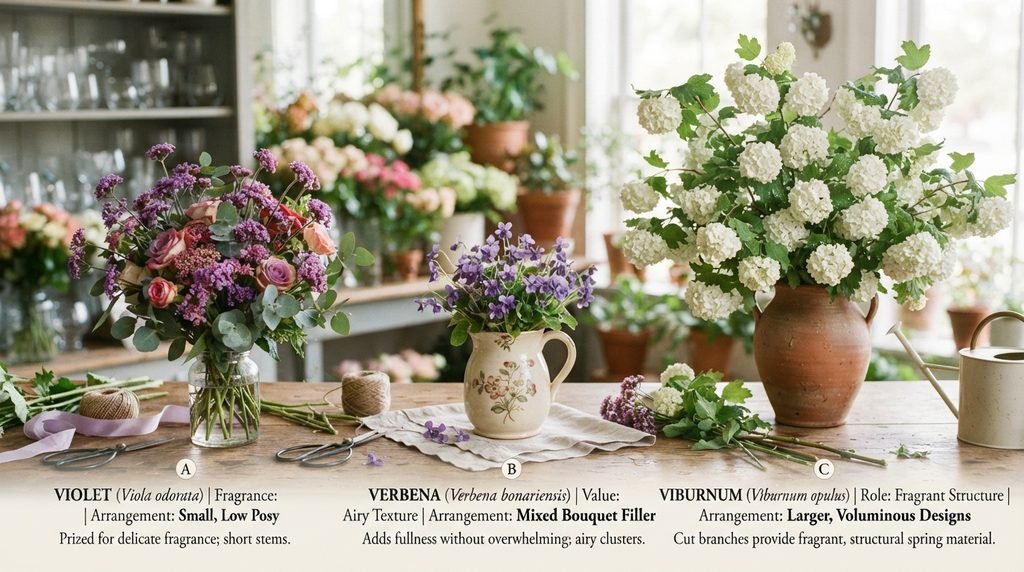
- Violet brings gentle fragrance but works best in small, low arrangements.
- Verbena adds airy texture and color as filler in mixed bouquets.
- Viburnum (cut branches) provides fragrant, structural spring material for larger arrangements.
Viburnum is worth a specific mention here, since florists often cut entire branches rather than individual stems, using the dense flower clusters to add both scent and volume to spring wedding work.
Rare Flowers That Start With V
A few V flowers rarely show up outside specialty growers or botanical gardens. Victoria water lily is the most extreme example, since its enormous leaf pads and single flower that changes from white to pink over two nights of bloom require a large, warm pond that few home gardeners can provide. Voodoo lily, though easier to grow than Victoria water lily, remains uncommon simply because most gardeners aren’t seeking out a plant known mainly for smelling like rotting meat to attract pollinating flies.
Vittadinia, a small native Australian daisy, pushes rarity further in a different way, staying largely unknown outside its native range despite being a tough, drought-tolerant groundcover once established. Violet cress, a tiny spring annual with pale lilac blooms, shares that same low profile, more often grown by rock garden specialists than found at an ordinary nursery. All four species share one trait: none of them tolerate rushed or generic growing conditions, which is part of why they’ve stayed uncommon.
Caution: Toxic Flowers That Start With V
Several V flowers carry real toxicity risks, and getting this section right matters more than any other part of this guide. Vinca, despite its reputation as an easy, reliable groundcover, contains alkaloids throughout the plant that can cause vomiting, low blood pressure, and other symptoms in dogs and cats if eaten in quantity. Voodoo lily contains calcium oxalate crystals, the same compound found in many other members of the arum family, which causes intense mouth and throat irritation if chewed.
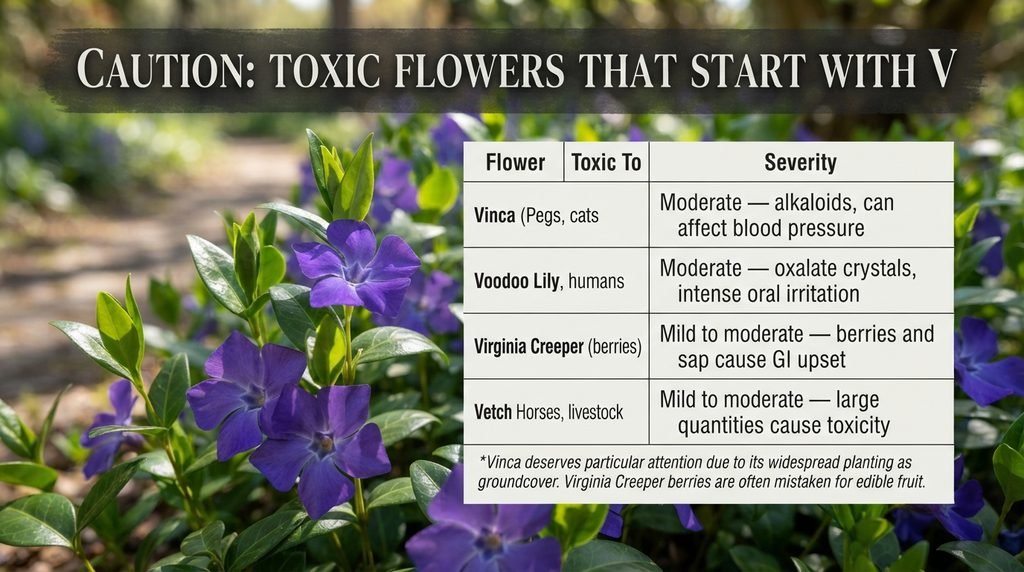
| Flower | Toxic To | Severity |
| Vinca (Periwinkle) | Dogs, cats | Moderate — alkaloids, can affect blood pressure |
| Voodoo Lily | Dogs, cats, humans | Moderate — oxalate crystals, intense oral irritation |
| Virginia Creeper (berries) | Dogs, cats, humans | Mild to moderate — berries and sap cause GI upset |
| Vetch | Horses, livestock | Mild to moderate — large quantities cause toxicity |
Vinca deserves particular attention here since it’s so widely planted as a low-maintenance groundcover that many gardeners don’t realize it carries any risk at all. Virginia creeper, while mainly grown for its foliage rather than its inconspicuous flowers, is included here because its berries are frequently mistaken for edible fruit by curious pets and children.
Life-Cycle Groupings for Flowers That Start With V
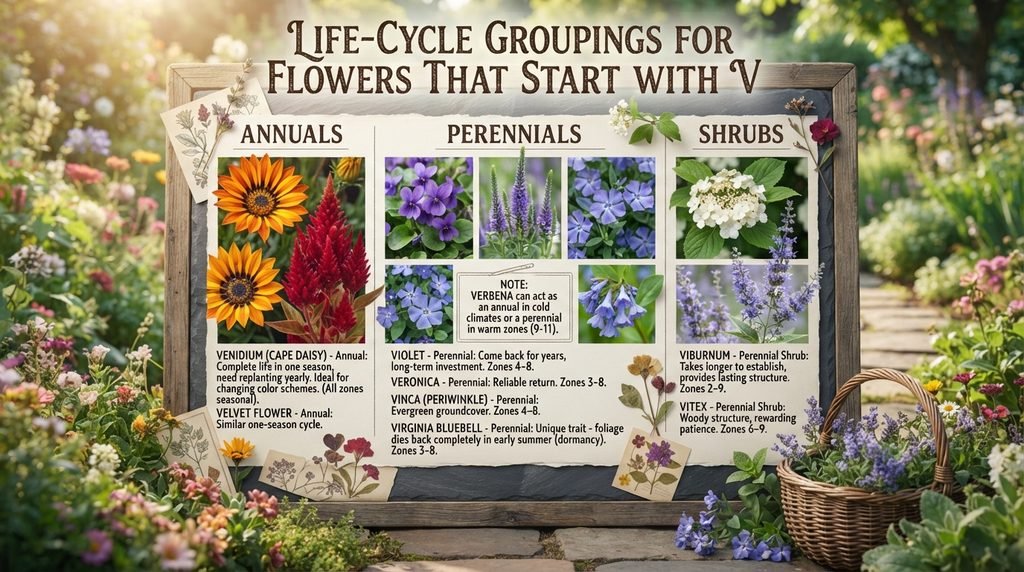
Knowing whether a V flower is an annual, perennial, or shrub changes how it should be planted and budgeted for. Annuals like venidium and velvet flower complete their whole life in one season and need replanting every year, which suits gardeners who like changing color schemes often. Perennials such as veronica and vinca come back on their own for years, making them a better long-term investment for a bed meant to mature over time. Shrubs like viburnum and vitex sit in a category of their own, taking longer to establish but rewarding patience with structure that herbaceous flowers can’t provide.
| Flower | Life Cycle | Typical Zones |
| Violet | Perennial | 4–8 |
| Verbena | Annual (perennial in mild zones) | 9–11 (perennial), elsewhere annual |
| Vinca (Periwinkle) | Perennial (evergreen groundcover) | 4–8 |
| Veronica | Perennial | 3–8 |
| Viburnum | Perennial (shrub) | 2–9, varies by species |
| Vitex | Perennial (shrub) | 6–9 |
| Virginia Bluebell | Perennial (goes dormant in summer) | 3–8 |
| Venidium (Cape Daisy) | Annual | All zones (seasonal) |
Virginia bluebell stands out on this table for an unusual reason: it’s a true perennial, but its foliage dies back completely by early summer, which can worry gardeners who don’t realize the plant is simply going dormant rather than dying. Verbena sits at the opposite pattern, treated as an annual in most climates but capable of returning as a true perennial in the warmest zones.
Master Alphabetical List of Flowers That Start With V
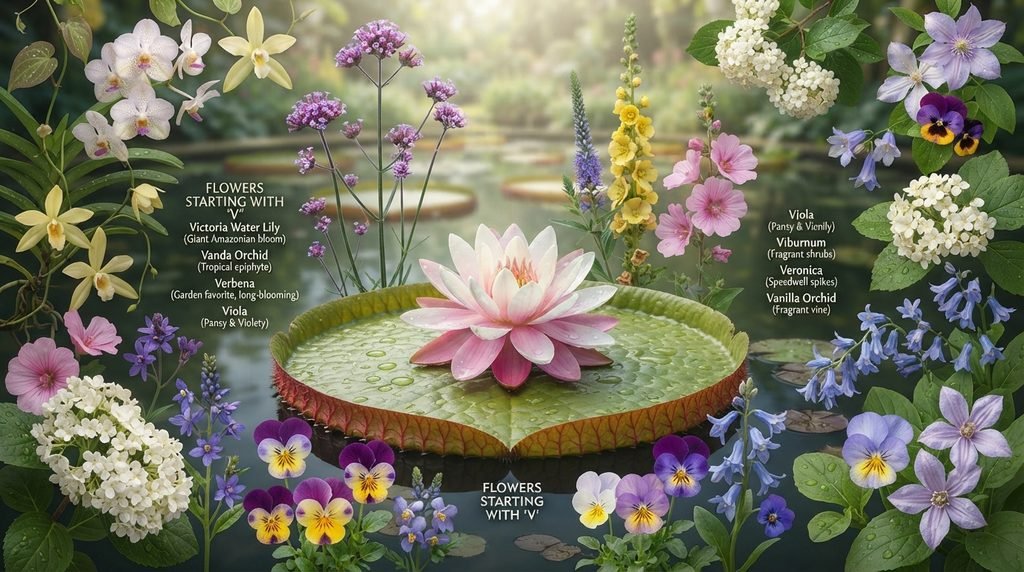
The list below covers more than 50 flowers that start with V, mixing well-known common names with entries more often searched under their botanical name. Common names come first wherever one exists; less familiar species are listed under the botanical name most nurseries actually use on their tags. Each entry includes a short note so the list stays useful rather than becoming a wall of text.
| Flower | Botanical Name | Note |
| Valerian | Valeriana officinalis | Fragrant white-pink clustered bloom |
| Valerian, Red (Jupiter’s Beard) | Centranthus ruber | Deep pink bloom, tolerates poor soil |
| Vanda Orchid | Vanda spp. | Large, long-lasting bare-root orchid bloom |
| Vanilla Orchid | Vanilla planifolia | Climbing vine, source of real vanilla flavor |
| Velvet Flower (Love-Lies-Bleeding) | Amaranthus caudatus | Trailing deep red tassel-like bloom |
| Venidium (Cape Daisy) | Arctotis fastuosa | Orange daisy bloom with a dark center ring |
| Venus Flytrap | Dionaea muscipula | Small white bloom above carnivorous traps |
| Venus’s Looking Glass | Triodanis perfoliata | Small purple bloom, leaf-clasping stem |
| Verbena | Verbena spp. | Clustered bloom, blooms nonstop through summer |
| Verbena Bonariensis | Verbena bonariensis | Tall, airy purple bloom on wiry stems |
| Verbena Canadensis | Verbena canadensis | Spreading pink-purple native verbena |
| Verbena Hastata (Blue Vervain) | Verbena hastata | Tall spiked blue-purple native bloom |
| Verbena Lilacina | Verbena lilacina | Soft lilac bloom, drought-tolerant shrub form |
| Verbena Peruviana | Verbena peruviana | Low, bright red spreading bloom |
| Verbena Rigida | Verbena rigida | Rough-leaved, deep purple clustered bloom |
| Verbascum (Mullein) | Verbascum thapsus | Tall yellow flower spike, self-seeds easily |
| Vernonia (Ironweed) | Vernonia noveboracensis | Tall purple native fall bloom |
| Veronica (Speedwell) | Veronica spp. | Blue-purple spike bloom, easy perennial |
| Veronicastrum (Culver’s Root) | Veronicastrum virginicum | Tall white-pink spiked native bloom |
| Vervain | Verbena officinalis | Small lilac bloom, historic medicinal herb |
| Vervain Mallow | Malva alcea | Pink cup-shaped bloom on a tall stem |
| Vetch | Vicia spp. | Small purple pea-like bloom, spreading vine |
| Vetiver | Chrysopogon zizanioides | Grown mainly for roots; small brown-purple bloom |
| Viburnum | Viburnum spp. | Fragrant white spring cluster on a shrub |
| Viburnum Carlesii (Korean Spice) | Viburnum carlesii | Intensely fragrant pink-white spring bloom |
| Viburnum Opulus (Snowball Bush) | Viburnum opulus | Round white flower clusters |
| Viburnum Tinus | Viburnum tinus | Pink-budded white winter-spring bloom |
| Victoria Water Lily | Victoria amazonica | Giant floating leaves, white-to-pink night bloom |
| Vinca (Periwinkle) | Vinca minor | Low, spreading blue-purple groundcover bloom |
| Vinca Major | Vinca major | Larger-leaved relative, similar purple bloom |
| Vinca Difformis | Vinca difformis | Pale blue bloom, later winter flowering |
| Vinca Rosea (Madagascar Periwinkle) | Catharanthus roseus | Heat-tolerant pink or white bloom |
| Viola | Viola spp. | Small, cheerful cool-season bedding bloom |
| Viola Cornuta (Horned Violet) | Viola cornuta | Small spurred purple-yellow bloom |
| Viola Pedata (Bird’s Foot Violet) | Viola pedata | Native violet, deeply lobed leaves |
| Viola Tricolor (Johnny Jump-Up) | Viola tricolor | Small purple-yellow-white patterned bloom |
| Violet | Viola odorata | Fragrant, low-growing purple spring bloom |
| Violet Cress | Ionopsidium acaule | Tiny pale lilac spring annual bloom |
| Violet Trumpet Vine | Clytostoma callistegioides | Trumpet-shaped lavender climbing bloom |
| Violet Wood Sorrel | Oxalis violacea | Small purple-pink native woodland bloom |
| Virginia Bluebell | Mertensia virginica | Clear blue nodding spring woodland bloom |
| Virginia Creeper Flower | Parthenocissus quinquefolia | Grown for foliage; small greenish bloom |
| Virginia Iris | Iris virginica | Blue-purple native wetland iris bloom |
| Virginia Rose | Rosa virginiana | Simple pink wild rose bloom |
| Virginia Spiderwort | Tradescantia virginiana | Three-petaled blue-purple native bloom |
| Virgin’s Bower | Clematis virginiana | Small white clustered native vine bloom |
| Vitex (Chaste Tree) | Vitex agnus-castus | Tall purple spike bloom, pollinator favorite |
| Vittadinia (New Holland Daisy) | Vittadinia spp. | Small white-purple Australian native daisy |
| Volkameria | Volkameria inermis | White-pink tubular tropical shrub bloom |
| Voodoo Lily | Sauromatum venosum | Strange mottled bloom, strong odor |
| Vriesea | Vriesea splendens | Bromeliad with a long-lasting red-orange bract |
| Vanhoutte Spirea | Spiraea × vanhouttei | Arching branches covered in small white blooms |
That table alone covers more than 50 distinct flowers that start with V, ranging from backyard staples to species most people will never encounter outside a botanical garden. Victoria water lily and violet sit at opposite ends of the list in terms of scale, yet both prove how wide this single letter actually stretches across the plant world.
Botanical Name Crosswalk
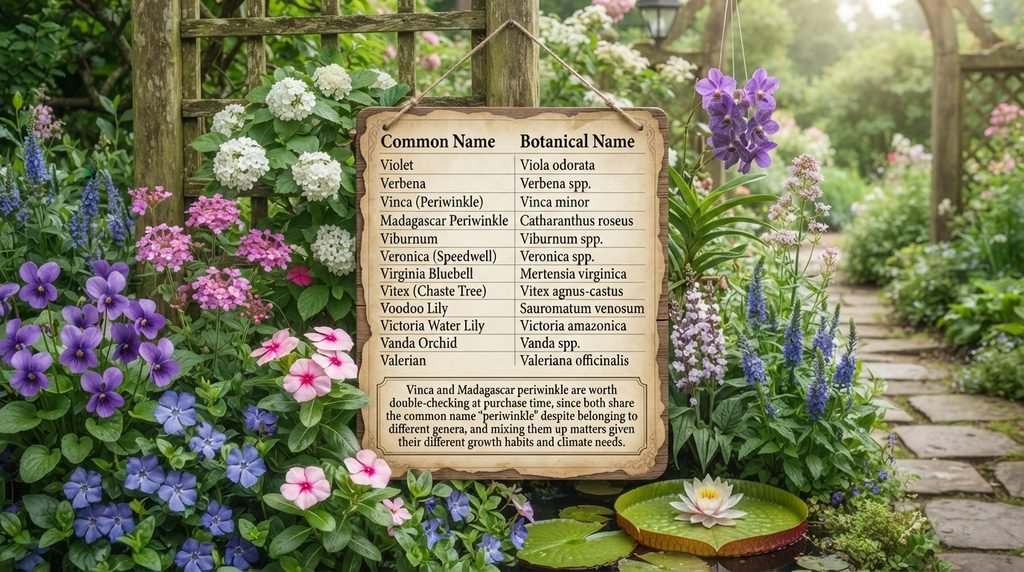
Nurseries and plant tags don’t always use common names, and a mislabeled purchase is an easy mistake to make when two related plants share a V nickname. The table below matches the most-searched common names to their correct botanical genus and species.
| Common Name | Botanical Name |
| Violet | Viola odorata |
| Verbena | Verbena spp. |
| Vinca (Periwinkle) | Vinca minor |
| Madagascar Periwinkle | Catharanthus roseus |
| Viburnum | Viburnum spp. |
| Veronica (Speedwell) | Veronica spp. |
| Virginia Bluebell | Mertensia virginica |
| Vitex (Chaste Tree) | Vitex agnus-castus |
| Voodoo Lily | Sauromatum venosum |
| Victoria Water Lily | Victoria amazonica |
| Vanda Orchid | Vanda spp. |
| Valerian | Valeriana officinalis |
Vinca and Madagascar periwinkle are worth double-checking at purchase time, since both share the common name “periwinkle” despite belonging to different genera, and mixing them up matters given their different growth habits and climate needs.
Full Comparison Table: Sun, Water, and Bloom Time
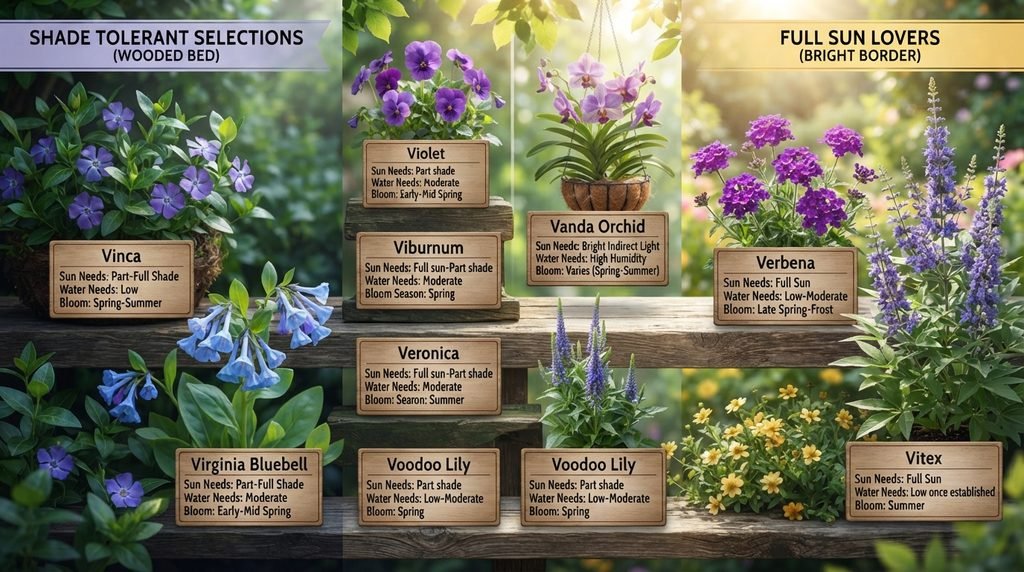
Choosing between two or three V flowers usually comes down to matching sun exposure and watering needs to the space available. The table below lines up the flowers featured throughout this guide so those comparisons take seconds instead of separate lookups.
| Flower | Sun Needs | Water Needs | Bloom Season |
| Violet | Part shade | Moderate | Early to mid-spring |
| Verbena | Full sun | Low to moderate | Late spring–frost |
| Vinca (Periwinkle) | Part shade to full shade | Low | Spring–summer |
| Veronica | Full sun to part shade | Moderate | Summer |
| Viburnum | Full sun to part shade | Moderate | Spring |
| Vitex | Full sun | Low once established | Summer |
| Virginia Bluebell | Part to full shade | Moderate | Early to mid-spring |
| Vanda Orchid | Bright indirect light | High humidity | Varies, often spring–summer |
| Voodoo Lily | Part shade | Low to moderate | Spring |
Vinca and Virginia bluebell stand out as the two most shade-tolerant entries here, both suited to gardeners working with a wooded or north-facing bed. Verbena and vitex sit at the opposite end, both needing consistent full sun to bloom at their best.
Decision Table: Which V Flower Fits Your Situation
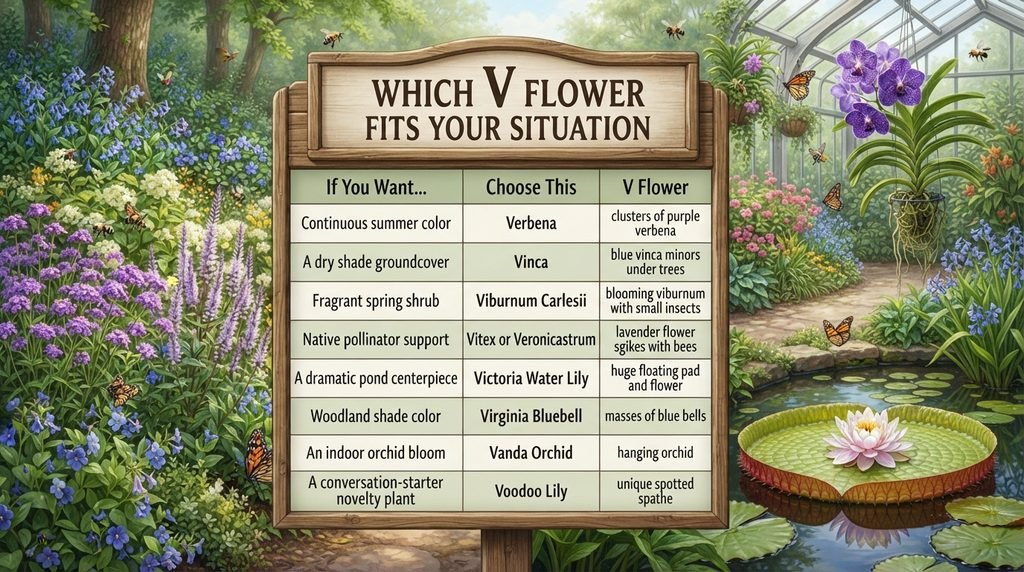
Matching a flower to a specific goal is often faster than browsing an entire list. The table below sorts common gardening goals against the V flowers best suited to solve them.
| If You Want… | Choose This V Flower |
| Continuous summer color | Verbena |
| A dry shade groundcover | Vinca |
| Fragrant spring shrub | Viburnum Carlesii |
| Native pollinator support | Vitex or Veronicastrum |
| A dramatic pond centerpiece | Victoria Water Lily |
| Woodland shade color | Virginia Bluebell |
| An indoor orchid bloom | Vanda Orchid |
| A conversation-starter novelty plant | Voodoo Lily |
Verbena and vinca together cover most everyday garden needs, one handling full sun and the other filling in the shaded, dry corners most flowering plants avoid. Victoria water lily remains the clear pick for anyone with the space and warmth for a genuine showpiece pond feature, though it’s realistically out of reach for most home gardens.
Conclusion
Flowers that start with V cover more ground than the short lists most people picture, running from the familiar violet to rarer finds like Victoria water lily and voodoo lily. This guide organized more than 50 of them by color, life cycle, and use case specifically so the list would be usable, not just long. Whether the goal is a fragrant spring shrub, a shaded groundcover, or a genuine botanical showpiece, there’s a flower that starts with V suited to the job, and the tables above should make finding it a matter of minutes rather than hours.
Frequently Asked Questions
How many flowers start with V?
More than 50 common and botanically recognized flowers start with V, ranging from familiar garden staples like violet and verbena to rarer species like Victoria water lily.
What is the most popular flower that starts with V?
Violet is among the most widely recognized flowers that start with V, prized for its fragrance and long history in gardens and perfumery.
Are violets perennials or annuals?
Violets are true perennials, returning each year from the same root system, though they often self-seed and spread beyond their original planting spot.
Which V flowers are toxic to pets?
Vinca and voodoo lily carry the clearest risks, with vinca containing alkaloids that affect blood pressure and voodoo lily causing intense oral irritation from oxalate crystals.
What V flower is best for dry shade?
Vinca is the top choice for dry, shaded ground, tolerating conditions that would stress most other flowering groundcovers.
Can Vanda orchids be grown without soil?
Yes, Vanda orchids are often grown bare-root in a hanging basket, relying on their exposed roots to absorb humidity from the air rather than soil.
What does a violet symbolize?
Violets are widely associated with modesty and faithfulness, a meaning traced back to Greek mythology and reinforced through centuries of flower-language tradition.
Which V flowers bloom earliest in spring?
Virginia bluebell and violet are typically among the first V flowers to bloom, both appearing in early to mid-spring.
Is Victoria water lily practical for a home pond? Not usually — it requires a large, warm pond and significant space, which puts it out of reach for most home gardeners despite its dramatic appearance.