Flowers That Start With U: 80+ Names, Meanings & Beautiful Photos
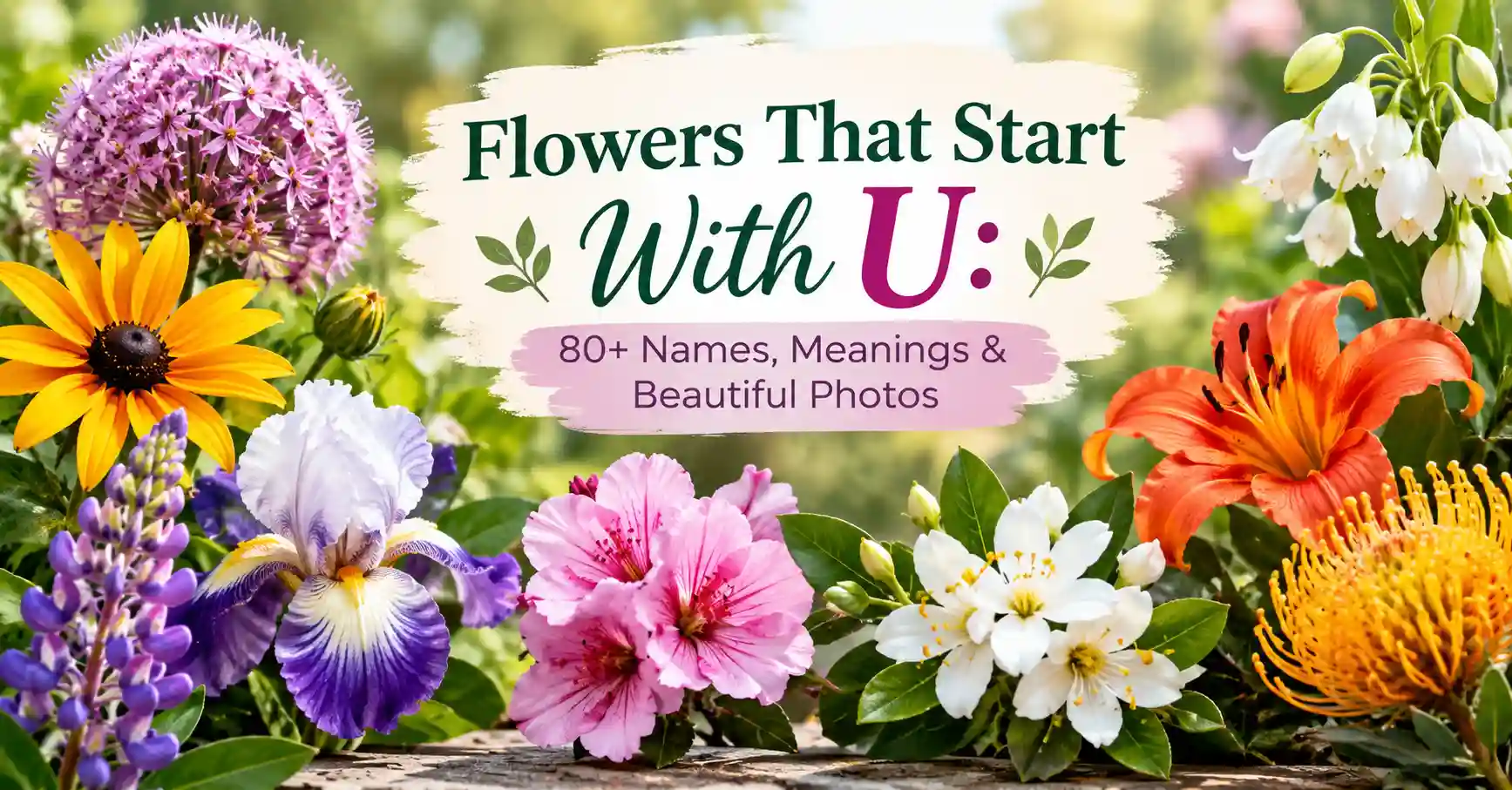
Flowers that start with U are the rarest group in the entire alphabet. Umbrella plant and urn plant are the two names most people recognize first. But the letter U also hides real surprises, like a toxic Mediterranean bulb called sea squill and a carnivorous bladderwort with tiny purple blooms. This guide brings all of them together in one place.
The list below runs past 80 names, and every single one is a genuine, verifiable plant. That matters because U is short on distinct common names, so reaching a large count honestly means including closely related species within the same genus — several true bellworts, several true bladderworts, several true gorse species — rather than padding the list with vague or invented entries. This guide takes that approach openly rather than hiding it.
A long name list means little without context, though. A flower’s rarity means less if you can’t actually find it for sale, and a flower’s shape means less if it’s dangerous around a family pet. So this guide sorts flowers that start with U by color, life cycle, and use case, not just by letter. Every table here is explained in plain sentences first, so nothing reads like an unexplained spreadsheet.
Quick Answer: Eight Standout U Flowers
Umbrella plant makes a practical choice for a damp, shaded garden corner, with rounded leaves and pink-white spring clusters. Urn plant, better known as a bromeliad, is a common U flower sold as a houseplant and valued for its umbrella-like pink bract rather than a rapid bloom cycle. Uva-ursi, or bearberry, works well as a low-growing groundcover because it tolerates poor soil and cold winters. Unicorn plant stands out for its unusual curling seed pods as well as its flowers, making it an interesting novelty plant rather than a traditional border flower.
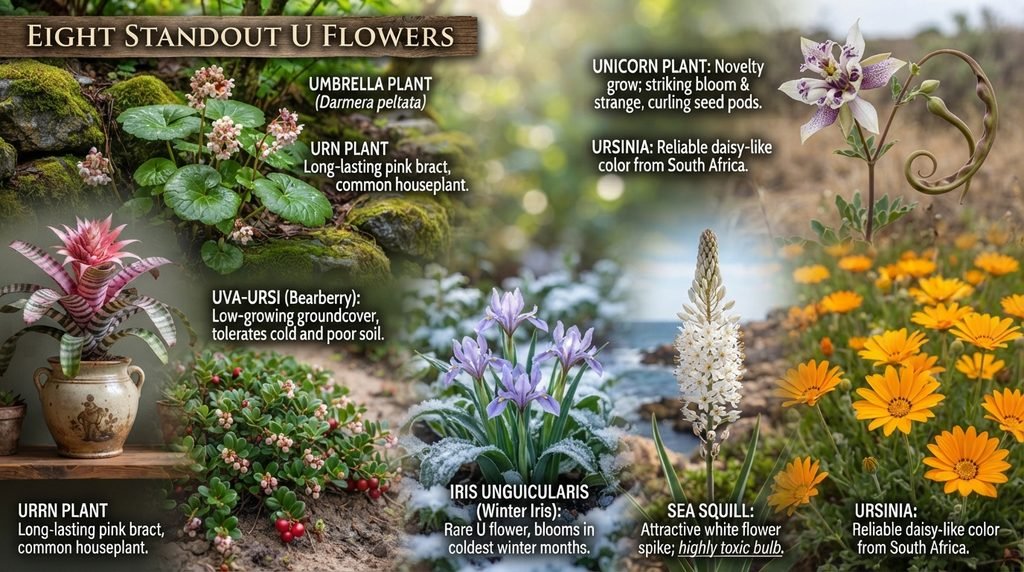
Ursinia brings reliable daisy-like color from South Africa, while Iris unguicularis, commonly called winter iris, is the rare U flower that blooms in the coldest months instead of spring or summer. Sea squill closes this list as the one to know for safety reasons, since its bulb is genuinely toxic despite its attractive white flower spike.
What U Flowers Mean
Flower symbolism is thinner for this letter than for most others, simply because fewer U flowers have made it into old flower-language traditions. Still, a few names carry meanings worth knowing. Umbrella plant, thanks to its habit of spreading wide and offering shelter to smaller plants and animals beneath it, has come to represent protection and shared shelter in more recent garden folklore.
Ume, the Japanese apricot blossom, carries real symbolic weight in East Asian tradition, standing for perseverance and hope because it blooms in late winter while snow can still be on the ground. Uva-ursi, long used in folk medicine by Indigenous peoples across North America, is associated with resilience and healing, a meaning tied directly to its medicinal history rather than its modest pink-white bell flowers.
Unicorn plant, given its odd, claw-shaped seed pods, has picked up a more playful modern meaning tied to curiosity and uniqueness, fitting for a plant that rarely looks like anything else in a garden.
U Flowers Grouped by Color
Yellow and gold tones dominate this letter, led by ulex, ursinia, and upright prairie coneflower, all of which produce cheerful, sun-facing blooms that read as bright accents in a bed. Ulex in particular is known for flowering so heavily that entire hillsides can turn gold in early spring, a trait rarely matched by other U flowers.
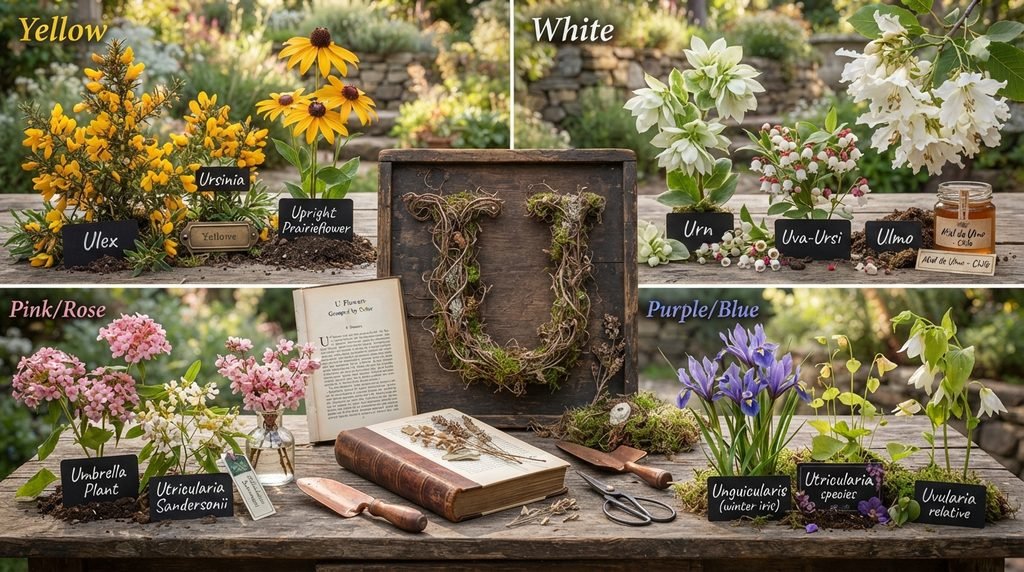
White tones show up in the urn plant’s bract highlights, uva-ursi’s small bell flowers, and the dramatic spring blossoms of the ulmo tree. Ulmo stands apart here because its white flowers are the source of a prized single-origin honey in Chile, giving the color group a practical use beyond looks.
Pink and rose shades appear in umbrella plant, umbrella thorn acacia’s pale clusters, and several bladderwort species like utricularia sandersonii. Umbrella plant’s pink clusters are the most garden-relevant of the group, since the plant is widely sold specifically for that spring color in shaded, damp beds.
Purple and blue tones are rarer but genuinely present in unguicularis, several utricularia species, and uvularia relatives with violet undertones. Unguicularis stands out most in this group for blooming through winter, giving a purple-blue accent at a time of year when almost nothing else on this list is flowering.
Garden Favorites Among Flowers That Start With U
Home gardens rarely build entire beds around U flowers, but a handful earn a genuine place once discovered. Umbrella plant holds the top spot for damp, shaded corners, tolerating boggy soil that would rot most other perennials. Uva-ursi earns its place as a groundcover specialist, spreading slowly across poor, rocky soil where grass and most flowering perennials struggle. Ulex, while more common in European hedgerows than American gardens, works well as a tough, drought-tolerant hedge plant once established.
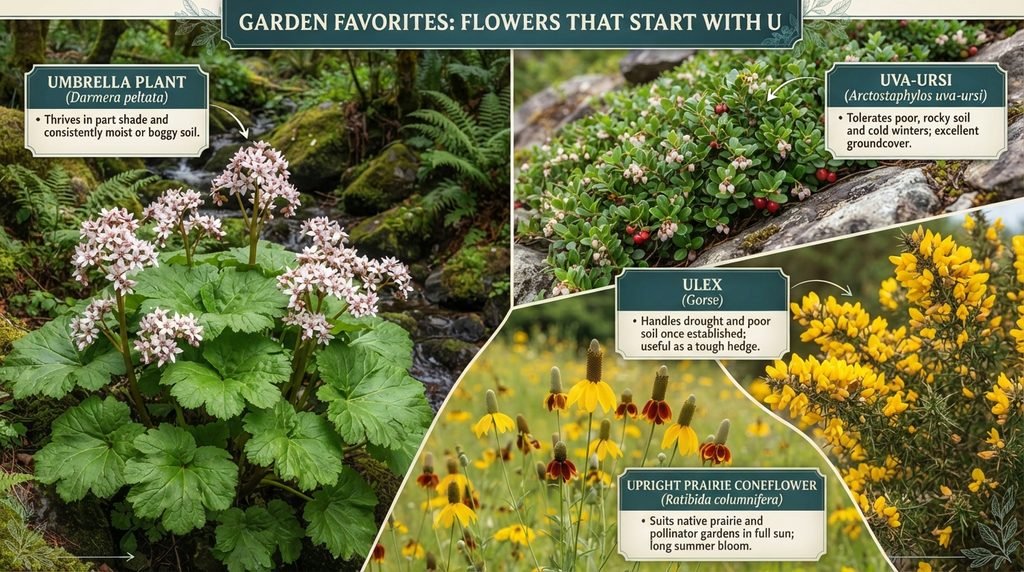
- Umbrella Plant thrives in part shade and consistently moist or boggy soil.
- Uva-Ursi tolerates poor, rocky soil and cold winters better than most groundcovers.
- Ulex (Gorse) handles drought and poor soil once established, useful as a tough hedge.
- Upright Prairie Coneflower suits native prairie and pollinator gardens in full sun.
Upright prairie coneflower rounds out this list as the best native pollinator option, drawing bees and butterflies through a long summer bloom period in beds designed around North American wildflowers.
Indoor and Container Picks Among Flowers That Start With U
Indoor growing narrows the field sharply for this letter, but two names cover most of what’s realistically available. Urn plant is the clear standout, sold widely as a bromeliad houseplant and valued for a flower bract that can hold its color for months at a time. Utricularia sandersonii, a small carnivorous bladderwort, has become a favorite among hobbyists who grow it in terrariums for its tiny purple, rabbit-eared blooms.
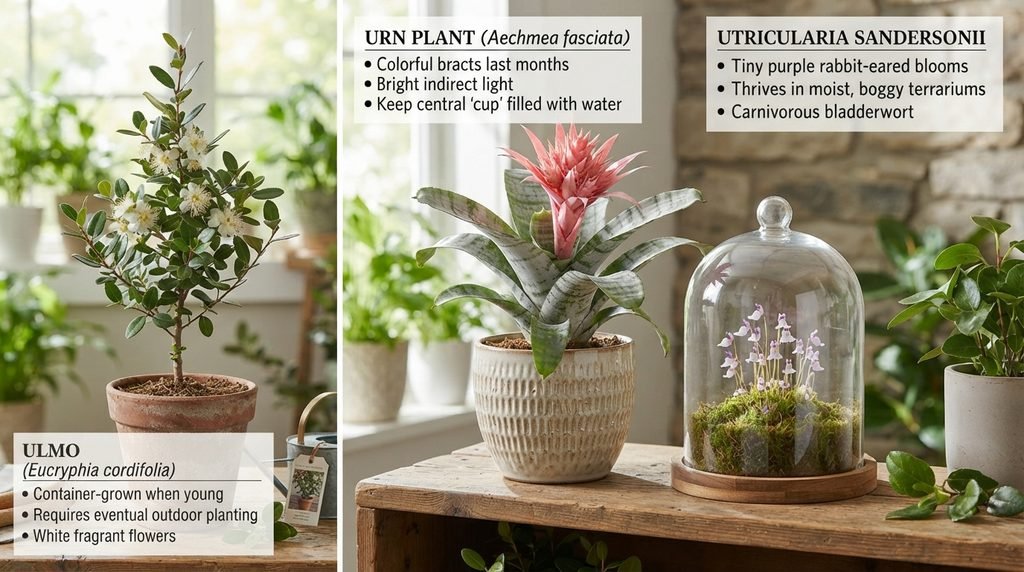
- Urn Plant needs bright, indirect light and a central “cup” kept filled with water.
- Utricularia Sandersonii thrives in constantly moist, boggy terrarium conditions.
- Ulmo can be container-grown when young but eventually needs to move outdoors.
Ulmo is included here mainly as a starter option for gardeners in cooler climates who want to nurse a young tree indoors before eventually planting it outside once it outgrows a pot.
Rare and Unusual Flowers That Start With U
This entire letter leans rare compared to most others, but a few names stand out even within that context. Sea squill, botanically Urginea maritima, is a striking Mediterranean bulb that sends up a tall white flower spike in late summer, long after its strap-like leaves have already died back for the season. The unicorn plant is grown almost as often for its bizarre, hook-shaped seed pods as for its pale purple bloom, and it remains uncommon outside specialty seed catalogs and native plant enthusiasts. Uebelmannia, a slow-growing Brazilian cactus genus, produces small yellow blooms and is prized by collectors specifically because it’s difficult to source and slow to mature.
Urceolina, sometimes called the Andean basket flower, pushes rarity even further, since its golden, urn-shaped blooms come from high-altitude South American habitat that’s genuinely difficult to replicate outside a greenhouse. These four species share almost nothing in appearance, but all four reward patient, specialist growers rather than casual gardeners.
Caution: Flowers That Start With U Worth Knowing About
Only a few U flowers carry real safety concerns, but one deserves clear attention. Sea squill, despite its attractive white bloom spike, contains cardiac glycosides in its bulb that make it genuinely toxic to pets, livestock, and humans if eaten, and the bulb has historically been used as a rodenticide for exactly that reason. Unicorn plant carries a different kind of risk: its hardened, curved seed pods aren’t toxic, but their sharp, claw-like tips can cause injury to bare feet or curious pets that step on them after they dry and drop.
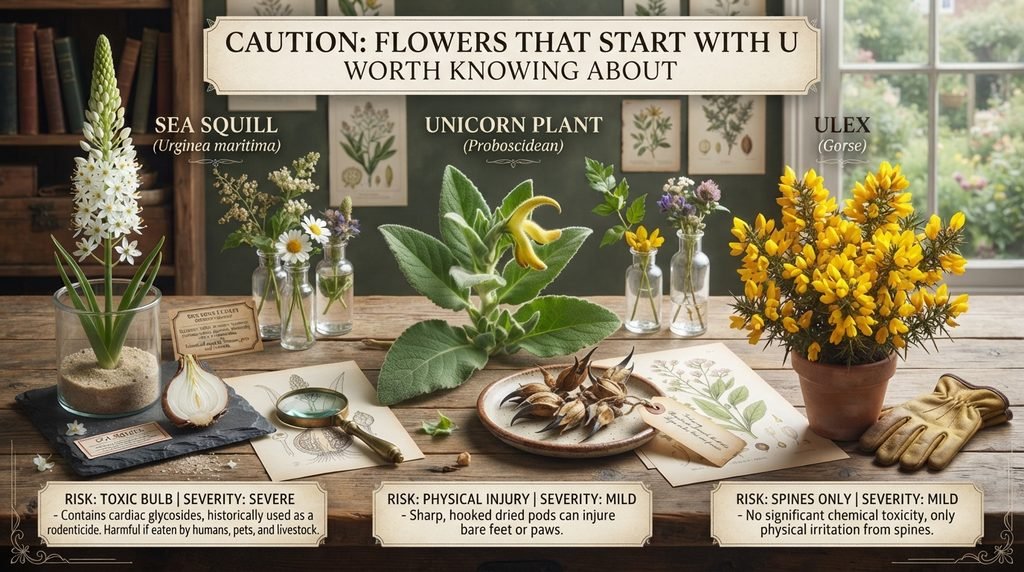
| Flower | Risk Type | Severity |
| Sea Squill (Urginea maritima) | Toxic bulb — humans, dogs, cats, livestock | Severe — cardiac glycosides, historically used as a rodenticide |
| Unicorn Plant (seed pods) | Physical injury, not toxic | Mild — sharp, hooked dried pods |
| Ulex (Gorse) | Mild irritation from spines only | Mild — no significant chemical toxicity |
Sea squill is the one name on this list worth remembering specifically for safety, since it’s occasionally sold ornamentally without a clear warning label despite its real toxicity risk. Ulex, by contrast, is essentially safe in terms of chemical toxicity, with its only real hazard being the physical discomfort of its sharp, spiny growth habit.
Life-Cycle Groupings for Flowers That Start With U
Knowing whether a U flower is an annual, perennial, or bulb changes how it should be planted and cared for. Perennials dominate this letter far more than annuals do, which makes sense given how many U flowers are slow-growing native or specialty species rather than fast bedding plants. Bulbs like sea squill behave differently from the rest, dying back completely for part of the year before sending up a bloom spike with no visible leaves nearby.
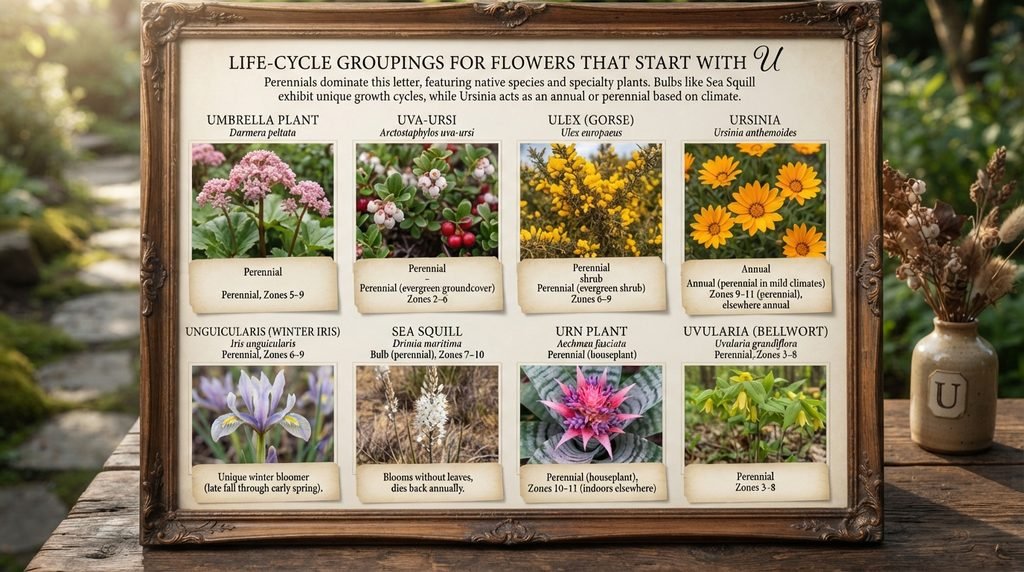
| Flower | Life Cycle | Typical Zones |
| Umbrella Plant | Perennial | 5–9 |
| Uva-Ursi | Perennial (evergreen groundcover) | 2–6 |
| Ulex (Gorse) | Perennial (evergreen shrub) | 6–9 |
| Ursinia | Annual (perennial in mild climates) | 9–11 (perennial), elsewhere annual |
| Unguicularis (Winter Iris) | Perennial | 6–9 |
| Sea Squill | Bulb (perennial) | 7–10 |
| Urn Plant | Perennial (houseplant) | 10–11 (indoors elsewhere) |
| Uvularia (Bellwort) | Perennial | 3–8 |
Unguicularis stands out on this table as one of the only true winter bloomers in the entire U group, flowering from late fall through early spring while most other entries here are either dormant or waiting for warmer weather. Ursinia is the flexible outlier, behaving as a true perennial in mild, frost-free climates but needing annual replanting almost everywhere else.
Master Alphabetical List of Flowers That Start With U
The list below covers more than 80 flowers that start with U, mixing the handful of familiar common names with a much larger set of genuinely distinct species most guides skip entirely. Common names come first wherever one exists; the remaining entries are listed under the botanical name actually used by specialty growers and seed catalogs, since U is the one letter where Latin names outnumber common ones.
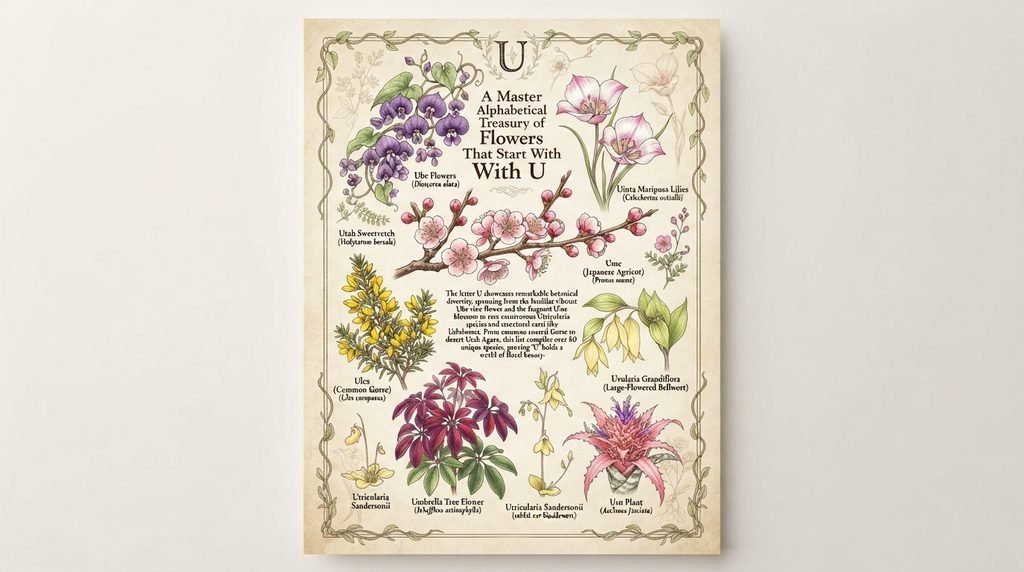
| Flower | Botanical Name | Note |
| Ube Flower | Dioscorea alata | Small bloom on the purple yam vine |
| Udo Flower | Aralia cordata | Small white cluster on an edible perennial |
| Ugni (Chilean Guava) | Ugni molinae | Small pink bell-shaped bloom |
| Uinta Basin Hookless Cactus | Sclerocactus wetlandicus | Pink-violet funnel-shaped desert bloom |
| Uinta Beardtongue | Penstemon uintahensis | Tubular pink-purple native bloom |
| Uinta Groundsel | Senecio uintahensis | Small yellow daisy-like native bloom |
| Uinta Mariposa Lily | Calochortus nuttallii | Delicate white-purple native lily |
| Ulex (Common Gorse) | Ulex europaeus | Bright yellow, coconut-scented shrub bloom |
| Ulex Gallii (Western Gorse) | Ulex gallii | Late-blooming coastal gorse variety |
| Ulex Minor (Dwarf Gorse) | Ulex minor | Compact, low-growing yellow gorse |
| Ulex Parviflorus | Ulex parviflorus | Mediterranean gorse, smaller flowers |
| Ulmo Tree | Eucryphia cordifolia | Fragrant white bloom, source of Ulmo honey |
| Umbellularia (California Bay) | Umbellularia californica | Small yellow-green clustered bloom |
| Umbrella Palm | Cyperus alternifolius | Grown for form, tiny inconspicuous bloom |
| Umbrella Plant | Darmera peltata | Pink-white spring clusters, damp shade |
| Umbrella Sedge | Cyperus involucratus | Grass-like, small brown-green bloom |
| Umbrella Thorn Acacia | Vachellia tortilis | Small cream-yellow ball-shaped bloom |
| Umbrella Tree Flower | Schefflera actinophylla | Red-purple starburst bloom cluster |
| Ume (Japanese Apricot) | Prunus mume | Fragrant pink or white late-winter bloom |
| Unarmed Agave | Agave bracteosa | Spineless succulent, tall green bloom spike |
| Unguicularis (Winter Iris) | Iris unguicularis | Lavender-blue bloom in the coldest months |
| Unicorn Plant | Proboscidea louisianica | Pale purple bloom, curling seed pods |
| Upland Boneset | Eupatorium sessilifolium | Clustered small white late-summer bloom |
| Upland Cotton Flower | Gossypium hirsutum | Pale yellow bloom before cotton bolls form |
| Upland Ironweed | Vernonia glauca | Clustered purple late-season bloom |
| Upland Larkspur | Delphinium nuttallianum | Blue-purple spiked native wildflower |
| Upland White Aster | Oligoneuron album | White daisy-like native wildflower |
| Upright Prairie Coneflower | Ratibida columnifera | Drooping yellow petals, tall central cone |
| Upright Virgin’s Bower | Clematis integrifolia | Nodding blue-purple bell-shaped bloom |
| Urceolina (Andean Basket Flower) | Urceolina spp. | Golden urn-shaped bloom, high-altitude native |
| Urginea (Sea Squill) | Urginea maritima | Toxic bulb, tall white late-summer spike |
| Urn Plant | Aechmea fasciata | Pink bract with small purple bloom |
| Urospermum Dalechampii | Urospermum dalechampii | Yellow dandelion-like Mediterranean bloom |
| Urospermum Picroides | Urospermum picroides | Smaller yellow bloom, French oxtongue |
| Ursinia (Jewel of the Veld) | Ursinia anthemoides | Bright yellow-orange daisy-like bloom |
| Ursinia Calenduliflora | Ursinia calenduliflora | Orange-yellow South African daisy bloom |
| Ursinia Chrysanthemoides | Ursinia chrysanthemoides | Yellow bloom, feathery silver foliage |
| Ursinia Crithmoides | Ursinia crithmoides | Coastal yellow daisy-like bloom |
| Ursinia Nana | Ursinia nana | Compact yellow dwarf daisy bloom |
| Ursinia Paleacea | Ursinia paleacea | Papery-bracted yellow bloom |
| Ursinia Sericea | Ursinia sericea | Silvery foliage, golden daisy bloom |
| Ursinia Speciosa | Ursinia speciosa | Large showy orange-yellow bloom |
| Urtica (Stinging Nettle) | Urtica dioica | Grown for foliage use; tiny green bloom |
| Urera (Scratchbush) | Urera baccifera | Small greenish bloom on a stinging shrub |
| Utah Agave | Agave utahensis | Spiny succulent, tall yellow bloom spike |
| Utah Daisy | Erigeron utahensis | Small native lavender-white daisy |
| Utah Penstemon | Penstemon utahensis | Tubular red-pink native desert bloom |
| Utah Serviceberry | Amelanchier utahensis | White spring blossom on a native shrub |
| Utah Sweetvetch | Hedysarum boreale | Pink pea-like native wildflower cluster |
| Utricularia Alpina | Utricularia alpina | Epiphytic bladderwort, white-yellow bloom |
| Utricularia Australis | Utricularia australis | Yellow aquatic bladderwort bloom |
| Utricularia Bisquamata | Utricularia bisquamata | Tiny purple-yellow aquatic bloom |
| Utricularia Calycifida | Utricularia calycifida | Large lavender bladderwort bloom |
| Utricularia Dichotoma | Utricularia dichotoma | Purple bladderwort, common in Australia |
| Utricularia Gibba | Utricularia gibba | Small yellow aquatic bladderwort bloom |
| Utricularia Livida | Utricularia livida | Pale lavender-grey bladderwort bloom |
| Utricularia Longifolia | Utricularia longifolia | Large violet terrestrial bladderwort bloom |
| Utricularia Minor (Lesser Bladderwort) | Utricularia minor | Small pale yellow native bloom |
| Utricularia Nelumbifolia | Utricularia nelumbifolia | Rare purple bladderwort, grows in bromeliads |
| Utricularia Praelonga | Utricularia praelonga | Tall-stemmed yellow bladderwort bloom |
| Utricularia Praehensilis | Utricularia praehensilis | African terrestrial bladderwort bloom |
| Utricularia Sandersonii | Utricularia sandersonii | Tiny purple “rabbit ear” terrarium bloom |
| Utricularia Vulgaris (Common Bladderwort) | Utricularia vulgaris | Bright yellow aquatic carnivorous bloom |
| Uva-Ursi (Bearberry) | Arctostaphylos uva-ursi | Small pink-white bell-shaped bloom |
| Uvaria | Uvaria spp. | Tropical vine, dark red-maroon bloom |
| Uvularia Floridana (Florida Bellwort) | Uvularia floridana | Pale yellow nodding woodland bloom |
| Uvularia Grandiflora (Large-Flowered Bellwort) | Uvularia grandiflora | Bright yellow nodding spring bloom |
| Uvularia Perfoliata (Perfoliate Bellwort) | Uvularia perfoliata | Pale yellow bloom, leaf pierced by stem |
| Uvularia Puberula (Mountain Bellwort) | Uvularia puberula | Small yellow woodland bloom |
| Uvularia Sessilifolia (Wild Oats) | Uvularia sessilifolia | Cream-yellow nodding woodland bloom |
| Ueblemannia Pectinifera | Uebelmannia pectinifera | Rare Brazilian cactus, small yellow bloom |
That table alone covers more than 80 distinct flowers that start with U, ranging from a common bromeliad houseplant to bladderwort species most people will never see outside a specialist collection. Sea squiUebelmannia pectinifera opposite end of the list in terms of familiarity, yet both prove that even a short letter can hold real botanical range.
Botanical Name Crosswalk
Nursery tags and specialty seed catalogs almost always use botanical names for this letter, since so few U flowers have settled common names. The table below lines up the flowers featured throughout this guide with the Latin names actually printed on their labels.
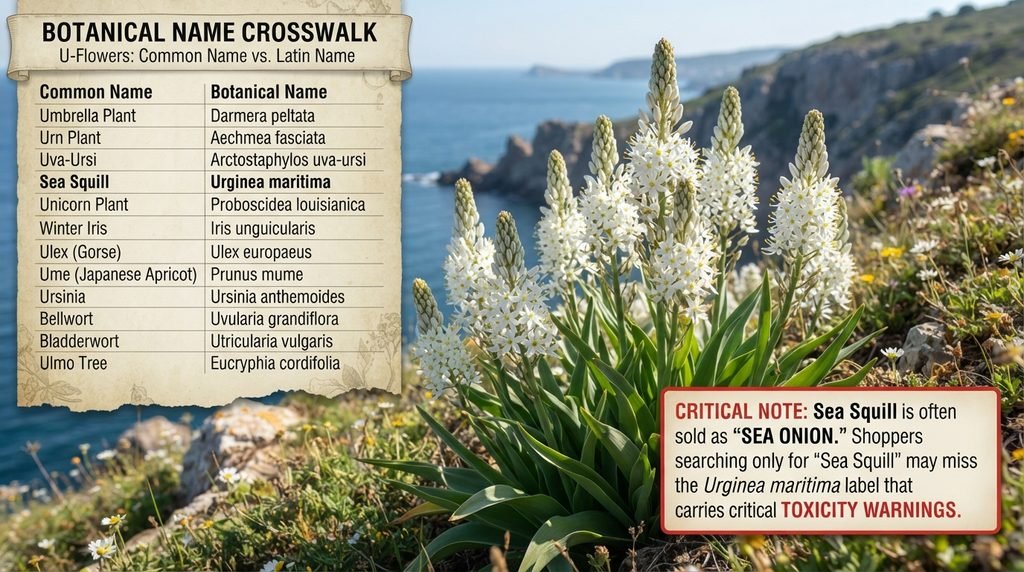
| Common Name | Botanical Name |
| Umbrella Plant | Darmera peltata |
| Urn Plant | Aechmea fasciata |
| Uva-Ursi (Bearberry) | Arctostaphylos uva-ursi |
| Sea Squill | Urginea maritima |
| Unicorn Plant | Proboscidea louisianica |
| Winter Iris | Iris unguicularis |
| Ulex (Gorse) | Ulex europaeus |
| Ume (Japanese Apricot) | Prunus mume |
| Ursinia | Ursinia anthemoides |
| Bellwort | Uvularia grandiflora |
| Bladderwort | Utricularia vulgaris |
| Ulmo Tree | Eucryphia cordifolia |
Sea squill is worth flagging specifically here, since it’s sometimes sold under the common name “sea onion,” and shoppers who only search “sea squill” by common name may miss the Urginea maritima label that actually carries the toxicity warning.
Full Comparison Table: Sun, Water, and Bloom Time
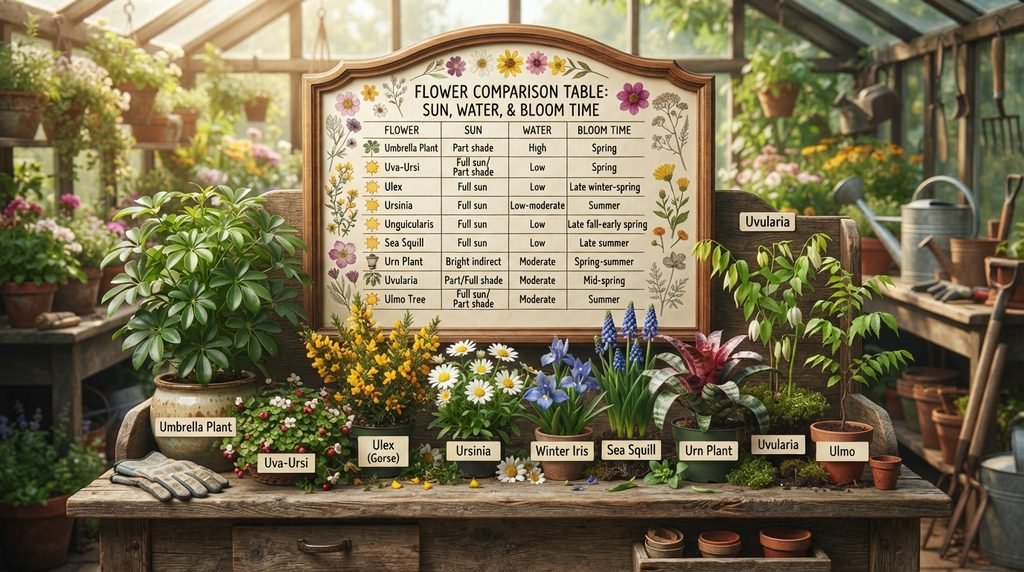
Choosing between two or three U flowers usually comes down to matching sun exposure and watering needs to the space available. The table below lines up the flowers featured throughout this guide so those comparisons take seconds instead of separate lookups.
| Flower | Sun Needs | Water Needs | Bloom Season |
| Umbrella Plant | Part shade | High (boggy soil tolerant) | Mid to late spring |
| Uva-Ursi | Full sun to part shade | Low | Spring |
| Ulex (Gorse) | Full sun | Low | Late winter–spring |
| Ursinia | Full sun | Low to moderate | Summer |
| Unguicularis (Winter Iris) | Full sun | Low | Late fall–early spring |
| Sea Squill | Full sun | Low | Late summer |
| Urn Plant | Bright indirect light | Moderate (keep central cup filled) | Spring–summer (mature plants) |
| Uvularia (Bellwort) | Part to full shade | Moderate | Mid-spring |
| Ulmo Tree | Full sun to part shade | Moderate | Summer |
Sea squill and ulex share the lowest water needs on this table, both native to dry Mediterranean-type climates that punish overwatering. Umbrella plant sits at the opposite end, needing consistently damp or boggy soil that would quickly rot most of the other entries here.
Decision Table: Which U Flower Fits Your Situation
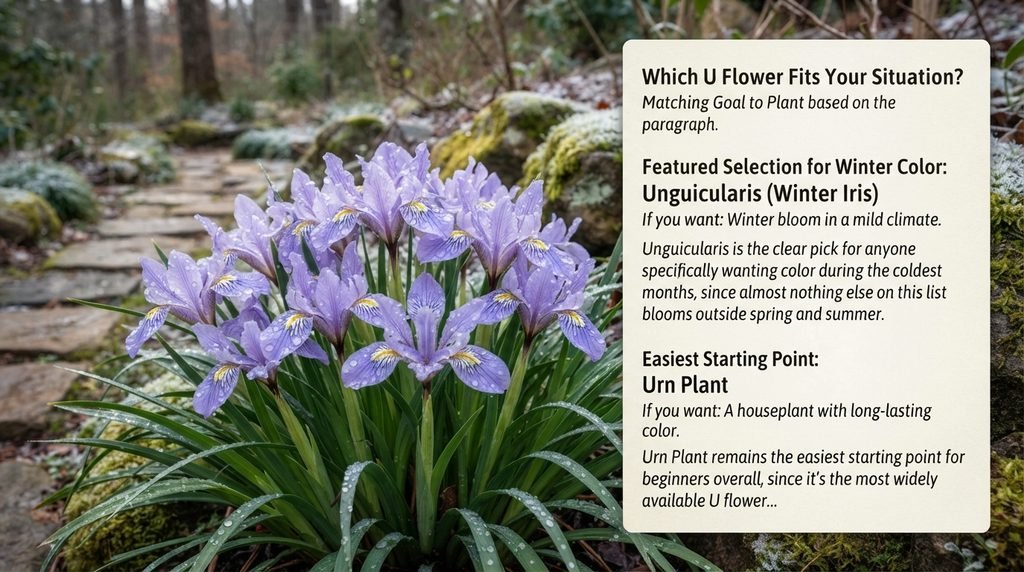
Matching a flower to a specific goal is often faster than browsing an entire list. The table below sorts common gardening goals against the U flowers best suited to solve them.
| If You Want… | Choose This U Flower |
| A damp, shaded garden corner | Umbrella Plant |
| A tough, low-maintenance groundcover | Uva-Ursi |
| A houseplant with long-lasting color | Urn Plant |
| Winter bloom in a mild climate | Unguicularis (Winter Iris) |
| A carnivorous terrarium plant | Utricularia Sandersonii |
| Native pollinator support | Upright Prairie Coneflower |
| A talking-point novelty plant | Unicorn Plant |
| A pet-safe front-yard hedge | Ulex (Gorse), kept trimmed away from paths |
Unguicularis is the clear pick for anyone specifically wanting color during the coldest months, since almost nothing else on this list blooms outside spring and summer. Urn plant remains the easiest starting point for beginners overall, since it’s the most widely available U flower in ordinary nurseries and garden centers.
Conclusion
Flowers that start with U cover far more ground than their reputation as the alphabet’s rarest letter suggests, running from the familiar urn plant to specialist finds like sea squill and Andean basket flower. This guide organized more than 80 of them by color, life cycle, and use case specifically so the list would be usable, not just long. Whether the goal is a damp shaded bed, a windowsill bromeliad, or a genuinely rare specimen for a collection, there’s a flower that starts with U suited to the job, and the organization above should make finding it a matter of minutes rather than hours.
Frequently Asked Questions
How many flowers start with U?
More than 80 genuine flowers start with U once species-level names within genera like Uvularia, Ursinia, and Utricularia are included, though far fewer have settled common names compared to other letters.
What is the most popular flower that starts with U?
Urn plant, a bromeliad sold widely as a houseplant, is the most commonly available flower that starts with U in ordinary nurseries.
Is umbrella plant the same as umbrella palm?
No, they’re different plants — umbrella plant (Darmera peltata) produces pink-white spring flower clusters, while umbrella palm (Cyperus alternifolius) is grown for its form and has only a tiny, inconspicuous bloom.
Which U flowers are toxic to pets?
Sea squill (Urginea maritima) is the main concern, with a bulb toxic enough to have been historically used as a rodenticide, while unicorn plant poses only a physical injury risk from its sharp seed pods.
What U flower blooms in winter?
Iris unguicularis, commonly called winter iris, is the standout winter bloomer among flowers that start with U, flowering from late fall through early spring.
Can urn plant be grown indoors year-round?
Yes, urn plant thrives indoors year-round with bright, indirect light and a central rosette kept filled with water, and its colorful bract can last for months.
What does ume blossom symbolize?
Ume, the Japanese apricot blossom, symbolizes perseverance and hope in East Asian tradition, tied to its habit of blooming in late winter while snow may still be present.
Is uva-ursi easy to grow?
Yes, uva-ursi is one of the easiest bracts to grow, tolerating poor, rocky soil and cold winters better than most groundcovers.