Flowers That Start With Q: 30+ Names, Meanings & Beautiful Photos
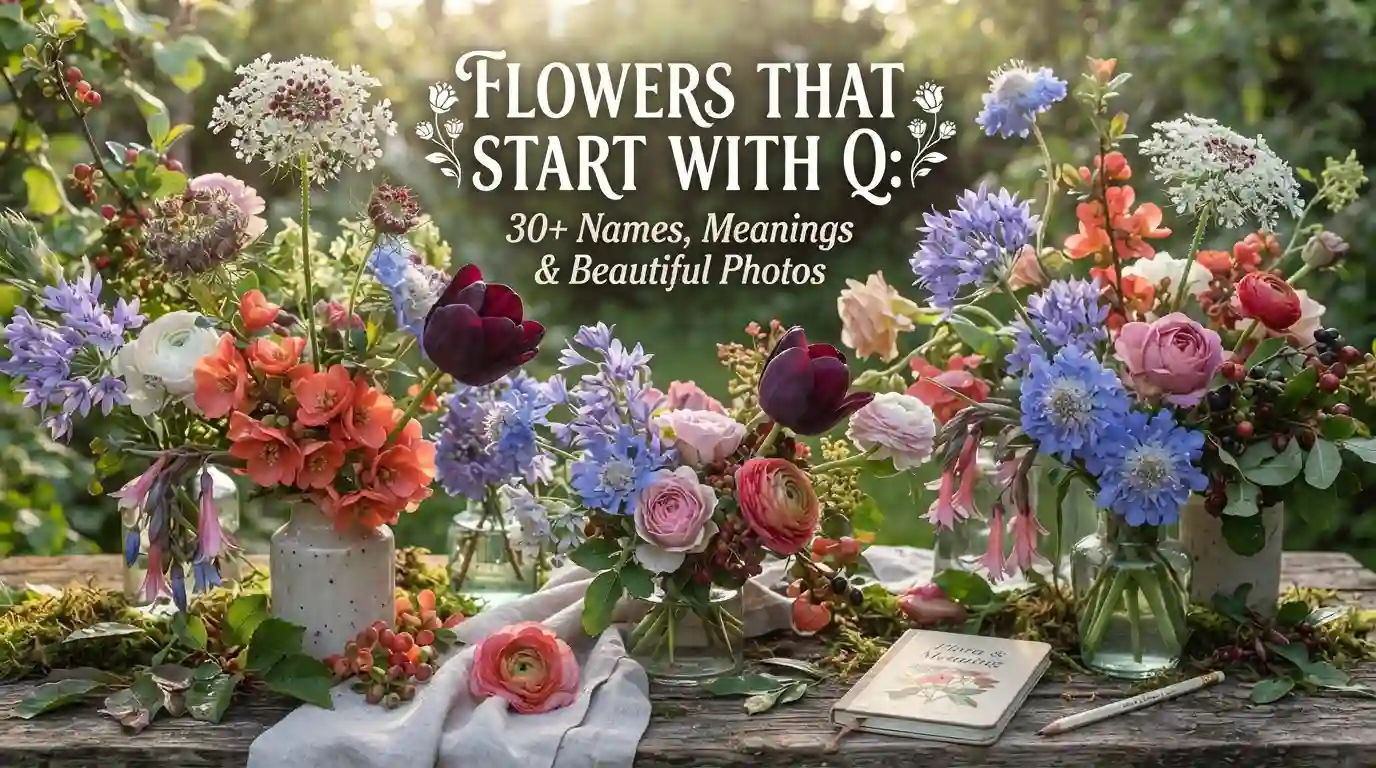
Flowers that start with Q are rare in the plant world. Queen Anne’s Lace is the name most folks know first. Quince comes next, with its soft spring bloom. Past those two, this letter still holds real charm, though the list stays short.
This guide serves a few kinds of readers. Some want to name a bloom they saw. Some want a new plant for a bed. This guide helps with each need.
The order here follows real use, not the alphabet. Garden picks come first. Indoor picks and florist picks come next. Then come rare finds. Then come flowers that need care. After that, you get quick tools: a bloom-cycle table, a full name list, and a growing chart. The full A to Z list sits near the end.
Top Q-Flowers to Know First
Anyone who looks up flowers that start with Q meets these names first. Queen Anne’s Lace tops the list. It grows wild in fields and along roads with its lace-like white top. Quince comes next. Its pink-white bloom opens each spring, ahead of its small, hard fruit. Queen of the Night opens just once a year, for one single night, with a huge, pale bloom.
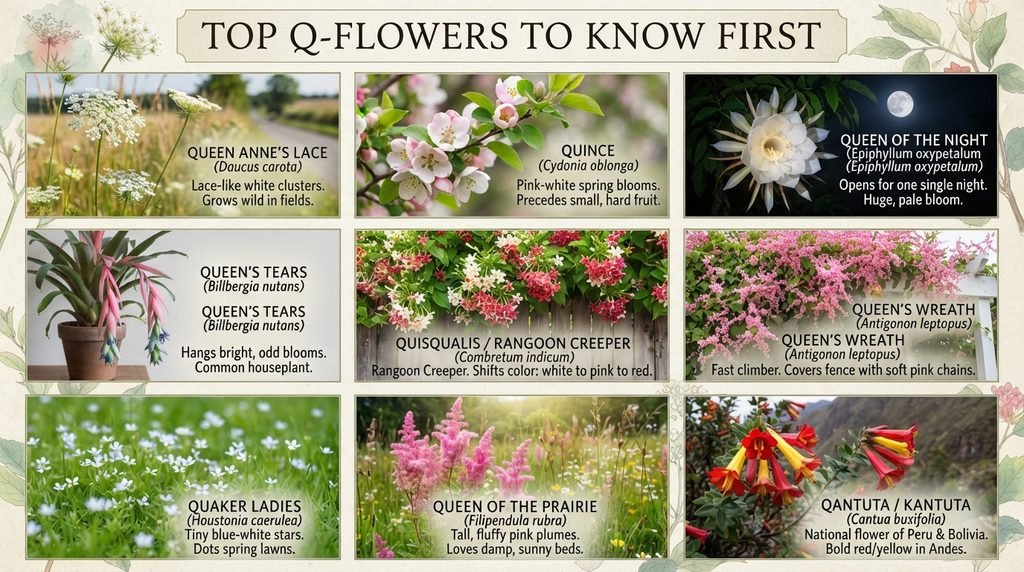
Queen’s Tears hangs its odd, bright bloom from a small houseplant. Quisqualis, also called Rangoon Creeper, shifts color from white to pink to deep red as each bloom ages. Queen’s Wreath climbs fast and covers a fence with soft pink flower chains. Quaker Ladies dot a spring lawn with tiny blue-white stars. Queen of the Prairie brings tall, fluffy pink plumes to a damp, sunny bed.
What These Blooms Have Meant Over Time
Flower meanings still shape real choices. People pick blooms for weddings. They pick blooms for gifts. They often do not know why a bloom feels right. But it does. Queen Anne’s Lace carries an old tale tied to its own name. The story says a drop of blood fell on the flower’s white center, from a queen who pricked her finger while making lace. That single dark fleck still shows up on many real blooms today.
Quince has long stood for love and good fortune in old Greek and Roman custom. Brides once carried or ate a bit of quince before a wedding feast, a habit tied to hopes for a sweet, full life ahead. Queen of the Night leans toward mystery and rare beauty, since so few people ever see its bloom open in real life, given its one-night show.
Grouping Q-Flowers by Color
Color often narrows a search faster than a name does. White rules a large share of this list. Queen Anne’s Lace, Quince, and Queen of the Night all bring soft white or cream tones. This shade feels light and airy, a strong pick for a wild, informal bed.
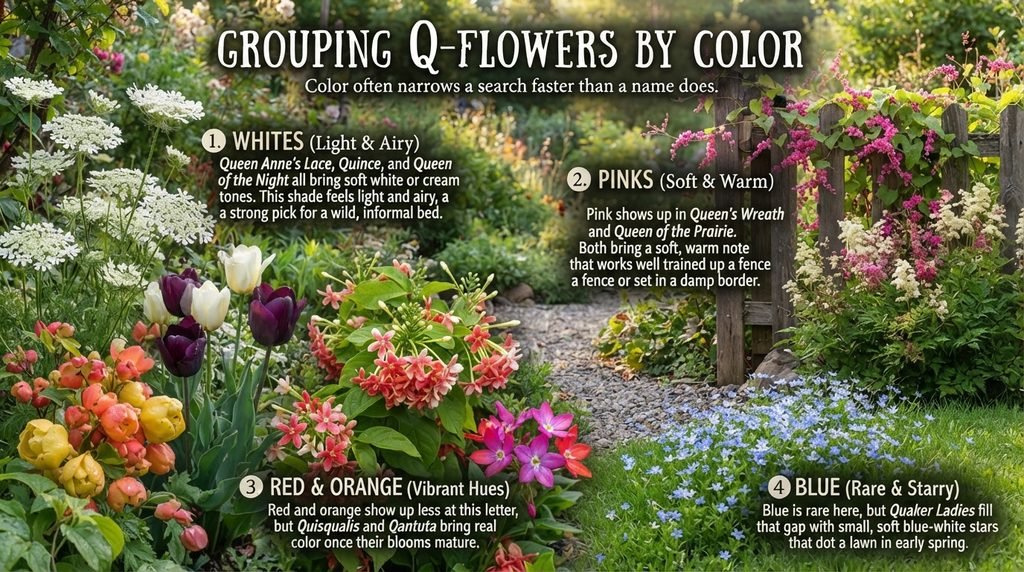
Pink shows up in Queen’s Wreath and Queen of the Prairie. Both bring a soft, warm note that works well trained up a fence or set in a damp border. Red and orange show up less at this letter, but Quisqualis and Qantuta bring real color once their blooms mature.
Blue is rare here, but Quaker Ladies fill that gap with small, soft blue-white stars that dot a lawn in early spring.
Solid Picks for the Garden
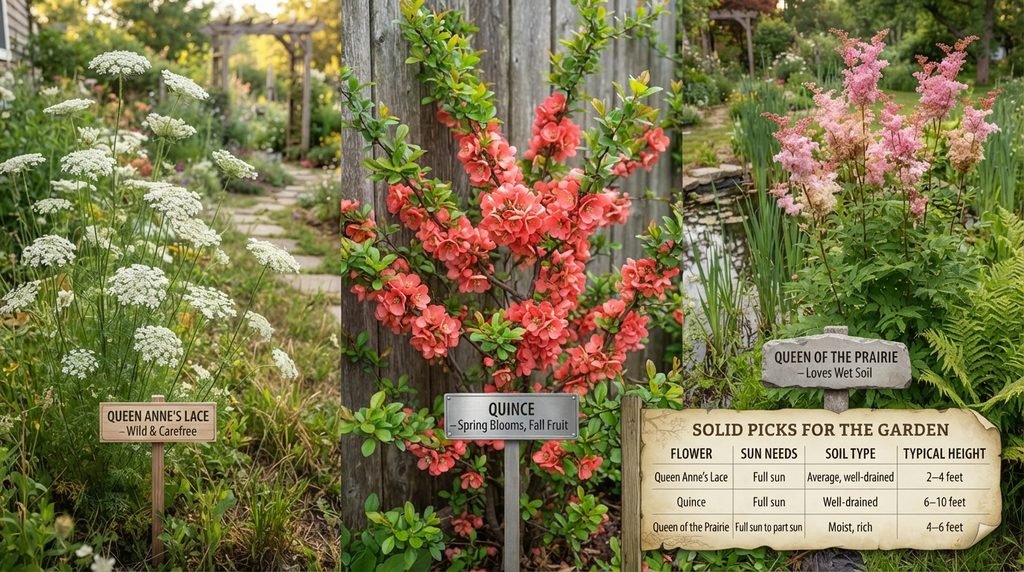
A few Q-flowers earn a real spot in home yards, plain and simple. Queen Anne’s Lace grows wild with no real care at all, thriving in poor soil where fussier plants fail. Quince, grown as a small tree or shrub, gives spring bloom and fall fruit from one low-fuss plant. Queen of the Prairie takes damp soil well, filling a wet, sunny spot where many other blooms would struggle.
| Flower | Sun Needs | Soil Type | Typical Height |
| Queen Anne’s Lace | Full sun | Average, well-drained soil | 2–4 feet |
| Quince | Full sun | Well-drained soil | 6–10 feet |
| Queen of the Prairie | Full sun to part sun | Moist, rich soil | 4–6 feet |
Queen Anne’s Lace stands out here for how little it asks. It often shows up on its own, with no real planting at all. Queen of the Prairie sits apart too, since it wants soil far wetter than most garden plants would tolerate.
Q-Flowers for Indoor Growing
A few Q-flowers do well indoors, though most on this list live outside. Queen’s Tears makes a fine houseplant, since it grows well in a small pot with bright, indirect light. Its odd, hanging bloom draws real notice even from folks who do not garden much.
- Queen’s Tears — grows well in a small pot; likes bright, indirect light and light, quick-drying soil
Queen’s Tears asks for little real care once it settles in. A light hand with water works best, since its roots stay shallow and rot fast in soil that stays wet too long.
What Florists Reach For
Cut flowers are a less common way to meet this letter, since few Q-flowers hold up well after a cut. Queen Anne’s Lace shows up most often, used as a soft, lacy filler next to bolder, rounder blooms in a bunch.
| Flower | Vase Life | Main Use |
| Queen Anne’s Lace | 5–7 days | Filler, texture, soft accent |
Queen Anne’s Lace pairs well with roses and other bold, single-shade blooms, since its lace-like shape softens a tight, formal bunch without pulling focus away from the main flower.
Harder-to-Find Q-Flowers
A few Q-flowers are hard to find outside small growers. Qantuta grows wild high in the Andes and needs cool, thin mountain air that few home yards can match, which keeps it rare outside South America. Quesnelia, a bromeliad with bold red bloom spikes, needs warm, humid air closer to a greenhouse than a normal yard. Queen Victoria Agave, prized for its bold white leaf markings, may take decades to bloom even once, which keeps mature blooming plants rare in most collections.
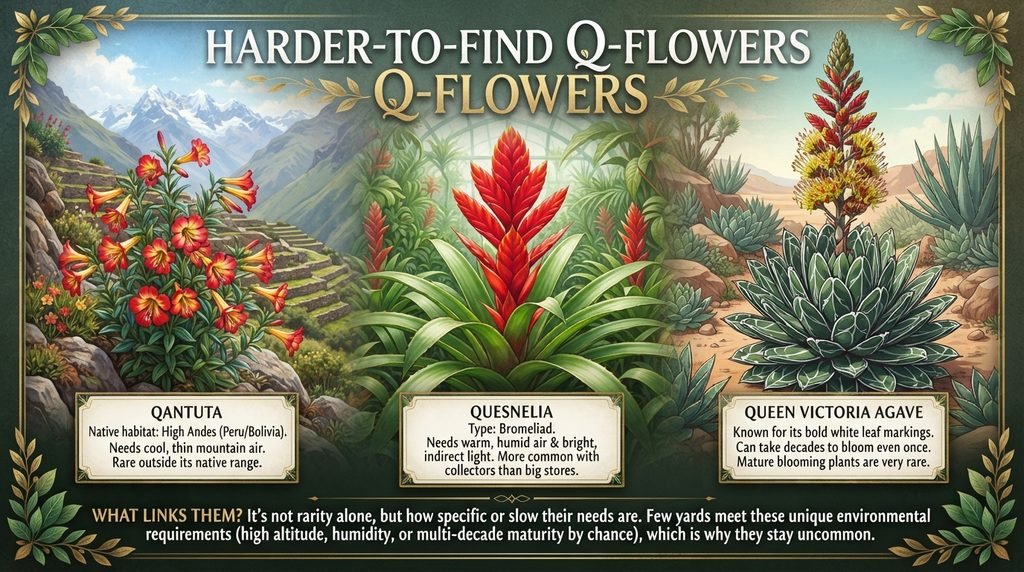
- Qantuta — needs cool, high-altitude air; rare outside its native Andes range
- Quesnelia — needs warm, humid air; more common with bromeliad collectors than big stores
- Queen Victoria Agave — can take decades to bloom even once
What links these three is not rarity alone. It is how specific, or how slow, their needs really are. None are truly hard to grow once you meet those needs. Few yards meet those needs by chance, which is why they stay uncommon.
Where to Use Care Q Flower
Few Q-flowers carry real risk, which sets this letter apart from some others on this list. Queen Anne’s Lace does carry one real caution, though. Its sap can cause a skin rash in some people after contact with bright sun, a condition doctors call phytophotodermatitis. Quince seeds hold small amounts of a compound that can release cyanide if chewed in a large amount, though the risk from casual contact with the fruit or bloom stays low.
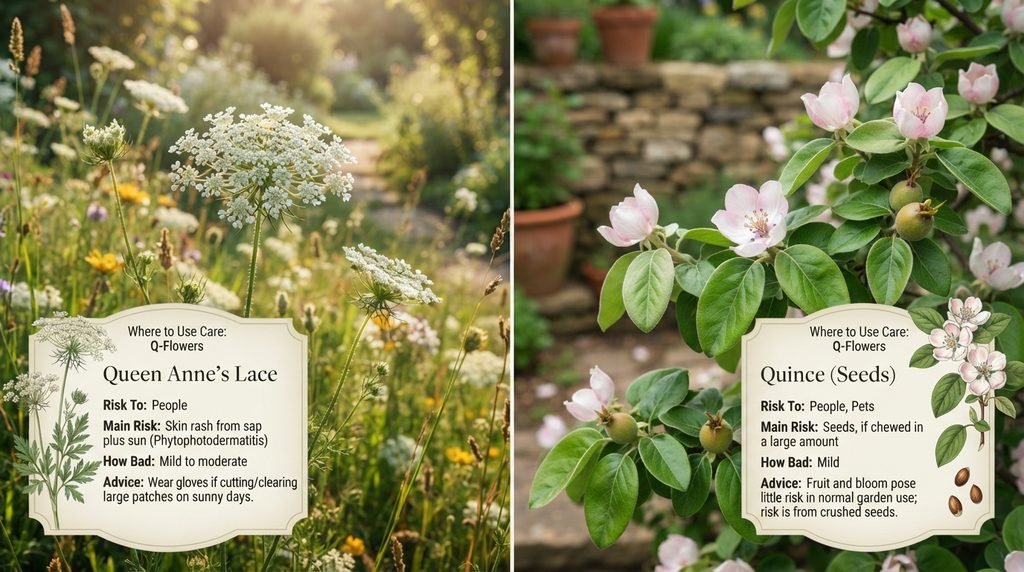
| Flower | Risk To | Main Risk | How Bad |
| Queen Anne’s Lace | People | Skin rash from sap plus sun | Mild to moderate |
| Quince (seeds) | People, pets | Seeds, if chewed in a large amount | Mild |
Queen Anne’s Lace deserves a bit of care mainly for its sap, not its bloom. Wear gloves if you plan to cut or clear a large patch by hand on a sunny day. Quince poses little real risk in normal garden use, since the fruit and bloom carry far less risk than the crushed seeds alone.
Planning by Bloom Cycle
Some blooms live one year. Some come back on their own. This fact shapes how you plan a bed. Queen Anne’s Lace often behaves as a two-year plant, growing leaves in year one and blooming in year two before it dies back and reseeds. Quince, by contrast, is a woody shrub that comes back and blooms for decades once planted.
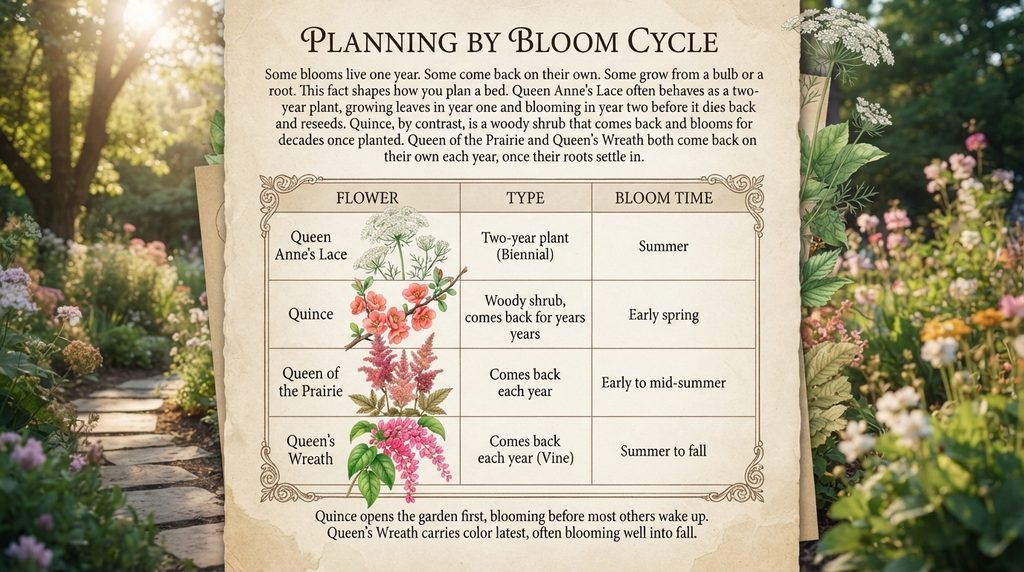
Queen of the Prairie and Queen’s Wreath both come back on their own each year, once their roots settle in.
| Flower | Type | Bloom Time |
| Queen Anne’s Lace | Two-year plant | Summer |
| Quince | Woody shrub, comes back for years | Early spring |
| Queen of the Prairie | Comes back each year | Early to mid-summer |
| Queen’s Wreath | Comes back each year (vine) | Summer to fall |
Quince opens the garden first on this table, blooming before most other plants wake up. Queen’s Wreath carries color latest, often blooming well into fall in a warm climate.
Every Q-Flower Name, A to Z
This is the full list of flowers that start with Q in this guide. It counts real names only, no padding. Most entries use the common name first, since that is how most folks search for a plant.
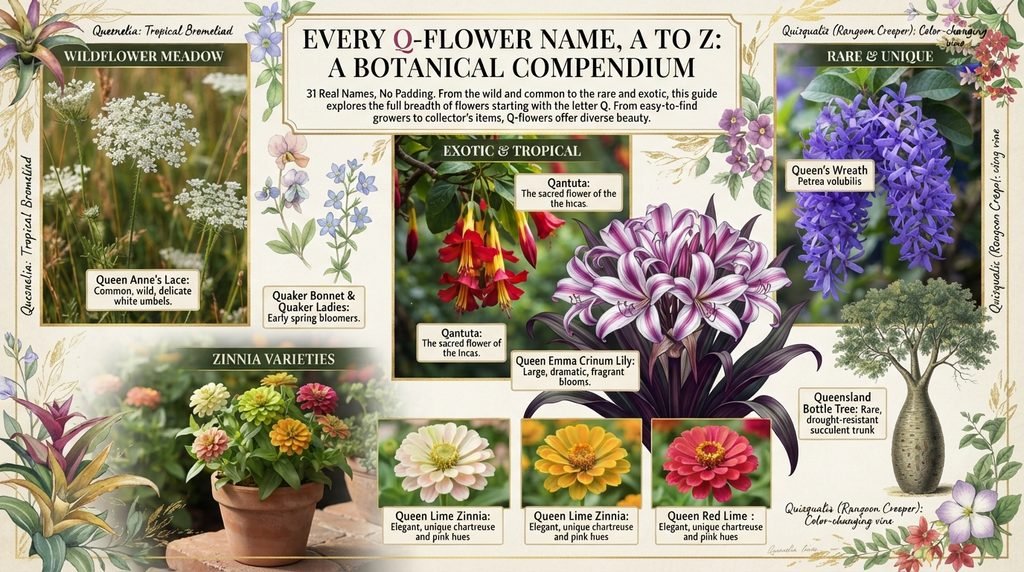
- Qantuta
- Quaker Bonnet
- Quaker Ladies
- Quamash (Camas)
- Queen Anne’s Lace
- Queen Emma Crinum Lily
- Queen Fabiola
- Queen Lily Ginger
- Queen Lime Blush Zinnia
- Queen Lime Orange Zinnia
- Queen Lime Zinnia
- Queen of the Meadow
- Queen of the Night
- Queen of the Prairie
- Queen Red Lime Zinnia
- Queen Victoria Agave
- Queen’s Crown
- Queen’s Cup
- Queen’s Delight
- Queen’s Flower
- Queen’s Tears
- Queen’s Wreath
- Queensland Bottle Tree
- Queensland Firewheel
- Queensland Grass Tree
- Queensland Silver Wattle
- Queeny Lime Zinnia
- Quesnelia
- Quince
- Quinine Bush
- Quisqualis (Rangoon Creeper)
That list holds thirty-one names in all, the full, honest count this guide found for this letter. Some, like Qantuta and Quesnelia, are hard to find outside a small grower or a collector. A few, like Queen Anne’s Lace, grow wild in many places and cost little to nothing to start.
Common Name to Plant-Science Name
Plant-science names matter most when you shop online or check a plant tag. This matters even more at this letter, since a few common names carry no real hint of the plant’s true family.
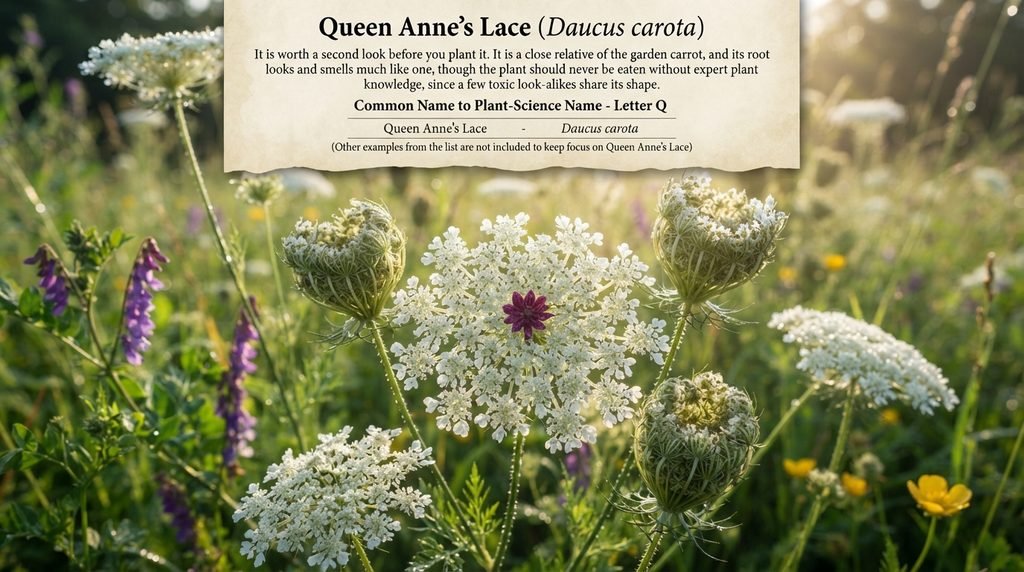
| Common Name | Plant-Science Name |
| Queen Anne’s Lace | Daucus carota |
| Quince | Cydonia oblonga |
| Queen of the Night | Selenicereus grandiflorus |
| Queen’s Tears | Billbergia nutans |
| Quisqualis | Quisqualis indica |
| Queen of the Prairie | Filipendula rubra |
| Qantuta | Cantua buxifolia |
Queen Anne’s Lace is worth a second look before you plant it. It is a close relative of the garden carrot, and its root looks and smells much like one, though the plant should never be eaten without expert plant knowledge, since a few toxic look-alikes share its shape.
Growing Conditions at a Glance
This chart pulls sun, soil, and bloom time into one place. It makes side-by-side checks easy. The table below holds each flower named in the growing sections above. It uses the same three columns each time, so nothing gets left out.
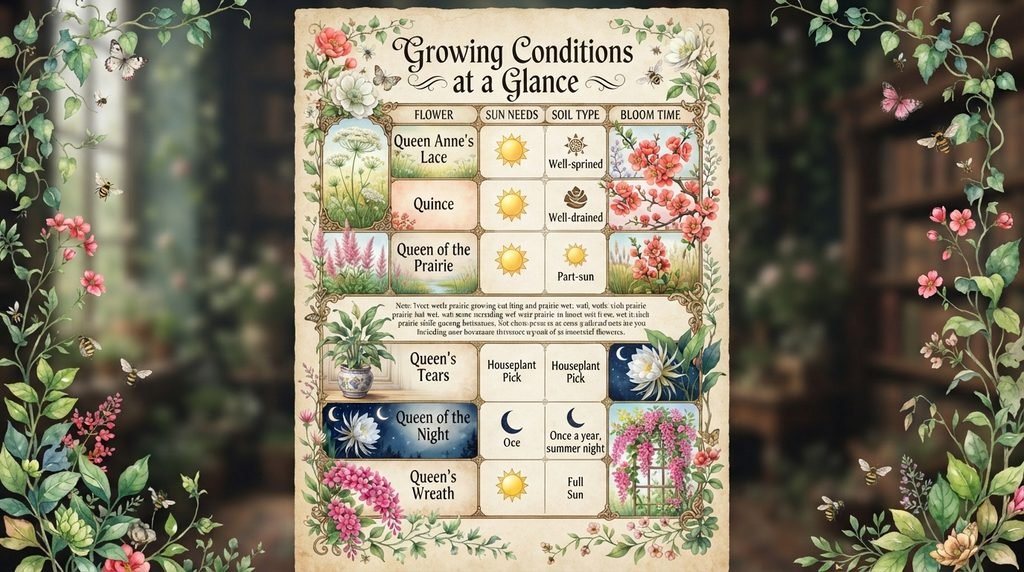
| Flower | Sun Needs | Soil Type | Bloom Time |
| Queen Anne’s Lace | Full sun | Average, well-drained soil | Summer |
| Quince | Full sun | Well-drained soil | Early spring |
| Queen of the Prairie | Full sun to part sun | Moist, rich soil | Early to mid-summer |
| Queen’s Tears | Bright, indirect light | Light, fast-draining mix | Spring through summer |
| Queen of the Night | Bright, indirect light | Well-drained, cactus-friendly mix | Once a year, summer night |
| Queen’s Wreath | Full sun | Well-drained soil | Summer to fall |
Queen of the Night stands apart here, since its bloom time is not a season but one short night each year. Queen’s Tears stands out too, as the only true houseplant pick in this whole table.
Pick Your Q-Flower by Need
Do not scan every row one by one. Start with your goal. The table below sets a need next to a clear pick, based on all the facts in this guide.
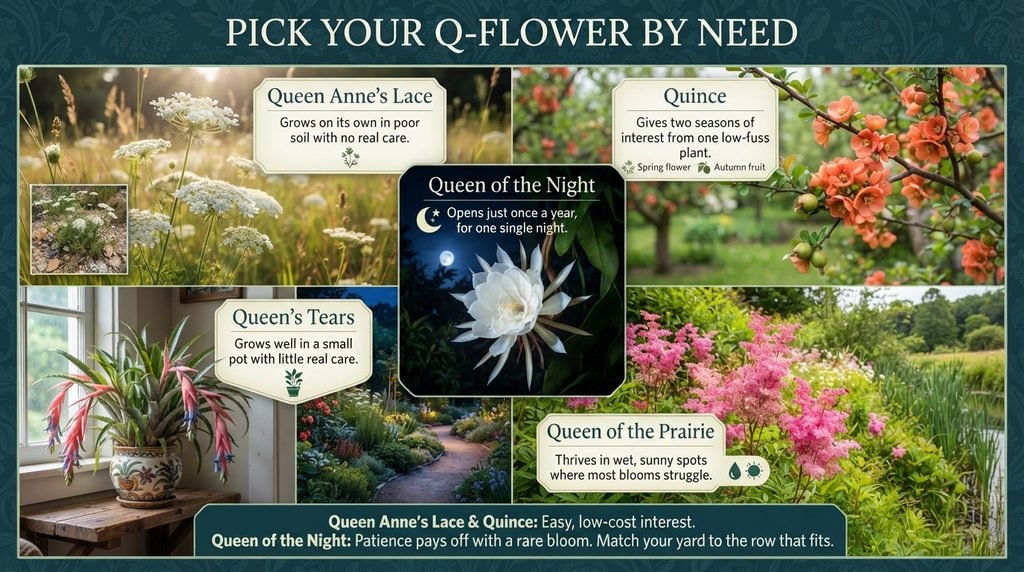
| If You Want… | Pick… | Why |
| A wild, low-fuss bloom | Queen Anne’s Lace | Grows on its own in poor soil with no real care |
| A small tree with spring bloom and fall fruit | Quince | Gives two seasons of interest from one low-fuss plant |
| A rare, one-night showpiece | Queen of the Night | Opens just once a year, for one single night |
| A quirky houseplant | Queen’s Tears | Grows well in a small pot with little real care |
| Damp-soil color | Queen of the Prairie | Thrives in wet, sunny spots where most blooms struggle |
Queen Anne’s Lace and Quince both solve a need for easy, low-cost interest. Queen of the Night asks for patience but pays off with a bloom few neighbors will ever see in person. Each pick here solves a real, different need, so match your yard to the row that fits.
Conclusion
Flowers that start with Q form the smallest list in this whole alphabet series, but real charm still runs through it, from the wild Queen Anne’s Lace to the rare, one-night Queen of the Night. This range is why this guide leans on real groups, not one flat list. Anyone who searches for flowers that start with Q should find a clear answer here, whether that means naming a bloom, picking a new plant, or checking if one is safe near a pet. This letter is small, but it still holds a real range worth knowing.
Frequently Asked Questions
What are some popular flowers that start with Q?
Queen Anne’s Lace, Quince, Queen’s Tears, and Queen of the Night are among the best-known flowers that start with Q. Each suits a different need, from wild fields to a small houseplant pot.
Are Q-flowers rare compared to other letters?
Yes. Q is one of the smallest letters for flower names in the whole alphabet, with a real, honest count landing around thirty names rather than the far larger counts found at letters like B or M.
Is Queen Anne’s Lace safe to touch?
Mostly, yes, but its sap can cause a skin rash in some people after contact with strong sun. Gloves are a smart choice if you plan to clear a large patch by hand.
How long does Queen of the Night bloom for? Just one night a year, for most types. The bloom opens after dark and closes again by morning, which makes it a true once-a-year event for most growers.
What is the gap between Quince the fruit and Quince the flower?
They come from the same plant. The spring bloom opens first, in soft pink-white, and the small, hard fruit follows later in the same growing season.
Which Q-flowers work best in cut arrangements?
Queen Anne’s Lace leads this short list, prized as a soft, lacy filler next to bolder, rounder blooms like roses in a mixed bunch.
Is Queen’s Tears easy to grow indoors?
Yes. It grows well in a small pot with bright, indirect light and a light hand with water, since its shallow roots rot fast in soil that stays too wet.