Flowers That Start With Y: 60+ Names, Photos & Growing Facts
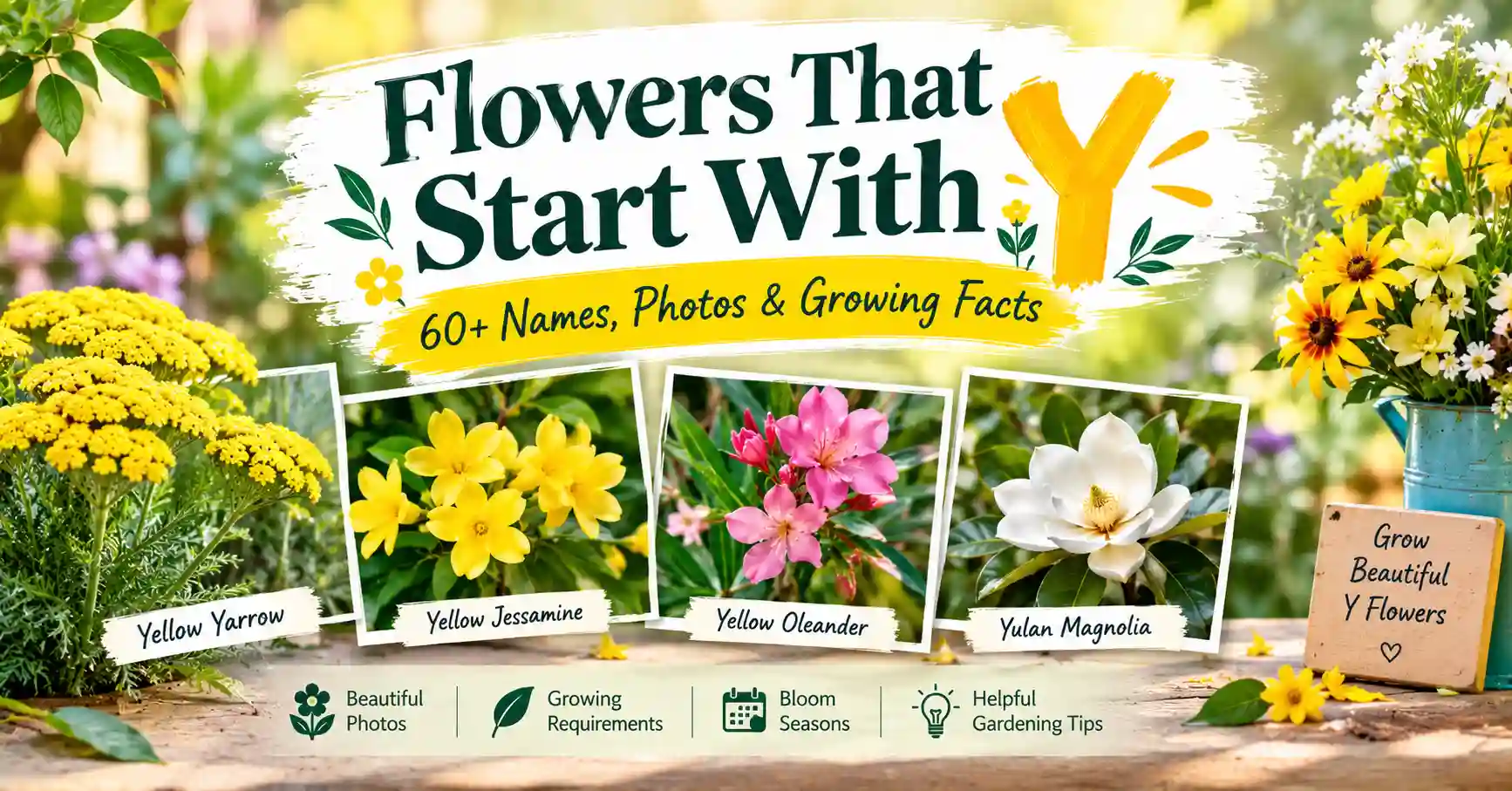
Flowers that start with Y earn their length from two overlapping sources. A genuine cluster of plants carries the letter in its actual common name, including yarrow, yucca, and yerba mansa. A second, much larger group exists because yellow is one of the most common flower colors in nature, and horticultural naming convention puts the color first, giving names like yellow rose and yellow tulip. Both categories are treated with equal care in this guide, since both are real, well-documented ways gardeners search for and refer to these plants.
This guide brings together more than sixty of these blooms. Each entry was checked individually for its botanical name, native range, and toxicity. Nothing here was pulled from a single source and lightly reworded. A few plants sometimes loosely associated with this letter, where the flower isn’t the main reason anyone grows them, were left off this list entirely.
Rather than opening with a flat alphabetical dump, this guide sorts its recommendations by how gardeners actually use these plants. Garden staples come first, followed by indoor options, florist favorites, genuinely rare specialty blooms, and a dedicated section flagging which entries need careful placement around pets and children.
Quick Answer: The Standout Y Flowers
A short list of names does most of the heavy lifting here. Yarrow and yucca cover the most drought-tolerant, low-maintenance end of this letter, while yellow rose and yellow tulip dominate the cut-flower and cottage-garden side.
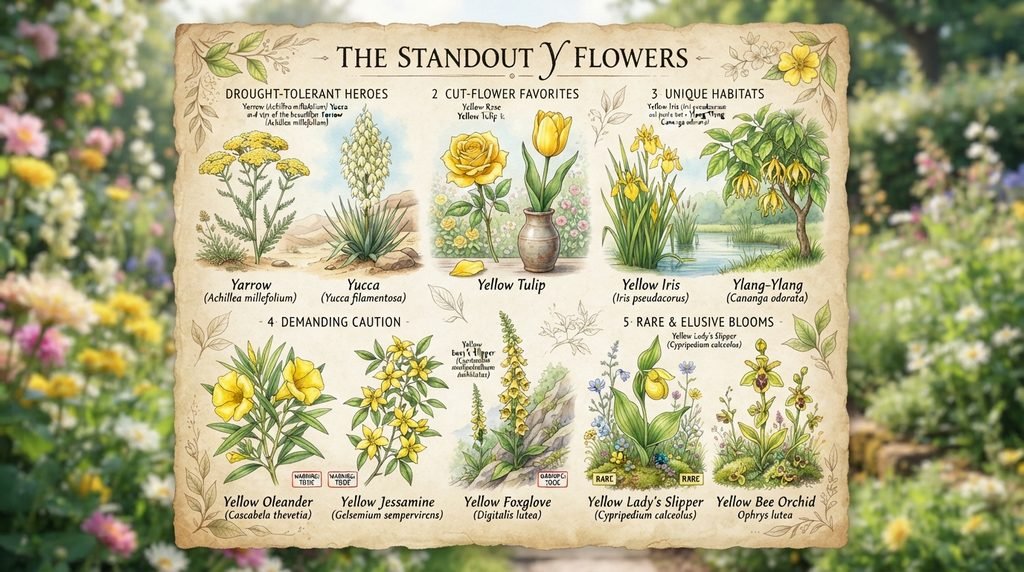
Yellow iris thrives in boggy, pond-edge conditions that few other plants on this list tolerate, and ylang-ylang brings genuine fragrance-industry credentials to a tropical container. Yellow oleander, yellow jessamine, and yellow foxglove all demand real caution, since each carries serious, well-documented toxicity.
What These Flowers Are Said to Represent
Symbolism across this letter draws heavily from yellow’s broader cultural associations, since so many entries share that color. Yellow rose carries a specific, well-documented meaning tied to friendship and warmth rather than romantic love, a distinction that sets it apart from red roses in most Western flower-language traditions. Yarrow carries an older, more practical symbolism rooted in centuries of use in traditional medicine, often associated with healing, protection, and courage in folklore that predates its purely ornamental garden use.
Yucca’s symbolism is thinner and more regional, tied in some Indigenous North American traditions to resilience and utility, given the plant’s historical use for fiber, food, and soap well beyond its ornamental value today. Ylang-ylang carries strong symbolic weight in parts of Southeast Asia and the Pacific, associated with celebration and romance, and its flowers appear in traditional wedding rituals in some Indonesian and Filipino cultures specifically because of that association.
Sorting These Flowers by Color
Yellow unsurprisingly dominates this letter, both because of the naming coincidence and because so many of these plants genuinely produce golden or lemon-toned blooms. Yarrow, yellow rose, yellow iris, yellow cosmos, and dozens of other entries fall into this category, spanning shades from pale butter to deep, saturated gold. White appears less often but shows up clearly in yerba mansa’s small white flower clusters and in York and Lancaster rose, an old striped rose variety that carries both white and pink on the same bloom.
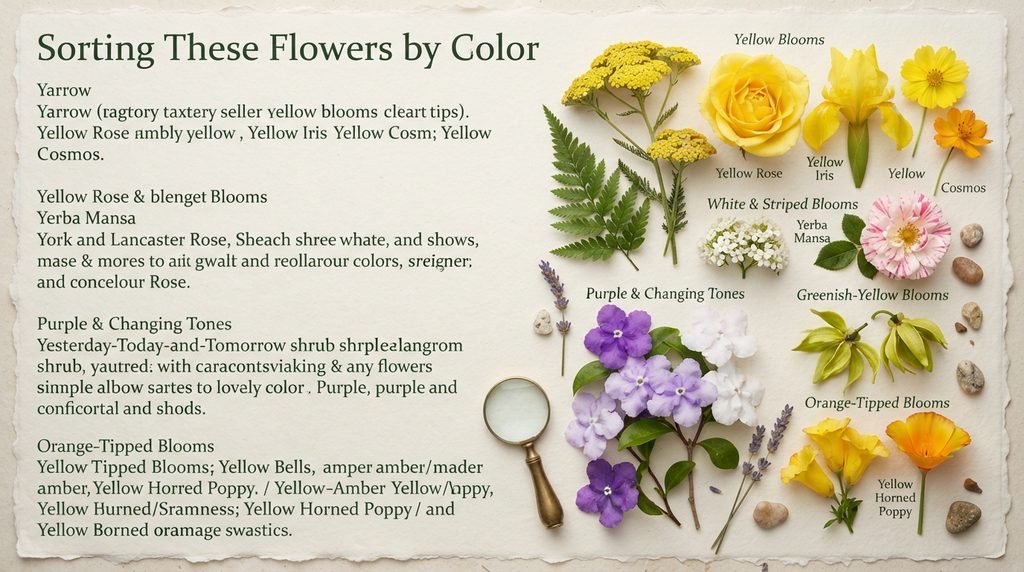
Purple tones surface in yesterday-today-and-tomorrow, whose flowers famously open deep purple, fade to lavender, and finish nearly white all on the same shrub over the course of a few days. Greenish-yellow tones are distinctive to ylang-ylang, whose star-shaped blooms carry a subtler, more muted color than the bright golds found elsewhere on this list. Orange tones appear at the edges of yellow bells and yellow horned poppy, both of which can shade toward a warm amber depending on the specific cultivar and growing conditions.
Garden Favorites Among Flowers That Start With Y
A core group of dependable plants carries most of the weight for gardeners exploring this letter. Yarrow anchors this group, tolerating drought, poor soil, and general neglect while still producing flat-topped flower clusters all summer long.
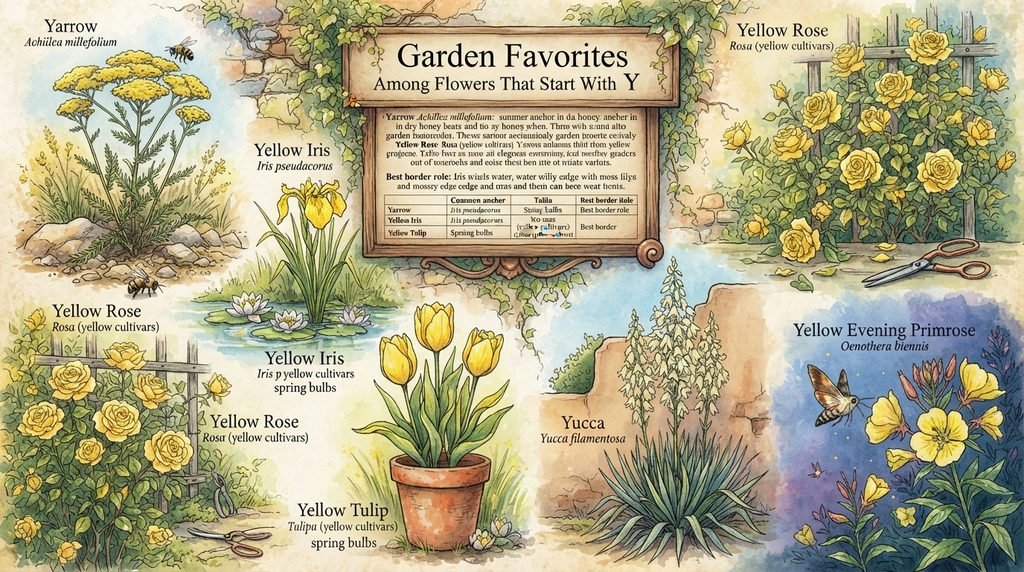
Yellow rose and yellow tulip both bring classic, reliable color to a spring or summer border, while yucca adds architectural drama with almost no ongoing care once established. Yellow evening primrose rounds out this group as a fragrant, easy-care perennial that opens its blooms in the evening, drawing moths and other night-flying pollinators.
| Flower | Botanical Name | Best Border Role |
| Yarrow | Achillea millefolium | Drought-tolerant summer anchor |
| Yellow Iris | Iris pseudacorus | Pond edge, boggy ground |
| Yellow Rose | Rosa (yellow cultivars) | Classic cut-flower color |
| Yellow Tulip | Tulipa (yellow cultivars) | Spring bulb display |
| Yucca | Yucca filamentosa | Architectural, near-zero maintenance |
| Yellow Evening Primrose | Oenothera biennis | Fragrant evening border |
Yarrow and yucca share more than a spot on this table. Both actually perform worse in rich, heavily fertilized soil, which makes them a natural pairing for the leanest, driest part of a yard rather than a showcase bed.
Indoor Plants: Flowers That Start With Y for Pots and Windowsills
A smaller group of Y flowers performs best indoors or in a container, where controlled conditions make up for a climate that can’t support them outdoors year-round. Ylang-ylang leads this group outside the tropics, needing greenhouse conditions or a heated indoor space through winter in most temperate climates, but rewarding that effort with flowers used in the perfume industry.
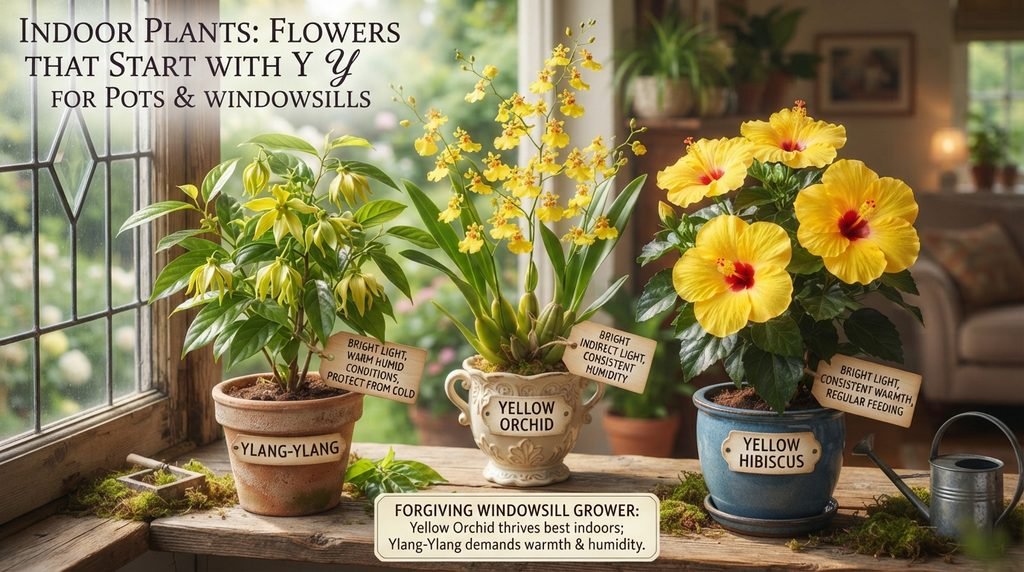
Yellow hibiscus, while often grown outdoors in warm climates, also performs well as a container specimen brought indoors before frost, provided it gets consistent warmth and strong light.
- Ylang-Ylang — bright light, warm humid conditions, protect from any cold snap
- Yellow Orchid — bright indirect light, consistent humidity
- Yellow Hibiscus — bright light, consistent warmth, regular feeding during bloom
Yellow orchid remains the most forgiving of this trio for a windowsill grower, tolerating typical home humidity levels far better than ylang-ylang, which struggles without genuinely warm, humid air.
Florist Favorites: Y Flowers Built for Cutting and Arranging
Cut-flower value depends on vase life, stem strength, and overall versatility, and several Y flowers perform strongly across all three. Holding its shape and color well after cutting it carries a distinct, friendship-focused meaning that sets it apart from red roses.
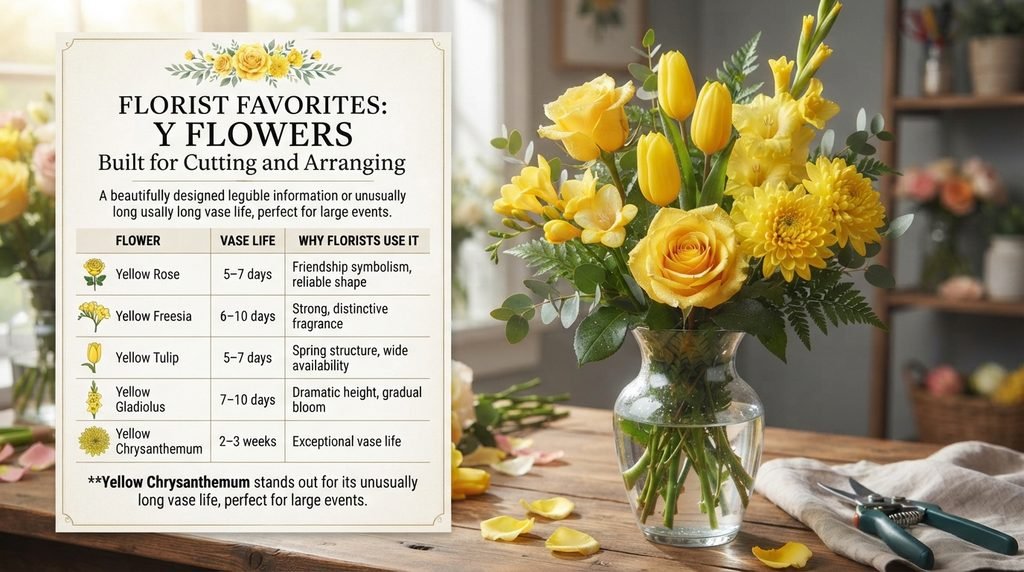
Yellow tulip and yellow gladiolus both add reliable seasonal structure to arrangements, the former for spring work and the latter for taller, more dramatic summer displays.
| Flower | Vase Life | Why Florists Use It |
| Yellow Rose | 5–7 days | Friendship symbolism, reliable shape |
| Yellow Freesia | 6–10 days | Strong, distinctive fragrance |
| Yellow Tulip | 5–7 days | Spring structure, wide availability |
| Yellow Gladiolus | 7–10 days | Dramatic height, gradual bloom |
| Yellow Chrysanthemum | 2–3 weeks | Exceptional vase life |
Yellow chrysanthemum stands out from the rest of this table for its unusually long vase life, which is exactly why it remains a practical choice for large event work where flowers need to hold up well past a single evening.
Rare Flowers: The Harder-to-Find Entries on This List
A handful of entries on this list are genuinely uncommon. Yellow lady’s slipper tops this group by a wide margin, since it’s a native orchid that depends on specific soil fungi to establish, which makes it notoriously difficult to transplant or cultivate deliberately outside its native woodland conditions. Yellow bee orchid, a European wildflower whose bloom mimics the appearance of a female bee to attract pollinators, remains uncommon in cultivation and is mostly encountered in the wild by dedicated orchid enthusiasts.
Yerba mansa, a wetland native of the American Southwest, follows a similar pattern, more often found through native-plant specialists than general nurseries, since it specifically needs saturated or boggy soil to thrive. Yellow fritillary, also called yellow bell, remains a niche choice limited mostly to western North American wildflower enthusiasts, since it requires the specific dry-summer, wet-spring cycle of its native range. Yellow pitcher plant rounds out this group as a genuinely specialized carnivorous bog plant that demands acidic, nutrient-poor soil and rainwater rather than standard tap water.
Caution: Y Flowers That Need Careful Placement
Toxicity risk varies sharply across this letter, and a few entries deserve serious, specific attention. Yellow oleander is genuinely dangerous, containing cardiac glycosides throughout the plant that can cause severe heart arrhythmias in humans, pets, and livestock if any part is ingested. This is not a plant to treat casually simply because it’s commonly sold at nurseries.
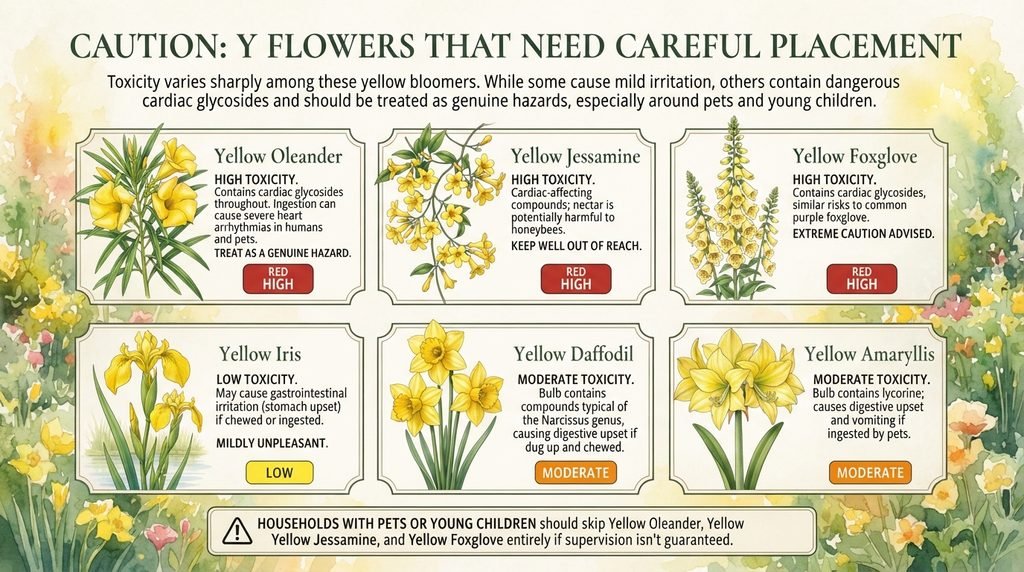
Yellow foxglove, like its more common purple relative, contains cardiac glycosides as well and should be treated with the same caution around pets and children. Yellow iris causes milder but still unpleasant symptoms, generally gastrointestinal irritation rather than anything life-threatening, if chewed or ingested.
| Flower | Toxicity Level | Risk Details |
| Yellow Oleander | High | Cardiac glycosides; can cause fatal heart arrhythmias if ingested |
| Yellow Jessamine | High | Cardiac-affecting compounds; nectar may harm honeybees |
| Yellow Foxglove | High | Cardiac glycosides, same risk category as common foxglove |
| Yellow Iris | Low to moderate | Causes gastrointestinal irritation if chewed or ingested |
| Yellow Daffodil | Moderate | Bulb toxicity typical of the Narcissus genus |
| Yellow Amaryllis | Moderate | Bulb contains lycorine, causes digestive upset |
Households with pets or young children should treat yellow oleander, yellow jessamine, and yellow foxglove as genuine hazards rather than ornamental curiosities, keeping all three well out of reach or skipping them entirely if supervision can’t be guaranteed.
Choosing by Life Cycle: Annuals, Perennials, Bulbs, and Beyond
Matching a flower’s life cycle to an actual planning horizon matters as much as matching its color. An annual that needs replanting every year plays a very different role than a shrub or tree that becomes a permanent fixture. Perennials make up the largest group among these flowers, offering repeat blooms with less ongoing replanting effort. Bulbs form a strong secondary group, including several spring bloomers that finish quickly before going dormant.
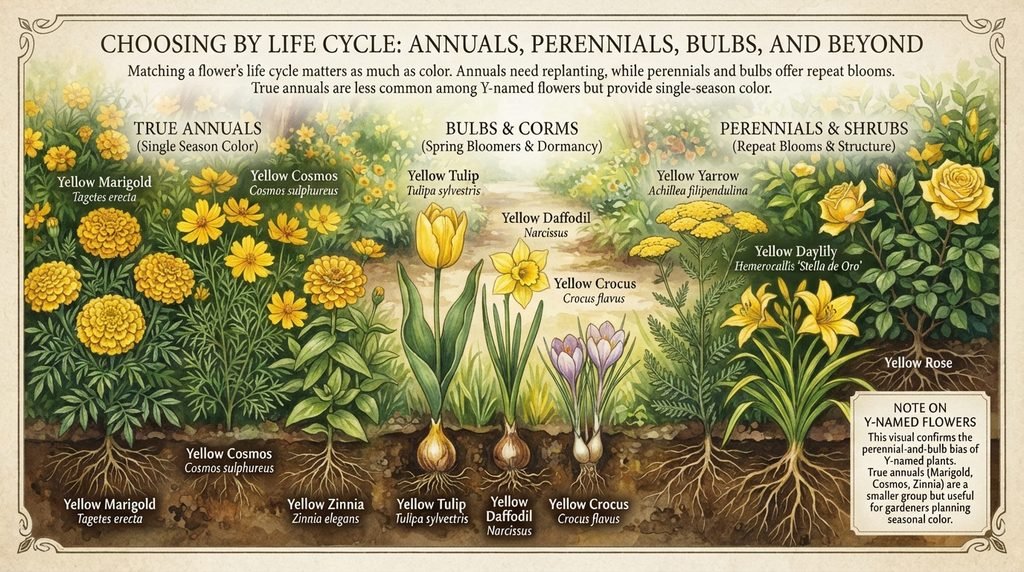
True annuals are somewhat less common among Y-named flowers specifically, though a few genuinely useful ones exist for gardeners wanting single-season color. Shrubs and trees round out the list with some of its most dramatic entries.
| Flower | Life Cycle |
| Yarrow | Perennial |
| Yellow Bells | Shrub |
| Yellow Iris (Flag) | Perennial (rhizome) |
| Yellow Archangel | Perennial groundcover |
| Yesterday-Today-and-Tomorrow | Shrub |
| Ylang-Ylang | Tree |
| Yucca | Perennial (evergreen) |
| Yellow Loosestrife | Perennial |
| Yellow Waterlily | Perennial (aquatic) |
| Yellow Cosmos | Annual |
| Yellow Rocket | Biennial |
| Yellow Toadflax | Perennial |
| Yellow Foxglove | Biennial or short-lived perennial |
| Yellow Jessamine | Perennial vine |
| Yellow Corydalis | Perennial |
| Yellow Lady’s Slipper | Perennial (terrestrial orchid) |
| Yellow Waxbells | Perennial |
| Yellow Star Grass | Perennial |
| Yellow Rattle | Annual |
| Yellow Sweet Clover | Biennial |
| Yellow Evening Primrose | Biennial |
| Yerba Mansa | Perennial |
| Yellow Monkeyflower | Perennial (short-lived) |
| York and Lancaster Rose | Perennial shrub |
| Yellow Columbine | Perennial |
| Yellow Adder’s Tongue | Bulb |
| Yellow Skunk Cabbage | Perennial |
| Yellow Wood Sorrel | Perennial (often self-seeding) |
| Yellow Bee Orchid | Perennial (terrestrial orchid) |
| Yellow Meadow Rue | Perennial |
| Yellow Horned Poppy | Biennial or short-lived perennial |
| Yellow Chamomile | Perennial |
| Yellow Gentian | Perennial |
| Yellow Ice Plant | Perennial succulent |
| Yellow Passionflower | Perennial vine |
| Yellow Fritillary (Yellow Bell) | Bulb |
| Yellow Trillium | Perennial |
| Yellow Wood Anemone | Perennial (tuber) |
| Yellow Butterwort | Perennial (carnivorous) |
| Yellow Pitcher Plant | Perennial (carnivorous) |
| Yellow Sage | Perennial shrub |
| Yellow Daylily | Perennial |
| Yellow Oleander | Evergreen shrub |
| Yellow Rose | Perennial shrub |
| Yellow Tulip | Bulb |
| Yellow Daffodil | Bulb |
| Yellow Marigold | Annual |
| Yellow Chrysanthemum | Perennial |
| Yellow Zinnia | Annual |
| Yellow Dahlia | Tuberous perennial |
| Yellow Carnation | Perennial |
| Yellow Orchid | Perennial (epiphytic) |
| Yellow Hibiscus | Perennial shrub |
| Yellow Ranunculus | Tuberous perennial |
| Yellow Freesia | Bulb (corm) |
| Yellow Gladiolus | Bulb (corm) |
| Yellow Amaryllis | Bulb |
| Yellow Canna Lily | Rhizome |
| Yellow Crocus | Bulb (corm) |
| Yellow Hyacinth | Bulb |
| Yellow Snapdragon | Annual or short-lived perennial |
| Yellow Poppy | Annual or perennial (species-dependent) |
| Yellow Camellia | Evergreen shrub |
| Yellow Azalea | Deciduous or evergreen shrub |
This table makes the perennial-and-bulb bias of this letter clear at a glance. True annuals, including yellow cosmos, yellow rattle, yellow marigold, yellow zinnia, and yellow snapdragon, remain a smaller but genuinely useful group for gardeners planning single-season color.
The Master List: Every Flower on This Guide, A to Z
Roughly two-thirds of the entries below carry the letter in their actual species or common name, while the remaining third are yellow-colored varieties of otherwise familiar garden flowers. Both groups are presented together here, since both are genuine, well-documented ways gardeners search for and buy these plants.
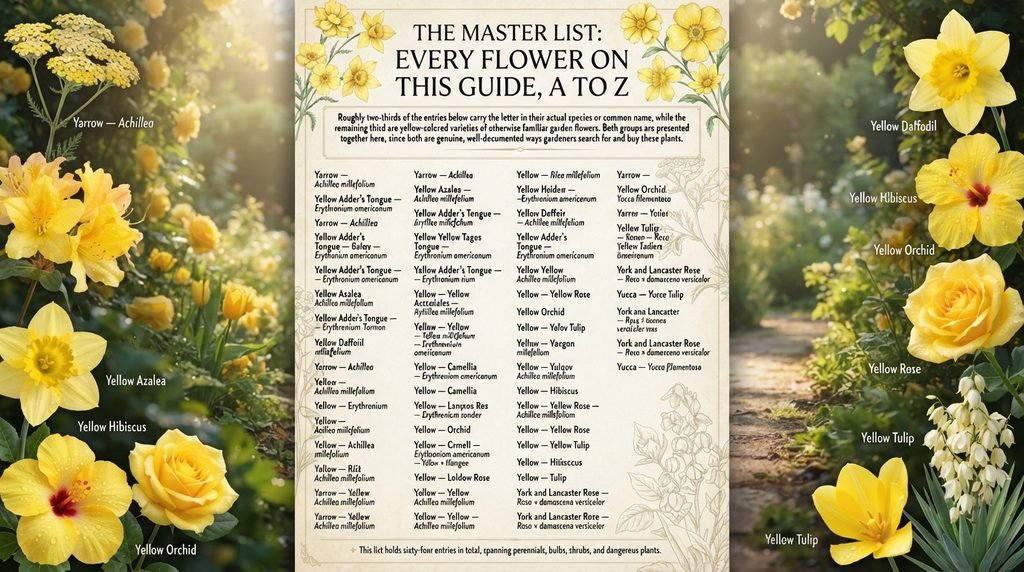
- Yarrow — Achillea millefolium
- Yellow Adder’s Tongue (Trout Lily) — Erythronium americanum
- Yellow Amaryllis — Hippeastrum (yellow cultivars)
- Yellow Archangel — Lamium galeobdolon
- Yellow Azalea — Rhododendron (yellow cultivars)
- Yellow Bee Orchid — Ophrys lutea
- Yellow Bells — Tecoma stans
- Yellow Butterwort — Pinguicula lutea
- Yellow Camellia — Camellia chrysantha
- Yellow Canna Lily — Canna indica (yellow cultivars)
- Yellow Carnation — Dianthus caryophyllus (yellow cultivars)
- Yellow Chamomile — Cota tinctoria
- Yellow Chrysanthemum — Chrysanthemum morifolium (yellow cultivars)
- Yellow Columbine — Aquilegia chrysantha
- Yellow Corydalis — Corydalis lutea
- Yellow Cosmos — Cosmos sulphureus
- Yellow Crocus — Crocus flavus
- Yellow Dahlia — Dahlia pinnata (yellow cultivars)
- Yellow Daffodil — Narcissus (yellow cultivars)
- Yellow Daylily — Hemerocallis lilioasphodelus
- Yellow Evening Primrose — Oenothera biennis
- Yellow Flag (Iris) — Iris pseudacorus
- Yellow Foxglove — Digitalis grandiflora
- Yellow Freesia — Freesia hybrida (yellow cultivars)
- Yellow Fritillary (Yellow Bell) — Fritillaria pudica
- Yellow Gentian — Gentiana lutea
- Yellow Gladiolus — Gladiolus (yellow cultivars)
- Yellow Hibiscus — Hibiscus rosa-sinensis (yellow cultivars)
- Yellow Horned Poppy — Glaucium flavum
- Yellow Hyacinth — Hyacinthus orientalis (yellow cultivars)
- Yellow Ice Plant — Delosperma nubigenum
- Yellow Jessamine — Gelsemium sempervirens
- Yellow Lady’s Slipper — Cypripedium parviflorum
- Yellow Loosestrife — Lysimachia vulgaris
- Yellow Marigold — Tagetes erecta (yellow cultivars)
- Yellow Meadow Rue — Thalictrum flavum
- Yellow Monkeyflower — Erythranthe guttata
- Yellow Oleander — Cascabela thevetia
- Yellow Orchid — Oncidium (yellow hybrids)
- Yellow Passionflower — Passiflora lutea
- Yellow Pitcher Plant — Sarracenia flava
- Yellow Poppy — Papaver (yellow cultivars)
- Yellow Ranunculus — Ranunculus asiaticus (yellow cultivars)
- Yellow Rattle — Rhinanthus minor
- Yellow Rocket — Barbarea vulgaris
- Yellow Rose — Rosa (yellow cultivars)
- Yellow Sage — Lantana camara
- Yellow Skunk Cabbage — Lysichiton americanus
- Yellow Snapdragon — Antirrhinum majus (yellow cultivars)
- Yellow Star Grass — Hypoxis hirsuta
- Yellow Sweet Clover — Melilotus officinalis
- Yellow Toadflax — Linaria vulgaris
- Yellow Trillium — Trillium luteum
- Yellow Tulip — Tulipa (yellow cultivars)
- Yellow Waterlily (Yellow Pond Lily) — Nuphar lutea
- Yellow Waxbells — Kirengeshoma palmata
- Yellow Wood Anemone — Anemone ranunculoides
- Yellow Wood Sorrel — Oxalis stricta
- Yellow Zinnia — Zinnia elegans (yellow cultivars)
- Yerba Mansa — Anemopsis californica
- Ylang-Ylang — Cananga odorata
- York and Lancaster Rose — Rosa × damascena versicolor
- Yucca — Yucca filamentosa
This list holds sixty-four entries in total. It spans easy garden perennials, spring bulbs, tropical shrubs, and several genuinely dangerous plants, which reflects just how much depth flowers that start with Y actually offer once both naming categories are counted honestly.
Why Botanical Names Matter for This Letter
Common-name confusion is a real risk with this letter, since several unrelated plants share the same descriptive prefix, and “yellow” alone covers dozens of genuinely different species on this list, from bulbs to shrubs to carnivorous bog plants. A number of other entries are rarely sold under any single standardized common name at all. Searching by botanical name is often the only reliable way to confirm that a nursery listing actually matches the plant intended, especially given how many Y-named plants carry serious toxicity risks that a name mix-up could make worse.
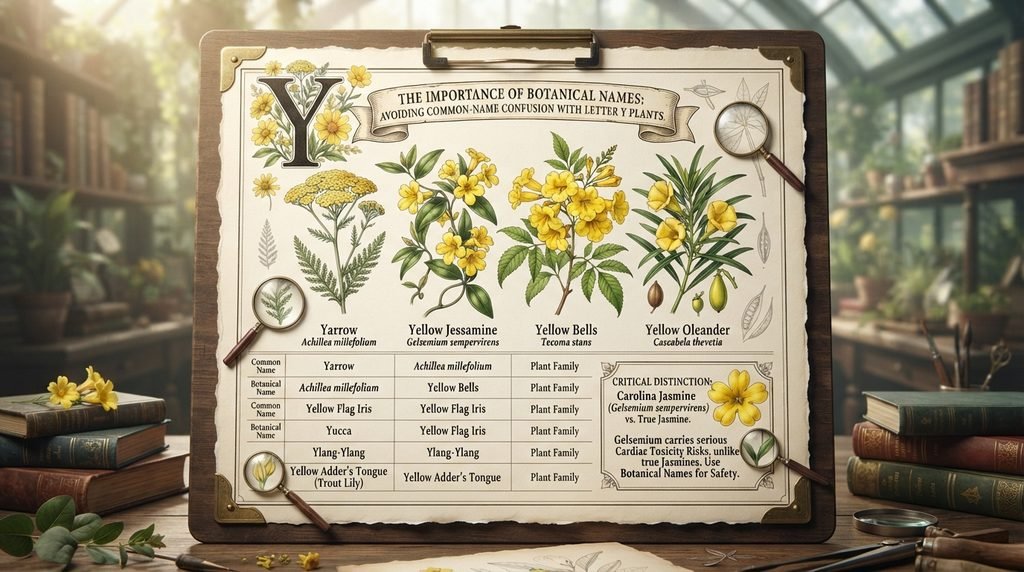
| Common Name | Botanical Name | Plant Family |
| Yarrow | Achillea millefolium | Asteraceae |
| Yellow Flag Iris | Iris pseudacorus | Iridaceae |
| Yellow Jessamine (Carolina Jasmine) | Gelsemium sempervirens | Gelsemiaceae |
| Yellow Bells (Yellow Elder) | Tecoma stans | Bignoniaceae |
| Yucca | Yucca filamentosa | Asparagaceae |
| Ylang-Ylang | Cananga odorata | Annonaceae |
| Yellow Oleander | Cascabela thevetia | Apocynaceae |
| Yellow Adder’s Tongue (Trout Lily) | Erythronium americanum | Liliaceae |
The Carolina jasmine naming overlap is worth double-checking before buying, since assuming yellow jessamine behaves like a true jasmine, which is generally low-risk, could lead someone to underestimate a plant that actually carries real cardiac toxicity.
Full Comparison Table: Bloom Time, Sun, and Safety at a Glance
The table below brings together bloom season, sun needs, toxicity level, and primary use for every flower covered in this guide. It makes it possible to scan for a specific combination of traits, such as a spring-blooming, full-sun, pet-safe option, without flipping back through each section above.
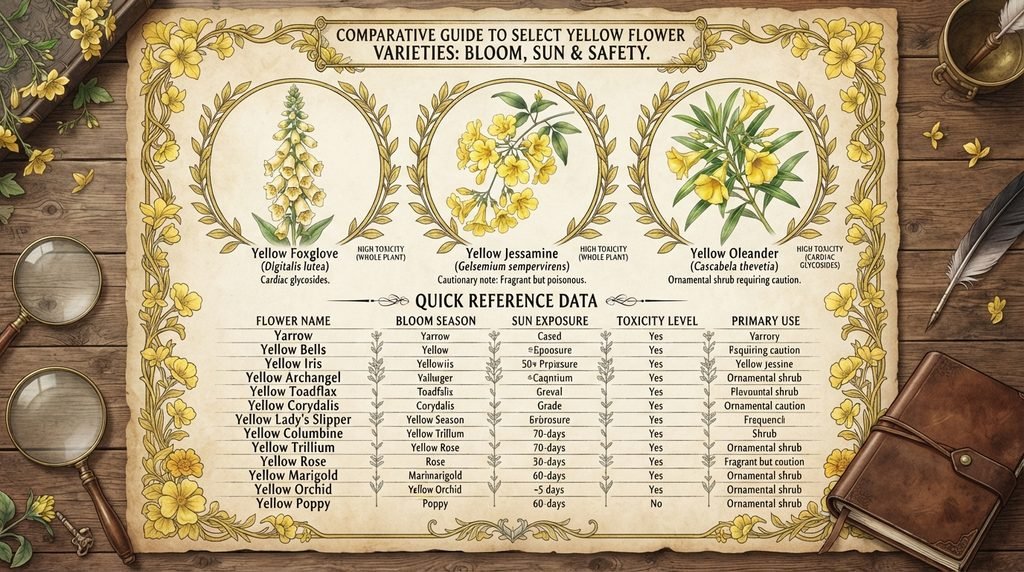
| Flower | Bloom Season | Sun | Toxicity | Primary Use |
| Yarrow | Summer | Full sun | Low | Garden, pollinator |
| Yellow Bells | Summer–fall | Full sun | Non-toxic | Warm-climate flowering shrub |
| Yellow Iris (Flag) | Late spring | Full sun–part shade | Low to moderate | Pond edge, boggy border |
| Yellow Archangel | Spring | Partial shade | Non-toxic | Shaded groundcover |
| Yesterday-Today-and-Tomorrow | Summer | Full sun–part shade | Mild | Color-shifting specimen shrub |
| Ylang-Ylang | Summer | Full sun | Non-toxic | Fragrance, tropical specimen |
| Yucca | Summer | Full sun | Non-toxic | Architectural accent |
| Yellow Loosestrife | Summer | Full sun–part shade | Non-toxic | Border, moist ground |
| Yellow Waterlily | Summer | Full sun | Non-toxic | Pond, water garden |
| Yellow Cosmos | Summer–fall | Full sun | Non-toxic | Cutting garden |
| Yellow Rocket | Spring | Full sun | Non-toxic | Naturalized wildflower |
| Yellow Toadflax | Summer–fall | Full sun | Mild | Naturalized border |
| Yellow Foxglove | Summer | Partial shade | High | Ornamental (extreme caution) |
| Yellow Jessamine | Spring | Full sun–part shade | High | Fragrant vine (extreme caution) |
| Yellow Corydalis | Spring–fall | Partial shade | Non-toxic | Shaded rock garden |
| Yellow Lady’s Slipper | Spring | Partial shade | Non-toxic | Rare native woodland specimen |
| Yellow Waxbells | Late summer | Partial shade | Non-toxic | Shade border |
| Yellow Star Grass | Spring–summer | Full sun–part shade | Non-toxic | Native wildflower meadow |
| Yellow Rattle | Summer | Full sun | Mild | Meadow restoration |
| Yellow Sweet Clover | Summer | Full sun | Non-toxic | Pollinator, cover crop |
| Yellow Evening Primrose | Summer | Full sun | Non-toxic | Fragrant evening border |
| Yerba Mansa | Spring–summer | Full sun–part shade | Non-toxic | Wetland native garden |
| Yellow Monkeyflower | Spring–summer | Full sun–part shade | Non-toxic | Streamside native planting |
| York and Lancaster Rose | Summer | Full sun | Non-toxic | Historic rose specimen |
| Yellow Columbine | Spring–summer | Partial shade | Mild | Woodland border |
| Yellow Adder’s Tongue | Spring | Partial to full shade | Non-toxic | Native woodland bulb |
| Yellow Skunk Cabbage | Spring | Partial shade | Mild | Boggy native planting |
| Yellow Wood Sorrel | Summer | Full sun–part shade | Mild | Edible groundcover |
| Yellow Bee Orchid | Spring | Full sun | Non-toxic | Rare wild specimen |
| Yellow Meadow Rue | Summer | Partial shade | Mild | Woodland border |
| Yellow Horned Poppy | Summer | Full sun | Moderate | Coastal wildflower |
| Yellow Chamomile | Summer | Full sun | Non-toxic | Border, dye garden |
| Yellow Gentian | Summer | Full sun–part shade | Non-toxic | Alpine specimen |
| Yellow Ice Plant | Summer | Full sun | Non-toxic | Groundcover, rock garden |
| Yellow Passionflower | Summer–fall | Full sun–part shade | Non-toxic | Native vine |
| Yellow Fritillary (Yellow Bell) | Spring | Full sun | Non-toxic | Native bulb specialty |
| Yellow Trillium | Spring | Full shade | Mild | Native woodland specimen |
| Yellow Wood Anemone | Spring | Full to partial shade | Non-toxic | Woodland groundcover |
| Yellow Butterwort | Spring–summer | Full sun | Non-toxic | Carnivorous bog specimen |
| Yellow Pitcher Plant | Spring–summer | Full sun | Non-toxic | Carnivorous bog specimen |
| Yellow Sage | Spring–fall | Full sun | Mild | Butterfly border |
| Yellow Daylily | Summer | Full sun | Non-toxic | Naturalized border |
| Yellow Oleander | Nearly year-round (warm) | Full sun | High | Caution ornamental shrub |
| Yellow Rose | Spring–fall | Full sun | Non-toxic | Cut flower, friendship gift |
| Yellow Tulip | Early–mid spring | Full sun | Mild | Spring bulb display |
| Yellow Daffodil | Early spring | Full sun–part shade | Moderate | Naturalized spring bulb |
| Yellow Marigold | Summer–fall | Full sun | Non-toxic | Bedding, companion planting |
| Yellow Chrysanthemum | Fall | Full sun | Mild | Cut flower, fall décor |
| Yellow Zinnia | Summer–fall | Full sun | Non-toxic | Cutting garden |
| Yellow Dahlia | Summer–fall | Full sun | Non-toxic | Cut flower, border |
| Yellow Carnation | Spring–fall | Full sun | Mild | Cut flower |
| Yellow Orchid | Varies | Bright indirect | Non-toxic | Houseplant |
| Yellow Hibiscus | Summer–fall | Full sun | Non-toxic | Tropical container specimen |
| Yellow Ranunculus | Spring | Full sun–part shade | Mild | Cut flower |
| Yellow Freesia | Spring | Full sun | Non-toxic | Fragrant cut flower |
| Yellow Gladiolus | Summer | Full sun | Moderate | Cut flower, border accent |
| Yellow Amaryllis | Winter (indoors) | Bright indirect | Moderate | Holiday bulb display |
| Yellow Canna Lily | Summer–fall | Full sun | Non-toxic | Tropical border |
| Yellow Crocus | Late winter–early spring | Full sun | Mild | Early bulb display |
| Yellow Hyacinth | Early spring | Full sun–part shade | Mild | Fragrant bulb display |
| Yellow Snapdragon | Spring–fall | Full sun | Non-toxic | Cut flower, border |
| Yellow Poppy | Spring–summer | Full sun | Mild | Cottage border |
| Yellow Camellia | Winter–spring | Partial shade | Non-toxic | Rare specimen shrub |
| Yellow Azalea | Spring | Partial shade | Mild | Woodland shrub border |
Three rows stand out on a closer look at this table. Yellow foxglove and yellow jasmine are the only two entries carrying a high toxicity rating for the whole plant, while yellow oleander follows just as seriously given its cardiac glycoside content.
Decision Guide: Matching a Scenario to the Right Y Flower
Sometimes the fastest way to choose a flower isn’t scrolling through a full list. It helps to start from the actual problem that needs solving, whether that’s a boggy corner, a fragrant container, or a household with pets. The table below maps common gardening scenarios to the Y flowers best suited to each one.
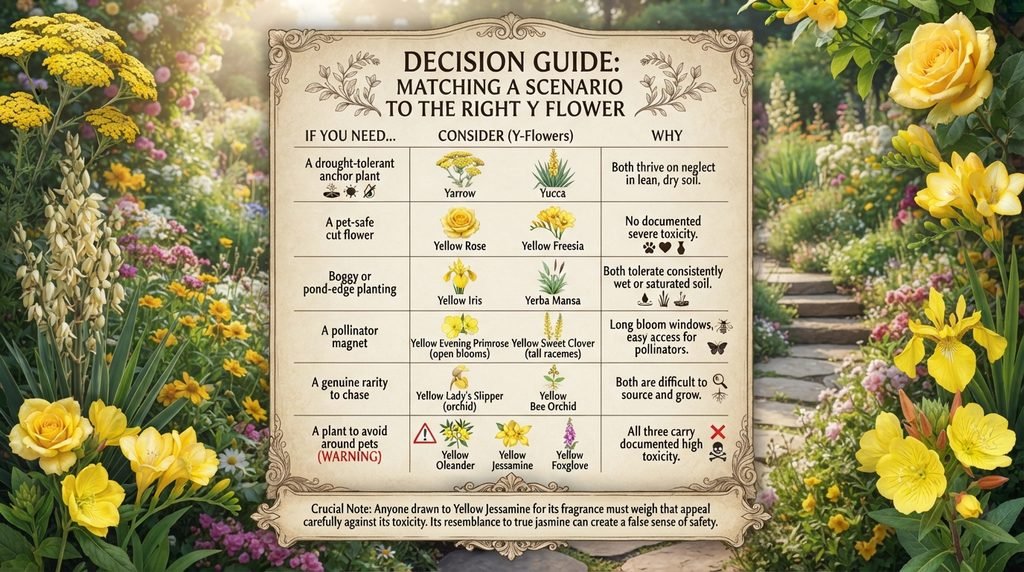
| If You Need… | Consider | Why |
| A drought-tolerant anchor plant | Yarrow, Yucca | Both thrive on neglect in lean, dry soil |
| A pet-safe cut flower | Yellow Rose, Yellow Freesia | No documented severe toxicity |
| Boggy or pond-edge planting | Yellow Iris, Yerba Mansa | Both tolerate consistently wet or saturated soil |
| A pollinator magnet | Yellow Evening Primrose, Yellow Sweet Clover | Long bloom windows, easy access for pollinators |
| A genuine rarity to chase | Yellow Lady’s Slipper, Yellow Bee Orchid | Both are difficult to source and grow |
| A plant to avoid around pets | Yellow Oleander, Yellow Jessamine, Yellow Foxglove | All three carry documented high toxicity |
Anyone drawn to yellow jessamine for its fragrance should weigh that appeal carefully against its toxicity, especially since its resemblance to true jasmine can create a false sense of safety.
Conclusion
Flowers that start with Y span a genuinely wide range, from drought-tolerant garden anchors and fragrant tropical shrubs to rare native orchids and a concentrated cluster of plants that demand real caution. Choosing among them comes down to matching a specific flower to an actual spot, household, or purpose, rather than working straight down an alphabetical list. With the category breakdowns, comparison table, and decision guide covered above, narrowing this list down to the few that genuinely fit a given garden should take far less trial and error than starting from scratch.
Frequently Asked Questions
1. How many flowers that start with Y are there?
This guide covers sixty-four verified flowers that start with Y, combining true Y-named species with well-documented yellow-colored varieties of familiar garden flowers.
2. What is the easiest Y flower to grow?
Yarrow is generally the easiest, tolerating drought, poor soil, and general neglect while still producing reliable summer blooms.
3. Which Y flowers are toxic to pets?
Yellow oleander, yellow jessamine, and yellow foxglove are all highly toxic, each containing cardiac-affecting compounds that can cause serious illness or death if ingested.
4. Is yellow jessamine the same as jasmine?
No. Despite the common alternate name Carolina jasmine, yellow jessamine belongs to the Gelsemium genus, not true jasmine, and it carries a cardiac toxicity risk that true jasmine species don’t share.
5. What Y flowers work well indoors?
Yellow orchid, yellow hibiscus, and ylang-ylang are the most common indoor or container choices, with yellow orchid tolerating typical home humidity the best of the three.
6. What is the fastest-blooming Y flower?
Yellow cosmos typically blooms within seven to nine weeks from seed, making it one of the quickest options on this list.
7. Can yucca survive in a cold climate?
Many common yucca species handle USDA zones as cold as 4, tolerating hard freezes better than their desert appearance might suggest.
8. What Y flower works best for a boggy or pond-edge garden?
Yellow iris and yerba mansa are both well-suited to consistently wet or boggy soil, unlike most other flowers on this list.
9. Do yellow roses mean something different from red roses?
Yes. Yellow roses are traditionally associated with friendship and warmth, while red roses carry the more familiar romantic association.
10. Are there any Y flowers that tolerate shade?
Yes. Yellow lady’s slipper, yellow trillium, and yellow wood anemone all thrive in shaded woodland conditions.
11. How toxic is yellow oleander exactly?
It’s considered highly toxic, containing cardiac glycosides throughout the plant that can cause dangerous heart arrhythmias in humans, pets, and livestock if ingested.
12. What does yucca need to finally bloom?
Maturity is the main factor. Young plants can take several years to reach blooming size, and even mature plants may skip flowering in some years depending on conditions.
13. Can ylang-ylang be grown outside the tropics?
Only with protection. Outside of USDA zones 10 and 11, it generally needs greenhouse conditions or a heated indoor space to survive winter.
14. What’s a good three-flower starter combination from this letter?
Yarrow for low-maintenance color, yellow rose for a cut-flower focal point, and yucca for structural, drought-tolerant interest cover a wide range of needs together.
15. Are any flowers that start with Y genuinely rare?
Yes. Yellow lady’s slipper and yellow bee orchid are both considered rare, the former due to its dependence on specific soil fungi and the latter due to its narrow native range in Europe.