Flowers That Start With W: 50+ Names, Meanings & Beautiful Photos
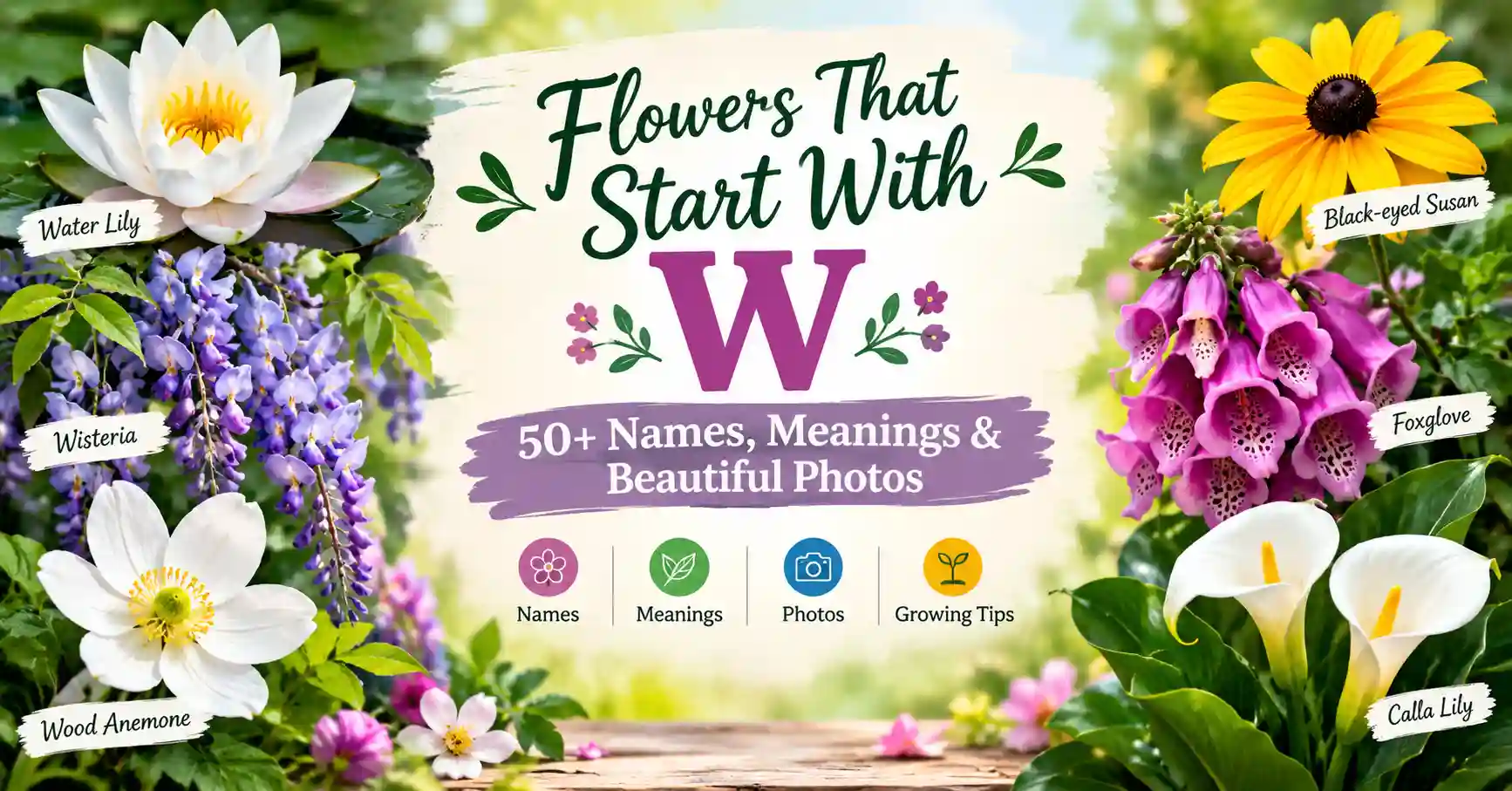
Flowers that start with W cover more range than a short list would suggest. Wisteria and water lily are the names most people already know. But the letter W also holds real surprises, like a Himalayan anemone and a shrub called wintersweet that blooms while snow is still on the ground. This guide brings all of them together in one place.
The list below runs past 50 names, and that number is not padding. Most W flower guides stop at 20 or 25 entries built around a handful of climbing vines and pond plants. This one goes further on purpose, covering garden staples, native wildflowers, shrubs, and rarer species that rarely make it onto a short list.
A long name list means little without context, though. A flower’s color means less if it can’t survive your climate, and a flower’s shape means less if it’s dangerous around a family pet.
Quick Answer: Ten Standout W Flowers
Wisteria is the obvious starting point, since its long, cascading purple clusters make it one of the most dramatic flowering vines a garden can hold. Water lily earns its spot as the pond centerpiece, floating on still water and opening fresh blooms through the warmer months. Wallflower and winter jasmine both solve a seasonal problem, bringing color to a garden in late winter and early spring when most other flowers are still dormant.
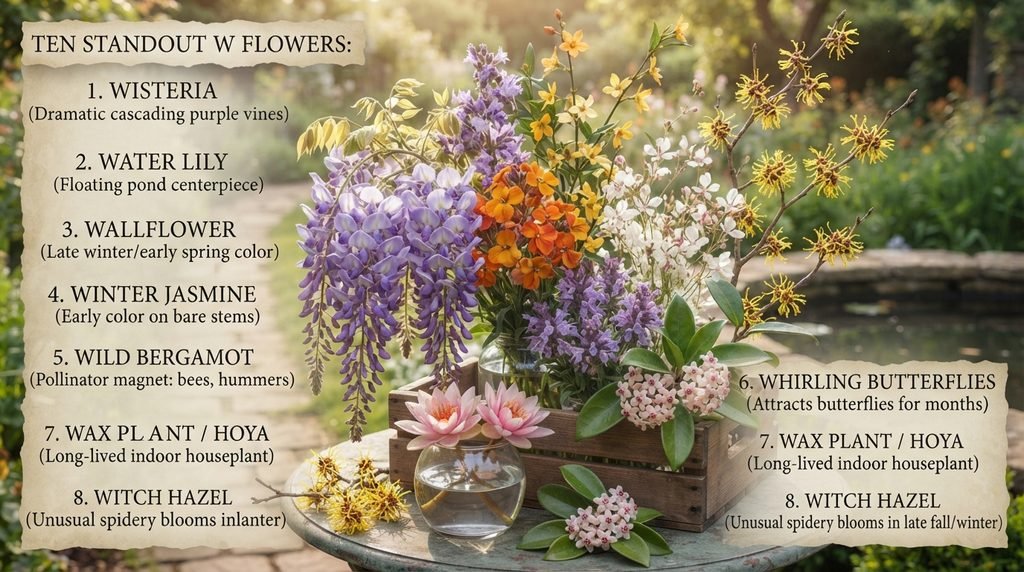
Wild bergamot and whirling butterflies are the pollinator magnets here, drawing bees, butterflies, and even hummingbirds for months at a stretch. Wax plant, better known as hoya, is the houseplant pick for anyone wanting a long-lived, low-maintenance flowering vine indoors. Witch hazel closes the list with a genuinely unusual trait: its spidery yellow blooms open in late fall or winter, on bare branches, when almost nothing else in the garden is flowering at all.
What W Flowers Mean
Flower symbolism rarely has one fixed answer, but a handful of W flowers carry meanings solid enough to show up consistently across old flower-language traditions and modern florist guides. Wisteria is closely tied to devotion and long life, a meaning that likely grew out of how long-lived and slow-maturing the vine actually is, sometimes taking years before its first full bloom. Water lily carries an older, more spiritual meaning in several cultures, associated with purity and rebirth because of how the flower rises clean from murky water.
Wallflower has picked up a double meaning worth knowing: in Victorian flower language, it represented faithfulness in adversity, a nod to its habit of growing out of old stone walls and rocky crevices where little else survives. Winter jasmine, blooming while much of the garden still looks bare, is often read as a symbol of hope and resilience through hard seasons.
Wild indigo, long used by Indigenous peoples across North America for dye and medicine, carries an association with protection and healing tied directly to that practical history. Witch hazel shares a similar practical root, its name and symbolism both connected to a long history of use in folk remedies and its odd habit of blooming when everything else has gone quiet for winter.
W Flowers Grouped by Color
Purple tones run through more of this letter than any other color, led by wisteria, wild indigo, and winecup, three plants that cover very different growth habits while sharing a similar rich purple range. Wisteria stands apart from the other two for sheer scale, since a mature vine can produce hundreds of flower clusters in a single spring.
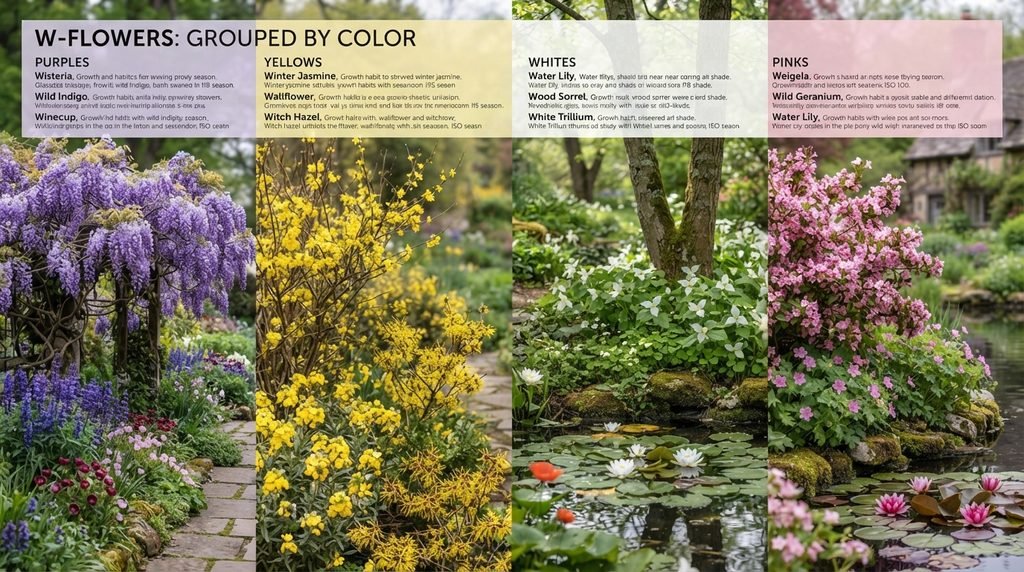
Yellow tones show up distinctly in wallflower, winter jasmine, and witch hazel, all three of which bloom during the colder months when a warm yellow accent stands out more than it would in a summer border already full of color. Witch hazel’s thin, ribbon-like petals give it a different texture than the rounder blooms of wallflower and winter jasmine.
White flowers that start with W lean toward water and fragrance. Water lily and water poppy both produce clean white or pale blooms suited to pond settings, while wood sorrel and white trillium bring a smaller, woodland version of that same white to shaded garden beds.
Pink and rose shades appear in weigela, wild geranium, and several water lily cultivars, giving softer texture than the bold purples and yellows above. Weigela is especially useful in this group since its trumpet-shaped blooms cover an entire shrub at once, making it a reliable color anchor for a spring border.
Garden Favorites Among Flowers That Start With W
Most home gardens lean on a small handful of reliable W flowers, and it’s worth naming a few before listing them out. Wisteria remains one of the most requested W flowers for anyone with a pergola, arbor, or fence needing a dramatic, long-term vine. Weigela holds its place as a garden favorite for a different reason: it blooms heavily for several weeks in late spring and needs almost no special care once established.
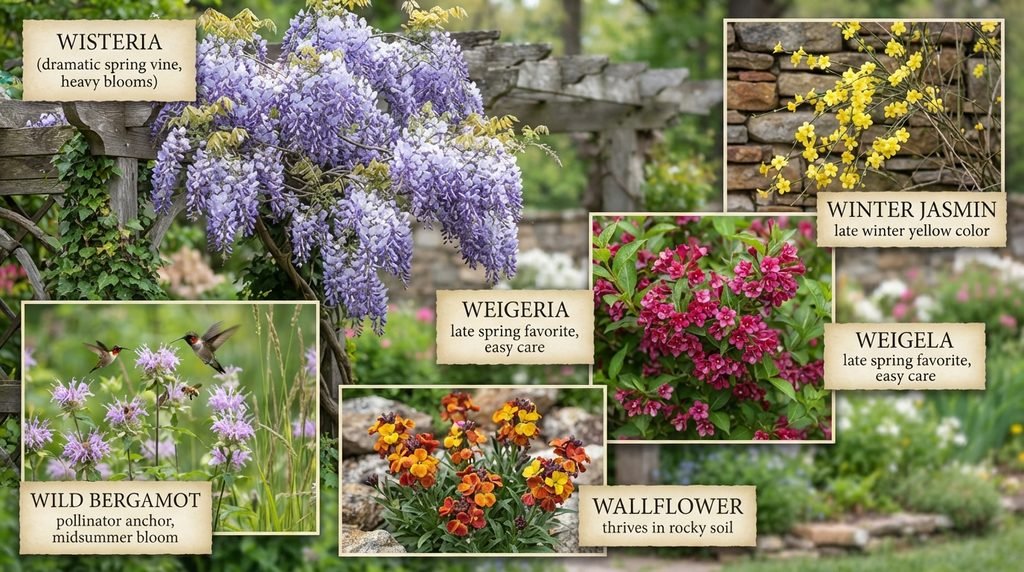
- Wisteria needs strong support and takes several years to reach full bloom, but rewards patience with dramatic spring color.
- Weigela blooms heavily in late spring and tolerates average soil without much fuss.
- Wild Bergamot draws pollinators reliably through summer and spreads well in a naturalized bed.
- Winter Jasmine brings yellow color in late winter, well before most shrubs wake up.
- Wallflower thrives in poor, rocky soil where richer beds would leave it leggy.
Winter jasmine and wallflower round out this list because both fill a seasonal gap that most other garden flowers can’t, bringing color to beds that would otherwise sit bare through the coldest stretch of the year.
Indoor Plants Among Flowers That Start With W
Indoor growing narrows the field considerably for this letter, but a couple of names cover most of what’s realistically available. Wax plant, commonly sold as hoya, is the clear standout, producing clusters of star-shaped, waxy blooms on a vine that can live and rebloom for decades with minimal care. Wax begonia is a gentler option for a sunny windowsill, flowering nearly continuously with simple, regular watering.
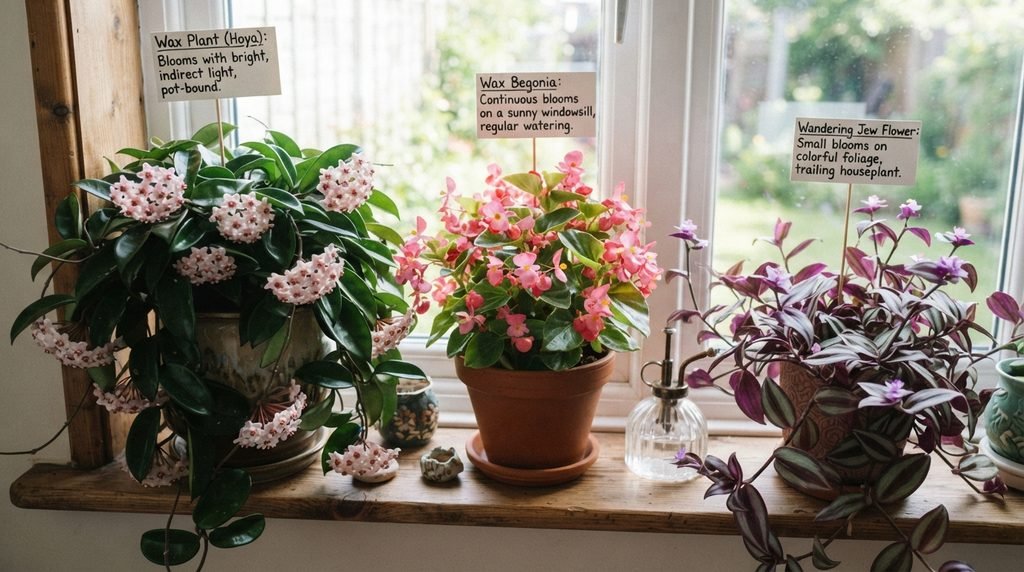
- Wax Plant (Hoya) blooms best when slightly pot-bound and given bright, indirect light.
- Wax Begonia flowers continuously indoors with regular watering and a sunny spot.
- Wandering Jew Flower produces small purple-pink blooms on a trailing houseplant grown mainly for its striped foliage.
Wandering Jew is included here mainly as a bonus, since most people grow it for its colorful leaves rather than its bloom, but the small flowers do appear regularly on a healthy, mature plant.
Florist Favorites Among Flowers That Start With W
Cut-flower work favors W blooms with strong stems, long vase life, or standout texture. Water lily rarely makes it into traditional arrangements since it closes once cut, but wax flower more than makes up for that gap, holding its small, star-shaped blooms for two weeks or longer in a vase. Whirling Butterflies, with its airy, fluttering white-pink blooms, is prized by florists specifically for the movement it adds to an otherwise structured arrangement.
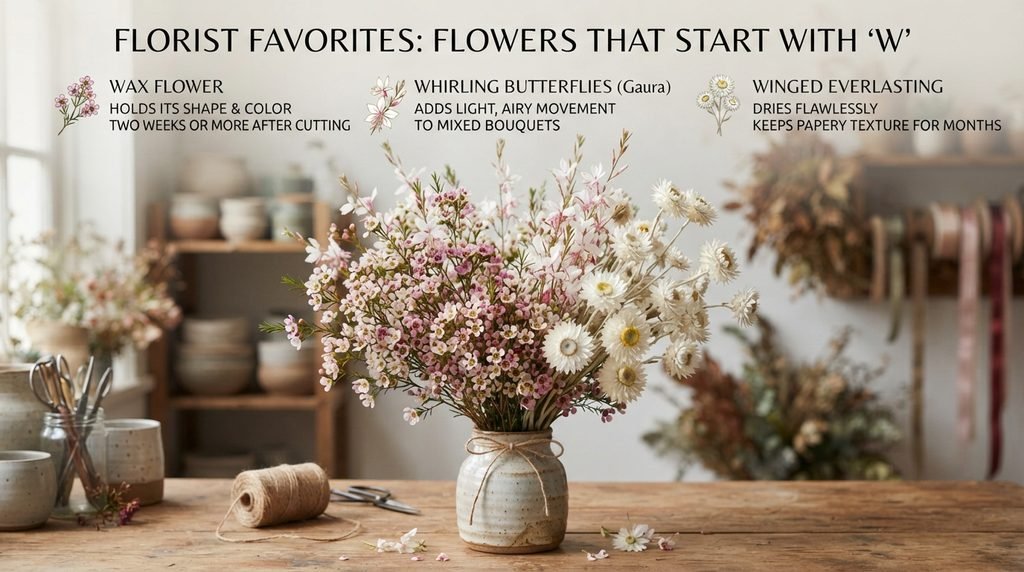
- Wax Flower holds its shape and color for two weeks or more once cut.
- Whirling Butterflies (Gaura) adds light, airy movement to mixed bouquets.
- Winged Everlasting dries well and keeps its papery texture for months.
Winged everlasting is worth a specific mention here, since it’s one of the few W flowers grown specifically for dried arrangements, keeping its pale, papery bracts long after the stem has been cut and hung to dry.
Rare Flowers That Start With W
A few W flowers rarely show up outside specialty growers or native plant collections. Wonga wonga vine, an Australian native with clusters of cream and maroon trumpet-shaped blooms, stays largely unknown outside its native range simply because it needs a mild, frost-free climate to thrive. Wallich’s anemone, a Himalayan wildflower with large white blooms tinged blue on the reverse side, is rarely sold commercially and is more often documented by alpine plant specialists than planted in an ordinary garden.
Wood lily pushes this rarity further in a different way, since it’s a slow-growing native species that’s become uncommon in the wild due to habitat loss, making nursery-grown stock the only responsible way to add it to a garden. White snakeroot shares that same overlooked status, more often noticed as a woodland wildflower than deliberately planted, despite its clean white late-summer blooms. All four species share one trait: none of them tolerate rushed or generic growing conditions, which is part of why they’ve stayed uncommon.
Caution: Toxic Flowers That Start With W
Several W flowers carry real toxicity risks, and getting this section right matters more than any other part of this guide. Wisteria seeds and pods contain compounds that can cause serious vomiting and stomach upset if eaten in quantity, even though the flower itself poses little risk. Wolfsbane, a close relative of monkshood, is far more dangerous, containing aconitine throughout the entire plant and capable of causing severe poisoning in humans and pets alike.
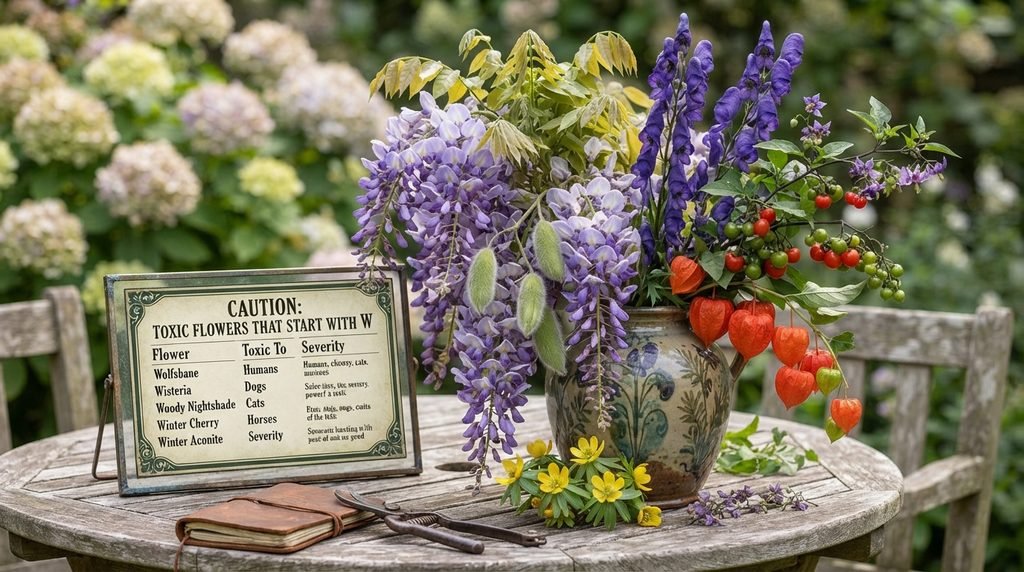
| Flower | Toxic To | Severity |
| Wolfsbane (Aconitum) | Humans, dogs, cats, horses | Severe — all parts, can be fatal |
| Wisteria (seeds/pods) | Dogs, cats, humans | Moderate — seeds and pods are the risky part |
| Woody Nightshade | Dogs, cats, humans | Moderate — unripe berries especially risky |
| Winter Cherry (Chinese Lantern) | Dogs, cats | Mild to moderate — unripe berries and foliage |
| Winter Aconite | Dogs, cats, horses | Moderate — cardiac-affecting compounds |
Wolfsbane deserves the strongest warning on this list, since even small amounts have caused serious poisoning cases, and it should never be planted where children play or pets roam unsupervised. Wisteria, by contrast, poses a much lower everyday risk, since the flower clusters themselves are safe to touch and only the seed pods that follow later in the season carry real toxicity concerns.
Life-Cycle Groupings for Flowers That Start With W
Knowing whether a W flower is an annual, perennial, or woody plant changes how it should be planted and budgeted for. Perennials and shrubs dominate this letter more than annuals do, which makes sense given how many W flowers are long-lived vines, woodland natives, or flowering shrubs rather than fast bedding plants. Wisteria sits in a category of its own, technically a perennial vine but one that can take several years to mature enough to bloom reliably.
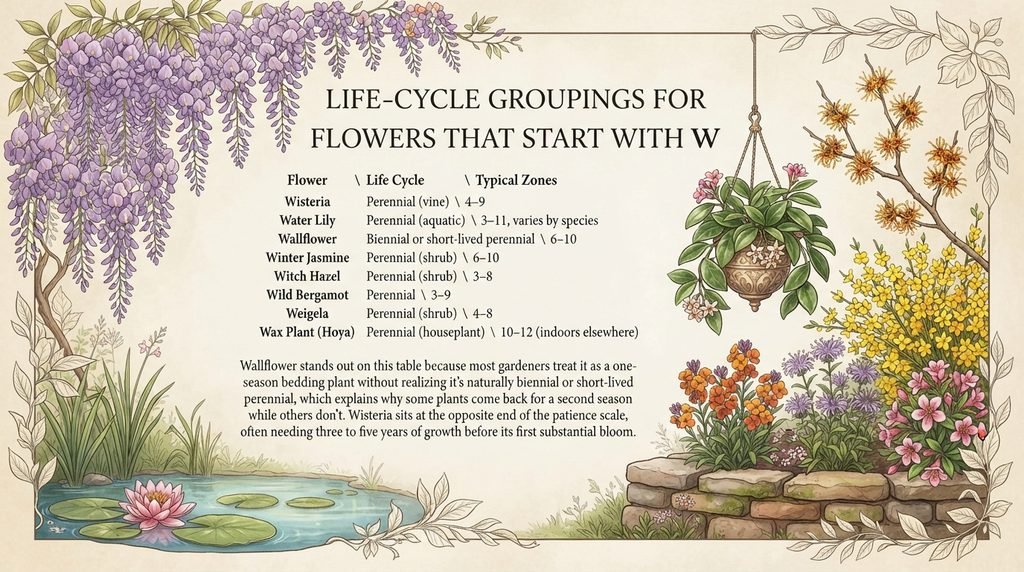
| Flower | Life Cycle | Typical Zones |
| Wisteria | Perennial (vine) | 4–9 |
| Water Lily | Perennial (aquatic) | 3–11, varies by species |
| Wallflower | Biennial or short-lived perennial | 6–10 |
| Winter Jasmine | Perennial (shrub) | 6–10 |
| Witch Hazel | Perennial (shrub) | 3–8 |
| Wild Bergamot | Perennial | 3–9 |
| Weigela | Perennial (shrub) | 4–8 |
| Wax Plant (Hoya) | Perennial (houseplant) | 10–12 (indoors elsewhere) |
Wallflower stands out on this table because most gardeners treat it as a one-season bedding plant without realizing it’s naturally biennial or a short-lived perennial, which explains why some plants come back for a second season while others don’t. Wisteria sits at the opposite end of the patience scale, often needing three to five years of growth before its first substantial bloom.
Master Alphabetical List of Flowers That Start With W
The list below covers more than 50 flowers that start with W, mixing well-known common names with entries more often searched under their botanical name. Common names come first wherever one exists; less familiar species are listed under the botanical name most nurseries actually use on their tags.
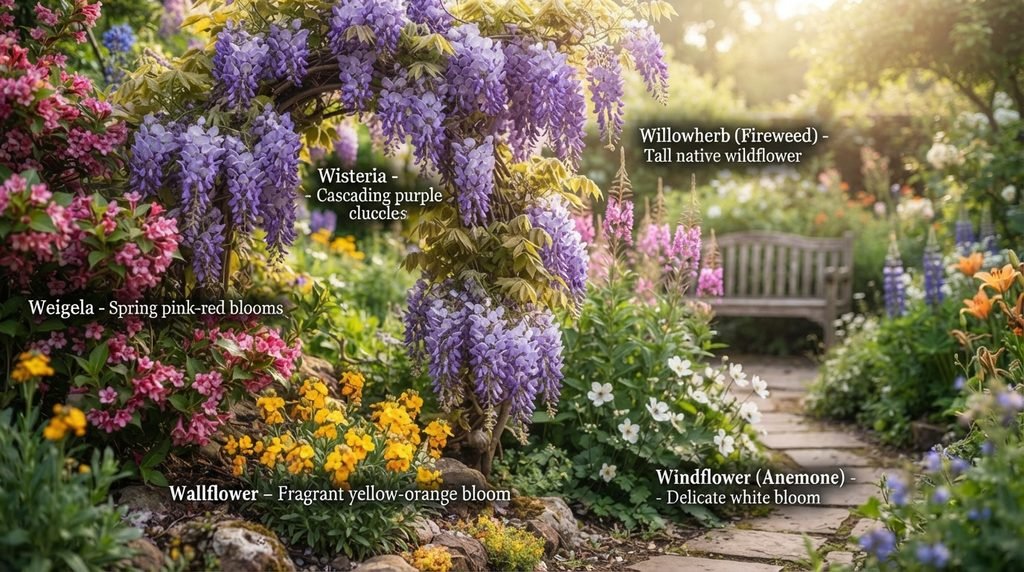
| Flower | Botanical Name | Note |
| Wallflower | Erysimum cheiri | Fragrant yellow-orange bloom, thrives in rocky soil |
| Wallich’s Anemone | Anemone wallichii | Large white Himalayan wildflower |
| Walking Iris | Neomarica gracilis | Blue-white bloom, plantlets form at flower tips |
| Wandflower | Dierama pulcherrimum | Arching stems with bell-shaped pink blooms |
| Wandering Jew Flower | Tradescantia zebrina | Small purple bloom on striped trailing foliage |
| Water Hyacinth | Eichhornia crassipes | Floating aquatic plant, lavender bloom spike |
| Water Lily | Nymphaea spp. | Classic floating pond bloom in many colors |
| Water Poppy | Hydrocleys nymphoides | Small yellow floating pond bloom |
| Waterlily Tulip | Tulipa kaufmanniana | Early spring bulb, star-shaped open bloom |
| Watsonia | Watsonia spp. | Tall spiked bloom, South African native |
| Wax Begonia | Begonia semperflorens | Continuous small pink, red, or white bloom |
| Wax Flower | Chamelaucium uncinatum | Small star-shaped bloom, long vase life |
| Wax Plant (Hoya) | Hoya carnosa | Waxy star-shaped cluster, long-lived vine |
| Weeping Cherry Blossom | Prunus subhirtella ‘Pendula’ | Cascading pink spring blossom on a tree |
| Weigela | Weigela florida | Trumpet-shaped pink-red spring bloom |
| Whirling Butterflies (Gaura) | Oenothera lindheimeri | Airy white-pink fluttering summer bloom |
| White Snakeroot | Ageratina altissima | Clustered small white late-summer bloom |
| White Trillium | Trillium grandiflorum | Large white three-petaled woodland bloom |
| Whorled Milkweed | Asclepias verticillata | Small white bloom, narrow whorled leaves |
| Widow’s Tears | Commelina erecta | Small blue three-petaled bloom |
| Wild Bergamot | Monarda fistulosa | Shaggy lavender bloom, pollinator favorite |
| Wild Geranium | Geranium maculatum | Soft pink-purple native woodland bloom |
| Wild Indigo | Baptisia australis | Tall blue-purple spiked native bloom |
| Wild Lupine | Lupinus perennis | Blue-purple spiked native wildflower |
| Wild Petunia | Ruellia humilis | Small lavender trumpet-shaped native bloom |
| Wild Rose | Rosa acicularis | Simple pink five-petaled wild bloom |
| Wild Sweet William | Phlox maculata | Fragrant pink-purple clustered native bloom |
| Willowherb (Fireweed) | Epilobium angustifolium | Tall pink-purple spiked wildflower |
| Windflower (Anemone) | Anemone spp. | Delicate cup-shaped bloom in many colors |
| Windmill Palm Bloom | Trachycarpus fortunei | Small cream flower clusters on a hardy palm |
| Winecup (Poppy Mallow) | Callirhoe involucrata | Deep magenta cup-shaped native bloom |
| Winged Everlasting | Ammobium alatum | Papery white bloom, popular dried flower |
| Winter Aconite | Eranthis hyemalis | Bright yellow bloom, one of the earliest of the year |
| Winter Cherry (Chinese Lantern) | Physalis alkekengi | Orange papery husk around a small bloom and berry |
| Winter Cyclamen | Cyclamen coum | Small pink-purple bloom over patterned leaves |
| Winter Jasmine | Jasminum nudiflorum | Bright yellow bloom on bare winter branches |
| Winter Rose (Hellebore) | Helleborus niger | White-pink nodding bloom in late winter |
| Wintersweet | Chimonanthus praecox | Fragrant pale yellow bloom on bare winter branches |
| Wishbone Flower | Torenia fournieri | Shade-tolerant purple and yellow bloom |
| Wisteria | Wisteria sinensis | Long cascading purple flower clusters |
| Witch Hazel | Hamamelis virginiana | Spidery yellow bloom on bare fall or winter branches |
| Wolfsbane (Aconite) | Aconitum lycoctonum | Highly toxic; hooded purple-yellow spiked bloom |
| Wonga Wonga Vine | Pandorea pandorana | Cream and maroon trumpet-shaped tropical bloom |
| Wood Anemone | Anemone nemorosa | Small white woodland spring bloom |
| Wood Lily | Lilium philadelphicum | Upward-facing orange-red native lily bloom |
| Wood Sorrel | Oxalis acetosella | Small white-pink bloom above clover-like leaves |
| Woodbine (Honeysuckle) | Lonicera periclymenum | Fragrant tubular pink-yellow climbing bloom |
| Woodland Phlox | Phlox divaricata | Fragrant lavender-blue woodland spring bloom |
| Woodruff (Sweet Woodruff) | Galium odoratum | Tiny white star-shaped groundcover bloom |
| Woody Nightshade | Solanum dulcamara | Purple star-shaped bloom, toxic berries follow |
| Woolflower (Celosia) | Celosia argentea var. cristata | Dense, textured plume or crest-shaped bloom |
Botanical Name Crosswalk
Nurseries and plant tags don’t always use common names, and a mismatch here is an easy way to bring home the wrong plant. The table below matches the most-searched common names to their correct botanical genus and species.
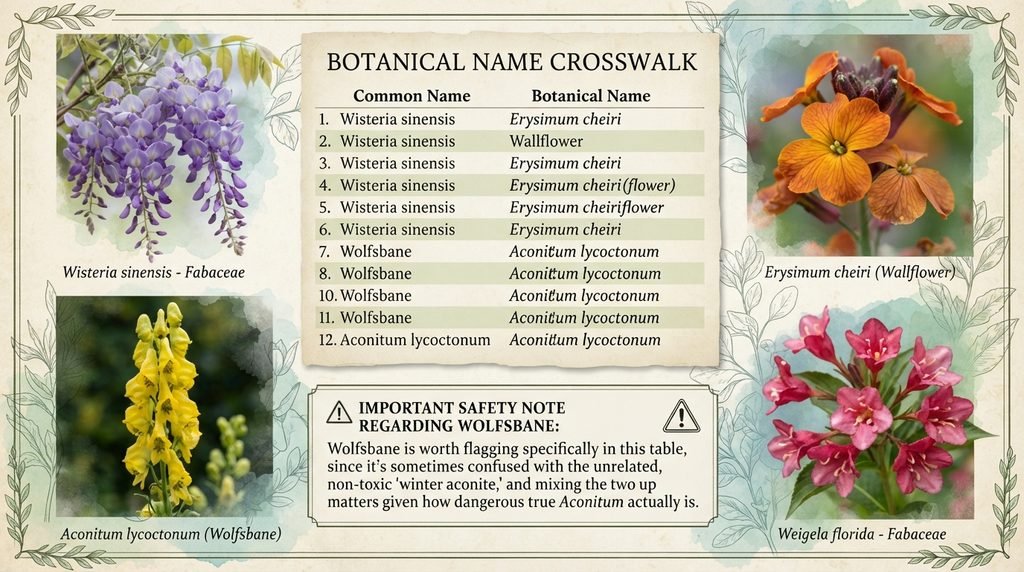
| Common Name | Botanical Name |
| Wisteria | Wisteria sinensis |
| Water Lily | Nymphaea spp. |
| Wallflower | Erysimum cheiri |
| Witch Hazel | Hamamelis virginiana |
| Winter Jasmine | Jasminum nudiflorum |
| Wolfsbane | Aconitum lycoctonum |
| Wild Bergamot | Monarda fistulosa |
| Wax Plant | Hoya carnosa |
| Weigela | Weigela florida |
| Wintersweet | Chimonanthus praecox |
| Wishbone Flower | Torenia fournieri |
| Woody Nightshade | Solanum dulcamara |
Full Comparison Table: Sun, Water, and Bloom Time
Choosing between two or three W flowers usually comes down to matching sun exposure and watering needs to the space available. The table below lines up the flowers featured throughout this guide so those comparisons take seconds instead of separate lookups.
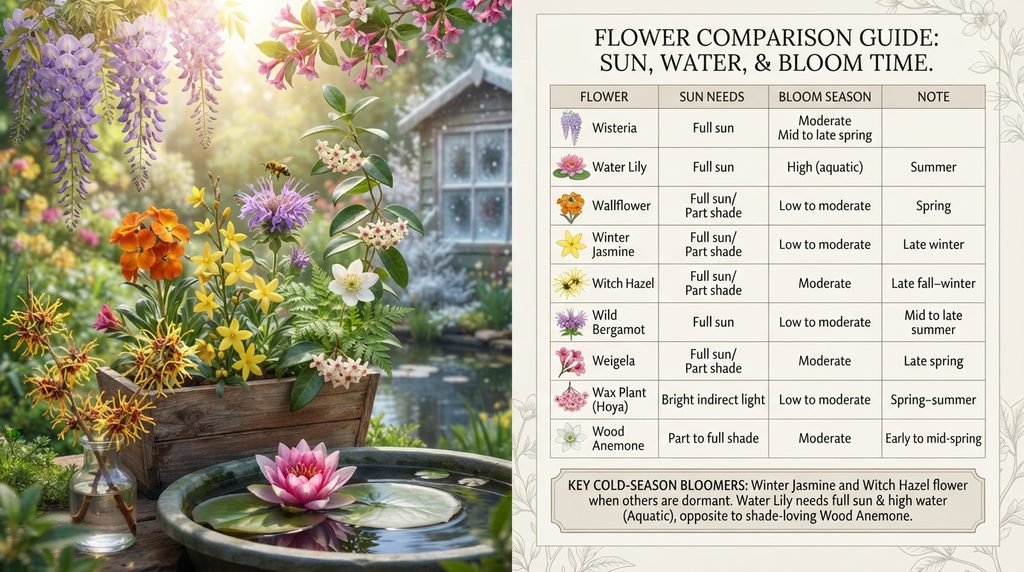
| Flower | Sun Needs | Water Needs | Bloom Season |
| Wisteria | Full sun | Moderate | Mid to late spring |
| Water Lily | Full sun | High (aquatic) | Summer |
| Wallflower | Full sun to part shade | Low to moderate | Spring |
| Winter Jasmine | Full sun to part shade | Low to moderate | Late winter |
| Witch Hazel | Full sun to part shade | Moderate | Late fall–winter |
| Wild Bergamot | Full sun | Low to moderate | Mid to late summer |
| Weigela | Full sun to part shade | Moderate | Late spring |
| Wax Plant (Hoya) | Bright indirect light | Low to moderate | Spring–summer (mature plants) |
| Wood Anemone | Part to full shade | Moderate | Early to mid-spring |
Water lily sits at the opposite end, needing standing water and full sun that would be completely wrong for a shade-loving entry like wood anemone.
Decision Table: Which W Flower Fits Your Situation
Matching a flower to a specific goal is often faster than browsing an entire list. The table below sorts common gardening goals against the W flowers best suited to solve them.
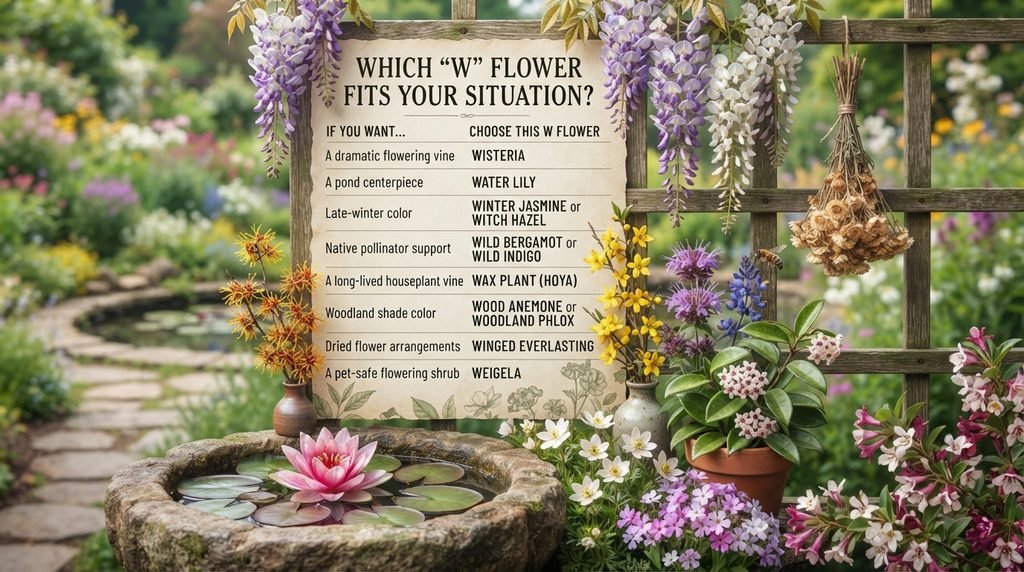
| If You Want… | Choose This W Flower |
| A dramatic flowering vine | Wisteria |
| A pond centerpiece | Water Lily |
| Late-winter color | Winter Jasmine or Witch Hazel |
| Native pollinator support | Wild Bergamot or Wild Indigo |
| A long-lived houseplant vine | Wax Plant (Hoya) |
| Woodland shade color | Wood Anemone or Woodland Phlox |
| Dried flower arrangements | Winged Everlasting |
| A pet-safe flowering shrub | Weigela |
Wisteria and water lily cover the two most dramatic, high-impact choices on this list, one built for vertical structures and the other built for standing water.
Conclusion
Flowers that start with W cover more ground than the short lists most people picture, running from the familiar wisteria to rarer finds like wonga wonga vine and Wallich’s anemone. This guide organizes more than 50 of them by color, life cycle, and use case specifically so the list would be usable, not just long. Whether the goal is a dramatic flowering vine, a pond centerpiece, or a shrub that blooms through winter, there’s a flower that starts with W suited to the job, and the tables above should make finding it a matter of minutes rather than hours.
Frequently Asked Questions
How many flowers start with W?
More than 50 common and botanically recognized flowers start with W, ranging from familiar vines like wisteria to rarer native and specialty species.
What is the most popular flower that starts with W?
Wisteria is among the most widely recognized flowers that start with W, prized for its dramatic, cascading purple flower clusters.
Is wisteria toxic to pets?
The flowers themselves pose low risk, but wisteria seeds and pods contain compounds that can cause serious stomach upset if eaten in quantity.
What W flower blooms in winter?
Witch hazel and winter jasmine are the standout winter bloomers among flowers that start with W, both flowering when most other plants are dormant.
Can wax plant (hoya) be grown indoors year-round?
Yes, wax plant thrives indoors year-round with bright, indirect light and blooms best when its roots are slightly crowded in the pot.
What does wisteria symbolize?
Wisteria is widely associated with devotion and long life, a meaning tied to how slow-growing and long-lived the vine actually is.
Which W flowers are dangerous to grow around pets?
Wolfsbane is the most dangerous, capable of causing severe poisoning in humans and pets, while wisteria seeds and woody nightshade berries carry moderate risks.
How long does it take wisteria to bloom?
Wisteria often takes three to five years to produce its first significant bloom, especially when grown from seed rather than a grafted nursery plant.
What’s the difference between wallflower and winter jasmine?
Wallflower is a low, biennial bedding plant with fragrant yellow-orange blooms, while winter jasmine is a shrub that produces bright yellow flowers on bare branches in late winter.