Flowers That Start With R: 90 Names, Meanings & Beautiful Photos
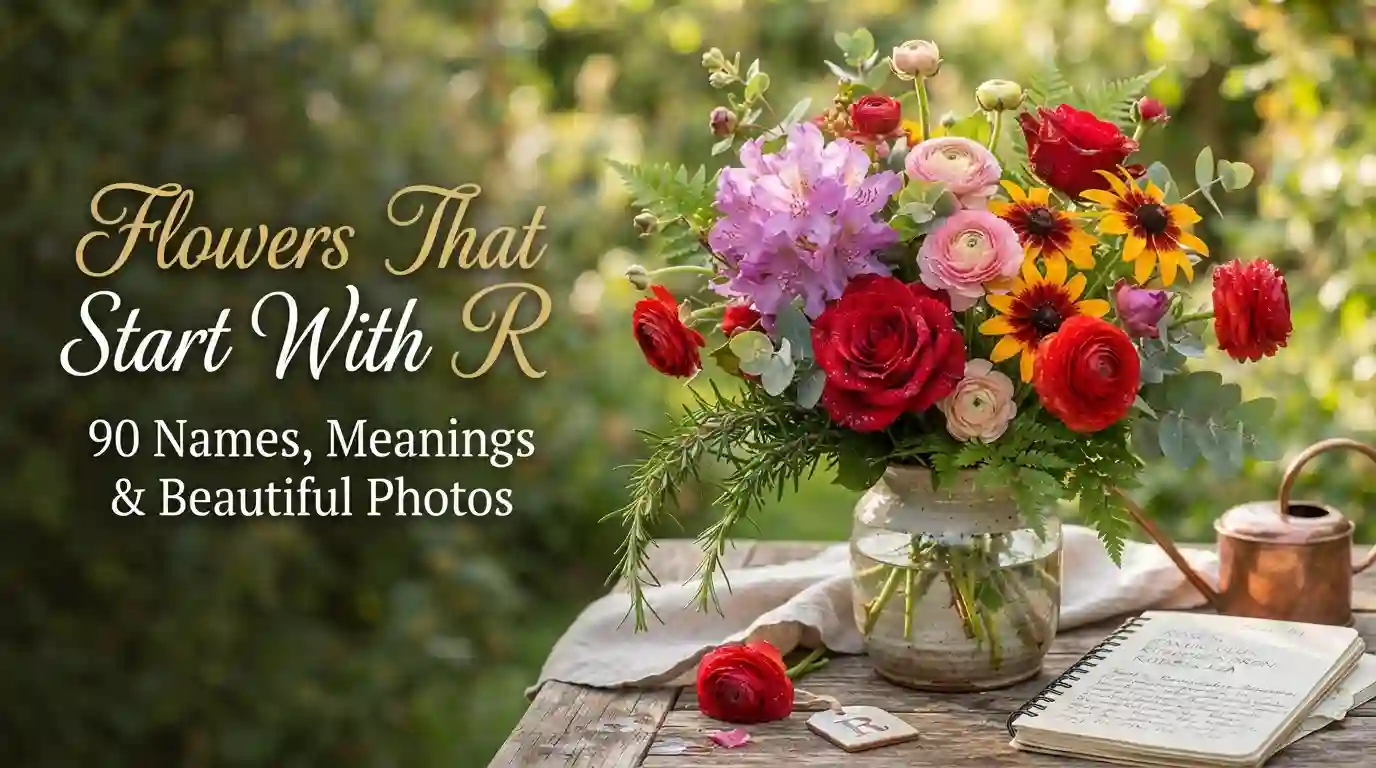
Flowers that start with R are one of the most popular lists in the garden world. Rose is the name most folks know first. Rhododendron blooms boldly in spring. Ranunculus gives a layered, rose-like look in a vase. This guide covers ninety real names in all.
This guide helps a few kinds of readers. Some want to name a bloom they saw. Some want a new plant for a bed. This guide helps with each need.
The order here follows real use. It does not just run A to Z. Garden picks come first. Indoor picks and florist picks come next. Then come rare finds. Then come flowers that need care. After that, you get quick tools. You get a full name list. You get a growing chart. The full A to Z list sits near the end.
Every flower here is real. We checked each home range. We checked each risk. Some plants often placed at this letter got left out. If the bloom is not the main reason to grow the plant, it did not make the list.
Top R-Flowers to Know First
Anyone who looks up flowers that start with R meets these names first, and this section covers the ten most useful ones to know. Rose leads the group. It comes in more shades and shapes than most flowers on Earth. Rhododendron comes next. Its spring bloom can fill a whole shaded bed with color. Ranunculus gives a full, layered bloom that holds up for weeks in a vase.
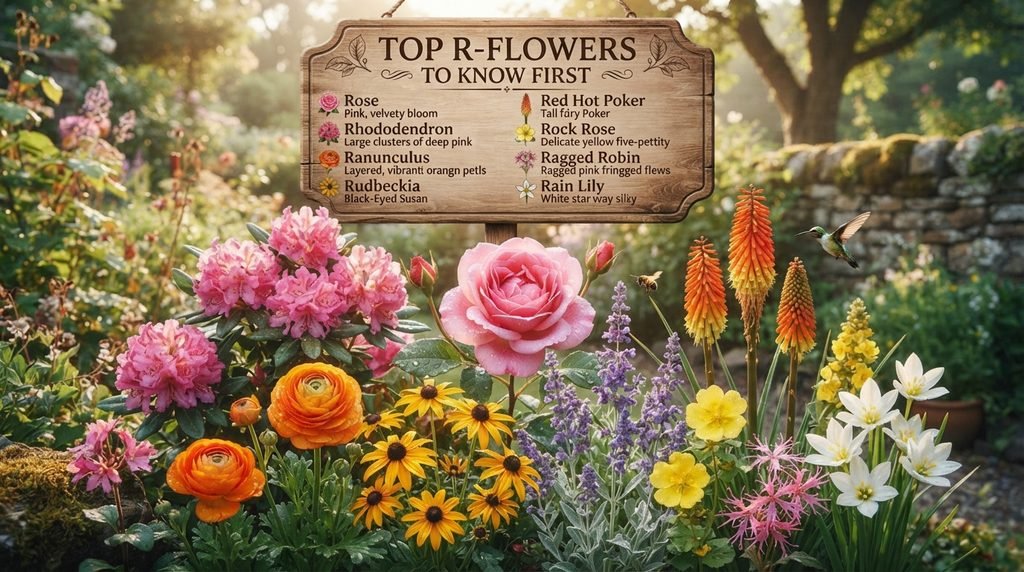
Rudbeckia, often called Black-Eyed Susan, draws bees for months with little care. Russian Sage takes the heat and dry soil well, asking for almost nothing once set in place. Red Hot Poker sends up bold, bright spikes that draw hummingbirds all summer. Rock Rose thrives in poor, dry ground where fussier plants would fail. Ragged Robin brings soft pink, fringed blooms to a damp spring bed. Rain Lily surprises gardeners with sudden blooms right after a good rain.
What These Blooms Have Meant Over Time
Flower meanings still shape real choices. People pick blooms for weddings. They pick blooms for gifts. They often do not know why a bloom feels right. But it does. The rose has long stood for love in nearly every culture that grows it. Red roses, in most cases, have become a near-global sign of deep, romantic love.
Rhododendron carries a mixed old story. In some places, it stood for danger, tied to its real toxic risk. In parts of the Himalayas, where it grows wild, it stands for new life each spring instead. Ranunculus, in old flower talk, stood for bright charm, a link drawn from its full, glowing petal form.
Rosemary is grown more for scent than bloom. Still, it has long been tied to memory and true love. Old wedding customs once had brides wear it in their hair.
Grouping R-Flowers by Color
Color often narrows a search faster than a name does. Red and pink rule a large share of this list, most of all in Rose, Ranunculus, and Rhododendron. This range feels bold and warm, a strong pick for a bed that wants a clear focal shade.
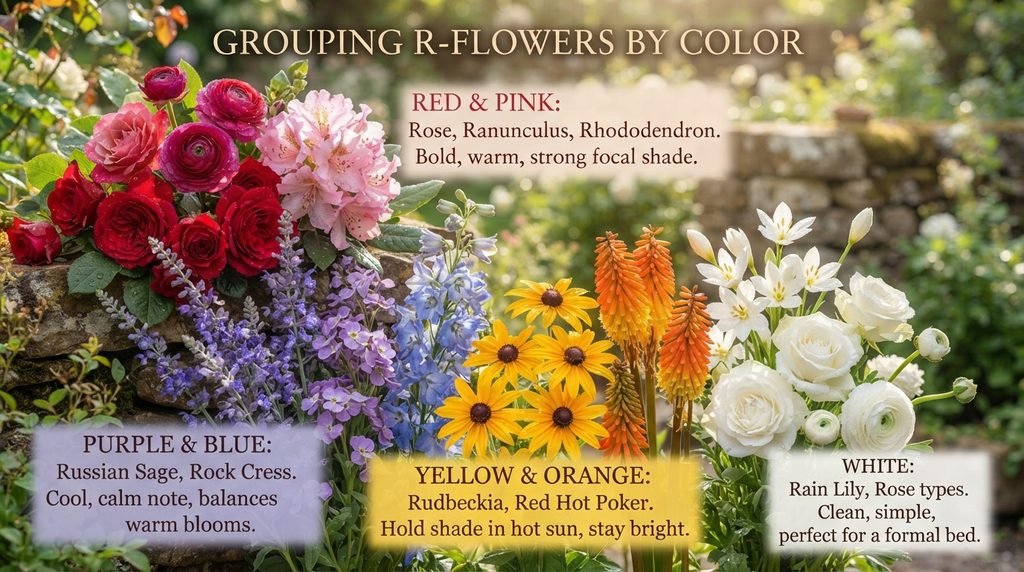
Purple and blue show up in Russian Sage and Rock Cress. Both bring a cool, calm note that works well next to bolder, warmer blooms nearby. Yellow and orange show up in Rudbeckia and Red Hot Poker. Both hold their shade well in hot sun, staying bright long after paler blooms have faded.
White shows up less at this letter, but Rain Lily and some Rose types bring it in. This shade feels clean and simple, a good pick for a formal bed.
Solid Picks for the Garden
Among all the flowers that start with R, a few earn a real spot in home yards, plain and simple. Rudbeckia blooms fast and keeps going for months, asking for little care once set in the ground. Russian Sage shares that same low-fuss nature, thriving in hot, dry spots where many plants fail. Rock Rose adds to this group with real drought skill, growing best in soil most other blooms would reject.
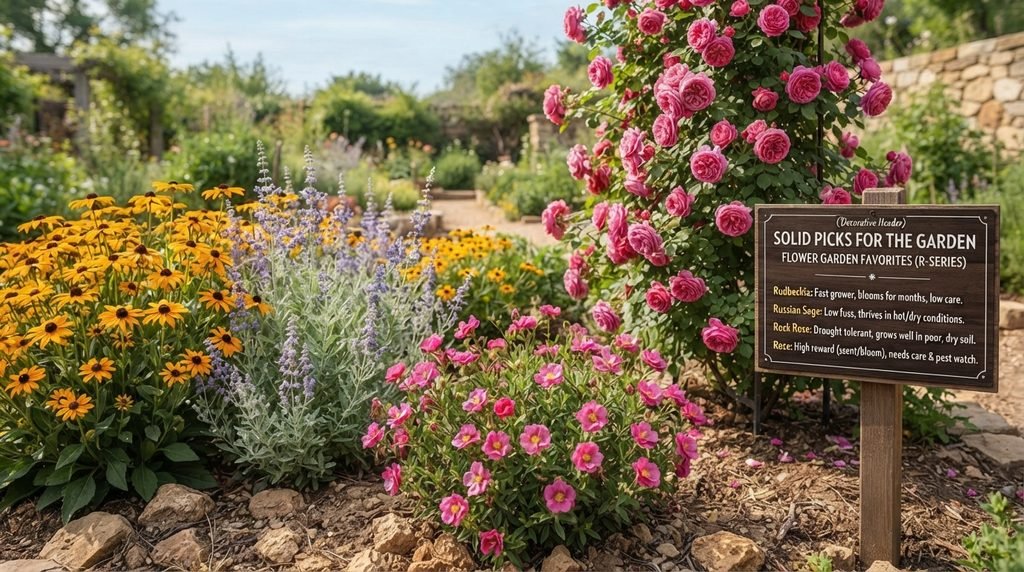
Rose asks for a bit more. It wants regular care and a close eye for pests. Still, its long bloom season makes the extra work worth it for most growers.
| Flower | Sun Needs | Soil Type | Typical Height |
| Rudbeckia | Full sun | Well-drained soil | 2–3 feet |
| Russian Sage | Full sun | Well-drained soil | 3–4 feet |
| Rock Rose | Full sun | Dry, well-drained soil | 2–3 feet |
| Rose | Full sun | Rich, well-drained soil | 2–6 feet |
Rock Rose stands out here for how little it asks, since rich soil can work against it. Rose sits at the other end of this table. It needs more care than the rest, but few flowers match its scent and bloom range.
R-Flowers for Indoor Growing
A few R-flowers do well indoors, though most on this list live outside. Rhipsalis is a trailing cactus with tiny star-shaped blooms. It makes a fine hanging houseplant. It grows well in low light and needs little water. Regal Pelargonium is close kin to the garden geranium. It can bloom well on a bright sill. It gives bold, ruffled flowers for weeks at a time.
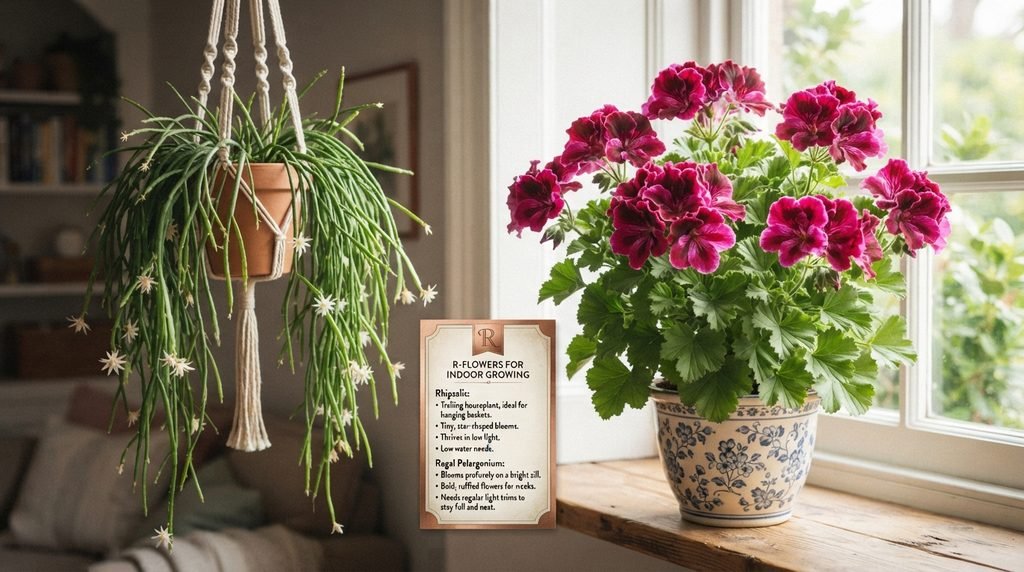
- Rhipsalis — trailing houseplant; grows well in low light with little water
- Regal Pelargonium — blooms well on a bright sill; needs regular light trims to stay full
Rhipsalis asks for almost no care once it settles in. Regal Pelargonium wants a bit more care. It can grow leggy fast. A light trim every so often keeps its shape neat.
What Florists Reach For
Cut flowers are a common way people meet this letter. Rose tops the list by a wide gap. Growers prize it for its scent, its long vase life, and its huge range of shades. Ranunculus follows close behind. Growers value its full, layered bloom. It holds its shape for two weeks or more in a vase. Red Ginger, though less common in shops, brings bold, tropical color to a themed bunch.
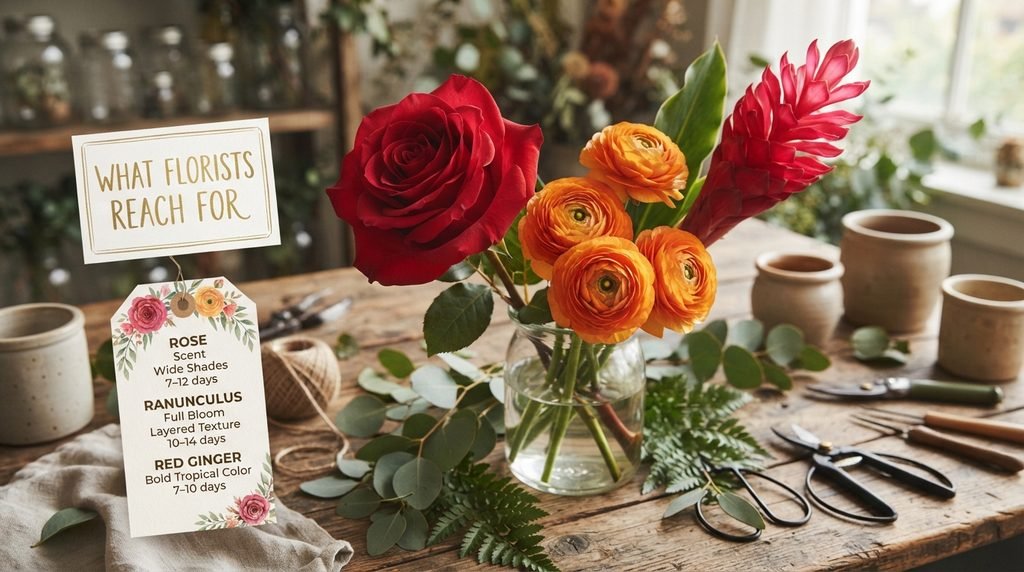
| Flower | Vase Life | Main Use |
| Rose | 7–12 days | Focal bloom, scent, wide color range |
| Ranunculus | 10–14 days | Focal bloom, layered petal texture |
| Red Ginger | 7–10 days | Tropical accent, bold color |
Ranunculus lasts longer than Rose in most cases. That is a big reason florists lean on it for pieces that need to hold up a full week or more. Red Ginger trades some of that vase life for a bold, tropical look few other cut flowers can match.
Harder-to-Find R-Flowers
A few R-flowers are hard to find outside small growers. Rothschild Slipper Orchid is one of the rarest orchids on Earth. It grows wild in just a small patch of Borneo. It can take fifteen years to bloom from seed. Royal Bluebell is the floral emblem of the Australian Capital Territory. It stays rare in trade. It needs cool, high-elevation air that few home yards can copy. Rock Harlequin is a small woodland wildflower with pink and yellow blooms. It grows in rocky, shaded spots. It rarely gets sold at a normal nursery.
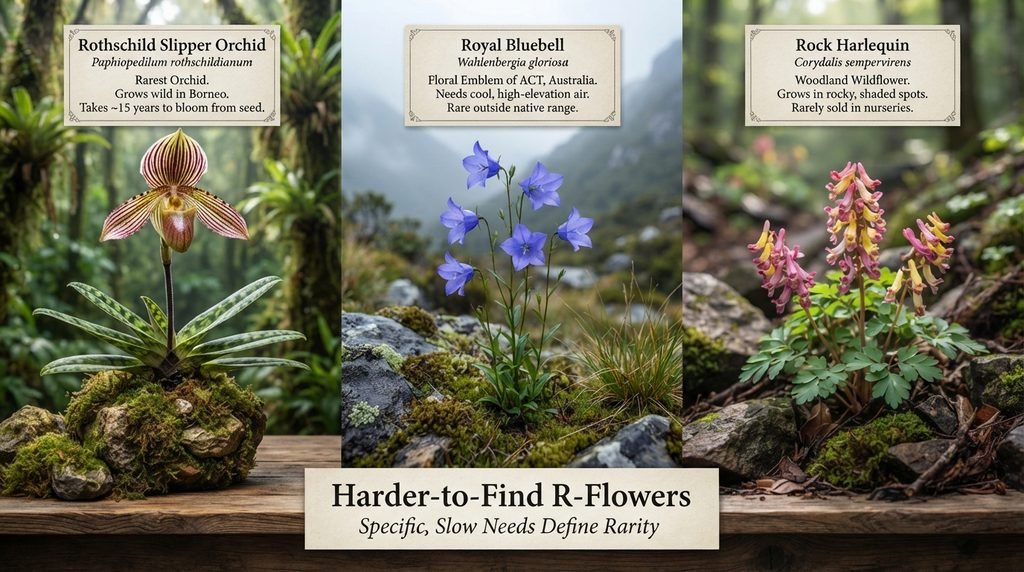
- Rothschild Slipper Orchid — grows wild in a small patch of Borneo; can take fifteen years to bloom
- Royal Bluebell — needs cool, high-elevation air; rare outside its native range
- Rock Harlequin — a woodland wildflower; grows in rocky shade and rarely sold in stores
What links these three is not rarity alone. It is how specific, or how slow, their needs really are. None are truly hard to grow once you meet those needs. Few yards meet those needs by chance, which is why they stay uncommon.
Where to Use Care
A few R-flowers carry real risk. This matters most in homes with pets or small kids. Rhododendron tops this list. Every part of the plant holds a compound called grayanotoxin. It can harm the heart. This is true if a person, a pet, or farm stock eats it. Ragwort holds toxins too. This is most of all a risk to grazing animals, like horses and cattle. They can eat it by mistake in a hay field.
Red Spider Lily is much like other Lycoris bulbs. It stores toxins. If a pet digs one up and chews it, this can cause vomiting and stomach pain. Rue holds a sap that can cause a real skin rash after contact with strong sun. This risk is much like the one seen with Queen Anne’s Lace.
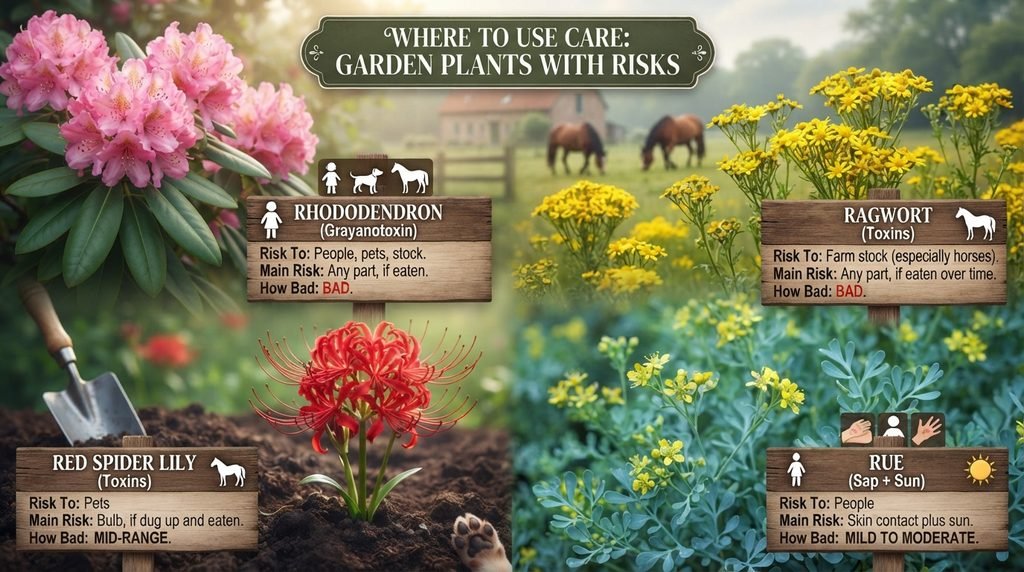
| Flower | Risk To | Main Risk | How Bad |
| Rhododendron | People, pets, farm stock | Any part, if eaten | Bad |
| Ragwort | Farm stock, most of all horses | Any part, if eaten over time | Bad |
| Red Spider Lily | Pets | Bulb, if dug up and eaten | Mid-range |
| Rue | People | Skin contact plus sun | Mild to moderate |
Rhododendron and Ragwort both need real care in a yard with farm stock nearby. Ragwort poses a slow, building risk most of all. Horses that eat small amounts over time can build up real harm. Rue is a milder case, tied mainly to skin contact rather than eating the plant.
Planning by Bloom Cycle
Some blooms live one year. Some come back on their own. This fact shapes how you plan a bed. Rudbeckia and Russian Sage come back on their own for years, trading some yearly change for far less work. Rose, as a woody shrub, comes back and blooms for decades once well placed.
Bulbs run on their own clock. Rain Lily and Red Spider Lily both grow slowly under the soil and return each year with little care.
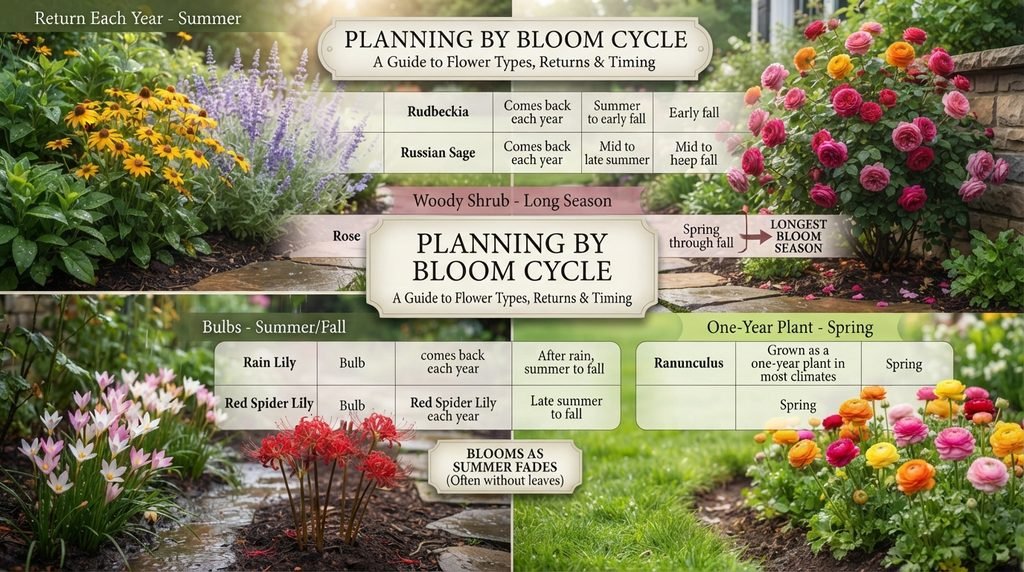
| Flower | Type | Bloom Time |
| Rudbeckia | Comes back each year | Summer to early fall |
| Russian Sage | Comes back each year | Mid to late summer |
| Rose | Woody shrub, comes back for years | Spring through fall |
| Rain Lily | Bulb, comes back each year | After rain, summer to fall |
| Red Spider Lily | Bulb, comes back each year | Late summer to fall |
| Ranunculus | Grown as a one-year plant in most climates | Spring |
Rose carries the longest bloom season on this table. It often flowers from spring clear through fall, with the right care. Red Spider Lily closes out the year. It often blooms with almost no leaves in sight, right as summer fades into fall.
Every R-Flower Name, A to Z
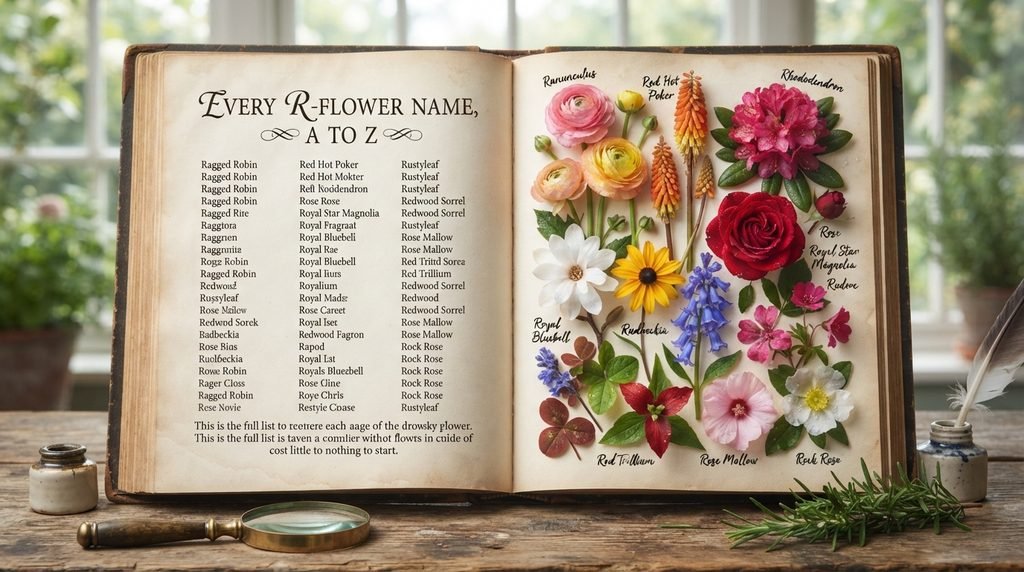
This is the full list of flowers that start with R in this guide. It counts ninety real names in all, including species-level names next to common group names. Most entries use the common name first, since that is how most folks search for a plant.
- Ragged Robin
- Ragwort
- Rain Daisy
- Rain Lily
- Rambling Rose
- Ranunculus (Persian Buttercup)
- Red Buckeye Blossom
- Red Campion
- Red Clover
- Red Columbine
- Red Ginger
- Red Hot Poker (Kniphofia)
- Red Maids
- Red Ribbons
- Red Sage
- Red Spider Lily
- Red Trillium
- Red Valerian
- Red Yucca
- Redbud Blossom
- Redwood Sorrel
- Reed Orchid
- Regal Lily
- Regal Pelargonium
- Resurrection Lily
- Rhipsalis
- Rhodanthe (Paper Daisy)
- Rhododendron
- Rice Flower
- Rice Paper Plant Flower
- Robin’s Plantain
- Rock Cress (Aubrieta)
- Rock Daisy
- Rock Fumewort
- Rock Harlequin
- Rock Hibiscus
- Rock Jasmine
- Rock Larkspur
- Rock Penstemon
- Rock Rose (Cistus)
- Rock Soapwort
- Rockfoil (Saxifrage)
- Rocket Larkspur
- Rocktrumpet
- Rocky Mountain Bee Plant
- Rocky Mountain Columbine
- Rocky Mountain Iris
- Rocky Mountain Penstemon
- Rodgersia
- Roman Chamomile
- Rondeletia (Panama Rose)
- Rooibos Flower
- Rose
- Rose Campion
- Rose Mallow
- Rose of Sharon
- Rose Vervain
- Roselle
- Rosemary Flower
- Roseroot
- Rosinweed
- Rosy Periwinkle
- Rosy Pussytoes
- Rosy Twistedstalk
- Rothschild Slipper Orchid
- Rough Blazing Star
- Round-Headed Bush Clover
- Round-Leaved Sundew
- Royal Bluebell
- Royal Catchfly
- Royal Poinciana
- Royal Star Magnolia
- Royal Trumpet Vine
- Royal Water Lily
- Rubber Vine
- Rubrum Lily
- Rudbeckia (Black-Eyed Susan)
- Rue Anemone
- Rue Flower
- Rue-Leaf Meadow-Rue
- Ruellia (Mexican Petunia)
- Rugosa Rose
- Running Myrtle
- Rush Skeletonweed
- Ruschia
- Russian Comfrey
- Russian Olive Blossom
- Russian Sage
- Rusty Foxglove
- Rustyleaf
That list holds ninety names in all, the full, honest count this guide set out to reach. Some, like Rothschild Slipper Orchid and Royal Bluebell, are hard to find outside a small grower. A few, like Ragwort and Red Clover, grow wild in many places and cost little to nothing to start.
Common Name to Plant-Science Name
Plant-science names matter most when you shop online or check a plant tag. This matters even more at this letter. A few common names, like Rice Flower, give no hint of the plant’s real family at all.
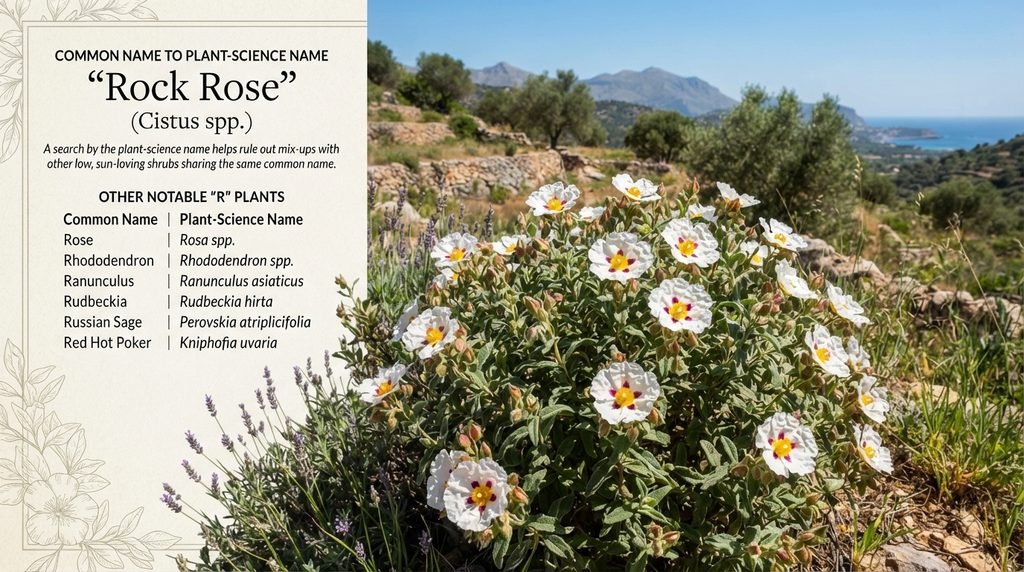
| Common Name | Plant-Science Name |
| Rose | Rosa spp. |
| Rhododendron | Rhododendron spp. |
| Ranunculus | Ranunculus asiaticus |
| Rudbeckia | Rudbeckia hirta |
| Russian Sage | Perovskia atriplicifolia |
| Red Hot Poker | Kniphofia uvaria |
| Rock Rose | Cistus spp. |
Rock Rose is the name most worth a double-check. A few unrelated plants share this common name in different regions. A search by the plant-science name, Cistus, helps rule out mix-ups with other low, sun-loving shrubs.
Growing Conditions at a Glance
This chart pulls sun, soil, and bloom time into one place. It makes side-by-side checks easy. The table below holds each flower named in the growing sections above. It uses the same three columns each time, so nothing gets left out.
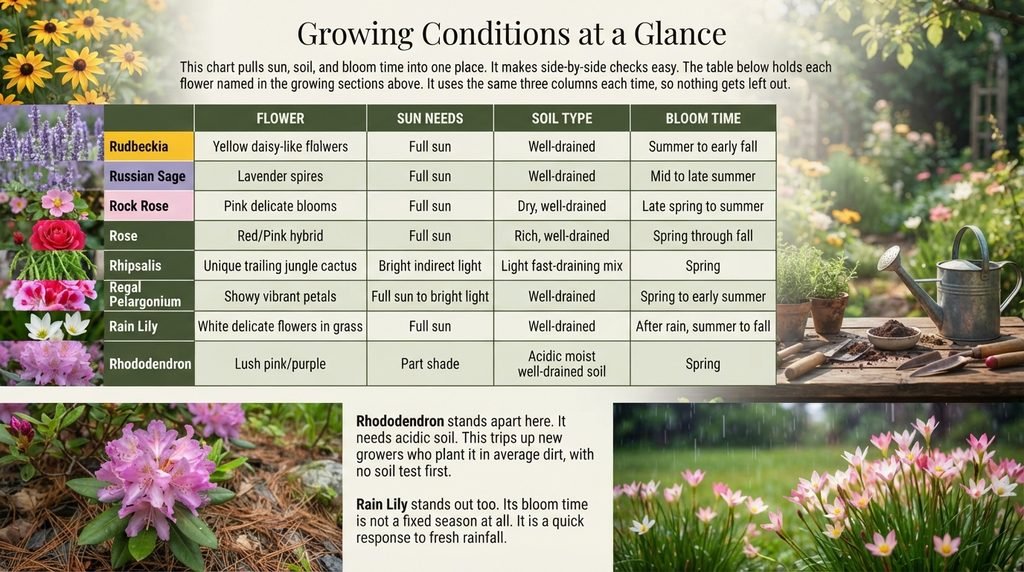
| Flower | Sun Needs | Soil Type | Bloom Time |
| Rudbeckia | Full sun | Well-drained soil | Summer to early fall |
| Russian Sage | Full sun | Well-drained soil | Mid to late summer |
| Rock Rose | Full sun | Dry, well-drained soil | Late spring to summer |
| Rose | Full sun | Rich, well-drained soil | Spring through fall |
| Rhipsalis | Bright, indirect light | Light, fast-draining mix | Spring |
| Regal Pelargonium | Full sun to bright light | Well-drained soil | Spring to early summer |
| Rain Lily | Full sun | Well-drained soil | After rain, summer to fall |
| Rhododendron | Part shade | Acidic, moist, well-drained soil | Spring |
Rhododendron stands apart here. It needs acidic soil. This trips up new growers who plant it in average dirt, with no soil test first. Rain Lily stands out too. Its bloom time is not a fixed season at all. It is a quick response to fresh rainfall.
Pick Your R-Flower by Need
Do not scan every row one by one. Start with your goal. The table below sets a need next to a clear pick. It draws on all the facts in this guide.
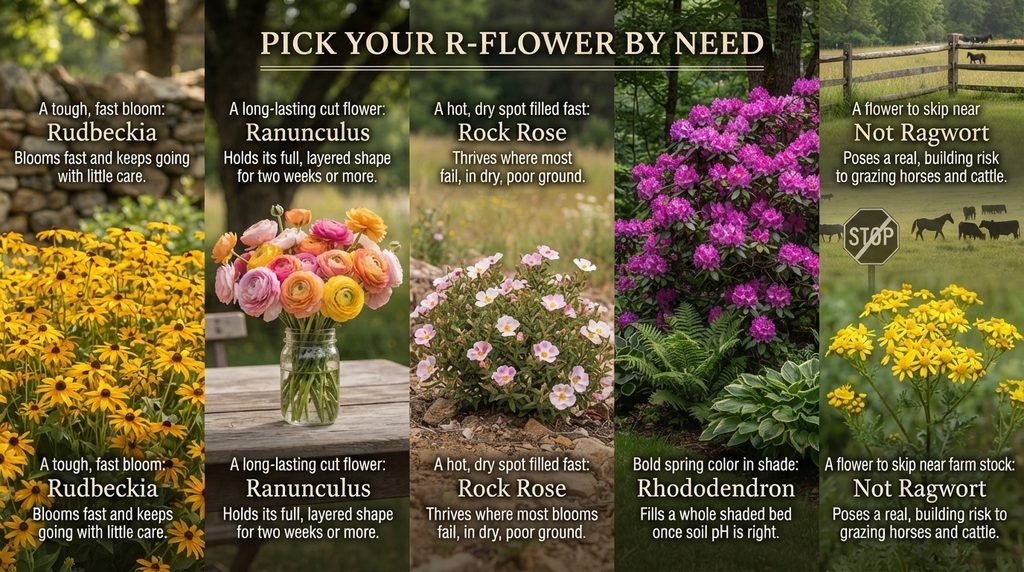
| If You Want… | Pick… | Why |
| A tough, fast bloom | Rudbeckia | Blooms fast and keeps going with little care |
| A long-lasting cut flower | Ranunculus | Holds its full, layered shape for two weeks or more |
| A hot, dry spot filled fast | Rock Rose | Thrives where most blooms fail, in dry, poor ground |
| Bold spring color in shade | Rhododendron | Fills a whole shaded bed once soil pH is right |
| A flower to skip near farm stock | Not Ragwort | Poses a real, building risk to grazing horses and cattle |
Rudbeckia and Rock Rose both solve a need for fast, tough color. Rhododendron asks for more planning, most of all around soil pH. Still, it pays off with a bold spring show. The last row matters just as much as the rest. Knowing which R-flower to skip can help keep farm stock safe.
Conclusion
Flowers that start with R run from the common Rose to the rare Rothschild Slipper Orchid. This range is why this guide leans on real groups, not one flat list. Anyone who searches for flowers that start with R should find a clear answer here. That may mean naming a bloom. That may mean picking a new plant. Few letters pack this much range into one guide.
Frequently Asked Questions
What are some popular flowers that start with R?
Rose, Rhododendron, Ranunculus, and Rudbeckia are among the best-known flowers that start with R. Each suits a different need, from long-lasting cut blooms to fast garden color.
Which R-flowers are toxic to pets?
Rhododendron is the top risk by far, since every part of the plant can cause real harm. Red Spider Lily bulbs and Rue also carry real, if smaller, risks.
How long does Ranunculus last as a cut flower?
Most types hold their full, layered shape for ten to fourteen days in a vase. This makes Ranunculus one of the longest-lasting cut flowers on this whole list.
Is Rhododendron safe to grow with kids or farm stock nearby?
No. Every part of the plant holds a toxin that can harm the heart. It is best kept well away from grazing farm stock and curious kids alike.
What is the gap between Rose and Rose of Sharon?
True Rose belongs to the plant group Rosa. Rose of Sharon is a type of Hibiscus. It is not a true rose at all, despite the shared common name.
Does Rock Rose really grow in poor soil?
Yes. It thrives in dry, average, even poor soil with little care. Rich, heavily fed soil can work against it, pushing out leaves instead of blooms.
Which R-flowers work best in cut arrangements?
Rose leads this group with a huge color range and strong scent. Ranunculus follows close behind, prized for its long vase life and full, layered bloom.