60+ Beautiful Flowers That Start With J: Names, Photos & Growing Tips
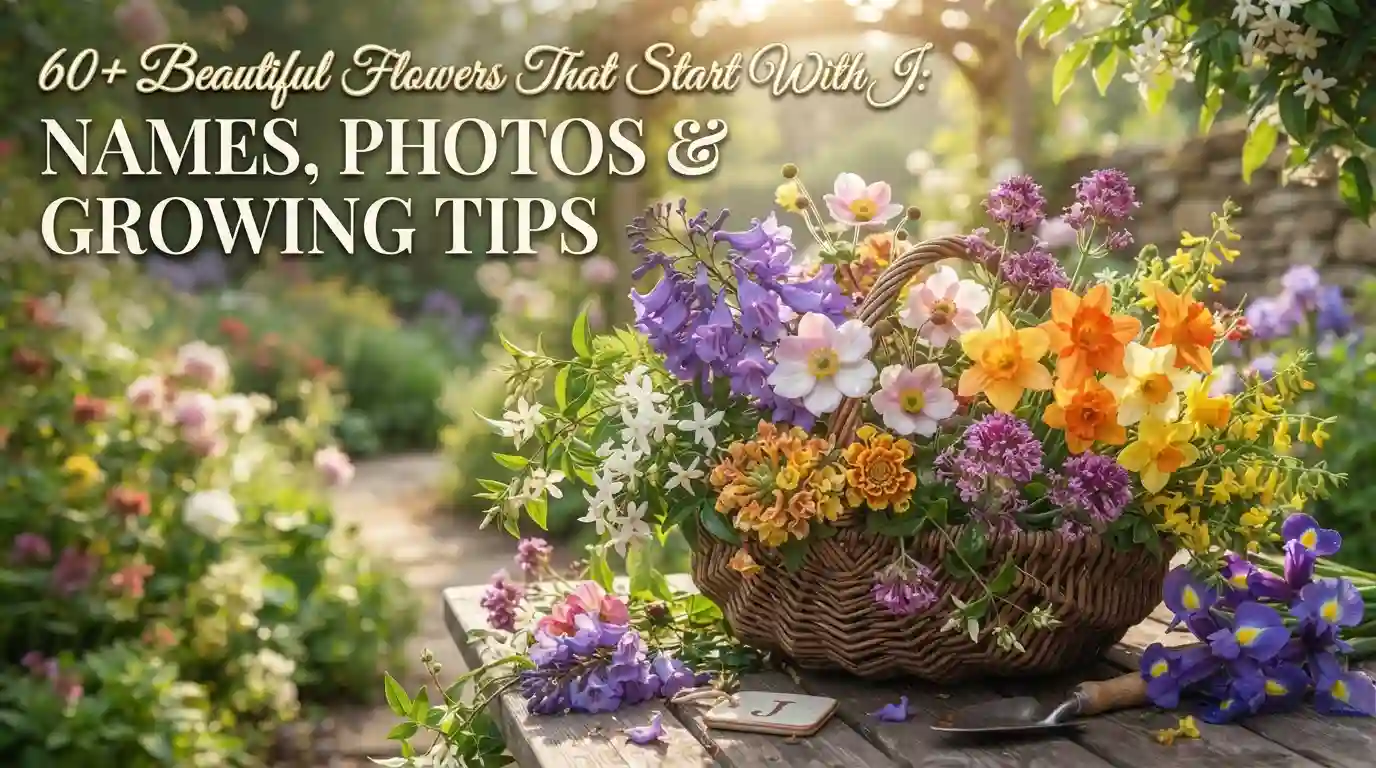
Flowers that start with J bring together fragrance, drama, and a surprising number of genuine hazards. Jasmine alone covers half a dozen distinct species, each prized for scent. Jacaranda turns entire streets purple each spring in warm climates. Jequirity, by contrast, carries seeds so toxic that a single one has caused documented fatalities.
Each entry was checked individually for its botanical name, native range, and toxicity. Nothing here was pulled from a single source and lightly reworded.
Rather than opening with a flat alphabetical dump, this guide sorts its recommendations by how gardeners actually use these plants. Garden staples come first, followed by indoor options, florist favorites, genuinely rare specialty blooms, and a dedicated section flagging which entries need careful placement around pets and children.
Quick Answer: The Standout J Flowers
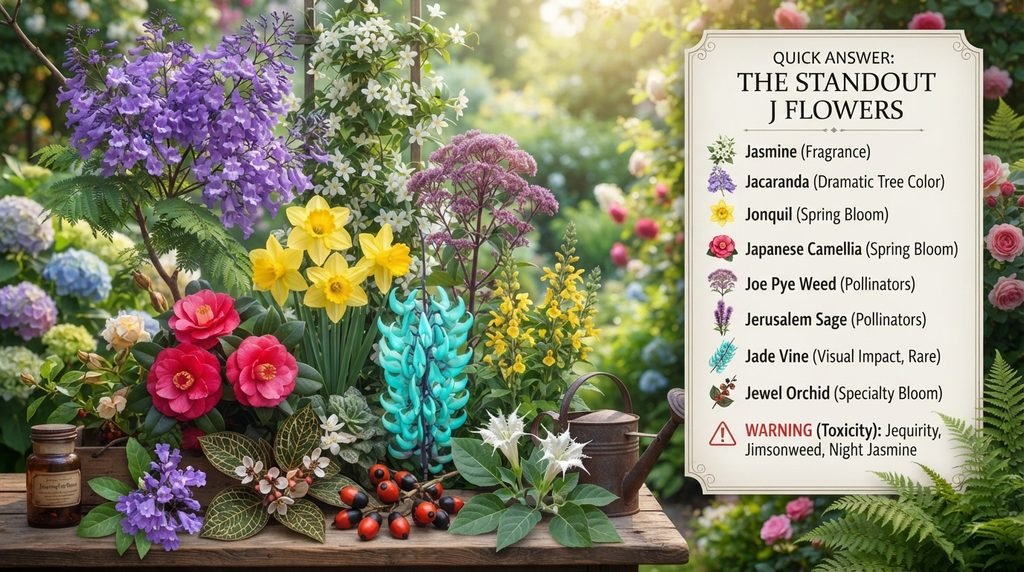
A short list of names does most of the heavy lifting here. Jasmine and jacaranda cover fragrance and dramatic tree color, while jonquil and Japanese camellia bring reliable spring bloom to a garden bed. Joe Pye weed and Jerusalem sage both draw heavy pollinator traffic, and jade vine remains one of the most visually striking climbing flowers grown anywhere. Jequirity, jimsonweed, and night jasmine all demand real caution, since each carries serious, well-documented toxicity. Jewel orchid and jade vine round out the group as two of the harder-to-find specialty blooms this letter has to offer.
What These Flowers Are Said to Represent
Symbolism across this letter ranges from centuries-old tradition to more modern, regional association. Jasmine carries deep meaning across several cultures, tied to love and sensuality in Western flower language and to purity and maternal love in parts of South and Southeast Asia, where it’s woven into wedding garlands and religious offerings. Jonquil symbolism leans toward affection and desire, a meaning close enough to its daffodil relatives that the two flowers are sometimes used interchangeably in bouquets meant to express early romantic interest.
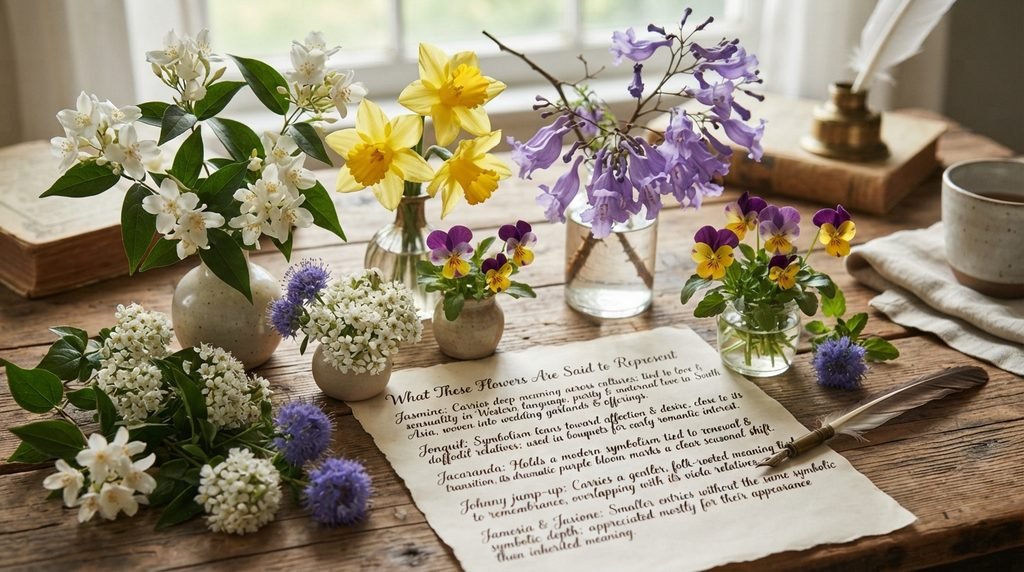
Johnny jump-up carries a gentler, folk-rooted meaning tied to remembrance, a tradition that overlaps closely with its viola relatives.
Several smaller entries on this list, including jamesia and jasione, have not built up the same depth of symbolic history. Both are appreciated mostly for their appearance rather than any inherited meaning, and it’s worth saying that plainly instead of manufacturing a tradition that doesn’t really exist.
Sorting These Flowers by Color
White tones dominate a large share of this letter. Jasmine, in nearly all its forms, produces small white or cream flowers prized more for fragrance than visual drama, and Japanese snowball and Japanese snowbell both echo that pale color with rounded and bell-shaped blooms, respectively.
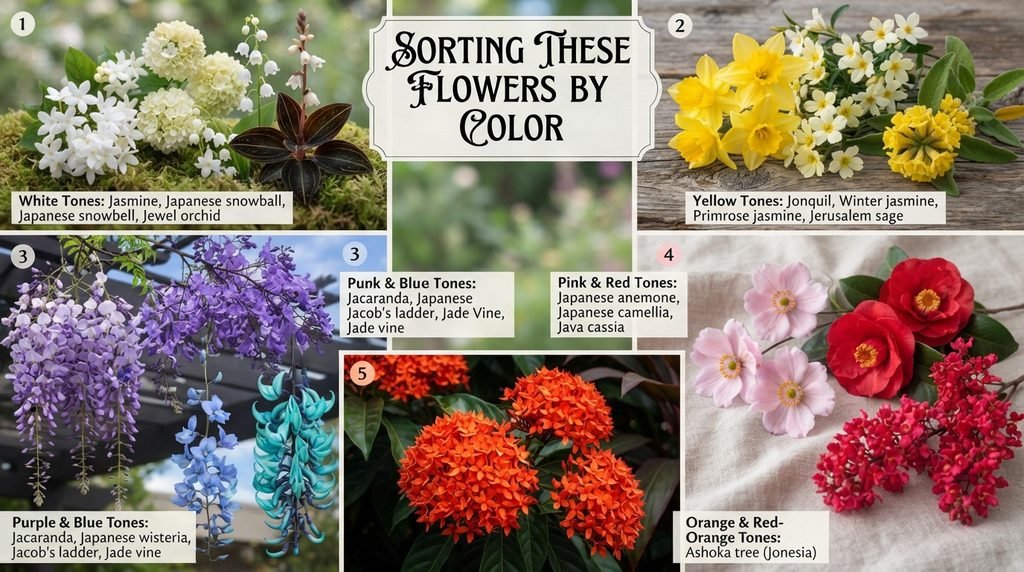
Yellow tones appear in jonquil, winter jasmine, primrose jasmine, and Jerusalem sage, most of which bloom in late winter or early spring, well before summer color takes over. Purple and blue tones cluster around some of this letter’s most dramatic entries, including jacaranda’s sweeping tree canopy, Japanese wisteria’s cascading clusters, and Jacob’s ladder’s smaller but equally clear blue.
Pink and red tones round out the group with Japanese anemone, Japanese camellia, and Java cassia, all of which bring warmer color to a bed in mid to late season. Orange and red-orange tones appear less often here, though the ashoka tree, still sometimes listed under its old botanical name Jonesia, produces a genuinely striking orange-red cluster that stands apart from almost everything else on this list.
Garden Favorites Among Flowers That Start With J
A core group of dependable plants carries most of the weight for gardeners exploring this letter. Jasmine anchors this group as a fragrant, easy-to-grow vine or shrub depending on the species chosen, tolerating a wide range of soil types once established. Japanese anemone performs a different role entirely, filling a late-summer and fall gap with tall, elegant blooms right when many earlier perennials have already finished.
Joe Pye weed brings genuine height and pollinator value to the back of a border, while Jacob’s ladder fills a shadier spot with soft blue flowers and fern-like foliage. Jerusalem sage rounds out this group as a drought-tolerant, silver-leafed shrub that pairs well with almost any Mediterranean-style planting scheme.
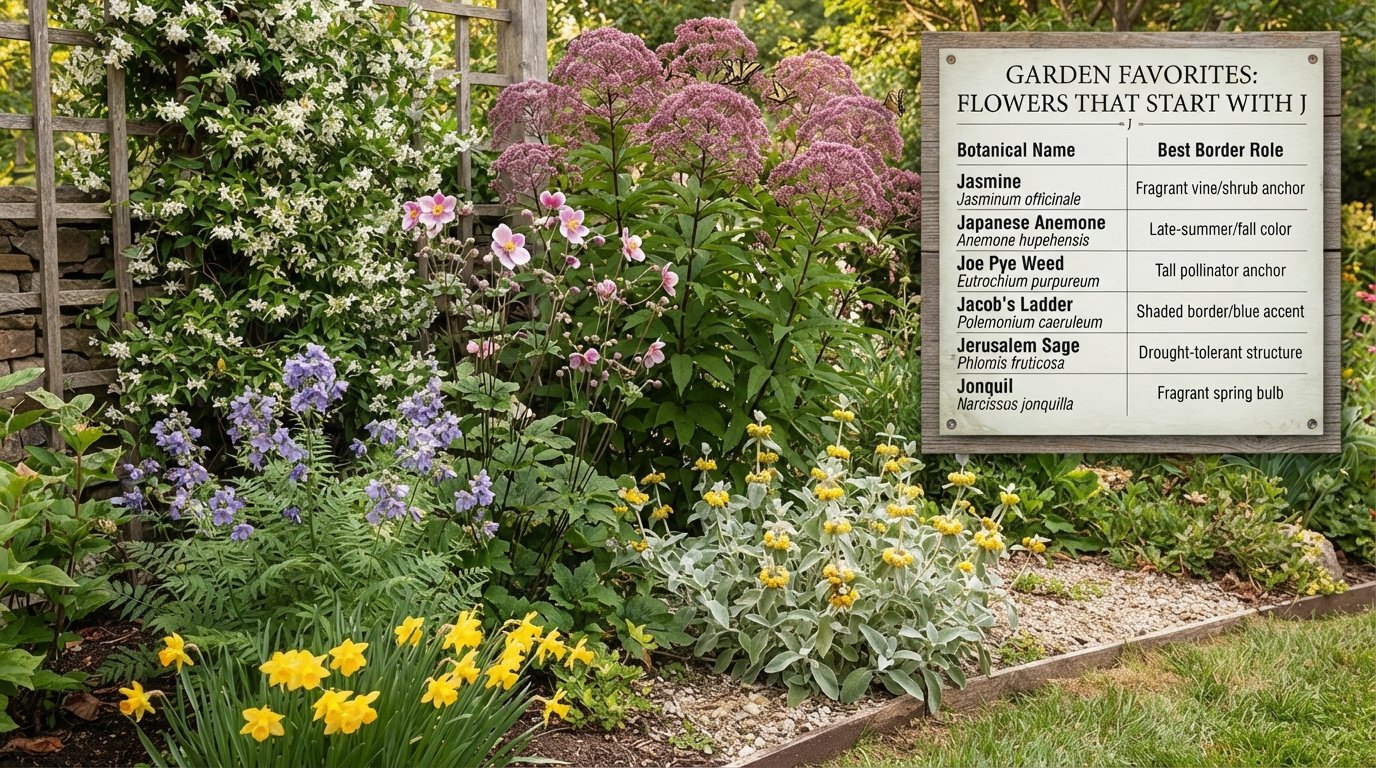
| Flower | Botanical Name | Best Border Role |
| Jasmine | Jasminum officinale | Fragrant vine or shrub anchor |
| Japanese Anemone | Anemone hupehensis | Late-summer and fall color |
| Joe Pye Weed | Eutrochium purpureum | Tall pollinator anchor |
| Jacob’s Ladder | Polemonium caeruleum | Shaded border, blue accent |
| Jerusalem Sage | Phlomis fruticosa | Drought-tolerant structure |
| Jonquil | Narcissus jonquilla | Fragrant spring bulb |
Joe Pye weed and Jacob’s ladder sit at opposite ends of this table in terms of scale. Joe Pye weed can reach well over head height by late summer, while Jacob’s ladder stays compact and low, making the two a natural pairing for front-to-back border layering.
Indoor Plants: Flowers That Start With J for Pots and Windowsills
A smaller group of J flowers performs best indoors, where steady warmth and humidity make up for conditions that would be hard to sustain outdoors year-round. Jasmine, particularly the more tender species like Arabian jasmine, is commonly grown as a container plant that can be brought indoors before frost, rewarding consistent bright light with intensely fragrant blooms.
Jerusalem cherry is widely sold as a decorative winter houseplant for its bright orange-red berries, though this plant demands a clear warning alongside its popularity, since every part of it carries a genuine toxicity risk. Justicia, a relative of the more familiar shrimp plant, produces curved, colorful bracts almost continuously under bright indoor light.
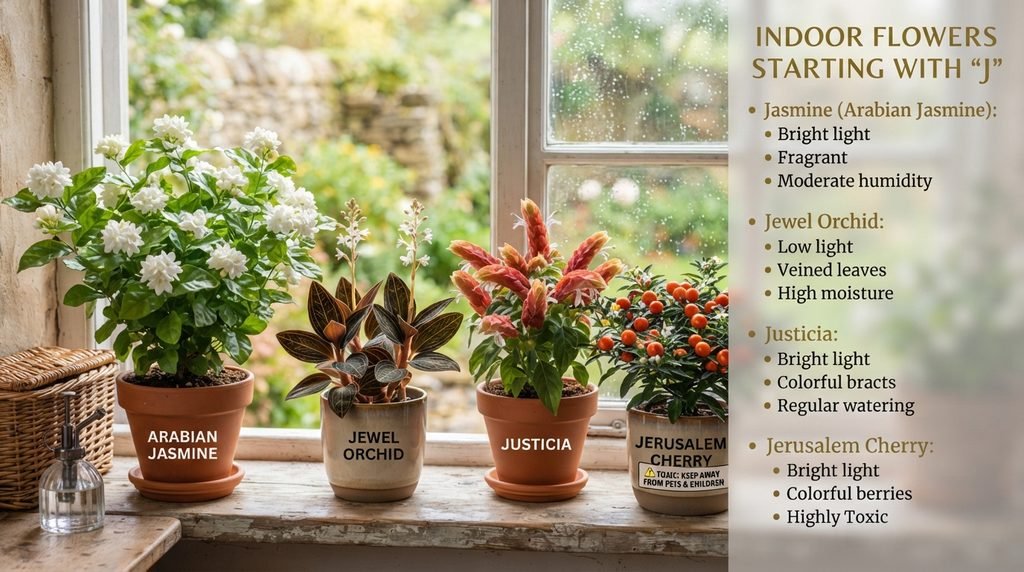
- Jasmine (Arabian Jasmine) — bright light, consistent warmth, moderate humidity
- Jewel Orchid — low to moderate light, consistent moisture, warm temperatures
- Justicia — bright light, regular watering during active growth
- Jerusalene Cherry — bright light, keep well away from pets and children
Jewel orchid tolerates lower light better than either jasmine or Justicia, making it a reasonable choice for a spot that doesn’t get strong direct sun through a window.
Florist Favorites: J Flowers Built for Cutting and Arranging
Cut-flower value depends on vase life, stem strength, and overall versatility, and a few J flowers perform strongly across all three. Jasmine, though short-stemmed compared to many cut flowers, remains a favorite for its fragrance, often woven into garlands and corsages rather than used as a standalone stem.
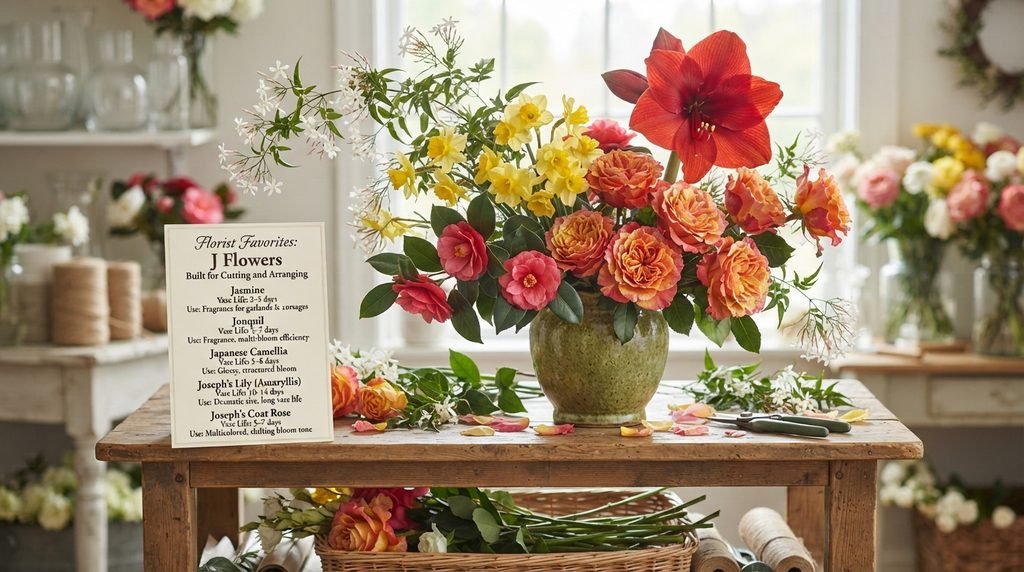
Japanese camellia offers a glossy, structured bloom that holds its shape well once cut, while Joseph’s lily, more widely known as amaryllis, delivers dramatic size and a long vase life that few other bulb flowers can match. Joseph’s coat rose rounds out this group with a striking, multicolored bloom that shifts in tone as it opens and ages on the stem.
| Flower | Vase Life | Why Florists Use It |
| Jasmine | 3–5 days | Fragrance for garlands and corsages |
| Jonquil | 5–7 days | Fragrance, efficient multi-bloom stems |
| Japanese Camellia | 5–8 days | Glossy, structured bloom |
| Joseph’s Lily (Amaryllis) | 10–14 days | Dramatic size, long vase life |
| Joseph’s Coat Rose | 5–7 days | Multicolored, shifting bloom tone |
Rare Flowers: The Harder-to-Find Entries on This List
A handful of entries on this list are genuinely uncommon. Jade vine tops this group for sheer visual rarity, producing claw-shaped, turquoise-blue flowers that hang in long, cascading clusters, a color so unusual in the plant world that the species remains difficult to source outside botanical gardens and specialist tropical growers. Jewel orchid follows closely, since most casual gardeners seek it out for its foliage without realizing it flowers at all, which keeps it firmly in specialist terrarium and houseplant circles rather than general nursery trade.
Jamesia, a native shrub of the western United States, remains uncommon in general cultivation despite its attractive white flower clusters, mostly because it strongly prefers the rocky, high-elevation conditions of its native range. Jonesia, still known to many by its old botanical name even though it’s now classified under Saraca, holds deep cultural and religious significance in South Asia but rarely appears in cultivation outside that region.
Caution: J Flowers That Need Careful Placement
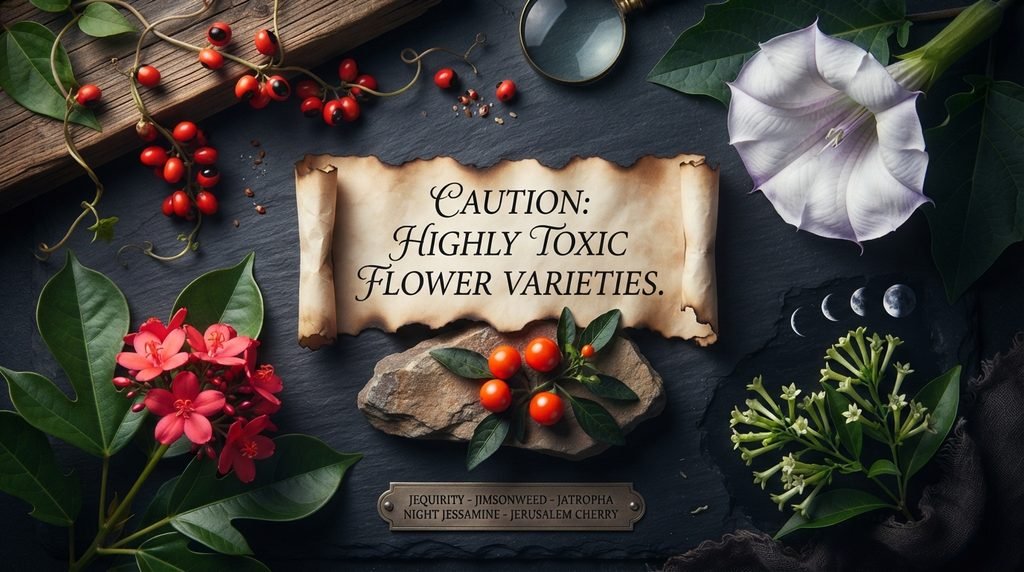
Toxicity risk varies enormously across this letter, and it holds an unusually high concentration of genuinely dangerous plants compared to most other letters in this series. Jequirity is the most extreme example, since its attractive red-and-black seeds contain abrin, a compound so toxic that a single properly chewed seed has caused human fatalities, making this one of the most dangerous ornamental seeds a gardener could encounter.
Jatropha adds a third genuinely high-risk entry to this list, since its seeds have caused repeated poisoning incidents in children who mistake them for nuts. Night jasmine, despite its appealing evening fragrance, contains toxic compounds throughout the plant, particularly concentrated in its berries, with documented cases of serious illness following ingestion.
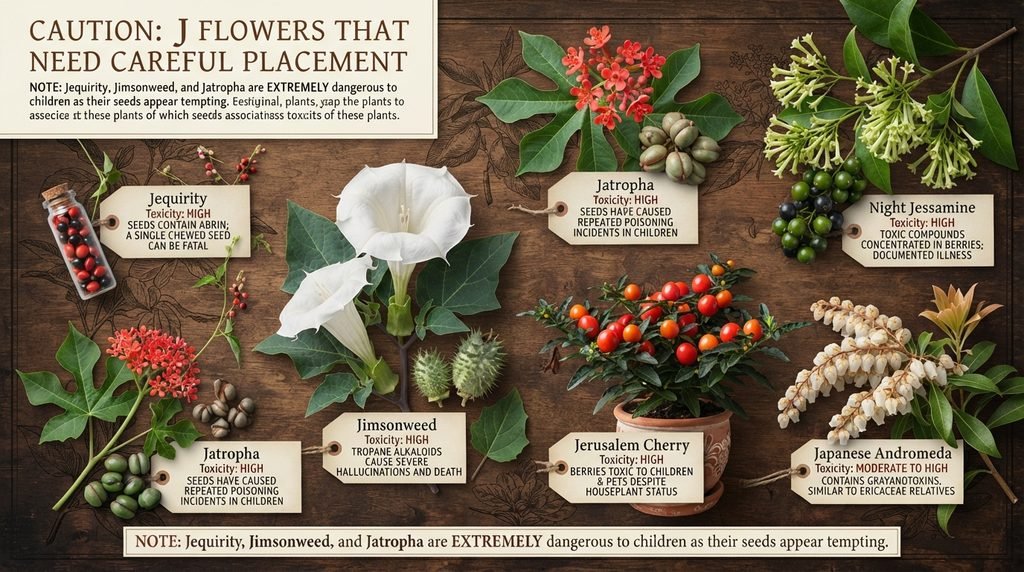
| Flower | Toxicity Level | Risk Details |
| Jequirity | High | Seeds contain abrin; a single chewed seed can be fatal |
| Jimsonweed | High | Tropane alkaloids cause severe hallucinations and death |
| Jatropha | High | Seeds have caused repeated poisoning incidents in children |
| Night Jessamine | High | Toxic compounds concentrated in berries; documented illness |
| Jerusalem Cherry | High | Berries toxic to children and pets despite common houseplant status |
| Japanese Andromeda | Moderate to High | Contains grayanotoxins, similar to other Ericaceae relatives |
Choosing by Life Cycle: Annuals, Perennials, Bulbs, and Beyond
Matching a flower’s life cycle to an actual planning horizon matters as much as matching its color. An annual that needs replanting every year plays a very different role than a tree that becomes a permanent fixture for decades. Perennials and shrubs together make up the largest share of this letter, offering repeat performance with comparatively less ongoing replanting effort.
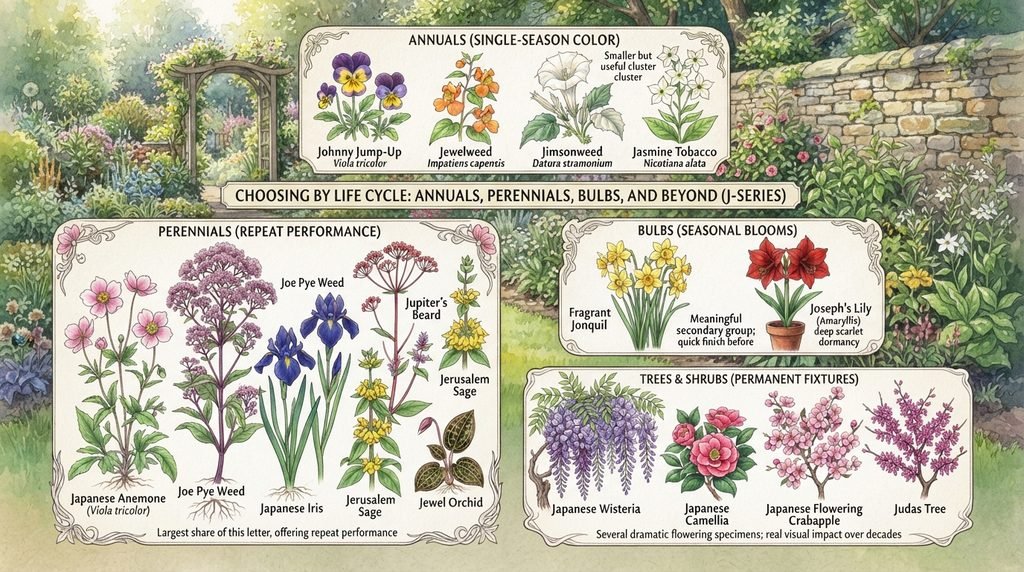
| Flower | Life Cycle |
| Jasmine | Perennial vine or shrub |
| Winter Jasmine | Deciduous shrub |
| Arabian Jasmine | Perennial shrub |
| Royal Jasmine | Perennial vine |
| Pink Jasmine | Perennial vine |
| Primrose Jasmine | Perennial shrub |
| Night Jessamine | Perennial shrub |
| Japanese Anemone | Perennial |
| Japanese Camellia | Evergreen shrub |
| Jonquil | Bulb |
| Joe Pye Weed | Perennial |
| Johnny Jump-Up | Annual or short-lived perennial |
| Jack-in-the-Pulpit | Perennial |
| Japanese Iris | Perennial (rhizome) |
| Japanese Wisteria | Perennial vine |
| Jerusalem Sage | Perennial shrub |
| Jerusalem Cherry | Perennial (grown as annual houseplant) |
| Jewelweed | Annual |
| Jacob’s Ladder | Perennial |
| Japanese Quince | Shrub |
| Japanese Primrose | Perennial |
| Japanese Snowball | Shrub |
| Japanese Snowbell | Tree |
| Japanese Spirea | Shrub |
| Japanese Aster | Perennial |
| Jupiter’s Beard | Perennial |
| Jimsonweed | Annual |
| Japanese Toad Lily | Perennial |
| Jerusalem Artichoke | Perennial (tuber) |
| Judas Tree | Tree |
| Java Glorybower | Perennial shrub |
| Jatropha | Perennial shrub |
| Japanese Rose (Kerria) | Shrub |
| Jade Vine | Perennial vine |
| Jequirity | Perennial vine |
| Justicia | Perennial shrub |
| Jamesia | Shrub |
| Jasione | Perennial |
| Jewel Orchid | Perennial (terrestrial orchid) |
| Japanese Andromeda | Evergreen shrub |
| Japanese Skimmia | Evergreen shrub |
| Jamaican Poinsettia | Shrub |
| Jamaican Vervain | Perennial |
| Japanese Hydrangea Vine | Perennial vine |
| Jungle Geranium (Ixora) | Perennial shrub |
| Joseph’s Coat Rose | Perennial shrub |
| Japanese Flowering Crabapple | Tree |
| Japanese Stewartia | Tree |
| Jamaican Dogwood | Tree |
| Jamaican Cherry | Tree |
| Jacaranda | Tree |
| Jasmine Tobacco | Annual (perennial in warm climates) |
| Java Cassia | Tree |
| Jerusalem Thorn | Tree |
| Japanese Pagoda Tree | Tree |
| Joseph’s Lily (Amaryllis) | Bulb |
| Jerusalem Cross | Perennial |
| Jonesia (Ashoka Tree) | Tree |
| Jack-by-the-Hedge | Biennial |
| Jack-go-to-bed-at-noon | Perennial (short-lived) |
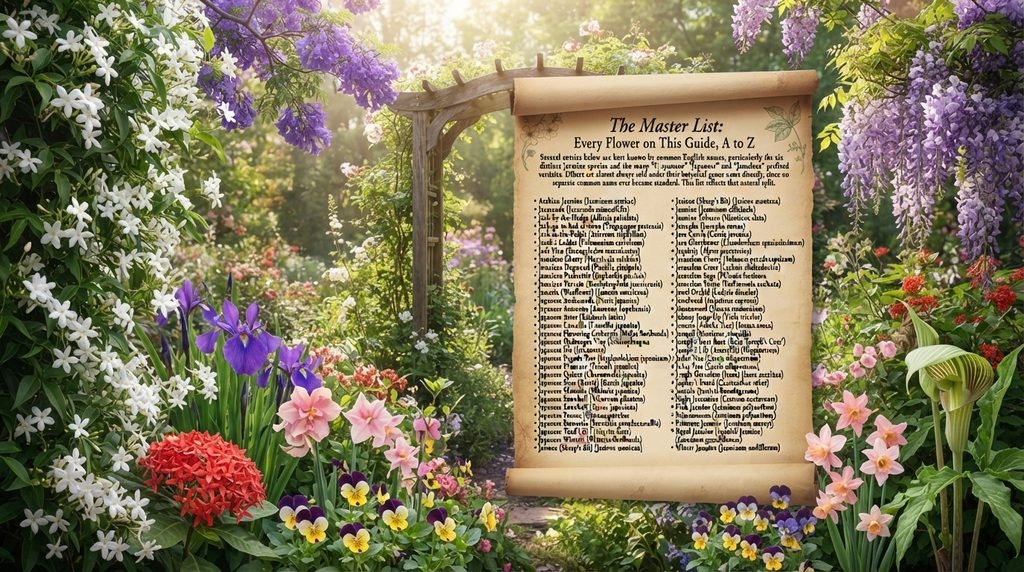
The Master List: Every Flower on This Guide, A to Z
Several entries below are best known by common English names, particularly the six distinct jasmine species and the many “Japanese” and “Jamaican” prefixed varieties. This list reflects that natural split.
- Arabian Jasmine — Jasminum sambac
- Jacaranda — Jacaranda mimosifolia
- Jack-by-the-Hedge — Alliaria petiolata
- Jack-go-to-bed-at-noon — Tragopogon pratensis
- Jack-in-the-Pulpit — Arisaema triphyllum
- Jacob’s Ladder — Polemonium caeruleum
- Jade Vine — Strongylodon macrobotrys
- Jamaican Cherry — Muntingia calabura
- Jamaican Dogwood — Piscidia piscipula
- Jamaican Poinsettia — Euphorbia punicea
- Jamaican Vervain — Stachytarpheta jamaicensis
- Jamesia (Waxflower) — Jamesia americana
- Japanese Andromeda — Pieris japonica
- Japanese Anemone — Anemone hupehensis
- Japanese Aster — Kalimeris incisa
- Japanese Camellia — Camellia japonica
- Japanese Flowering Crabapple — Malus floribunda
- Japanese Hydrangea Vine — Schizophragma hydrangeoides
- Japanese Iris — Iris ensata
- Japanese Pagoda Tree — Styphnolobium japonicum
- Japanese Primrose — Primula japonica
- Japanese Quince — Chaenomeles japonica
- Japanese Rose (Kerria) — Kerria japonica
- Japanese Skimmia — Skimmia japonica
- Japanese Snowball — Viburnum plicatum
- Japanese Snowbell — Styrax japonicus
- Japanese Spirea — Spiraea japonica
- Japanese Stewartia — Stewartia pseudocamellia
- Japanese Toad Lily — Tricyrtis hirta
- Japanese Wisteria — Wisteria floribunda
- Jasione (Sheep’s Bit) — Jasione montana
- Jasmine — Jasminum officinale
- Jasmine Tobacco — Nicotiana alata
- Jatropha — Jatropha curcas
- Java Cassia — Cassia javanica
- Java Glorybower — Clerodendrum speciosissimum
- Jequirity — Abrus precatorius
- Jerusalem Artichoke — Helianthus tuberosus
- Jerusalem Cherry — Solanum pseudocapsicum
- Jerusalem Cross — Lychnis chalcedonica
- Jerusalem Sage — Phlomis fruticosa
- Jerusalem Thorn — Parkinsonia aculeata
- Jewel Orchid — Ludisia discolor
- Jewelweed — Impatiens capensis
- Jimsonweed — Datura stramonium
- Johnny Jump-Up — Viola tricolor
- Jonesia (Ashoka Tree) — Saraca asoca
- Jonquil — Narcissus jonquilla
- Joseph’s Coat Rose — Rosa ‘Joseph’s Coat’
- Joseph’s Lily (Amaryllis) — Hippeastrum
- Judas Tree — Cercis siliquastrum
- Jungle Geranium (Ixora) — Ixora coccinea
- Jupiter’s Beard — Centranthus ruber
- Justicia — Justicia brandegeeana
- Night Jessamine — Cestrum nocturnum
- Pink Jasmine — Jasminum polyanthum
- Primrose Jasmine — Jasminum mesnyi
- Royal Jasmine (Spanish Jasmine) — Jasminum grandiflorum
- Winter Jasmine — Jasminum nudiflorum
This list holds sixty entries in total. It spans fragrant vines, flowering trees, native wildflowers, and several genuinely dangerous plants, which reflects just how much range this letter actually offers once foliage-only and fruit-only plants are set aside.
Why Botanical Names Matter for This Letter
Common-name confusion is a real risk with this letter. Jasmine alone covers at least six distinct species on this list, each with different hardiness, fragrance strength, and toxicity profile, which makes a botanical name essential rather than optional when ordering from a nursery. A large number of other entries are rarely sold under any English common name at all.
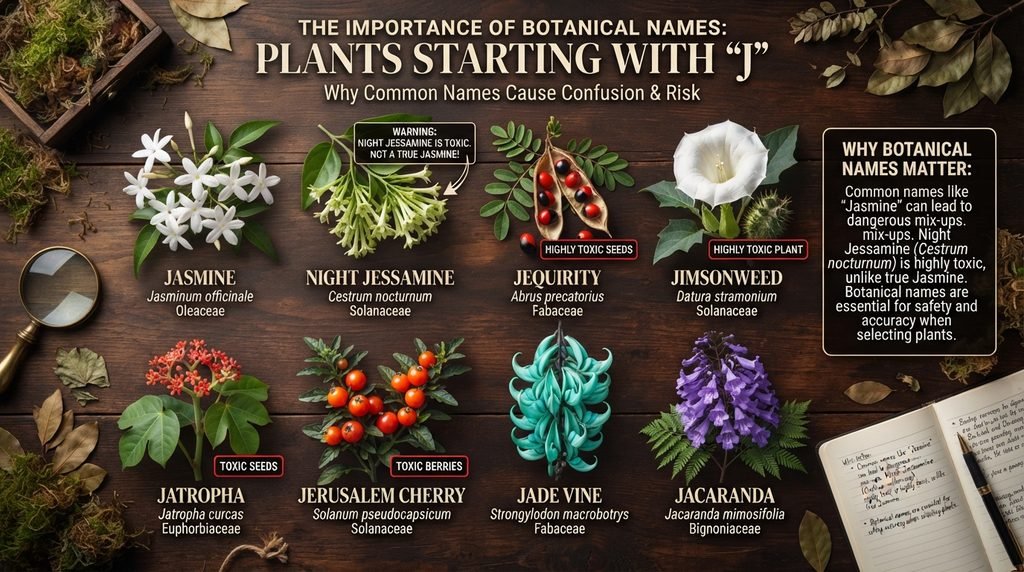
| Common Name | Botanical Name | Plant Family |
| Jasmine | Jasminum officinale | Oleaceae |
| Night Jessamine | Cestrum nocturnum | Solanaceae |
| Jequirity | Abrus precatorius | Fabaceae |
| Jimsonweed | Datura stramonium | Solanaceae |
| Jatropha | Jatropha curcas | Euphorbiaceae |
| Jerusalem Cherry | Solanum pseudocapsicum | Solanaceae |
| Jade Vine | Strongylodon macrobotrys | Fabaceae |
| Jacaranda | Jacaranda mimosifolia | Bignoniaceae |
Night jasmine’s name is worth double-checking specifically, since it sounds close enough to true jasmine that shoppers sometimes assume it shares jasmine’s low-risk safety profile. It does not, and the botanical name Cestrum nocturnum makes that distinction immediately clear.
Full Comparison Table: Bloom Time, Sun, and Safety at a Glance
The table below brings together bloom season, sun needs, toxicity level, and primary use for every flower covered in this guide. It makes it possible to scan for a specific combination of traits, such as a spring-blooming, full-sun, pet-safe option, without flipping back through each section above.
| Flower | Bloom Season | Sun | Toxicity | Primary Use |
| Jasmine | Summer | Full sun–part shade | Mild | Fragrant vine, shrub |
| Winter Jasmine | Late winter | Full sun | Mild | Early-season color |
| Arabian Jasmine | Nearly year-round (warm) | Full sun–part shade | Non-toxic | Fragrance, garlands |
| Royal Jasmine | Summer | Full sun | Non-toxic | Perfumery, fragrance |
| Pink Jasmine | Spring | Full sun–part shade | Non-toxic | Fragrant climbing vine |
| Primrose Jasmine | Winter–spring | Full sun | Non-toxic | Early yellow color |
| Night Jessamine | Summer–fall | Full sun–part shade | High | Evening fragrance (caution) |
| Japanese Anemone | Late summer–fall | Partial shade | Mild | Fall border color |
| Japanese Camellia | Winter–spring | Partial shade | Non-toxic | Cut flower, hedge |
| Jonquil | Early spring | Full sun | Moderate | Fragrant bulb display |
| Joe Pye Weed | Summer–fall | Full sun–part shade | Non-toxic | Pollinator anchor |
| Johnny Jump-Up | Spring–fall | Full sun–part shade | Non-toxic | Edging, edible |
| Jack-in-the-Pulpit | Spring | Partial to full shade | Moderate | Native woodland garden |
| Japanese Iris | Early summer | Full sun–part shade | Mild | Pond edge, border |
| Japanese Wisteria | Late spring | Full sun | Moderate | Arbor, pergola vine |
| Jerusalem Sage | Summer | Full sun | Non-toxic | Drought-tolerant structure |
| Jerusalem Cherry | Winter (fruit display) | Bright indirect | High | Houseplant (caution) |
| Jewelweed | Summer–fall | Partial shade | Non-toxic | Wetland native garden |
| Jacob’s Ladder | Late spring | Partial shade | Non-toxic | Shaded border |
| Japanese Quince | Late winter–spring | Full sun | Mild | Early hedge color |
| Japanese Primrose | Spring | Partial shade | Mild | Moist shade garden |
| Japanese Snowball | Late spring | Full sun–part shade | Mild | Specimen shrub |
| Japanese Snowbell | Early summer | Full sun–part shade | Non-toxic | Specimen flowering tree |
| Japanese Spirea | Summer | Full sun | Non-toxic | Low border shrub |
| Japanese Aster | Late summer–fall | Full sun | Non-toxic | Cottage border |
| Jupiter’s Beard | Late spring–fall | Full sun | Non-toxic | Rock garden, coastal border |
| Jimsonweed | Summer–fall | Full sun | High | Caution wildflower |
| Japanese Toad Lily | Late summer–fall | Partial shade | Non-toxic | Shade border novelty |
| Jerusalem Artichoke | Late summer–fall | Full sun | Non-toxic | Edible garden |
| Judas Tree | Spring | Full sun | Non-toxic | Specimen flowering tree |
| Java Glorybower | Summer | Full sun–part shade | Mild | Tropical border |
| Jatropha | Summer | Full sun | High | Caution ornamental shrub |
| Japanese Rose (Kerria) | Mid-spring | Partial shade | Non-toxic | Shaded shrub border |
| Jade Vine | Spring | Full sun–part shade | Non-toxic | Rare tropical specimen |
| Jequirity | Summer | Full sun | High | Caution ornamental vine |
| Justicia | Nearly year-round (indoor) | Bright light | Non-toxic | Houseplant, container |
| Jamesia (Waxflower) | Late spring | Full sun–part shade | Non-toxic | Rock garden shrub |
| Jasione (Sheep’s Bit) | Summer | Full sun | Non-toxic | Coastal wildflower |
| Jewel Orchid | Fall–winter | Low to moderate light | Non-toxic | Terrarium, houseplant |
| Japanese Andromeda | Early spring | Partial shade | Moderate to High | Evergreen specimen shrub |
| Japanese Skimmia | Spring | Partial shade | Moderate | Evergreen berry shrub |
| Jamaican Poinsettia | Winter | Full sun | Moderate | Tropical color |
| Jamaican Vervain | Summer–fall | Full sun | Non-toxic | Butterfly garden |
| Japanese Hydrangea Vine | Summer | Partial shade | Moderate | Climbing wall cover |
| Jungle Geranium (Ixora) | Nearly year-round (warm) | Full sun | Non-toxic | Tropical hedge |
| Joseph’s Coat Rose | Spring–fall | Full sun | Non-toxic | Multicolor cut flower |
| Japanese Flowering Crabapple | Spring | Full sun | Moderate | Specimen flowering tree |
| Japanese Stewartia | Summer | Full sun–part shade | Non-toxic | Specimen flowering tree |
| Jamaican Dogwood | Spring | Full sun | Moderate | Specimen flowering tree |
| Jamaican Cherry | Nearly year-round (warm) | Full sun | Non-toxic | Edible ornamental tree |
| Jacaranda | Spring | Full sun | Non-toxic | Dramatic flowering tree |
| Jasmine Tobacco | Summer–fall | Full sun–part shade | Moderate | Fragrant evening garden |
| Java Cassia | Summer | Full sun | Mild | Flowering shade tree |
| Jerusalem Thorn | Spring–summer | Full sun | Non-toxic | Desert specimen tree |
| Japanese Pagoda Tree | Summer | Full sun | Mild | Shade tree, late bloom |
| Joseph’s Lily (Amaryllis) | Winter (indoors) | Bright indirect | Moderate | Holiday bulb display |
| Jerusalem Cross | Early summer | Full sun | Non-toxic | Cottage border |
| Jonesia (Ashoka Tree) | Spring | Full sun–part shade | Non-toxic | Culturally significant specimen |
| Jack-by-the-Hedge | Spring | Partial shade | Non-toxic | Edible wildflower |
| Jack-go-to-bed-at-noon | Summer | Full sun | Non-toxic | Wildflower meadow |
Decision Guide: Matching a Scenario to the Right J Flower
Sometimes the fastest way to choose a flower isn’t scrolling through a full list. It helps to start from the actual problem that needs solving, whether that’s a fragrant entryway, a shaded corner, or a household with pets. The table below maps common gardening scenarios to the J flowers best suited to each one.
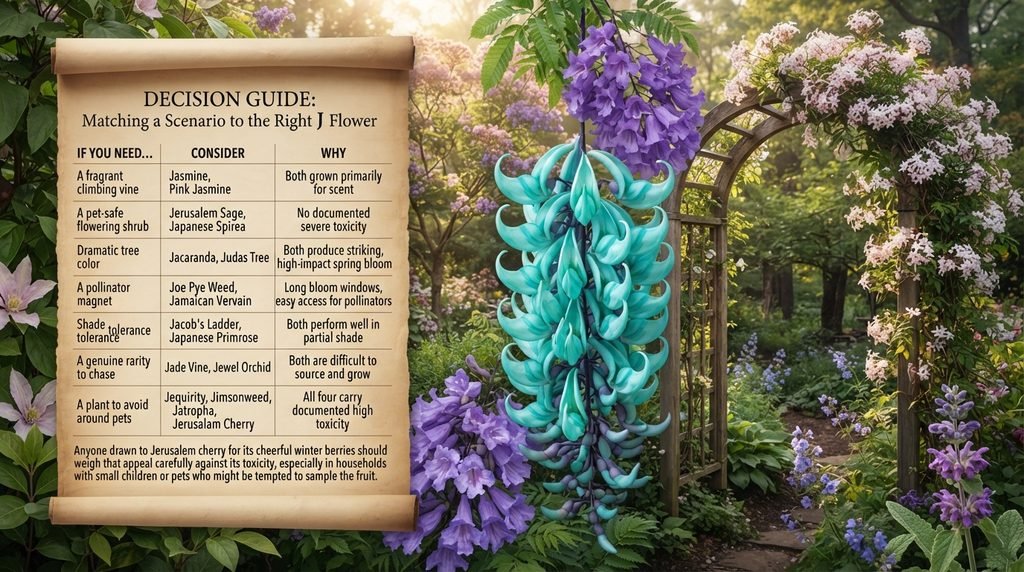
| If You Need… | Consider | Why |
| A fragrant climbing vine | Jasmine, Pink Jasmine | Both grown primarily for scent |
| A pet-safe flowering shrub | Jerusalem Sage, Japanese Spirea | No documented severe toxicity |
| Dramatic tree color | Jacaranda, Judas Tree | Both produce striking, high-impact spring bloom |
| A pollinator magnet | Joe Pye Weed, Jamaican Vervain | Long bloom windows, easy access for pollinators |
| Shade tolerance | Jacob’s Ladder, Japanese Primrose | Both perform well in partial shade |
| A genuine rarity to chase | Jade Vine, Jewel Orchid | Both are difficult to source and grow |
| A plant to avoid around pets | Jequirity, Jimsonweed, Jatropha, Jerusalem Cherry | All four carry documented high toxicity |
Conclusion
Flowers that start with J span a genuinely wide range, from fragrant jasmine vines and dramatic flowering trees to a concentrated cluster of plants that demand real caution. Choosing among them comes down to matching a specific flower to an actual spot, household, or purpose, rather than working straight down an alphabetical list. With the category breakdowns, comparison table, and decision guide covered above, narrowing this list down to the few that genuinely fit a given garden should take far less trial and error than starting from scratch.
Frequently Asked Questions
1. How many flowers that start with J are there?
This guide covers sixty verified flowers that start with J, ranging from fragrant vines and flowering trees to several plants that require serious caution.
2. What is the easiest J flower to grow?
Jasmine and Jerusalem sage are both excellent choices for beginners, tolerating a wide range of conditions while still performing each year reliably.
3. Which J flowers are the most dangerous?
Jequirity, jimsonweed, and jatropha are the three most dangerous, each containing compounds capable of causing serious illness or death if ingested.
4. What does jasmine symbolize?
Jasmine is tied to love and sensuality in many Western traditions, while in parts of South and Southeast Asia it symbolizes purity and maternal love.
5. What J flowers work well indoors?
Jewel orchid, Justicia, and Arabian jasmine are the most common indoor choices, though Jerusalem cherry also remains popular despite its toxicity risk.
6. Is Jerusalem cherry safe to have in a home with pets?
No, it requires serious caution. Its bright berries are toxic if ingested and should be kept well away from curious pets and children.
7. What’s the best J flower for a fragrant garden?
Jasmine and night jasmine are both grown primarily for scent, though night jasmine’s fragrance comes with a significant toxicity warning that jasmine does not carry.
8. Are any of these J blooms genuinely rare?
Yes. Jade vine and jewel orchid are both considered rare, the former due to its unusual color and limited cultivation, and the latter due to its niche appeal among specialist growers.
9. What’s the difference between jasmine and night jessamine?
Despite the similar-sounding names, jasmine belongs to the olive family and is generally low-risk, while night jessamine belongs to the nightshade family and carries genuine toxicity.
10. Can jacaranda trees grow outside tropical climates?
Only in mild, frost-free regions. Jacaranda is sensitive to hard freezes and is best suited to warm, temperate to subtropical climates.
11. What J flower is best for a pollinator garden?
Joe Pye weed and Jamaican vervain are both strong choices, offering long bloom windows that draw in bees and butterflies through summer.
12. Is Johnny jump-up the same as a pansy?
Not exactly. Johnny jump-up is a smaller, wild relative of the modern pansy, though both belong to the same Viola genus and share a similar face-like bloom pattern.